Background Switcher (Hidden)

Showing posts with label monarch. Show all posts

Not-so-Crazy Caterpillar Lady

Tuesday, August 30, 2022

9 comments

 Year in, year out, I fight it, that urge to take in all the little caterpillars and keep them safe from harm. 


Usually, things go well for the monarchs and I see them hatch, eat, grow, thrive, pupate and flutter away in the wild. This year is different. Very different. 

For one, monarchs have been declared endangered. Not by the U.S. Fish and Wildlife Service, no...that takes for-freakin'-ever. The change in status was announced, rather, by the International Union for Conservation of Nature a few weeks ago. Essentially they're yelling at the USFWS that somebody's got to say something about this disappearing insect. Monarchs are big and charismatic and people notice them, which makes it all the more dispiriting that we are letting them slip away before our eyes. 

Here on a micro-scale, it's a very wet year in Ohio (like almost nowhere else in the country). I don't know if that is why there are so many predatory stinkbugs, but every monarch caterpillar I've found on my yard "ranch" in the first part of the season was eventually killed by stinkbugs. It really bothers me to see a great fat fourth instar monarch that I've been watching since it was a tiny hatchling, hanging limply from the sucking beak of a stinkbug. If there's anything that bothers me, it's seeing a young thing die.

So, reluctantly, I've climbed aboard the Crazy Caterpillar Lady Train again. But I'm only bringing them inside while they're tiny, and then again when they turn into chrysalides. I'm researching and experimenting with ways to keep them outside in the sun and wind and rain, chewing away on live milkweed, with fine mesh sleeves to protect them from parasites and predators. It's been a thing. I just don't think they were meant to grow up in an air conditioned house, or jammed together in a plastic box.


Outdoors is the thing. They've got three species of Asclepius to choose from in my yard. 


My obsession with watching the caterpillars in transition has pushed me to learn some things about time lapses and video editing. I'm proud to present my latest effort: five hours of caterpillar to chrysalis transition, condensed to a very satisfying minute and a half. Made the video today, August 30, 2022. 

 I hope you enjoy it.


Making a Summer Day

Wednesday, February 3, 2021

10 comments

Lest anyone think that the only thing I've done during the past two years is rip out invasive vegetation, I'm happy to say that 2020 has been a super-painty year for me. I took an 18-painting commission and knocked it out from August-December. I should have been working on it all year, but I couldn't focus in the first five months of the pandemic. My kids were home and I felt this frantic need to hold them close and do stuff with them and serve Sunday best meals every dang night. I'm so glad we did that--took the hikes and the bike rides and shared the incredible meals. We picked flowers and vegetables from the garden. We raked mountains of lawn clippings. We raised a song sparrow named Dustin and took long walks and played with Curtis. 

And then August came and they had to go back to their lives, and with the house quiet and nobody "needing fed," as we say in Appalachian Ohio, I could finally get going on those paintings. 
Wish I could show them to you, but like all my works for publication, I can't, at least until they're produced. Oh, I had such fun! and I can't wait to show you the paintings. I was working so hard and fast I didn't take progress photos, but it'll be fun to show them to you when I am finally allowed.

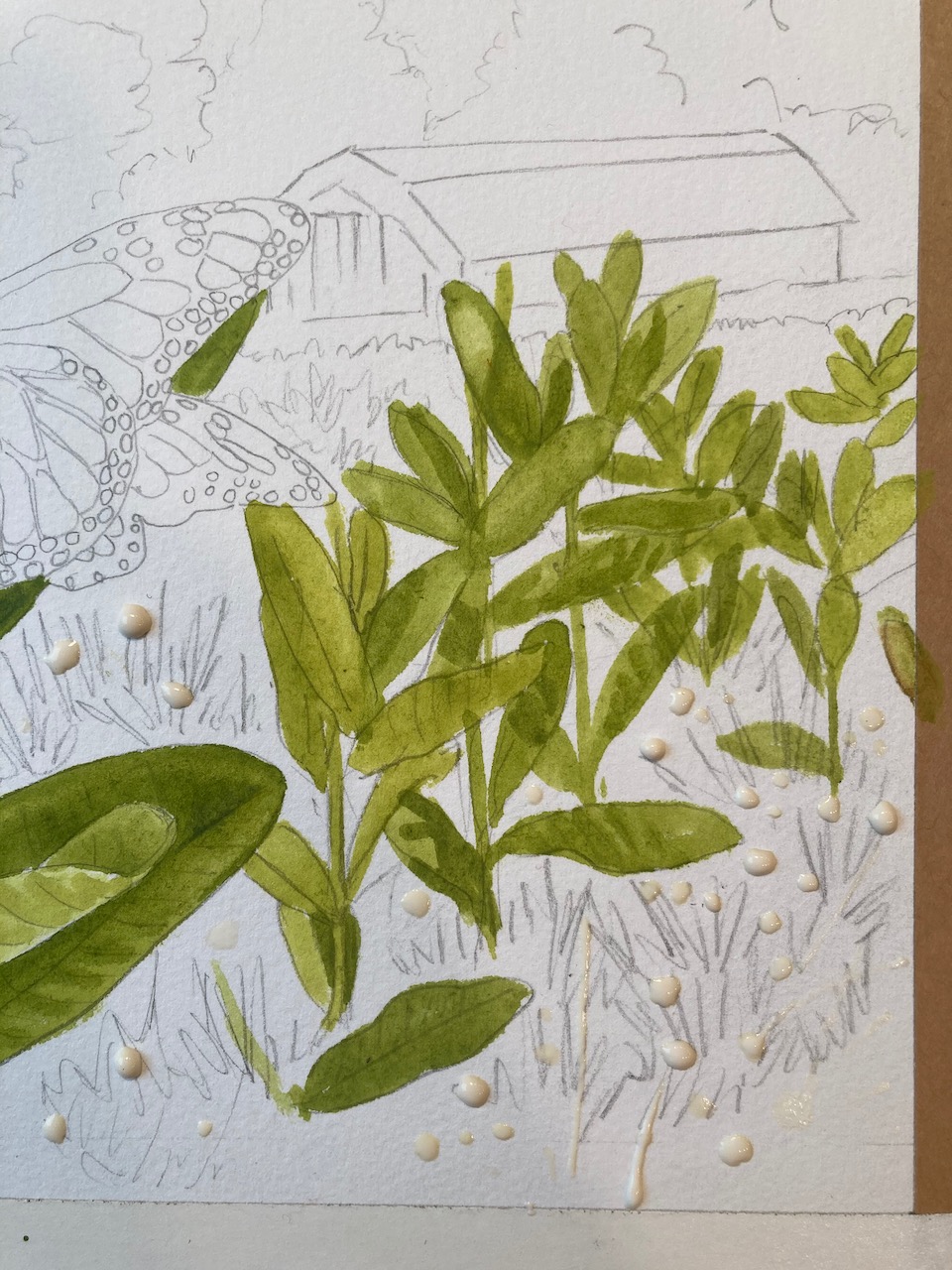
Still feeling fairly well-oiled from that experience, I was delighted to start a 9.5 x 12" watercolor. I'm happy to be able to share the process of creating a paeon to the monarch butterfly, and to my favorite stand of milkweed on the planet, property of my good neighbors on the ridge. For those who don't know the story, this is a field, thick with common milkweed, that, when I discovered the problem, was being mowed down at the absolute height of caterpillar abundance. All I had to do was work with the landowner to adjust the mowing schedule to mow right after the flowers faded, and then not at all until after frost, and BOOM we had a going proposition, absolutely cranking out monarchs. Soo satisfying, and the rewards flutter over by the dozen in August and September. I've been loving and studying this field since about 2009. It's the biggest contiguous stand of common milkweed I've ever seen.

So I've cobbled together a composition with a milkweed plant as the star. I've drawn it all out, transferred it to the watercolor paper, and taped the paper down sopping wet. As it dries it stretches taut, so it doesn't buckle when I lay a big wash on it.  I tackle the big milkweed plant first. 


It's important to notice the big difference in local color of the leaf tops and their undersides. Thoe pale undersides, and the little veins on them, give a sense of movement, transition, and sinuousness to the plant. They are the grace notes that lead the eye around the form.  I paint some shadows in on the leaves, and then start on the field proper. Painting masses of plants is always a little tricky, but I'm trying not to get too wrapped up in it. I figure I'll do a few milkweed plants that you can identify as such, and then get less specific with the understory.


The understory is all red clover, so I decide to put some drops of masking fluid down to reserve the paper for their pink blossoms. Once that's dry, I can keep painting all the jumbled greens right over it.


I keep plugging, painting in milkweed leaves. It ain't easy, making sure every leaf goes to a plant, but I'm still having fun. 


Now that I've got all the milkweed in, here comes the understory of clover foliage. It's a darker green than the milkweed. 


This is fun! I'm creating an army of vegetation! 


When I'm satisfied with the meadow, I rub away the drops of dried masking fluid with my fingers and expose the white paper beneath. Then I get to paint lots of red clover. It's important to vary the shade of the blossoms, to give the impression of changing light, distance and depth. 
I decide to go ahead and paint the sky right afterward.  It's very fast and dashy.  Even so, I have a little trouble controlling the wash--the paper is drying too fast, dang it! Ack! I have to finish it all before it dries! I'm slapping paint and water around but in the winter, with low humidity in the house, you don't have much time to tarry. Oh well--that's watercolor skies for you! You can see that I've run the wash down into the tops of the trees behind the barn. That's important to avoid hard edges where the washes meet. 


Here come the trees behind the milkweed. Their darks will help anchor the composition. 


I knew that once I got some darks in there, the painting would come to life. With the sky of blue and the anchoring darks, you can finally feel the sunshine pouring down! I got wound up painting the flowers and buds and forgot to take progress shots. 


There's a hard line between the trees and sky that I don't like, so I soften that by scrubbing the paint off and sucking it up with a damp brush. Then I run a wash of Chinese white over it to dull it out further, and push it well into the background.  Compare the treeline in the photo above to the one below.

Now it's time for the barn! When the black shadow goes in under the roof, that's when the sun really comes out. I'm telling you it's shining by the intensity of that shadow. That's how you suggest strong light--by deep shadow.


You may recognize it as the Shadowbarn! And you may recognize the wee companion, too. 


Sept. 7, 2014

OK. It's butterfly time! 

I haven't painted an ornate butterfly in awhile. Every time, I gain new respect for painters of insects. Whew. So many tiny details, and they all have to be in the right places, or it doesn't look accurate.

Same for the caterpillar, hiding on the lower left. I had to figure out the color sequence before I could paint it. It goes black yellow black white black white black yellow black...Mix that up, and your caterpillar isn't going to look right. 


This post compresses three days of actual painting. Each morning, I'd get up thinking I'd finish it that day, but it turns out I only have so much painting in me in a given day. I'd go out, cut brush for three or four hours, then paint, and before I'd know it, it would be dinnertime. What a good way to spend a few days!

I always feel best when I'm getting lots of exercise and painting, too.  When I'm painting a scene, I get to live inside it as I work. When I paint ivory-billed woodpeckers, I'm seeing them, alive, and I'm living in their habitat. When I paint a monarch fluttering at a milkweed, I'm there in that meadow, kneeling, sweat and all. There's nothing quite like creating a hot summer morning out of nothing, especially when it's dreary outside. It's the closest thing to a time machine that I have.  And that's what I love about painting, after the obvious continuous challenges of striving to attain some kind of mastery over the medium. Nah. Wrong word. Mastery being denied, I'll settle for control!

If you've enjoyed this step by step, just look up in the far left top corner of this blog homepage. Click "Search Julie's Blog" and type "watercolor" in the search box. Free tutorials for years. Been doing them since 2005!


When Hummingbird Meets Butterfly

Sunday, October 11, 2020

10 comments


Staying home a lot is not a bad thing when you love your home. Magical things can happen when you stay home. 

 Making your home a lovable place is work, but if that work is done with joy, you don't feel it, except in your muscles when you get up the next morning. It is a gift you give yourself. 

This past summer I learned how to make and use outdoor rooms. It's pretty simple. You run some extension cords from the basement, get some comfortable furniture and a Yeti thermos full of something nice like lemon mint water, and set up with your laptop, camera and binoculars in the shade of a handy tree, say Jemima's Japanese maple. This is now your office, and you get to work out amongst the salvias, with orthopteran music as your soundtrack.

On this particular late September day, some late rubythroats were working the salvias and zinnias in my terraced bed. My bedsheets flapped gently in the warm breeze behind. I couldn't stop snapping photos. The cream-colored sheets add a dreamy touch, don't you think? 


Salvia greggii "Cherry Chief" is a favorite, as it always has a few fresh scarlet blossoms full of nectar to offer each day, floating high on wiry stems where it's easy for hummingbirds to access them. 


Salvia guaranitica "Black and Blue" is a favorite of mine. Last fall, I cut them off and saved the roots to these plants in long planters set on the cold floor of my greenhouse, so I wouldn't have to go looking to buy them again this spring. When it warmed up, they sent out new growth and we were off! Saved a ton of money and made another successful experiment. I love this shot, with the hummingbird glugging down nectar or perhaps a tiny flying insect.

I heard a persistent buzzing, as of a hummingbird investigating something, off to my right, and that was how I found out that the chrysalis I had hung on a tomato cage, thinking it might be a bit off, had hatched successfully!  I watch the chrysalides I bring into the house for safekeeping over the two weeks it takes them to metamorphose. If one looks a bit off-color or anything other than perfect, I take it back outside just to be safe. I don't want anything infecting my precious jewels.

Well, this one was a bit off color but turned out to be perfect anyway, and a beautiful female monarch had emerged without my knowing it only an hour earlier!


And wouldn't you know, there was a hummingbird pestering the poor creature!


Who knows what the hummingbird had in mind? Just deviltry. This is a juvenile male, as evidenced by its darkish streaky throat. Figures.


The monarch wasn't having any of it, and she snapped her wings open and closed to try to startle the hummingbird into leaving her alone while she finished drying her new wings. 


In the end, I had to holler at the durn hummingbird. I think it's the first time I've yelled at a hummingbird...no, no, I have done that before. I used to yell at Bela, one of the four hummingbirds I raised in the summer of 2003, because he was soo bad, first to fly and constantly pestering the other three before they were ready for release. 


Bela was just as unpleasant as he looks here. He was much better once he got out in the yard. 
Aren't we all? (I loved him just as he was). 

Oh man. I just realized that the bonsai behind him is the one that got so big I couldn't keep it in a pot any more, and I planted it out on Bill's grave last spring. Wow. It's coloring up out there; it made it through the summer OK, even though May froze its leaves off twice. Pfffft. 2020. 

The four orphaned hummingbirds' story is told in my book, The Bluebird Effect: Uncommon Bonds with Common Birds, in a huge chapter that threatened to take over the whole book. At one point I was considering calling the book My Hummingbird Summer and Other Stories.


Where was I? Yelling at a hummingbird, right. Well, the whole point of this post is to say that something very special has happened with me and monarch butterflies this fall. Starting in early September, I began work on a photography project that I am still working on now. Yes, my last caterpillar just writhed around and became a chrysalis. It's 9:40 pm on October 11...late for me, and wicked late in the year, but I was determined to stay up until it happened, to record the event with my iPhone on timelapse setting. 

Guess when I started making timelapse videos of this caterpillar? Around 8:45 this morning. With monarchs, you have to BE THERE or you'll miss it. I've probably got 50 timelapse videos to delete now, ones where nothing much is happening, but I got it, and I got it good. The timelapse is still running.

All this makes me nostalgic for the old days. My love affair with monarchs started in the summer of 2010. I had sketched and painted the various stages of metamorphosis, but I knew there had to be a better way to capture it--get the whole thing, not just snapshots. So I put my tiny Olympus point and shoot camera on a little bitty tripod, and I sat next to the metamorphosing caterpillar, pushing the shutter button every few seconds, through the entire caterpillar to chrysalis transformation. Then I waited two weeks and was somehow miraculously THERE for its emergence as a butterfly. I did the same thing, click click click click, for the emergence and wing drying.

In the end, I had 1250 photos. I wasn't sure what I was going to do with them, but at least I had the data.

So, as I often do when I'm trying to figure something out, I wrote about it, and one of my pieces ended up as a commentary for All Things Considered, back in the good old days a decade ago when I contributed natural history commentaries. Imagine! We had something else to talk about but spreading disease and beastly human behavior.  Oh, for those days...In the end, I wound up giving the 1250 photos to NPR, where a brilliant producer named Mito Habe-Evans stitched them together into the animation you see below. It's still one of my favorite things I've ever done. And all without iPhones or timelapse or anything but persistence and a little Olympus camera. Oh, and being there. Enjoy it! 


The "new Blogger" is giving me fits; won't let me into html to load the video. I've tried twice to embed it here. If you're reading from your phone and you see nothing in the space below, scroll down and tap View Web Version at the bottom of the post. If that doesn't work, here's the link to the video on YouTube.  Monarch Metamorphosis


August Garden Tour--Sneak Preview

Wednesday, August 15, 2018

12 comments
Like all avid gardeners, I work hard at beautifying this place. 2018's wonderful growing season, with gentle, frequent rains, has brought the gardens to a peak of perfection. But we're so far out in the sticks, nobody but my kids and I ever see them! The meadow is alight with prairie sunflowers, ironweed and goldenrod. The zinnias are losing their minds. I want to share!


Come to Indigo Hill Garden Tour and Plant Sale, Saturday, August 18, 12-5 pm.


We’ll talk plants, birds and nature, and I’ll share my secrets of gardening for birds, butterflies and people, too. See the bonsai collection, the Heirloom Garden, 


the burgeoning vegetable garden, 

Anybody know what this is?

and the hummingbird/butterfly beds. Get tips on gardening for, feeding, and watering birds. Peek into my studio, and climb the stairs to the birdwatching tower for a commanding view of the 80-acre property.

Want to bring home a souvenir of your visit? I’ve been propagating hard-to-find plants from my collection all summer long: Achimenes longiflora “Pink Nighty,” the magical evening primrose that opens before your eyes, the heirloom chrysanthemum “Sheffield Pink” –the first mum brought to the US by English colonists--and even native Lobelia cardinalis (Cardinal flower). My hardcover books, art prints, notecards and jigsaw puzzles will be for sale in a pop-up store in the greenhouse out back. Of course, I'll be happy to sign them.


Achimenes longiflora "Pink Nighty"--the perfect late summer hanging basket companion! Refresh those tired hanging baskets--yank out the dead lobelia and leggy petunias, the put a shot of hot pink in your life!


                           The Pink Nighty Chipmunk-Proof Growing Table. Crude, but effective.

Plan to be here for one of the scheduled Zick-led garden tours at 12:30 pm or 2 pm.

I’m asking a $20 suggested donation per person for what is sure to be a delightful treat of a day. There will be a donation can on the front porch.


 On your way out to Indigo Hill, keep a sharp eye out for the trees I call the Three Graces, the Monarch Meadow and the Shadow Barn.

 The Three Graces, about 4 miles out Dalzell Rd.
 

The Shadow Barn, and the sweet asphalt-shingled machine shed by the giant oak. Just across the road from the barn is the Monarch Meadow, which, having been cut in early July, is coming into full bloom NOW. It should be full of striped caterpillars. Side trip, before or after the open garden event. Plan on it!


The Three Graces, Shadow Barn and Monarch Meadow are all right together, in sight of each other, about 4.5 miles out Dalzell Road. Fergus the Frog’s pond is just beyond them, in a hollow down to your right.  Drive slowly around the big curve and take it in. It’s a beautiful drive and is sure to be a beautiful day.


                                              Click HERE for details and directions.  This is a link to a Facebook page about the event. You may not be able to RSVP by clicking "Going" if you're not already on Facebook. So please let me know in the comment section if you can make it. I apologize for the late notice.


Looking out the kitchen window.


Parking: If you see cars parked on Scott's Ridge Road, that means we ran out of space in the yard. If you can walk .2 mile, it would save yard parking for those who may be less mobile. Don't worry--we'll run your potted plants, books, and souvenirs out to your car when you're ready to go.

 This is a great big fun experiment, so be sure to RSVP, and to check back on this event page for notifications and alerts. To see updates, you'll have to click "Discussion" under the photo of my house. I'll hope to see you at my home on Saturday, August 18!

PS. Tested the directions you get by clicking "Get Directions" on the map. Those directions will get you there, but it's far easier, when coming up Rt. 821 N, to turn right on Dalzell Road and STAY ON IT for about 5 1/2 mi. until you get to Scotts Ridge Rd. Eyeroll.


Bug Crazy

Wednesday, August 2, 2017

12 comments
I've always loved bugs. Everyone claims they were a lonely, nerdy child who spent hours alone. But not many people can claim they spent hours as a child nudging an assortment of small insects down the sloping sides of ant lion pits to see what would happen; digging them up to find the crazy little ice-tong faced critter that could only crawl backward in circles; playing with tiger beetle larvae deep in their burrows, figuring out how to get them to clamp onto a grass stem so she could pull them out to have a look. Nope, most people don't say that in their memoirs. 

This is an unadulterated look at the right side of my "drawing board." I put that in quotes because I'm spending all my time there writing lately. That's OK. I write in big spurts and chunks, and then I draw the same way. It feels sooo good to be writing again, unblocked. Getting up in the morning looking forward to writing. It's a thing.


The Peterson Field Guide to Moths of Northeastern North America by David Beadle and my pal! Seabrooke Leckie is what you'll find me reading a lot lately. What a treat it is to page through and find the moths I've photographed without knowing what they were. 


The Beautiful Wood Nymph is technically a bird dropping mimic, but it's oh so much more when you have a close look. Yep, it's supposed to look like feces to fool predatory birds (who'd wanna eat that?), but gaaah what a beautiful dropping. That bronzy edge to the chestnut border; the olive spots of corruption, and the furry forelegs which are designed to look like squiggly softserve drips...ahhhhh.

When something like this blunders through the dog door and into the kitchen, I get all ate up.


I AM THE NIGHT! RELEASE ME IMMEDIATELY!
All right. Out the door you go.

So on August 1 when I saw a spectacularly colorful beetle clinging by one good leg to the bird-proof netting on the outside of my studio window, it was the most natural thing in the world to haul a kitchen chair out to the hummingbird garden so I could climb up and get it down. 
 I knew it was a metallic wood borer, but didn't know which one. It was a beautiful one.  Holy smokes  what a living jewel.


The Kaufman field guides are the ones I grab first. Small, compact, illustrated with immaculate photos (many retouched for accuracy), these guides are the bomb. My sentimental favorite is the Kaufman Field Guide to Insects of North America. I love it because it's given me so many thrills. Ounce for ounce, the insect guide is the one that thrills the most. That's just because there is so darn much to know about bugs, and no naturalist can know everything. I started to write "amateur naturalist" then stopped. Ehh. I think I safely qualify as a pro at this point. 

 I turned the unfortunate beetle over in my hand, noting that it had somehow lost all but one of its feet. Perhaps through aging? An accident? It was hanging in there. I was so grateful to see it, to hold it in my hand.

I looked it up, posted photos on Instagram and Facebook, and was quickly and cheerfully corrected by a career entomologist named Ted MacRae. It wasn't Cypriacis fasciata, but Buprestes rufipes. Thus we discovered that there'd been a caption switch in the Kaufman guide. These things happen. They've happened to me. Imagine putting together a book like this with hundreds upon hundreds of photos to match to their names. This small error does not diminish my love for Eric Eaton's book in the slightest. It is incredible and I'm grateful to have it. You should have it too. 


The underside was particularly ridiculous. 


Buprestes rufipes is a wood borer, with a grublike larva that chews through already dead maple, oak and elm trees. Do not hate it. It doesn't kill your favorite trees. Just hope that you get to see one some- day, too. It is a spectacular insect.

Another thrilling ID from the Eaton/Kaufman guide: the Mydas fly! I knew I'd never seen anything like this gigantic fly. At first I thought it was a tarantula hawk, and that's what the Mydas fly wants you to think it is. But the head and antennae were all fly. The abdomen had a blunt end, no stinger. Good ruse!


The closer I got the more fly-like it became. The sweet thing was placidly sponging up nectar from the milkweed blossoms with a tongue that was standard-issue housefly--tipped with a spiny sponge. 


Will ya look at the honeybees on this milkweed?? This photo begins to capture the riot of activity in my favorite Monarch Meadow. 


It also begins to capture my joy at its conservation. This is the single best stand of common milkweed I've ever seen. Acres of it. And it was getting mown twice a summer, once just before bloom peak, and once again just before the cut plants struggled back with another attempt at blossoms. I will never forget the day I came back from the bus stop to find it being mowed. Late instar monarch caterpillars were being thrown through the air. We got out of the car and flagged my neighbor down.

All I did, back when the kids were still riding a big yellow school bus and Liam was about half as tall as Phoebe, was to speak with my neighbor, show him the displaced caterpillars, and suggest that he not do that second mow. That we leave the milkweed for the butterflies and bees. 

We took all the caterpillars, some 70 of them, home to our meadow to grow up. Sweet SuperLiam just happened to be wearing his cape when he was pressed into service to pick monarchs and transfer them to uncut plants in our yard.
please forgive your mother Liam, for posting this photo. You were and are the sweetest boy.


The meadow has never been mowed in late summer again.

This is the result.


The magic here is that the milkweed, having been mown in June, is bursting into bloom at precisely the time that bees, butterflies, and monarchs especially need it most. Ovipositing female monarchs are presumably ecstatic to find young, tender shoots to lay their eggs on, and a big drink of sticky nectar to boot. 

This, by the little black scent glands on his hindwings, is a male, but you get the picture.


There will be more posts from Monarch Meadow. I cannot stay away. Perfection is a real draw for me.


[Back to Top]