Background Switcher (Hidden)

Showing posts with label The Bluebird Effect. Show all posts

Titmouse, in a Bad Way

Wednesday, December 1, 2021

3 comments

 I'm not sure what little voice told me to go back out to the greenhouse late on the afternoon of November 29. I didn't have any particular mission there. I'd watered that morning. I just wanted to go back out. As I opened the sliding door to the little patio, there was a squeak and a flutter, and a tufted titmouse sort of trundled out of a pile of sycamore leaves that had blown up against the house. Dark was coming on, and I figure it had been planning to roost there. Oh dear! No titmouse in its right mind roosts on the ground, unless it has no other choice. This one was fluttering in a tight circle, its head tilted far over to the side. Something bad had happened to it. What were the chances it would fetch up against the very door I use the most? Was it chance, or something else? Birds know. They know.

 I fetched my butterfly net and dropped it over the little bird. It was in a bad way. I put it in a plastic Critter Keeper and pulled back to observe it. Tipping over on its side, it was stargazing, with an inverted head. Uh-oh. That looked like traumatic brain injury to me. Whatever had happened to it, it would need food, so I prepared a little dish of Zick Dough and crushed sunflower hearts. The poor bird began to eat before I could even withdraw my hand, something that I would learn is typical of titmice. They are survivors, fighters. It took a sunflower heart, tried to tuck it in its toes, but couldn't get its head to cooperate, so it dug into the Zick Dough. I was so touched by its will to live that I pledged on the spot to do whatever it took to get it back into the wild. And if it wasn't going to make it, at least it would have had a warm place to sleep, and a full belly before it died.


The Intake Video...I had a feeling it wasn't going to die! But neither was I prepared for what happened next.

From the get-go, I got a strong male energy from this bird, so I'm going to switch its pronouns to he/his. Some may laugh at me. They may go ahead. So far, I've batted 100, even with sexually monomorphic birds like brown thrashers, song sparrows, and blue jays. We raised three brown thrasher nestlings a few years back. By the first evening I knew I had two females and a male. Harper, Melba and Cletus. And who first found his voice on June 22?  Cletus. And the other two remained silent. Same with the three song sparrows I just raised. Two males and a female. Ball, Bob and Baby, the only female. I just knew. 

                                             Cletus sings quietly, June 22, 2015, on his 37th day of life. 


The sight that greeted me the next morning, after this promising beginning, was shocking. The poor titmouse's head was completely inverted, and any attempt at moving caused him to flip over on his back. Holding the bird up to the light, I could see its left eye flicking back and forth, a condition called nystagmus. I've had it with the three cases of vertigo I've endured, and it is no fun at all. The world spins around you and all you can do is close your eyes and try not to throw up. 

Shila pointed out to me that the day or two after a car accident are usually worse than the day of the accident, as the body assesses what just happened to it. So it was for this bird. Though titmice are savvy birds and not typically victims of window strikes, one could surmise that perhaps a raptor had made a pass through the yard and scared him into a window collision. Brain swelling could easily cause the torticollis and nystagmus. I wanted to alleviate that, so as soon as offices opened at 8 I started calling around to locate Metacam, an NSAID that veterinarians use for brain trauma. It's what they give window-struck birds that squads of volunteers collect in the streets of big cities during migration. I'm grateful for the local veterinarian who is willing to sell me the drugs I need!

By 10 AM, I had charged to town, grabbed the meds, bought a flame-orange reflective dog collar, picked out and tied a Christmas tree on top of the car, and had the first dose of Metacam in the titmouse. Still Nov. 30 was rough. I had to hand-feed the bird hourly from dawn to dark. And he looked so pathetic, all twisted up and unable to move, that it was hard not to lose hope. And hard not to wonder how long we'd have to keep this up.


I had good reason to wonder.  I remembered a case like this from way back in my Connecticut life, a bird named Sunshine.

 He was a white-throated sparrow, named by the little daughters of the woman who'd picked him up, and he had severe torticollis. I wouldn't discover the cause for several days: a deep wound right at the base of his skull, likely inflicted by a cat. I guess that qualifies as a traumatic brain injury! I got him on April 23, 1991, and it took twelve days of hourly hand-feeding and physical therapy (gently turning his head the way it didn't want to go) until the bird could self- feed again. By the 19th day, he was ready for release. Against all odds, I had a viable, releasable white-throated sparrow where once there was a sad little lump of feathers with an upside-down head. 

Click on the picture to read his story.


I released Sunshine on May 11, long after all the local white-throats had departed for Canada. I didn't see him again until the next afternoon. And on the morning of May 14, I awoke to his song--he had been singing in the cage and I knew it well. 
From The Bluebird Effect: Uncommon Bonds with Common Birds

"I pulled on my clothes and walked out into the yard to listen to this small bird's hymn to the silence. Had the cat had its way, his song would have been forever stilled. I was changed, transformed by these three weeks of feeding, massaging, and hoping for a sparrow. Such work is its own reward. I knelt to pull some weeds from the neglected garden on the east side of the house, the May sun warming my back. Sunshine flew closer, to a maple just overhead, and sang. I smiled up at him, finished weeding, and moved to the iris bed in the front yard, happy to be in the company of a wild white-throated sparrow. He followed, perching in the top of a white pine just over a stone wall from where I was weeding. And he sang.

"For the next two days, Sunshine would follow me around the yard, singing from the closest perch he could find. I don't know why he did it; whether, like a newly captured, hand-fed falcon, he'd (bonded with) me in those three weeks of intensive feeding and therapy; whether he considered me a substitute mate, parent, or rival. I know far better than to make the anthorpomorphic leap to say he was trying to thank me. What does a bird know of gratitude? Perhaps quite a lot more than we think. I can only say that he followed me, singing, and in signing, touched an inarticulate place in my heart. By May 18, he was gone, headed north, I hoped, tracking his own course once again."


Based on that experience, which was both grueling and transformative, I had reason to be hopeful about this titmouse. I was unshakably determined to see him through to whatever outcome Fate would decree.

 

When Hummingbird Meets Butterfly

Sunday, October 11, 2020

10 comments


Staying home a lot is not a bad thing when you love your home. Magical things can happen when you stay home. 

 Making your home a lovable place is work, but if that work is done with joy, you don't feel it, except in your muscles when you get up the next morning. It is a gift you give yourself. 

This past summer I learned how to make and use outdoor rooms. It's pretty simple. You run some extension cords from the basement, get some comfortable furniture and a Yeti thermos full of something nice like lemon mint water, and set up with your laptop, camera and binoculars in the shade of a handy tree, say Jemima's Japanese maple. This is now your office, and you get to work out amongst the salvias, with orthopteran music as your soundtrack.

On this particular late September day, some late rubythroats were working the salvias and zinnias in my terraced bed. My bedsheets flapped gently in the warm breeze behind. I couldn't stop snapping photos. The cream-colored sheets add a dreamy touch, don't you think? 


Salvia greggii "Cherry Chief" is a favorite, as it always has a few fresh scarlet blossoms full of nectar to offer each day, floating high on wiry stems where it's easy for hummingbirds to access them. 


Salvia guaranitica "Black and Blue" is a favorite of mine. Last fall, I cut them off and saved the roots to these plants in long planters set on the cold floor of my greenhouse, so I wouldn't have to go looking to buy them again this spring. When it warmed up, they sent out new growth and we were off! Saved a ton of money and made another successful experiment. I love this shot, with the hummingbird glugging down nectar or perhaps a tiny flying insect.

I heard a persistent buzzing, as of a hummingbird investigating something, off to my right, and that was how I found out that the chrysalis I had hung on a tomato cage, thinking it might be a bit off, had hatched successfully!  I watch the chrysalides I bring into the house for safekeeping over the two weeks it takes them to metamorphose. If one looks a bit off-color or anything other than perfect, I take it back outside just to be safe. I don't want anything infecting my precious jewels.

Well, this one was a bit off color but turned out to be perfect anyway, and a beautiful female monarch had emerged without my knowing it only an hour earlier!


And wouldn't you know, there was a hummingbird pestering the poor creature!


Who knows what the hummingbird had in mind? Just deviltry. This is a juvenile male, as evidenced by its darkish streaky throat. Figures.


The monarch wasn't having any of it, and she snapped her wings open and closed to try to startle the hummingbird into leaving her alone while she finished drying her new wings. 


In the end, I had to holler at the durn hummingbird. I think it's the first time I've yelled at a hummingbird...no, no, I have done that before. I used to yell at Bela, one of the four hummingbirds I raised in the summer of 2003, because he was soo bad, first to fly and constantly pestering the other three before they were ready for release. 


Bela was just as unpleasant as he looks here. He was much better once he got out in the yard. 
Aren't we all? (I loved him just as he was). 

Oh man. I just realized that the bonsai behind him is the one that got so big I couldn't keep it in a pot any more, and I planted it out on Bill's grave last spring. Wow. It's coloring up out there; it made it through the summer OK, even though May froze its leaves off twice. Pfffft. 2020. 

The four orphaned hummingbirds' story is told in my book, The Bluebird Effect: Uncommon Bonds with Common Birds, in a huge chapter that threatened to take over the whole book. At one point I was considering calling the book My Hummingbird Summer and Other Stories.


Where was I? Yelling at a hummingbird, right. Well, the whole point of this post is to say that something very special has happened with me and monarch butterflies this fall. Starting in early September, I began work on a photography project that I am still working on now. Yes, my last caterpillar just writhed around and became a chrysalis. It's 9:40 pm on October 11...late for me, and wicked late in the year, but I was determined to stay up until it happened, to record the event with my iPhone on timelapse setting. 

Guess when I started making timelapse videos of this caterpillar? Around 8:45 this morning. With monarchs, you have to BE THERE or you'll miss it. I've probably got 50 timelapse videos to delete now, ones where nothing much is happening, but I got it, and I got it good. The timelapse is still running.

All this makes me nostalgic for the old days. My love affair with monarchs started in the summer of 2010. I had sketched and painted the various stages of metamorphosis, but I knew there had to be a better way to capture it--get the whole thing, not just snapshots. So I put my tiny Olympus point and shoot camera on a little bitty tripod, and I sat next to the metamorphosing caterpillar, pushing the shutter button every few seconds, through the entire caterpillar to chrysalis transformation. Then I waited two weeks and was somehow miraculously THERE for its emergence as a butterfly. I did the same thing, click click click click, for the emergence and wing drying.

In the end, I had 1250 photos. I wasn't sure what I was going to do with them, but at least I had the data.

So, as I often do when I'm trying to figure something out, I wrote about it, and one of my pieces ended up as a commentary for All Things Considered, back in the good old days a decade ago when I contributed natural history commentaries. Imagine! We had something else to talk about but spreading disease and beastly human behavior.  Oh, for those days...In the end, I wound up giving the 1250 photos to NPR, where a brilliant producer named Mito Habe-Evans stitched them together into the animation you see below. It's still one of my favorite things I've ever done. And all without iPhones or timelapse or anything but persistence and a little Olympus camera. Oh, and being there. Enjoy it! 


The "new Blogger" is giving me fits; won't let me into html to load the video. I've tried twice to embed it here. If you're reading from your phone and you see nothing in the space below, scroll down and tap View Web Version at the bottom of the post. If that doesn't work, here's the link to the video on YouTube.  Monarch Metamorphosis


Orioles and Rosebreasts, In Detail

Friday, May 8, 2020

8 comments

This frigid spring weather really smokes out the birds. I've been very thankful that I overbought on peanuts and seed a few months back. I remember thinking, "Now how am I going to use 50 pounds of  peanut halves?" Well.

But when orioles come in, I have to get creative. Turns out a grapefruit half will serve just as well as a navel orange or Clementine.


This is an interesting plumage. It's an adult female Baltimore oriole, and she's fairly old, as evidenced by the increasing black coming in on her face and back. Some might think this is a young male, but the secret to sexing Baltimore orioles is in the tail. No matter how much black an old female Baltimore has on her head and back; no matter how bright her orange breast, she will always show an olive-brown, not black tail. So don't be fooled by male-like coloration. If the tail is olive-brown and dull orange, it's a female.


Male Baltimores have black deck feathers on their tail. The deck feathers are the two that sit atop all the rest, forming the center stripe of the tail.

I got this smart fellow to try Zick Dough by loading an exhausted Clementine half with it. He took a shine to it right away.


When a bird does something novel, other birds watch it. This female rose-breasted grosbeak wondered about the Clementine the young male oriole was feeding from.

I've had good luck with peanuts and rose-breasts. Everybody seems to like peanuts. Though this is the only rose-breast this year who's gone for them.


He liked them so much he got into some good spats with the resident redbellies over access. Red is a battle flag for birds. He's intimidating her with that fancy shirtfront.


She is, however, better armed in the poking department, having a vicious stabber rather than a pincer.  

Rebelly: I WIN.
Rosebreast: I wait.


They love my Bird Spa, with its bubbling water. Rose-breasts are avid bathers. Seeing one on it always stops my heart, in a good way. 


This little female grosbeak was watching the oriole eating fruit. So. Is that good to eat? Should I bump you off and try it?

Look at the oriole's response! Ha ha!! He is evil!


His evil eye sufficed to drive the grosbeak away. Look at her beautiful yellow wingpits! If this were a young male, they'd be pink. And carmine-rose on an older male.


Here's a young male rosebreast, taking off from our sycamore,  from early autumn. Isn't that underwing gorgeous? So that's how you sex a bird in all-brown plumage. In rosebreasts, yellow= girl, pink= boy!


 I raised a baby grosbeak one summer years ago--Jeffy. He was one of my favorite clients EVER. So gentle and sweet and easy to be with. When I released him, he hung around eating from little cups of mixed vegetables and mealworms around my yard. At the time he left, he still had yellow wing linings. Though there was no way to be sure, I had a strong feeling he was a male. 
I didn't see Jeffy for several weeks. Then one September day, he came out of nowhere and circled over me, calling, as I worked in the garden. I was SO excited to see him. And I saw his pink wingpits, and knew I'd been right about his sex all along. That was such a great moment, one of the gifts of sticking with rehab and being there for the magic moment when a bird returns to say hi and show me his wingpits. This is my watercolor of that moment (as described in The Bluebird Effect). 


The older a male rosebreast gets, the more immaculate his coloration. Young males will show an admixture of brown in their black parts, especially on wings and head, and lots of speckling on the breast and flanks. Look at this amazing male, probably in his second spring (though as always I'm happy to be corrected!He's got fully black feathers in his wings, so maybe he's in his third spring?)  Wing linings are pale pink, and he has a very small pink cravat. Lots of streaking on the underparts, as well, and brown mottling on head and back. Taken May 2, 2016 here. Click on the photo to embiggen it and see the details I'm talking about.


This is interesting. I've been digging around trying to find out how long it takes a male rose-breast to attain full adult plumage. Found this in Birds of North America (now known as Birds of the World!): 

"Some males may not acquire complete Definitive Alternate (what we plebes know as breeding) plumage until their third year or later. Smith () cites a single male that was banded as a yearling in 1961 and did not acquire a completely bright-pink bib until 1965. "

Whoa! Like a bald eagle, taking four years to get that cravat? WHO KNEW? Probably not the case for all individuals, but still. Who knew?

This is the best shot I've ever gotten showing molt in a second spring male rose-breasted grosbeak. Look at the retained juvenile plumage in wings and tail! It shows as dull brown. He's got the remnants of the broad white crown stripes he wore as a juvenile.  All his ebony finery is still on its way in. And the deck feathers on his tail are newly grown, and black. Taken May 3, 2016, in Whipple, OH.


 This one has just a few black specks on his breast. But look at the extent of the carmine on this boy! Runs all the way down his midline, goes almost from shoulder to shoulder across his breast. From what I've observed, I suspect the rose cravat gets more extensive as he ages, as well. I'm fascinated by the progression of molt in birds, especially as it is used to age them. 


It has been such a delight having grosbeaks around this spring. They are one of the great gifts of early May. I know they're helping keep me content on the gray rainy cold days when I'm not grubbing in the garden or ranging through the forest. 

Another reminder, my last. Tomorrow, May 9, I will be participating in the Virtual World Series of Birding, with an all-star team of 22. Proceeds from our pledges will go to monarch butterfly research. The money is needed more than ever, with the recent slaying of two of Michoacan's most ardent monarch conservationists by drug cartel fiends on the butterflies' mass wintering grounds. My esteemed friend Mark Garland has put together the team. I'm included for geographic diversity, since most of us are from the East Coast. I got 61 species on my place alone on my dry run May 7, so you can do the math if you wish to pledge. At 10 cents per bird, that would be $6.10. :) Who knows how many species we can rack up, with people like Louise Zemaitis and Michael O'Brien birding their yard in Cape May? Scott Weidensaul will be checking in, with highs in the 30's and blowing snow in northern New Hampshire. Seth Benz's forecast on the Maine coast isn't much balmier. Nowhere but Texas, where Angel and Mariel Abreu will clock in,  is the weather going to be salubrious, but we're all going out and seeing all the birds we can. I'm hoping for peeks of sun, but it won't even reach 50 degrees here tomorrow. 

 I'll be birding around my admittedly largeish "yard" and along my bluebird trail, as I feed hungry babies in the box and leave little crocks full of live mealworms on the box roofs. Just got back from my second run today. All are warm and well-fed. One more run before nightfall. 

 If so moved, you can pledge for monarch conservation here: 


Thank you so much!


Zick Gifts-Your Handy Shopping Guide

Wednesday, December 10, 2014

1 comments
Looking for the right Christmas gift for the bird-lovers in your life? I have ideas. I have just ordered a mess more "Four Seasons of Birds Keepsake Box" notecards.  Zickards, as FloridaCracker calls them. Four seasonal designs, with 16 cards and 17 envelopes in a magnetic-closing keepsake box. They're really pretty. And I am hard to please. (Thank you, Galison/Mudpuppy; you do fabulous work!

 The backs are covered with my sketches and writing. I love them and use them all the time. So buy extra, some to save, some to send, some to give as gifts. We love bulk orders.


When I launched the first push for notecard sales here and on Facebook, I was blown away by the response. It was awesome, and for about two weeks I did nothing else but pack and send cards out.

What surprised me was the photos people sent of their pets with the cards. There was a regular photosalon of cute pet shots on my Facebook page!


 There was Stella the cat. 

And sweet Cooky the dog. She is a music lover, obviously. She got a CD, too.


And a mess'o pups from Harma!


Mr. Bean is a music fan, so he ordered a Rain Crows CD. He must've known that was the one (Dream of Flying Dream) with the Turtle Song "Little Soldiers" on it.

But Looks Like Rain is awesome, too. 


Here's somebody's pet Eiffel tower. :)


and what has to be the leggiest, prettiest Dobie on the planet.

If you look in the right sidebar of the blog, you'll see handy order buttons for lots of Zickmerch. I'll be more than happy to pack some gifts up for you.  Don't miss the limited-edition art prints. 

We love bulk orders here at ZickMerch. If you want to order more than the order form lets you, just write me a message on the order form and we'll work it out.  Don't worry--the order form comes right to moi. Staff of one. Packing up some presents for you will be a nice break from painting baby birds. Which I am now doing. All the time. 

Don't forget The Bluebird Effect. Surely you know someone who'd love it!


I miss forsythia. Almost as much as I miss shirtsleeve weather.

Thank you for perusing this little ad. Wishing you a peaceful Christmas, a happy Hanukah, a kewl Kwanzaa, a fabulous Festimas.

JZ and Christmas Sweetness!


The Bluebird Effect Wins 2013 Ohioana Nonfiction Award!

Sunday, November 10, 2013

13 comments

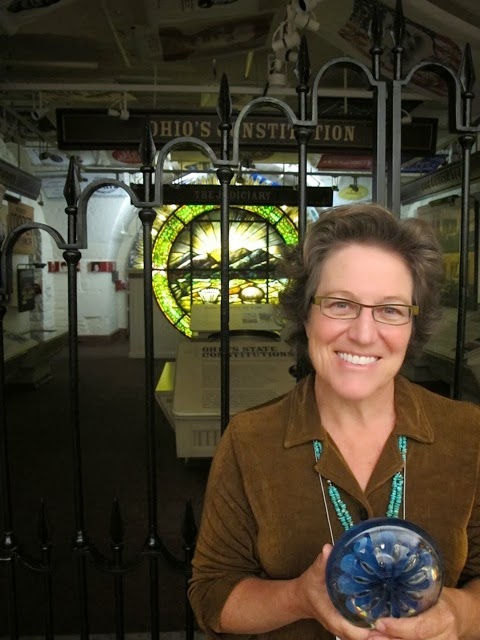
On October 11, Bill and I drove to the State House in Columbus for an awards ceremony. The Ohioana Library Association had given The Bluebird Effect its 2013 Book Award for Nonfiction.


Why thank you!!

Michelle Gubola, member of Ohioana's Board of Trustees, awards the orb.
Photo by James J. Bishop

                                                           photo by James J. Bishop


Attending Ohioana functions has made me keenly aware of just how much writerly talent resides in this big, square state. Ohioana Library Association's main charter is to bring Ohio's deep, wide pool of writer talent to everyone's attention. They've got this huge library made up entirely of works written by Ohioans, about Ohioans, and the gems within would surprise you. It includes more than 45,000 books, 10,000 pieces of sheet music, and approximately 20,000 biographical files on Ohio writers, musicians, artists and others of note. I was really floored that my book floated to the top of their Nonfiction pile. Here are the honorees who were present that night:


from left: JZ (The Bluebird Effect, Nonfiction); Martha Collins (White Papers, Poetry); Bernard Matambo (Walter Rumsey Marvin Grant for Unpublished Author); Joy Kiser (America's Other Audubon, About an Ohioan); Louise Borden (His Name Was Raoul Wallenberg: Courage, Rescue and Mystery During World War II, Juvenile) ; Robert Olmstead (The Coldest Night, Fiction). Also awarded was Tracy Chevalier (The Last Runaway, Fiction Set in Ohio).

We had a panel discussion wherein all the writers were asked a single question to answer in their own way. I tried to keep my answers short and to the point. Everyone did. It was neat to hear about each other's "process." Robert Olmstead said he hates to write. Which made everyone laugh. I said I save writing as dessert when I'm done with ordinary work because I enjoy it so much. Which might have made some of the writers hate me. That's OK. It's true.


 And I am ever so happy to put a beautiful hand-blown blue glass orb (by Ohio artist Robert Eickholt) on the kitchen windowsill, to join the one Ohioana had given me for Art, Writing and Commentary in 2008. A repeat offender! And there's a third, won by Bill for his many books, gracing his office at Bird Watcher's Digest. Ohioana been berry berry good to us. We're grateful. I'm grateful to Bill for these photos, and for being my date to the ceremony. It was sweet. Ohioana is made up of the nicest people. You can join, and in so doing directly support the arts in this great state. Check out ohioana.org. 


Awards are nice, especially when they catch the sun the way these do. Awards make you feel like somebody noticed your work. You want to say thank you, and it's nice to say it in a satisfying way. Here's the text of my acceptance speech, which had to come in under two minutes. Smart, Ohioana, because I'd still be there blathering away. It's in what I call "commentary style." Some things that look right written don't survive in spoken word, and spoken word can look odd when written. So be it.


As someone who had always talked to animals and birds, I’m not sure it sank in on me that I was doing anything at all unusual until I got to college. I looked around, and no one else in the dorms had a baby squirrel in their dresser or a lab-rescued chicken in a pen in their common room. People brought me things in cardboard boxes with holes punched in their tops. They still do.

The Bluebird Effect is about uncommon bonds with common birds. It’s about forging those bonds with them when they’re injured or orphaned, the reward of getting to know individual birds personally. This strikes a common chord in anyone who’s looked at a bird and wondered if it might be the same one they saw yesterday, or last year. If the robin nesting over their porch light could have been the same one that’s been there for seven years.

I think of myself as an advocate for songbirds. So many people rehabilitate and work with raptors; so many fewer choose to work with songbirds. Mostly, that’s because you can lay a frozen rat in a hawk’s cage and be done with it for the day. But you have to feed orphaned baby songbirds every 30 minutes, dawn to dusk. Not many people are willing to do that, or to go through the arduous procedure of readying them for release into the wild. But it’s there that the magic happens. You can’t really know a bird until you’ve been its mama.

The trick in writing about such warm, downy things is not making the birds out to be tiny people. They’re not. They’re a whole lot cooler than people; they’re quivering bundles of instinct, avid curiosity, and flexible intelligence, making new neural connections every hour, fighting their way from an artificial upbringing with a human mother, back to being birds. Functioning wild things, ready to fly, search for food and find mates all by themselves. And I get to watch, and sketch, and write, and marvel at my luck in just being there for that. This book is a memoir of encounters with 26 different species, and yeah, it’s a little unusual. I’m deeply grateful that Ohioana Library Association has smiled upon it. In the words of Mary Oliver,

If you want to talk about this
come to visit. I live in the house
near the corner, which I have named
Gratitude.

Thank you Mimi for that poem. Thank you Jeanne for your light. Thank you Dad for your storytelling. Thank you Mom for letting me fix robins and doves on the kitchen table. Thank you Phoebe and Liam for looking at the changing light with me. Thank you Bill for everything, for prodding me into writing Letters from Eden, my first book. And for wearing your bluebird tie.


photo by James J. Bishop

Working on the next book now. It's about baby bird development. Dessert after the wildest summer and fall on record. My total output yesterday was four titmice. Four mourning doves today. That's a pret-ty good day.


You can order a personalized copy of The Bluebird Effect on the right sidebar of this blog or by clicking here. I'll sign it to whomever you wish, box it up and send it. 

Sole employee at Indigo Hill Arts. Answers phone, email, works in mailroom, head of promotional department, staff blogger, social media director; head horticulturist and director of animal care; shrew, bat and dog videographer. Also writes and illustrates books when not being a scrubby-dubby housewife.


photo by James J. Bishop--thank you!!
And thanks to Rudine Sims Bishop, President of the Ohioana Board of Trustees, for help with this post. 

New York State Zick Alert!

Saturday, July 27, 2013

2 comments
Delighted to tell you that I'll be speaking at the Roger Tory Peterson Institute in Jamestown, NY, on Wednesday, July 31 at 7 pm. I'll give my talk, "The Bluebird Effect: Uncommon Bonds with Common Birds." The talk is free and open to the public. I am at this moment working to include photos and video of my three current charges, Elsa, Ida and Toddy, the orphaned bluebird sisters. If I've been a bit scarce lately, it's because they've worn me ragged, teaching courses and cooking for the little Bluebird Survival School being held right in my yard. I hope by Wednesday morning they will no longer need me to pop out of the house like a figure on a cuckoo clock, every hour on the hour, to feed them.


Toddy (left, with dark red breast) and Ida, hanging out in the yard. Ida caught a moth on the side of the chimney this morning and gobbled it down. You go girl!

On Friday, August 2, I'll present the same talk to Chautauqua's Bird Tree and Garden Club for their Life Member Centennial Luncheon. Which is not free or open to the public, but is a huge honor for me  to address.  Holy cow.  A gardening club in its centennial. An august organization. Which, perhaps is why the luncheon is in August. I adore going to Chautauqua. It's a little island of bustling serenity, culture, music, art, and deep thought. And it has fabulous flowers and the most alluring porches.

So if you're in the Jamestown NY area, come and see me at the Roger Tory Peterson Institute next Wednesday. Or maybe I'll run into you on the shaded walks of Chautauqua. If I'm not running, I'll be festooned with cameras. Taking my best pal Shila for much needed R & R and photoexpotition. Squee!

Bluebirds, get yo act together. Mama's going on a road trip.

Yes. This is the Art Gallery.

Sunday, September 2, 2012

12 comments
Always wanted an original Zickefoose watercolor? Read on.

Living out as far as we do, we don't get many knocks on the front door that we aren't already expecting. A scorching early August day. I'm still in my running clothes, still wearing the sweatband and the sweat, too. The doorbell rings. I peek through the beveled glass to see a woman in a bright blue blouse standing on the stoop. I reflexively open the door, instantly wishing I'd thought to throw a shirt over the sports bra. Oh well. Nothing she hasn't seen before, I expect. (Why don't I keep a shirt by the door? Duh!)

"Is this the art gallery?" She peered past me to the shoes in the foyer; the clutter of everyday life.

"Uhhhhm....well, my stuff is all over the walls, so I guess you could....umm, lemme get a shirt on..." My kids would have given the moment a 9.5 on the Awkward-o-Meter.

"Oh, I'm terribly sorry. I was just at Bird Watcher's Digest's office in Marietta, and I looked up your business listing on my phone and it gave me a map to your house. I thought it must be set up as a gallery. And this is your home. I'm so sorry!! You're Julie Zickefoose, right?"

"Yes! that's me. Please come inside. Don't feel bad. Maybe I can sign your book for you."

 I'd noted that she had a copy of The Bluebird Effect in her hands. I got her a glass of cold water and it wasn't long before we were laughing about the misunderstanding. I think I'd have abandoned the assumption that I'd find a retail art gallery after the first couple miles of winding country road and distinct paucity of retail businesses (Yes! We're right next to the Starbuck's and across from Curves! Or...turn right at the hayfield where the old Morgenstern place got torn down...) The whole episode was instructive. First, I hadn't realized that my business was listed online with full contact information and a Google map. I never did that! So who did?? Eeek. Ack. This Information Age, it can be scarily intrusive (says the blogger who's been telling you everything for almost seven years...)

She asked to see some limited edition prints and, being a nice person, bought a couple, as well a copy of Letters from Eden. I took her up to the tower and we stood and looked out at the hills and the gardens down below. I was glad she came, and I think she was too.

The whole thing got me thinking. My house is an art gallery, really, if you don't count the shoes in the foyer and the dishes in the sink or the usual attire of the proprietor (No stilettos or little black Chanel dresses to my name). And there are stacks of paintings that won't fit on the walls, stored neatly in two huge flat files that dominate the studio floor space. Downstairs, boxes of framed paintings. Upstairs in a storage room, carrels of paintings. What am I saving them for? I don't know. But they're not doing us any good sitting around in boxes.

I was asked to be Executrix for the estate of Louis and Lois Darling in 1991-2. Both amazing natural history artists, their house looked something like my house: paintings on every possible wall, and stacks of 'em in flat files and boxes. Lois asked me to donate the lot to the University of Minnesota's Kerlan Collection of Children's Literature, and I did. As I sorted and stacked, I shook my head at how sad it all was, that nobody got to see this incredible work but me, and here I am wrapping and boxing it up to ship off to be stored somewhere else. And with that experience behind me, I find myself wondering if all this art I've got here might be better appreciated in the homes of people who know me and like my stuff.

I've not had much experience with gallery transactions, and what I've had I didn't much like. There's something about a gallery marking things up then taking 50% of the price just for hanging it that rubs me the wrong way. Having to call to see if they've sold your paintings, finding out they sold months earlier, then having to ask for your check again and again...nuhhhhh.  Even if people wanted to pay that much for bird paintings, which by all accounts they don't.

So. The tower is peeling; the boards are rotting. Windows and roof vents are leaking into my art storage room. Ack. That's not where you want leaks. We'd hoped to make some repairs on our slowly deliquescing house, had hoped to hire someone to paint it; even bought all the paint last fall. And then in January 2012 we made an album (The Rain Crows' "Looks Like Rain")  and making it the absolute best it could be, we cleaned ourselves completely out and have yet to recover from that. We don't regret making the CD for a moment, but we have yet to have anything to show for it other than a few people saying, "Hey! Great stuff!"  I don't kid myself that selling a few bird paintings can paint the tower for us, but it might help make the wait between book payments go a little easier, might make that next stack of bills, that next mortgage payment a little less frightening.

What I thought I'd try is posting a photo of a painting I'd like to offer, with a minimum suggested bid.  Giving it a week, letting people bid on it, then closing the bidding and sending the painting off to the highest bidder. It might work. It might not.**see update, below. I guess if it doesn't work, the worst that can happen is that it's embarrassing for me.  Nothing ventured, nothing gained. And if you don't try something new, nothing ever changes. Make like Nike and just do it. I sound intrepid, but I'm pumping myself up because I'm tired of pondering, wondering if being my own sales rep for original art could work. I'm ready to do it.

So here's the first piece. So many people have expressed their admiration for the book's cover, and asked if I have prints of it, that I thought I'd offer an original watercolor that looks just like it. It's a study for the cover of my book, The Bluebird Effect: Uncommon Bonds with Common Birds.  11" x 13", transparent watercolor on Winsor-Newton paper.  Minimum bid: $550.   Bidding closes next Sunday, September 9, 2012.

You can leave a comment with a bid in the Comments section, or if that seems too public, just email me:
julieATjuliezickefooseDOTcom. I'll let people know where the bidding's going in the comments section and here on this post, but will absolutely respect your privacy if you'd prefer to bid via email.

OK. Deep breath. Here we go!

11 AM 9/2/12: Minimum bid met.
11 AM 9/9/12: Closed.

Update 9/9/12: I found out in the  meantime via a concerned reader and a wise mentor that there are all kinds of regulations in Ohio regarding auctions, involving applying for a permit, and awesome fines for trying to conduct one without sanction from the Ohio Dept. of Agriculture. Which is not exactly what I need at this point. Fines. So I was relieved that this turned out to be a direct sale instead. And am delighted to send the painting off to the first and only bidder. A win-win, to find that out, to avoid being fined for striking out in a new entrepreneurial direction; to find a home for a painting I love with a person I love, too. In the future I'll offer art for a fixed price. And probably, based on your comments, keep the pieces smaller and more affordable. Thanks for your feedback and encouragement.


A Real Simple Recommendation

Wednesday, April 18, 2012

3 comments
Dear readers,


  My alert sister-in-law Laura brought to my attention that Real Simple Magazine is looking for a coffee table book to feature in its August issue. She knew just the book to recommend. Why, so do I. Now, it would be cheesy for me to enter the fray, recommending my own book. But you?
                                     My putting you up to it wouldn't be cheesy at all, would it?

If you frequent Facebook (and who doesn't, these days?) and you feel like giving The Bluebird Effect a boost, or even its little sister Letters from Eden, and you do actually keep them on your coffee table because you love leafing through them, please tell Real Simple that. Here's the link to Real Simple's Facebook request for book recommendations.


Thank you so much!  Let's give this book wings!

And while I'm at it:

BOSTON AREA ZICK ALERT!!

On Saturday, April 21 at 10 AM, I'll give a talk on my experiences raising baby birds at the Mass Audubon Drumlin Farm Sanctuary in Lincoln, MA.  It's at 208 S. Great Rd,  and the contact phone number is (781) 259-2200. We'll have a field trip afterward, walking Drumlin Farm's bluebird trail. There will also be a book signing, so if you haven't got your copy yet, come get one signed in person.


For Boston area folks, I'll be on the Emily Rooney show, interviewed by Kara Miller, on WGBH sometime around 12:30 pm Thursday, April 19, so tune in your radios.


And Joe Viglione will interview me on Visual Radio (that's TV, actually), at 1:30 on Friday, April 20 in Winchester, MA. 


Back to packing and figuring out what to do with the bats and turtles and greenhouse while I'm away. Oh, Bill.....

[Back to Top]