Background Switcher (Hidden)

Showing posts with label chrysalis. Show all posts

Not-so-Crazy Caterpillar Lady

Tuesday, August 30, 2022

9 comments

 Year in, year out, I fight it, that urge to take in all the little caterpillars and keep them safe from harm. 


Usually, things go well for the monarchs and I see them hatch, eat, grow, thrive, pupate and flutter away in the wild. This year is different. Very different. 

For one, monarchs have been declared endangered. Not by the U.S. Fish and Wildlife Service, no...that takes for-freakin'-ever. The change in status was announced, rather, by the International Union for Conservation of Nature a few weeks ago. Essentially they're yelling at the USFWS that somebody's got to say something about this disappearing insect. Monarchs are big and charismatic and people notice them, which makes it all the more dispiriting that we are letting them slip away before our eyes. 

Here on a micro-scale, it's a very wet year in Ohio (like almost nowhere else in the country). I don't know if that is why there are so many predatory stinkbugs, but every monarch caterpillar I've found on my yard "ranch" in the first part of the season was eventually killed by stinkbugs. It really bothers me to see a great fat fourth instar monarch that I've been watching since it was a tiny hatchling, hanging limply from the sucking beak of a stinkbug. If there's anything that bothers me, it's seeing a young thing die.

So, reluctantly, I've climbed aboard the Crazy Caterpillar Lady Train again. But I'm only bringing them inside while they're tiny, and then again when they turn into chrysalides. I'm researching and experimenting with ways to keep them outside in the sun and wind and rain, chewing away on live milkweed, with fine mesh sleeves to protect them from parasites and predators. It's been a thing. I just don't think they were meant to grow up in an air conditioned house, or jammed together in a plastic box.


Outdoors is the thing. They've got three species of Asclepius to choose from in my yard. 


My obsession with watching the caterpillars in transition has pushed me to learn some things about time lapses and video editing. I'm proud to present my latest effort: five hours of caterpillar to chrysalis transition, condensed to a very satisfying minute and a half. Made the video today, August 30, 2022. 

 I hope you enjoy it.


When Hummingbird Meets Butterfly

Sunday, October 11, 2020

10 comments


Staying home a lot is not a bad thing when you love your home. Magical things can happen when you stay home. 

 Making your home a lovable place is work, but if that work is done with joy, you don't feel it, except in your muscles when you get up the next morning. It is a gift you give yourself. 

This past summer I learned how to make and use outdoor rooms. It's pretty simple. You run some extension cords from the basement, get some comfortable furniture and a Yeti thermos full of something nice like lemon mint water, and set up with your laptop, camera and binoculars in the shade of a handy tree, say Jemima's Japanese maple. This is now your office, and you get to work out amongst the salvias, with orthopteran music as your soundtrack.

On this particular late September day, some late rubythroats were working the salvias and zinnias in my terraced bed. My bedsheets flapped gently in the warm breeze behind. I couldn't stop snapping photos. The cream-colored sheets add a dreamy touch, don't you think? 


Salvia greggii "Cherry Chief" is a favorite, as it always has a few fresh scarlet blossoms full of nectar to offer each day, floating high on wiry stems where it's easy for hummingbirds to access them. 


Salvia guaranitica "Black and Blue" is a favorite of mine. Last fall, I cut them off and saved the roots to these plants in long planters set on the cold floor of my greenhouse, so I wouldn't have to go looking to buy them again this spring. When it warmed up, they sent out new growth and we were off! Saved a ton of money and made another successful experiment. I love this shot, with the hummingbird glugging down nectar or perhaps a tiny flying insect.

I heard a persistent buzzing, as of a hummingbird investigating something, off to my right, and that was how I found out that the chrysalis I had hung on a tomato cage, thinking it might be a bit off, had hatched successfully!  I watch the chrysalides I bring into the house for safekeeping over the two weeks it takes them to metamorphose. If one looks a bit off-color or anything other than perfect, I take it back outside just to be safe. I don't want anything infecting my precious jewels.

Well, this one was a bit off color but turned out to be perfect anyway, and a beautiful female monarch had emerged without my knowing it only an hour earlier!


And wouldn't you know, there was a hummingbird pestering the poor creature!


Who knows what the hummingbird had in mind? Just deviltry. This is a juvenile male, as evidenced by its darkish streaky throat. Figures.


The monarch wasn't having any of it, and she snapped her wings open and closed to try to startle the hummingbird into leaving her alone while she finished drying her new wings. 


In the end, I had to holler at the durn hummingbird. I think it's the first time I've yelled at a hummingbird...no, no, I have done that before. I used to yell at Bela, one of the four hummingbirds I raised in the summer of 2003, because he was soo bad, first to fly and constantly pestering the other three before they were ready for release. 


Bela was just as unpleasant as he looks here. He was much better once he got out in the yard. 
Aren't we all? (I loved him just as he was). 

Oh man. I just realized that the bonsai behind him is the one that got so big I couldn't keep it in a pot any more, and I planted it out on Bill's grave last spring. Wow. It's coloring up out there; it made it through the summer OK, even though May froze its leaves off twice. Pfffft. 2020. 

The four orphaned hummingbirds' story is told in my book, The Bluebird Effect: Uncommon Bonds with Common Birds, in a huge chapter that threatened to take over the whole book. At one point I was considering calling the book My Hummingbird Summer and Other Stories.


Where was I? Yelling at a hummingbird, right. Well, the whole point of this post is to say that something very special has happened with me and monarch butterflies this fall. Starting in early September, I began work on a photography project that I am still working on now. Yes, my last caterpillar just writhed around and became a chrysalis. It's 9:40 pm on October 11...late for me, and wicked late in the year, but I was determined to stay up until it happened, to record the event with my iPhone on timelapse setting. 

Guess when I started making timelapse videos of this caterpillar? Around 8:45 this morning. With monarchs, you have to BE THERE or you'll miss it. I've probably got 50 timelapse videos to delete now, ones where nothing much is happening, but I got it, and I got it good. The timelapse is still running.

All this makes me nostalgic for the old days. My love affair with monarchs started in the summer of 2010. I had sketched and painted the various stages of metamorphosis, but I knew there had to be a better way to capture it--get the whole thing, not just snapshots. So I put my tiny Olympus point and shoot camera on a little bitty tripod, and I sat next to the metamorphosing caterpillar, pushing the shutter button every few seconds, through the entire caterpillar to chrysalis transformation. Then I waited two weeks and was somehow miraculously THERE for its emergence as a butterfly. I did the same thing, click click click click, for the emergence and wing drying.

In the end, I had 1250 photos. I wasn't sure what I was going to do with them, but at least I had the data.

So, as I often do when I'm trying to figure something out, I wrote about it, and one of my pieces ended up as a commentary for All Things Considered, back in the good old days a decade ago when I contributed natural history commentaries. Imagine! We had something else to talk about but spreading disease and beastly human behavior.  Oh, for those days...In the end, I wound up giving the 1250 photos to NPR, where a brilliant producer named Mito Habe-Evans stitched them together into the animation you see below. It's still one of my favorite things I've ever done. And all without iPhones or timelapse or anything but persistence and a little Olympus camera. Oh, and being there. Enjoy it! 


The "new Blogger" is giving me fits; won't let me into html to load the video. I've tried twice to embed it here. If you're reading from your phone and you see nothing in the space below, scroll down and tap View Web Version at the bottom of the post. If that doesn't work, here's the link to the video on YouTube.  Monarch Metamorphosis


And the Chrysalis Became...

Tuesday, June 2, 2020

8 comments

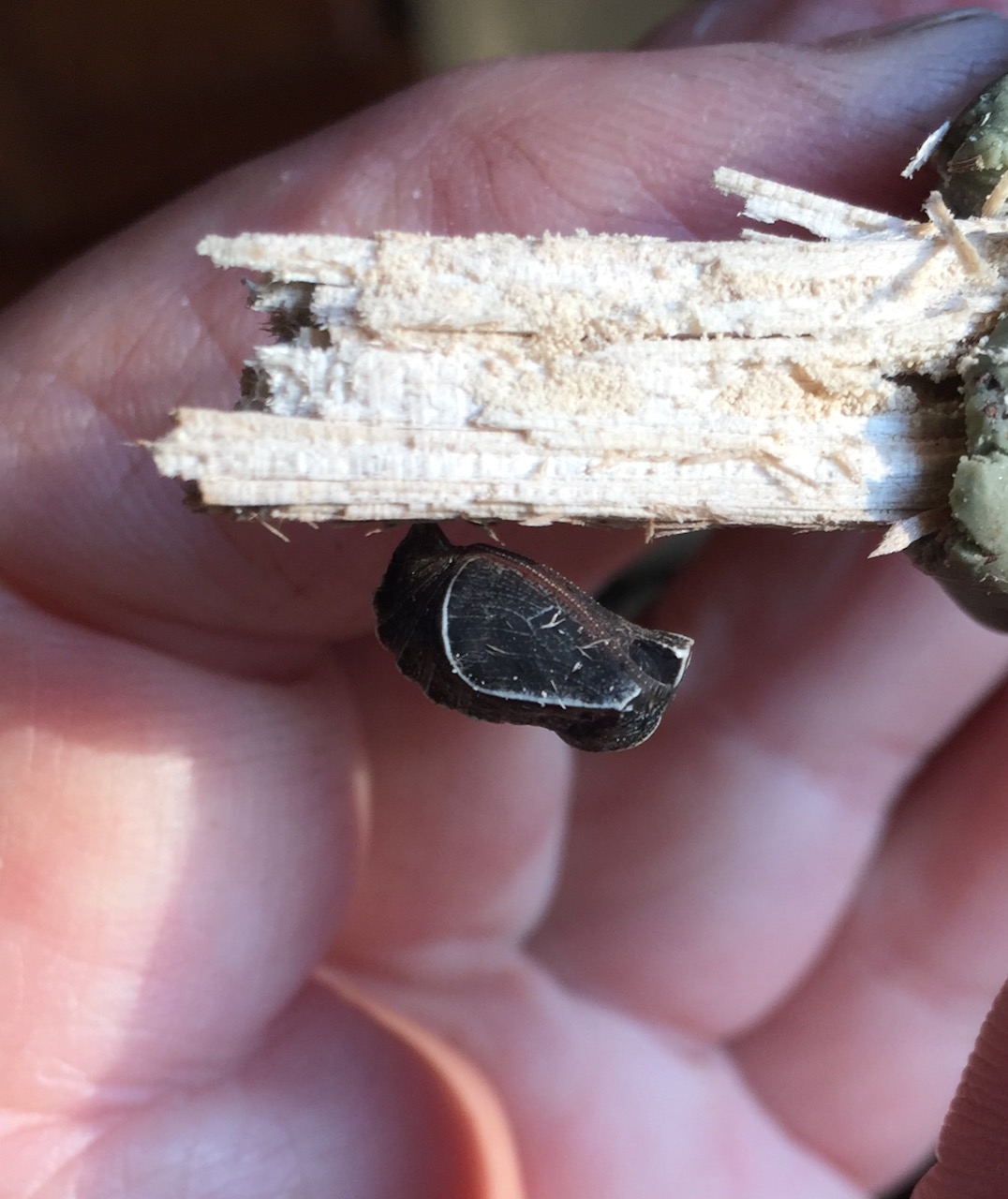
A small, unknown but very sweet and beautiful chrysalis found May 28, which oddly enough would have been my dear mother Ida's 100th birthday. How fitting, to find a little mystery on her birthday, something pregnant and wonderful. 

Mama had me when she was 38. That was considered impossibly old in 1958. I'm so very glad she did. Sigh! Thank you for this gift of life, Mom! I am enjoying it so much.

We wondered and wondered about this little capsule. What would it be? As naturalists do, I looked around to see what was abundant right now, what was hatching out, and I thought about it. I decided it might be a small wood satyr, based on who was bouncing along the woodland edges at the time. 

I purposely did not want to Google it, because I didn't want to spoil the surprise.

The chrysalis got darker and darker. That could mean it was getting ready to eclose, a nice word describing the moment a butterfly emerges. Or it could mean it had died. I decided it had to be the first choice. I kept sniffing it, in a Science Chimpy way, to make sure it was still with the living. Yep. 


If you click you might be able to see the threadlike segmented antennae running down from its squarish eye. The head got a lot more prominent in the last couple of days.
I've shoved its support stick into plasticene so it can't possibly tip over and squash itself, and also so it has room to hang from the chrysalis once it comes out.


I checked that little thing probably 20 times the morning of June 1. And then stuff kept happening and a couple of packages came with the mail and we got all excited about it, and I went to move the little critter keeper and saw A SMALL WOOD SATYR where there had once been a CHRYSALIS!!!


I just don't get a whole lot more excited than this. SO BEAUTIFUL!! Appearing like magic! When I wasn't looking, of course!

Its wings were wet and floppy when I found it. Oh, how I wished I'd seen it pumping them full of fluid! Oh well. I was thrilled beyond thrilled that it was alive and hatched out without a hitch.


After maybe three hours, it was ready to go, bouncing off the walls of its critter keeper. The kids and I carried it out to the orchard and Phoebe made this little video. Warning--there is high-pitched squeeing from me. I made the same sound when I caught my first northern pike.


Resting after its big morning, in perfect habitat, in the orchard I've been working so hard to clean up.


Speaking of hard work, the Living on Earth presentation went off without a hitch. I was dang proud to have been my own techie on it, too. Well, I had plenty of help from the LOE staff, who were WONDERFUL to work with. And interviewer Bobby Bascomb couldn't have been more sensitive, wide-ranging, or beautifully prepared in her questions. Wow. We had well in excess of 300 people watching the Zoom presentation, including many friends, family and Zickfans, and it was exciting for me to make my way through such tall corn, talking about blue jays, my favorite topic. Well, one of them.


My setup in the good Internet at the Bird Watcher's Digest office. I taped a bird-themed huipil from Guatemala over my head. The wee square hole is for a person's head--it's kind of like a poncho. I couldn't get my head through that hole to save my life, but I bought it for the fabric. 

If you'd like to listen to it (and you should, if you've never been to one of my talks but would like to), it's archived on the Facebook page of Living on Earth. Here's the link:


Be aware that the first several minutes are devoted to a holding screen, while we waited for everyone to arrive and get set up. So hit Play with the volume up and tune in when you hear voices. I hope you enjoy the presentation as much as we enjoyed creating it! 


Sources of Joy

Sunday, May 31, 2020

2 comments

I came back from a morning run...yes, I'm at it again, tired of quarantine flubber. I have lost 6 lb and Curtis, 4.5. I decided to do a loop through the woods on our east 40. What did I find but a box turtle out and about?! Glad I had the notion!


Because I was looking through the phone and concentrating on the light, I totally missed the odd profile of his shell.


It's low and flat, indented. Concave.

I was so captivated by the runes on his side that I missed the scars on the top.


But look at this turtle. He's been mowed, many years ago. The pigmentation is missing; the scutes along the right top are irregular, and there's an indentation down the right side of the spine and a great dip on the left. Oh my God! what this animal has suffered and survived. With no help whatsoever, he crawled into the woods and set about healing from an injury that should have killed him.


His plastron is still cracked. But he's healed. 


Oh you fine old soldier, you walking survivor, may you avoid the blade and the wheels of man. 

I had plenty to think about in that scarred but surviving box turtle. Oh how cruel is man with his implements, his weapons for conquering nature. 

I got a little breakfast and jumped on my best weapon for fighting multiflora rose and honeysuckle: my John Deere. The irony did not escape me as I rolled out the orchard, planning to mow down the resprouting rose that I'd cut early this spring. See, I think I'm on the good side! Since about February I've cut so many rose canes--probably many thousands--that I've given myself a trigger finger on my right hand which makes it hard to write. Ah, what does a writer need with a functional right hand? I will say that it's changed morning journaling for me. Massages and stretches have helped, and I'm hoping it goes away, as one hopes about all things that might need surgery one day. 

I did get a nice set of hard muskles out of it, though. Just wish my right hand hadn't suffered so. You can be sure I'm trying to figure out how to use a boltcutter style pruner without clenching my right hand, but so far it isn't going too well. Also, how do you weed a garden or turn soil without clenching your right hand? There is still so much multiflora that needs to be cut and killed, so many weeds to be felled. Finding out you aren't bionic is a bummer, especially when you feel that way.


I was rolling out the orchard, looking with satisfaction and trepidation on the prairie we planted, seeing so damn much Japanese stiltgrass coming up amidst the expensive seed I bought...


and there was a feather, nay, a barred owl feather! lying on the prairie. I call these apports, gifts from the world beyond. Who lays them out for me to find? The owl, to be sure. But who sent the owl? It's fun to wonder.

You can see the noise-canceling fringe along the left edge. The whole thing is downy, overlain by fine noise-absorbing filaments.

 That's the prairie patch coming up behind it. Pray with me that flowers and native grasses rise over the Japanese stiltgrass, which has been on our land for only about five years. It was brought in on the tires of the four-wheeler that's used to visit our long-broken welljack. The oil company that owns the lease does virtually nothing to maintain its equipment; I think we're going into our fourth year with a jammed shaft on the welljack. And for this kind of service, we get stiltgrass, too. If the stiltgrass smothers my beautiful prairie plants, I will weep and rage. I don't understand why invasive exotics have to win every time, but it seems they do. I might be whistling into the wind with my dream of a native shortgrass prairie out here, but I've worked too hard to make it happen to give up now. It's a pitched battle between the stiltgrass and the bluestem, deertongue, black-eyed Susan, New England aster, and partridge pea. Who will win?


The Zabulon skippers are hatching out wherever I walk.
Each one I see in the orchard seems like a little victory to me. Skippers are so very rare any more. Butterflies in general are where one can most easily see the insect apocalypse at work. Diversity and numers, corkscrewing down. 

This is a male. That chocolate band on the inner hindwing, and the fairly smooth checkered outside border, are his marks. 


The female Zabulon skipper is chocolate brown, and she has a neat white line along the top of the hindwing.


Speaking of butterflies, I found a chrysalis in the meadow on May 28. It was clinging to the underside of a little pine stick I was about to toss off the path.


It was the most beautiful thing. I thought it might be a skipper of some kind. A duskywing? A Zabulon? Even a small wood satyr?


I had to bring it into the house so we could find out what it is to be.
I gave it to my Willowtree figurine, "Joy," to hold for awhile. 


The chrysalis keeps changing. These later close up photos were taken May 31. 

It has darkened a lot, and you can see the tiny segmented antennae running along the top of the chrysalis; the white hindwing border, and the eyes, which weren't as evident before.


Of course, I can't wait to see what it's going to be. I have a feeling it's going to eclose very soon, as dark as it's gotten. All these mysteries go  on around us. We can walk on by, or we can notice them and get involved. I now have the chrysalis' anchor stick in a lump of plasticine, on the softly padded floor of a small critter keeper, so we can see it should it eclose when we're not watching. But oh, we are watching. 


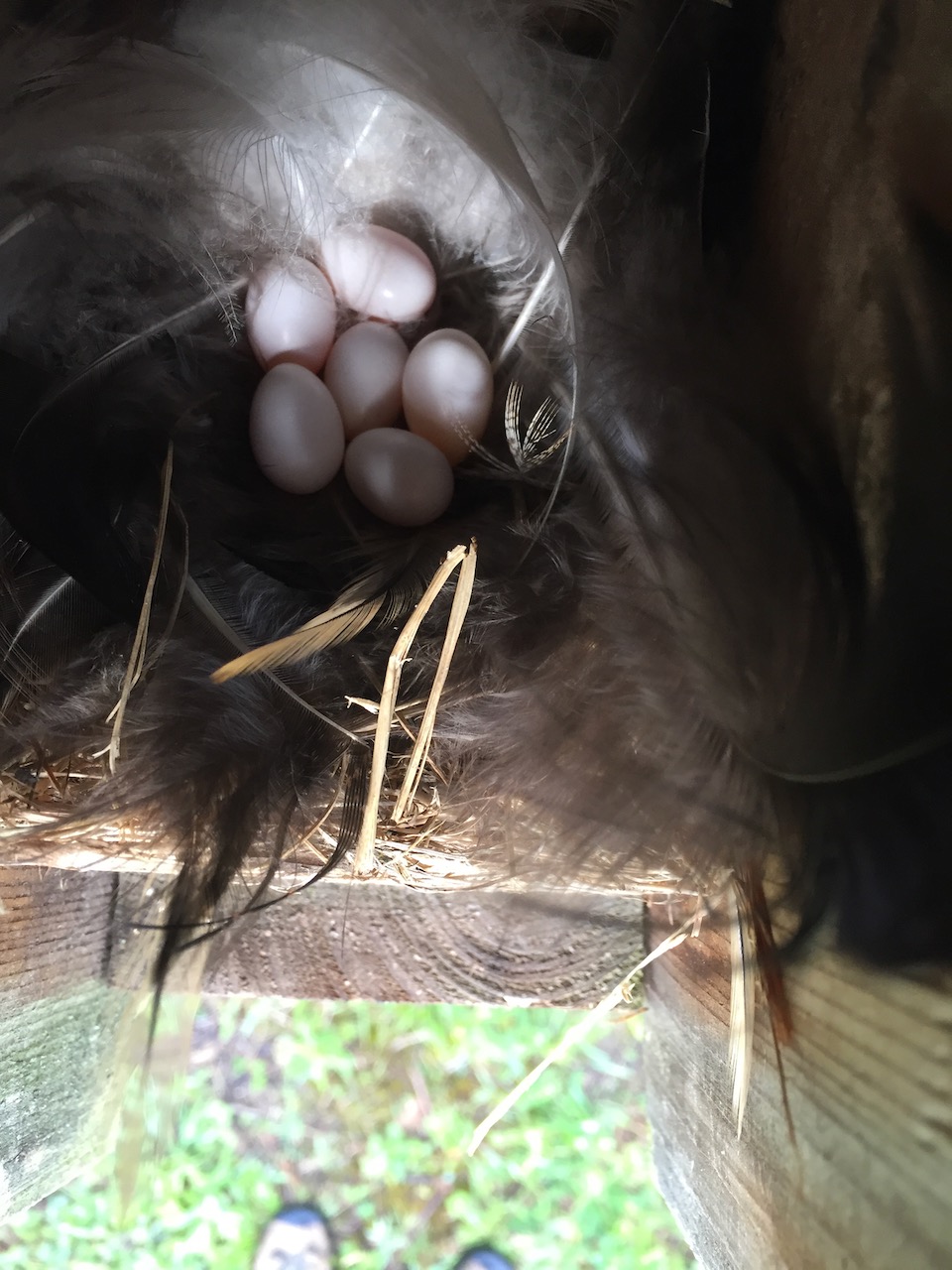
The end of May is a grand finale of joy fireworks for the naturalist. After the cruel clamp of rain and cold, everything is springing forth. Birds are starting over, many having lost their first nesting attempts. Here's a little overcompensation from a pair of bluebirds in a country churchyard that I watch over. Six eggs is a highly unusual second clutch, but this is a highly unusual year.


It's a bit more usual for tree swallows to haul off and lay a sixpack.This is their second attempt as well. The first clutch was thrown out by bluebirds, who lost their fledglings to cold then turned around and kicked the swallows out. The swallows reluctantly moved to the bluebirds' old box, and peace has settled over the meadow once again.


I find myself stopping at the Three Graces every time I go by. They are in their late spring glory at last. The black tupelo, far right, held off the longest, but even she is in full raiment.


And Iris Cora from the Adirondacks is holding forth with the scent of grape Kool-Aid, some Granny's  bonnet columbines sneaking up through their spires. Before the storm blew through...


and after, all bespangled.


This is just a little piece of late May. There is alwasy so much more than I can take in or tell about, but I feel I must try.

Don't forget to sign up for my live Zoom interview with Living on Earth. It's happening Monday, June 1, 2020, at 6:30 pm. Here's the link. 


[Back to Top]