Background Switcher (Hidden)

Showing posts with label monarch butterfly. Show all posts

Not-so-Crazy Caterpillar Lady

Tuesday, August 30, 2022

9 comments

 Year in, year out, I fight it, that urge to take in all the little caterpillars and keep them safe from harm. 


Usually, things go well for the monarchs and I see them hatch, eat, grow, thrive, pupate and flutter away in the wild. This year is different. Very different. 

For one, monarchs have been declared endangered. Not by the U.S. Fish and Wildlife Service, no...that takes for-freakin'-ever. The change in status was announced, rather, by the International Union for Conservation of Nature a few weeks ago. Essentially they're yelling at the USFWS that somebody's got to say something about this disappearing insect. Monarchs are big and charismatic and people notice them, which makes it all the more dispiriting that we are letting them slip away before our eyes. 

Here on a micro-scale, it's a very wet year in Ohio (like almost nowhere else in the country). I don't know if that is why there are so many predatory stinkbugs, but every monarch caterpillar I've found on my yard "ranch" in the first part of the season was eventually killed by stinkbugs. It really bothers me to see a great fat fourth instar monarch that I've been watching since it was a tiny hatchling, hanging limply from the sucking beak of a stinkbug. If there's anything that bothers me, it's seeing a young thing die.

So, reluctantly, I've climbed aboard the Crazy Caterpillar Lady Train again. But I'm only bringing them inside while they're tiny, and then again when they turn into chrysalides. I'm researching and experimenting with ways to keep them outside in the sun and wind and rain, chewing away on live milkweed, with fine mesh sleeves to protect them from parasites and predators. It's been a thing. I just don't think they were meant to grow up in an air conditioned house, or jammed together in a plastic box.


Outdoors is the thing. They've got three species of Asclepius to choose from in my yard. 


My obsession with watching the caterpillars in transition has pushed me to learn some things about time lapses and video editing. I'm proud to present my latest effort: five hours of caterpillar to chrysalis transition, condensed to a very satisfying minute and a half. Made the video today, August 30, 2022. 

 I hope you enjoy it.


Hope for the Monarch, and a Great Golden Digger Wasp

Sunday, August 24, 2014

17 comments

The summer of 2013 was one of the saddest ones I've ever lived through, if you're talking about butterflies. All that summer, I saw exactly four monarchs, and no caterpillars. 

I am elated to report that 2014 is a different story. I've seen 25 monarchs this season so far. They're still scarce enough for me to count and treasure and try to photograph every one. I couldn't bear the thought that this magnificent butterfly might vanish from our meadows. I remember seeing endless streams of them along the Connecticut shoreline in September, all heading for Mexico. I hope to see that again someday.

This gorgeous male (identified by the thickened vein, second from bottom on his hindwing) was nectaring on narrow-leaved mountain mint in Harrisville, WV, not far from my beloved North Bend State Park. 


That thickened vein translates to a little black dot, which is a scent gland, on the upper surface of his hindwing. 


For whatever reason I've seen many more males than females this year. Male again (see the thickening?)

The monarch was a serendipitous add-on. I left North Bend first, and David and Mary Jane followed. I was driving along Rte. 16 when my eye was arrested by a stand of rose gentian so thick and fine I squealed! I pulled off and waited for David and Mary Jane to catch up. Flagged them down and introduced them to my favorite wildflower. It was new to them. New no more. Now they'll look for it wherever they go. A little gift I could give them, for turning me on to North Bend. I'll never be able to repay that giant present.


We wandered in the meadow, bending down to bury our noses in its delicate perfume.


A particularly nice combo with Queen Anne's lace. This is the best QUAL year I can remember. Best rose gentian year, too.


And enjoying the gentian and monarchs, I noticed this spectacular wasp, more than an inch long. It took me a little while with The Google, calling up images with tagwords like "orange black spider wasp" and finally "spider wasp Queen Anne's lace" to finally find an image that matched it. That led me to digger wasps, and I finally figured out what I had. It's a different kind of 21st century field guide I've got in my laptop. Leafing through it is kind of like playing Pin the Tail on the Donkey, but eventually I get there. Having a little knowledge aforehand helps immensely.


Great Golden Digger Wasp, Sphex ichneumoneus, nectaring on Narrow-leaved Mountain Mint. A nectar feeder as an adult, the GGDW feeds its young on more proteinaceous stuff. This wasp makes vertical tunnels in sandy soil, into which she drags crickets and katydids that she has stung and paralyzed. There are several chambers at the bottom of her tunnel, a paralyzed insect deposited in each one. She lays an egg on each immobilized insect, and in the grand manner of parasitic fly and wasp larvae, the grubs eat around the hapless victim's vital organs until the very last minute, when the wasp grub is ready to pupate, thus keeping its food source fresh for the duration. Eating its host alive, as it were. Eeesh! Insects are the coolest, the most macabre, the most terrible and wonderful things on the planet. I find this sleek, peaceful fighter jet of a wasp captivating. Now I look for it on wildflowers, where it sips nectar, belying its katydid-paralyzing nature.


You beautiful thing, you make my heart sing. 

Beauty: my #1 motivator. Sharing it: #2.
You're welcome!

The Ephemeral Meadow

Thursday, October 27, 2011

9 comments

 Arrgh. It's all going so fast, so fast...the greens are leaving, the browns are coming. We haven't really had a proper fall here in southern Ohio, just a whole bunch of rain and wind and trees dropping their still-green leaves, and other trees that should be riotously colorful just standing around buck naked.

So I'm looking through my photo archives for things to share and it all looks impossibly bright and colorful and fresh and late-summery.


 I could just smell my neighbor winding up to mow this incredible meadow of mistflower (Eupatorium coelestinum.) I like to call it "wild ageratum" because that's what it is. It's one of my favorite flowers for the way it can paint a meadow sky-lavender.

I'd drive by the meadow and think, "I have GOT to get in there with the camera before he mows it!" Because when things are at their most beautiful, that's when he gets the bug to mow. You may remember the monarch rescue two years ago, when we saved 67 caterpillars as the tractor was grinding through. To his credit, he helped us gather them--once we told him they were there!

Wonderful guy. Just a different ethos about beauty, that's all. Mowed close is his beautiful. 

Mistflower and butterflies is mine. Here's a pearl crescent.


a clouded sulfur


A leatherwing or soldier beetle, possibly Pennsylvania Leatherwing (Chauliognathus pennsylvanicus) . You usually see these all over goldenrod.


 I kept stepping back, marveling at the beauty of the biggest stand of mistflower I'd ever seen. Knowing its days were numbered. Thankful it had been left this long.


Common buckeyes, a fall migrant around here, and one of my favorite butterflies. Those white wingbars flash in flight, and I can almost always identify this one on the wing before it alights. That's saying something for a butterfly.


And of course there were monarchs, but they preferred the more vividly colored tall ironweed.


On the leeward side, where he'd already mowed, mistflower still grows in the  uncut shadow of the hayrolls. There's a painting in there somewhere.

You know how I feel about hayrolls...


Not a week later, it was all gone. I guess you have to mow if you're going to make hayrolls.

 But he didn't even take hay this time. Just cleaned it up, made for an early frost.

Midwest Native Plant Conference

Tuesday, August 17, 2010

11 comments
Science Chimp, ready for anything. Photo by William Ringer, a nature-loving Hoosier who gets around, from the Potholes of North Dakota to the Fens of Ohio.

On the first weekend in August, I traveled to Dayton to speak at the second annual Midwest Native Plant Conference. I couldn't know what a blast it would be. I was so freaked out at the thought that native plant purists would turn up their nose at my habitat gardening talk, rife as it is with Chinese buddleia and Mexican salvias

Autumn sage, Salvia greggii

and Chilean fuchsias, that I refused an invitation to speak at the first annual conference.

But my friend Kathy MacDonald persisted and assured me they really did want me to come, so I spent a couple of days tearing up my talk to emphasize native plants like these in my garden.

My cardinalflower Lobelia cardinalis bed, with some Salvia guaranitica "Black and Blue" and Salvia greggii "Cherry Chief" and Fuchsia "Gartenmeister Bonstedt" and Crocosmia "Lucifer" thrown in for fun and hummingbird appeal.


The naturalized purple coneflower Echinacea purpurea along our driveway. I find it grows best along woodland edges.


So I wrote a special piece for the occasion about native plant snobbery, useful exotics, why I love lilacs and tuberoses and crape myrtle and how I don't care what anyone says about them. I love them not because I am too dumb to know the difference between a good (native) plant and a bad (exotic) plant but because I love them. For my own reasons, for the memories and the beloved people I associate with them; just because they are beautiful and good.

Being non-native doesn't automatically make a plant (or any organism) bad, despite the awful, awful preponderance of invasive exotics from grass carp to bamboo. I was still nervous about how it might go over, scarred as I am from a few run-ins with people who consider anything non-native a noxious pest. I needn't have worried. The Native Plant conferees were the finest kind, friendly and warm and full of good humor. Front-loaded with Master Gardeners, in fact, who are used to working with plant material from all over the planet. The talk went well, I had a load of fun, and best of all there was a field trip to Cedar Bog just west of Springfield, Ohio. You must, must attend the next one if you love native plants and would like to learn more about using them in your landscaping.

The gorgeous conference room at the Bergamo Center in Dayton, where I was privileged to speak.

Cedar Bog, outside Springfield, is the only open fen where white cedar grows in Ohio. A fen is an open wet meadow through which little streams course. Heavily underlain by marl (limestone) and somehow having escaped the cement mining that ruined most of our other marl bogs, it's got a terrific floral and insect community, and it's full of things you can't see anywhere else.

Here's part of the open fen/wet meadow which was full of white boneset, tall ironweed (purple) and obedient plant ( Physostegia, pink, in background) as well as black-eyed Susans, hops, dodder, sandvine, nettles...on and on. It was full of butterflies!

Tiger swallowtails on pasture thistle.

A Monarch on tall ironweed.
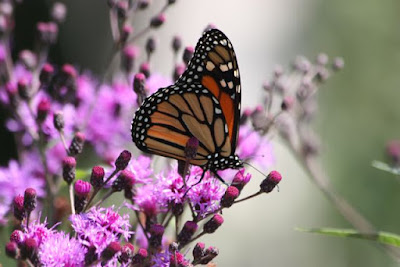
And a black swallowtail, also enjoying pasture thistle.


A pugnacious hackberry emperor kept hitting me in the chest and sometimes below the belt as I trod upon his boardwalk. He looks mean, doesn't he? I was intimidated.

A gray hairstreak rubbed his hindwings together as he sipped from a yellow flower only Jim knows. Bog loosestrife? No. Some sorta St. Johnswort? I dunno. Hm. Sumpin'. This is the problem with being a generalist, and on the downside of 50. I should write this stuff down. I should know by now I won't remember it for ten minutes.


At Cedar Bog there are orchids in spring, like showy lady's slipper and dragonmouth. There are elfin skimmer dragonflies (exceedingly rare) and the also rare and charming seepage dancer, which were abundant when we visited.

Seepage dancer, Argia bipunctulata. Nice name! It has much shorter wings than the common bluet, but otherwise, it'd be hard to know you've got an endangered damselfly.

A far more common but unnamed damselfly. My field guide only does dragonflies. Rats! Arrgh! Jim told me what it was...I found a beautiful pdf, Dragonflies and Damselflies of Ohio, by my friend Dave McShaffrey online! Maybe maybe a female blue-ringed dancer?

Anyone?

There is spiked gayfeather Liatris spicata
and cowbane Oxypolis rigidior

which is host to black swallowtail larvae, which eat things in the parsley and carrot family.

There will be more natural wonders from Cedar Bog in the next post. If you're passing through Springfield, Ohio, on I-70 (and judging from the traffic, who isn't?) you must take a detour and walk this amazing boardwalk. I had time for less than half of it and came out wanting to return soon! What a glorious place, with a wonderfully appointed and staffed "green" visitor's center. Check out their website, and visit Weds-Sun 10-4.

Yes, I'm posting one more day a week, to make three: Sundays, Tuesdays and Thursdays. There's just too much good stuff to share and the backlog is tremendous now.

And today, August 17, is Charlie the chestnut-fronted macaw's 21st birthday. I found my check register from 1989 with the record of his purchase. That was before kids, house, dog, Ohio; even before Bill. We're in it for the long haul. He'll be trundling around the studio floor, playing Stab the Doll with Liam, stealing toys from Chet, hanging out on my shoulder as I paint, cackling maniacally under his favorite blue cabinet, and sharing stirfry and a beer with Bill at sundown--just another day for a kooky and well-loved little macaw.

Ooh, that's GOOD!

Liftoff

Tuesday, November 11, 2008

25 comments

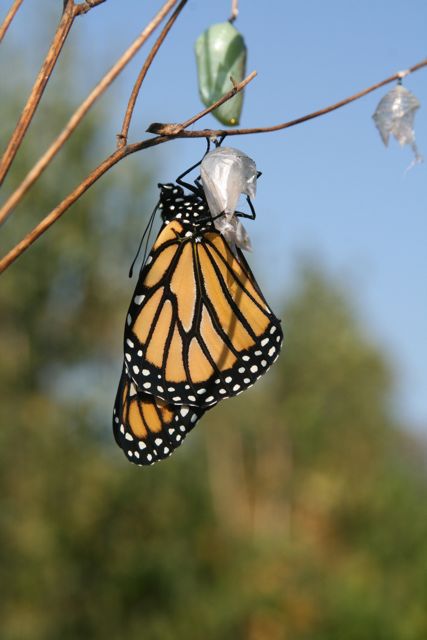
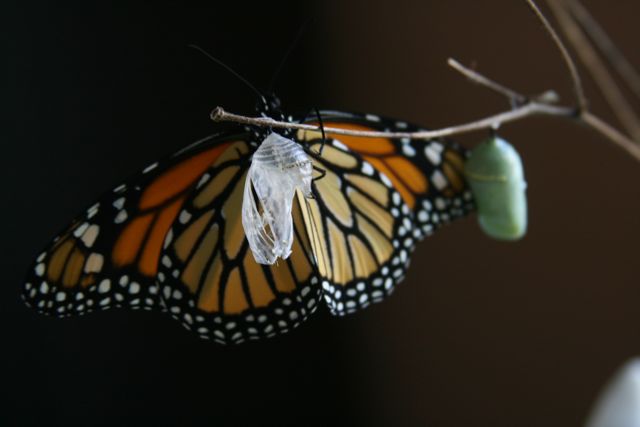
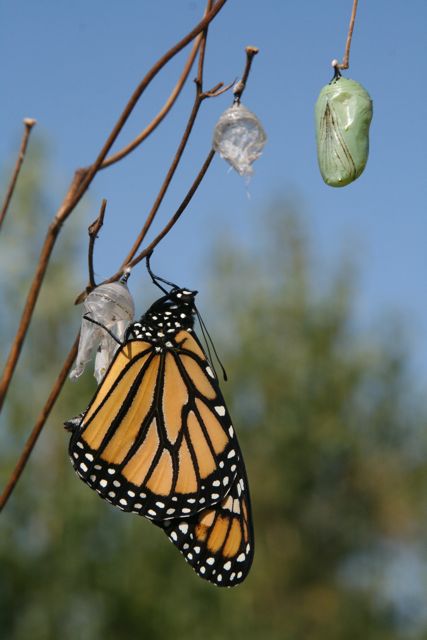
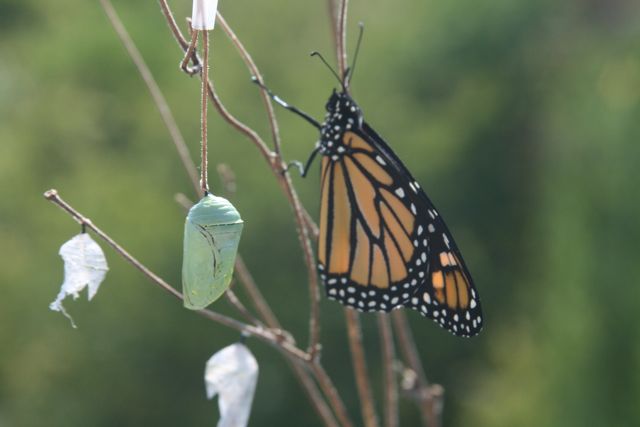
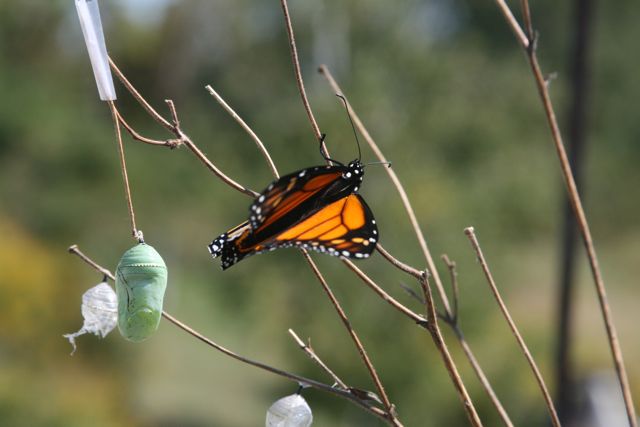
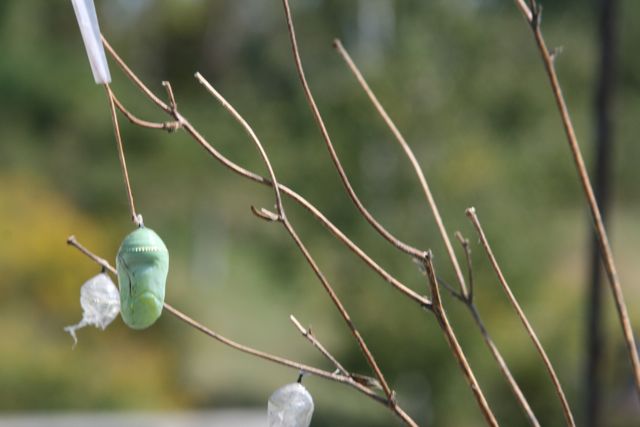
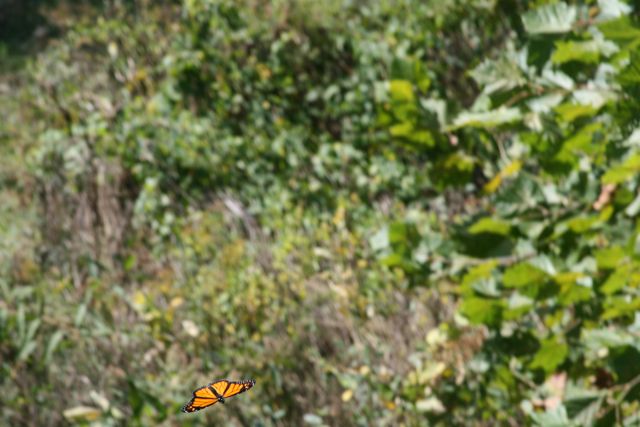
It is afternoon now. I have let the butterfly rest and drop its orange liquid waste on my kitchen table for four hours. I want it to be outside when it takes its first flight, which I sense is coming very soon. I wish no indignity for this one, such as the one who hatched before had suffered. That one dropped out of its chrysalis and stretched its wings quietly in the kitchen, I working in another room, unaware...and when I came in for lunch it set sail and clambered against a window, struggling toward freedom. I had to carry it, flailing and doubtless shouting in a voice too high to hear, to the clear September air outside.

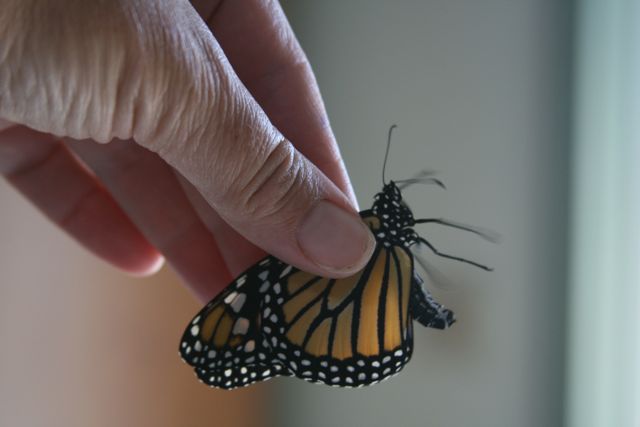
For this one, this special butterfly at whose side I've held such a long vigil, I creep softly, holding the creature aloft on its twig, hoping that it won't lift off before we get outside.
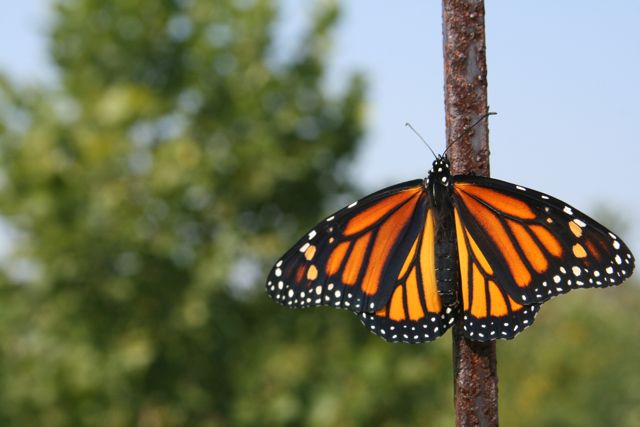
It snaps its new wings open and shut, a butterfly's signal of arrival and power, and clambers higher on its twig.
Wait... don't go yet.
I'm not ready for you to leave.

Swinging around wildly, I click and click, capturing a few frames, amazingly enough. Have you ever tried to photograph a flying butterfly
When you are crying
When your breath is taken from your lungs

When you are engulfed in grace?
[Back to Top]