 Science Chimp, ready for anything. Photo by William Ringer, a nature-loving Hoosier who gets around, from the Potholes of North Dakota to the Fens of Ohio.
On the first weekend in August, I traveled to Dayton to speak at the second annual Midwest Native Plant Conference. I couldn't know what a blast it would be. I was so freaked out at the thought that native plant purists would turn up their nose at my habitat gardening talk, rife as it is with Chinese buddleia and Mexican salvias
 Autumn sage, Salvia greggii
and Chilean fuchsias, that I refused an invitation to speak at the first annual conference.
But my friend Kathy MacDonald persisted and assured me they really did want me to come, so I spent a couple of days tearing up my talk to emphasize native plants like these in my garden.
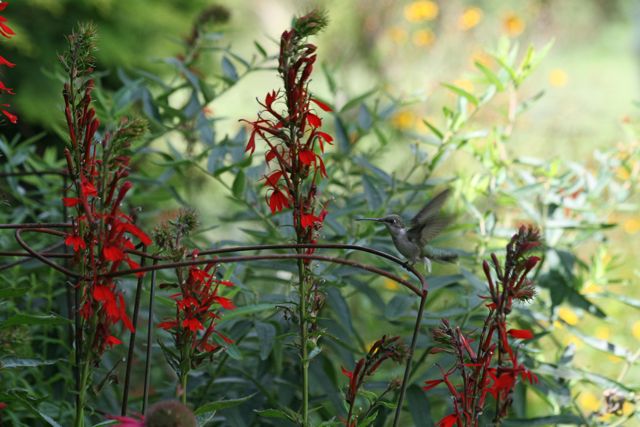
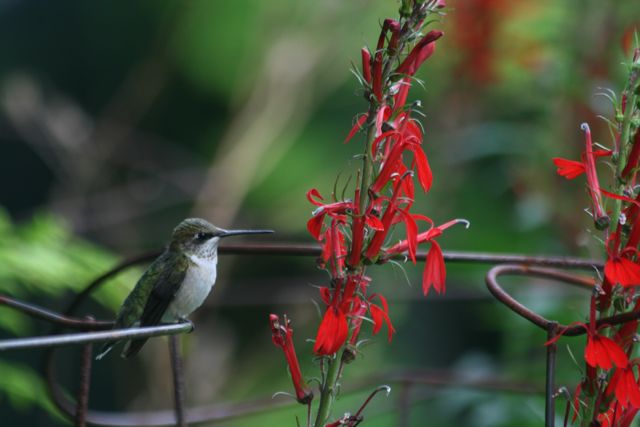
My cardinalflower Lobelia cardinalis bed, with some Salvia guaranitica "Black and Blue" and Salvia greggii "Cherry Chief" and Fuchsia "Gartenmeister Bonstedt" and Crocosmia "Lucifer" thrown in for fun and hummingbird appeal.

The naturalized purple coneflower Echinacea purpurea along our driveway. I find it grows best along woodland edges.

So I wrote a special piece for the occasion about native plant snobbery, useful exotics, why I love lilacs and tuberoses and crape myrtle and how I don't care what anyone says about them. I love them not because I am too dumb to know the difference between a good (native) plant and a bad (exotic) plant but because I love them. For my own reasons, for the memories and the beloved people I associate with them; just because they are beautiful and good.
Being non-native doesn't automatically make a plant (or any organism) bad, despite the awful, awful preponderance of invasive exotics from grass carp to bamboo. I was still nervous about how it might go over, scarred as I am from a few run-ins with people who consider anything non-native a noxious pest. I needn't have worried. The Native Plant conferees were the finest kind, friendly and warm and full of good humor. Front-loaded with Master Gardeners, in fact, who are used to working with plant material from all over the planet. The talk went well, I had a load of fun, and best of all there was a field trip to Cedar Bog just west of Springfield, Ohio. You must, must attend the next one if you love native plants and would like to learn more about using them in your landscaping.
 The gorgeous conference room at the Bergamo Center in Dayton, where I was privileged to speak.
Cedar Bog, outside Springfield, is the only open fen where white cedar grows in Ohio. A fen is an open wet meadow through which little streams course. Heavily underlain by marl (limestone) and somehow having escaped the cement mining that ruined most of our other marl bogs, it's got a terrific floral and insect community, and it's full of things you can't see anywhere else.
 Here's part of the open fen/wet meadow which was full of white boneset, tall ironweed (purple) and obedient plant ( Physostegia, pink, in background) as well as black-eyed Susans, hops, dodder, sandvine, nettles...on and on. It was full of butterflies!
 Tiger swallowtails on pasture thistle.
 Here's part of the open fen/wet meadow which was full of white boneset, tall ironweed (purple) and obedient plant ( Physostegia, pink, in background) as well as black-eyed Susans, hops, dodder, sandvine, nettles...on and on. It was full of butterflies!
 Tiger swallowtails on pasture thistle.
 A Monarch on tall ironweed.
 And a black swallowtail, also enjoying pasture thistle.
A pugnacious hackberry emperor kept hitting me in the chest and sometimes below the belt as I trod upon his boardwalk. He looks mean, doesn't he? I was intimidated.
 A gray hairstreak rubbed his hindwings together as he sipped from a yellow flower only Jim knows. Bog loosestrife? No. Some sorta St. Johnswort? I dunno. Hm. Sumpin'. This is the problem with being a generalist, and on the downside of 50. I should write this stuff down. I should know by now I won't remember it for ten minutes.
At Cedar Bog there are orchids in spring, like showy lady's slipper and dragonmouth. There are elfin skimmer dragonflies (exceedingly rare) and the also rare and charming seepage dancer, which were abundant when we visited.
 Seepage dancer, Argia bipunctulata. Nice name! It has much shorter wings than the common bluet, but otherwise, it'd be hard to know you've got an endangered damselfly.
A far more common but unnamed damselfly. My field guide only does dragonflies. Rats! Arrgh! Jim told me what it was...I found a beautiful pdf, Dragonflies and Damselflies of Ohio, by my friend Dave McShaffrey online! Maybe maybe a female blue-ringed dancer?
 Anyone?
There is spiked gayfeather Liatris spicata
 and cowbane Oxypolis rigidior
 which is host to black swallowtail larvae, which eat things in the parsley and carrot family.
 There will be more natural wonders from Cedar Bog in the next post. If you're passing through Springfield, Ohio, on I-70 (and judging from the traffic, who isn't?) you must take a detour and walk this amazing boardwalk. I had time for less than half of it and came out wanting to return soon! What a glorious place, with a wonderfully appointed and staffed "green" visitor's center. Check out their website, and visit Weds-Sun 10-4.
Yes, I'm posting one more day a week, to make three: Sundays, Tuesdays and Thursdays. There's just too much good stuff to share and the backlog is tremendous now.

And today, August 17, is Charlie the chestnut-fronted macaw's 21st birthday. I found my check register from 1989 with the record of his purchase. That was before kids, house, dog, Ohio; even before Bill. We're in it for the long haul. He'll be trundling around the studio floor, playing Stab the Doll with Liam, stealing toys from Chet, hanging out on my shoulder as I paint, cackling maniacally under his favorite blue cabinet, and sharing stirfry and a beer with Bill at sundown--just another day for a kooky and well-loved little macaw.
 Ooh, that's GOOD!
 Ooh, that's GOOD!







Tuesday, August 17, 2010
11 comments