It has been one heck of a spring. April was pretty bad. May was hideous. The weather just will not warm up, and the rain keeps sluicing down.
 |
| What did she leave for us on the roof? |
 |
| Hand-feeding bug omelet to one of many hungry bluebird nestlings. Repeat 3x daily for each box until you drop. |
I was tired from a seemingly endless day, another in a succession of rainy mid-May days in the 30’s and 40’s. They have run into a blur in my mind. I usually wake up thinking about what I need to do around 3:30 AM, and get up around 5. Cut oranges for the orioles and make more Zick Dough. Scramble eggs mixed with dried insects and powdered eggshell for bug omelet. Go out, stock the feeders, festooning the yard with orange and grapefruit halves, stocking small hanging feeders with nutritious Zick Dough. Refill the seed feeders, throw seed on the ground. Back inside to pick mealworms out of my fast-dwindling supply. Transfer mealworms, Zick Dough and bug omelet to small carrying cups. Grab a few shots of the multicolored party of birds crawling all over the feeders, then jump in the car to go feed baby bluebirds in seven far-flung boxes on my bluebird trail. At each of the seven boxes, leave food in small crocks on the roof. At three of those boxes, hand-feed bug omelet to the babies, making sure each is stuffed full when I leave. Head home.
(This was written May 11, and as I write now I'm back at it on May 20, a carbon copy of that day, pouring and 40's, still feeding bluebirds, but different broods. When will it end?)
Getting divebombed by bluebirds as I approach with bug omelet. Photo by Phoebe Thompson, who helps me on the trail in the afternoons.
On a bad day like today, I get to do this three times. Got to keep those birds alive in the cruelest spring in memory, because I’ve come too far with them to let them die now. It’s not that their parents aren’t working full-time to try to feed them. It’s that there are no insects to be found in this weather. They can’t do it alone. And I feel a great responsibility to help them along.
Female bluebird taking mealworms from her crock, to feed her young.
So when I got an enthusiastic Facebook message from my friend Andi in Indiana, my reaction to her good news was not what she might have expected.
"I currently have a whopping FIFTEEN Baltimore Orioles eating grapes and oranges in my yard. I have never seen so many in my life! Tonight at closing time there might have been 20. Almost all Baltimore orioles and 3-4 orchards in the mix… Lots of people in this region reporting huge flocks. One lady 20 miles north of here had 30+ at one time—she posted a video or I would not have believed her. Last year I had two and felt lucky to see them!”
My response to Andi’s observation about the whopping crowds of orioles and rose-breasted grosbeaks at those Indiana feeders (and everywhere across the Upper Midwest and Northeast, if the photos on social media are any indication) was uncharacteristically terse. I was far from being happy or excited about a flock of 30 orioles at one feeder. I was heartbroken.
Blueberries and banana pieces, with a strip of skin peeled, are a hit with orioles.
Morosely, I responded. “They stop and eat or die. This is ominous.”
Andi was taken aback. Of course she was! Who says something like that?
“Can you explain what you mean?”
“They’re starving from the cold. That’s why you have so many at the feeders.”
“Oh my gosh.”
An easy way to offer citrus: back to back halves in a big suet cage.
Wait. Andi, who loves birds and is scrambling to keep her orioles in food, doesn’t realize what’s going on here? If Andi hasn’t grasped the big picture, what about everyone else merrily posting photos of the amazing birds at their feeders? Time to drive the point home.
“It’s got to be an unprecedented mortality event for all insectivores. Tanagers. Orioles. Grosbeaks. Warblers. Vireos. Swallows. Martins. You name it."
“Yeah there’s no bugs available,” Andi replied.
“You’re just seeing the ones that found your feeder. What about all the ones who have nothing? It just makes me so sad. I am comforted that while I see a lot of new birds, I also see the first ones who showed up, and I hope that they will move on when they can.”
Andi summed it up perfectly. “So, it’s not that there are so many more this year. They are stopping and staying because they’ve found a good food source and the group just keeps getting larger. Oh my gosh I had no idea.”
“Yeah. Most people haven’t connected the dots between the great birds at their feeders and the cold weather.”
“No, I haven’t heard anyone say that.”
“It’s totally weather related. Maybe I’ll have to do another blogpost to explain. I can’t find the time. I will have to feed bluebirds again tomorrow.”
And with that, I literally fell asleep at my keyboard, my finger pressing one keyyyyyyyyyyyyyyyyyyyyyyyyy.
Andi’s observation really rang my bell. I truly am not here to steal the delight of anyone who’s exulting at the throngs of beautiful new birds at their feeders. But I realize that, while I am keenly attuned to the effects of weather on birds, not everyone is. And I think it’s important for everyone to understand why this is happening.
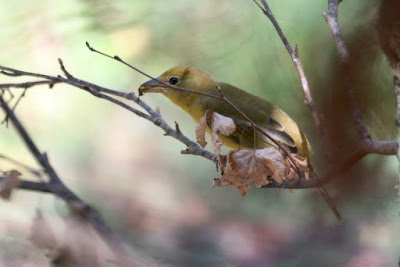
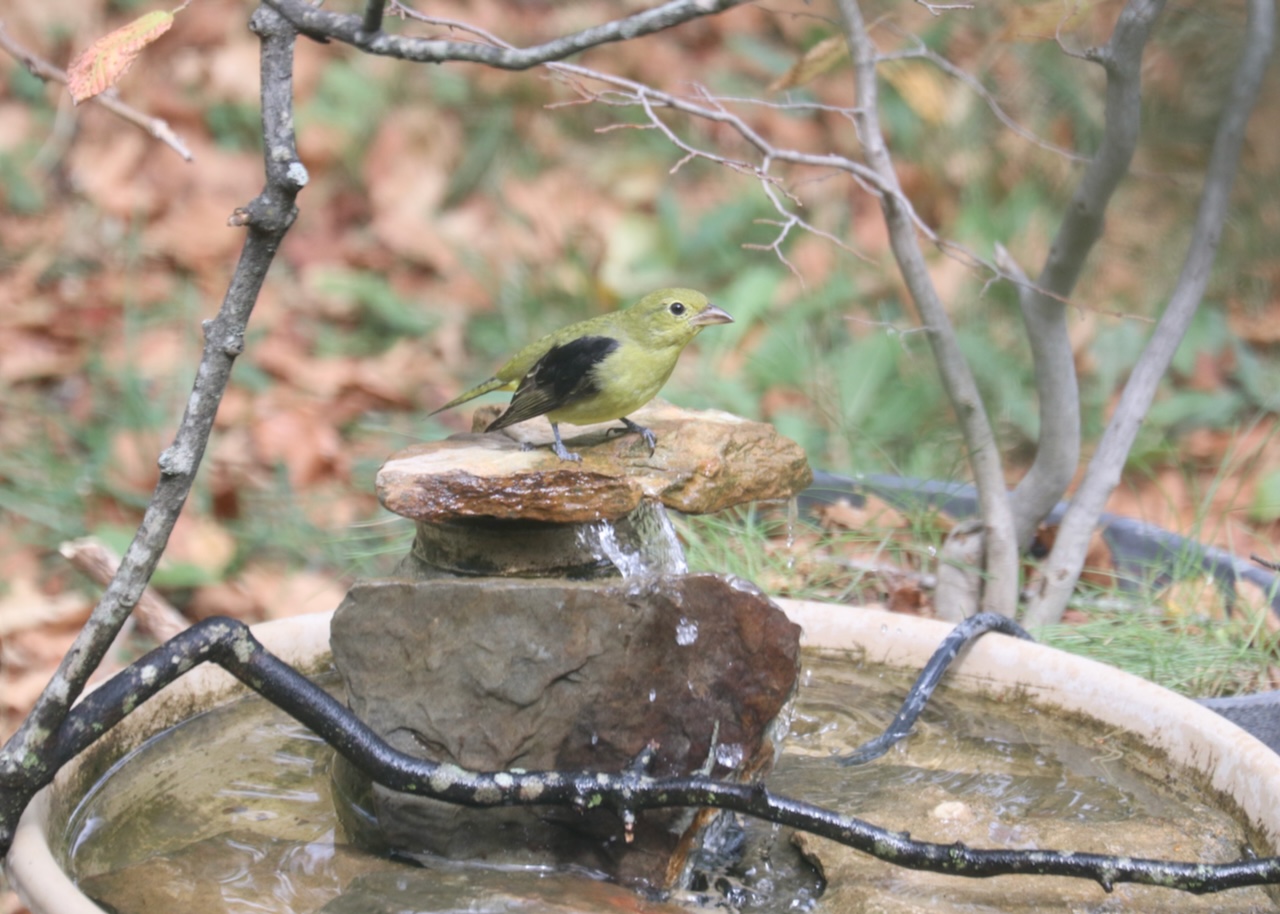
My first-ever summer tanagers at my feeders weren't here by choice. When you see an insectivorous summer tanager eating peanuts and sunflower hearts, for God's sake, something is really seriously out of whack in nature.
He moved on to Zick Dough (what he could get in between gorgings by desperate downy woodpecker parents)
April and May of 2020 have not seen a sudden, delightful population explosion of scarlet and summer tanagers, Baltimore and orchard orioles and grosbeaks. No, exactly the opposite is happening. The unending cold wet weather is pulling migrating birds down out of the trees and to our feeders.
My first summer tanager at the feeders.
This is an unprecedented, grindingly cold, wet and insect-poor April and May. Insectivorous birds who normally tweetle away in the treetops, eating caterpillars along their way to their northerly breeding grounds, are being stopped in their tracks by starvation. Driven down to our feeders. They’re beautiful and entertaining, but make no mistake: they are also desperate. And those who scramble to provide food for them are doing hero’s work, keeping them alive so they can continue on their way when the weather finally does what it’s supposed to do in late April...mid May...late May...When will this ever end??
I have another friend who takes the role of gadfly in many social media discussions. He’s very well-informed, always there with a good point. David commented: “Raises lots of good questions like "why feed birds at all?" Do they need our handouts? For most species, if we just leave them the right habitat, they will be fine. Are we doing it for our entertainment? If so, alternatives like bird baths are much better.”
In theory, I’d agree that bird feeding, on the whole, is something we humans do for our own entertainment. In the crushingly cruel Spring of 2020, however, people who are willing to scramble to buy oranges, mealworms and suet, make Zick Dough and fill feeders several times daily (and feed baby bluebirds in their boxes, if anybody else even does that...) are saving many precious lives. It’s tiring and darned expensive to cater to starving migrants, (think 15 pound bags of navel oranges, cartons of fresh blueberries, mealworms by the 5,000 batch) but the rewards are abundant. Knowing that we’re saving lives and sending them on, after this weeks-long, exhausting halt to their northward journey, keeps us going. That, and the sudden flame of an oriole at eye-level; the whirling pinwheel of black, white and carmine-pink that's a grosbeak.
 |
| A blueberry clutched in his left foot. |
And as we gasp at their beauty, I maintain that we should think beyond the intake of breath and connect the dots about why they are there. It's not because we're lucky--though we are lucky to have them in our yards. It's not because we're all suddenly bird feeding geniuses and have the best feeding stations out there. It's because they have to eat. And there's not much out there to keep them alive when it's raining and cold and insects are hidden, dormant. Even woodpeckers, who rely on gleaning insects this time of year, are hitting bottom of the barrel; I'm throwing corn, peanuts and mixed seed along the roadsides for a small colony of red-headed woodpeckers near my home, and they are gladly taking advantage of it. Yes, I drive around with bug omelet, Zick Dough, mealworms, and mixed seed in my car, and I feed those who need it. Mealworms on Wheels. I'm sure all these red-headed woodpeckers wondered how corn and seed magically appeared on their fenceposts...
 |
Well, when you see red-headed woodpeckers sitting motionless close to the ground, they're probably in trouble.
|
After a day of abundant food, much of which they probably cached, they were back up in the trees where they belonged.

From there, we should also think of all the insect-dependent species who won't come to our feeders—the warblers and vireos, flycatchers, swallows and martins. The spring of 2020, while it has afforded us never-before-seen feeder birds, fabulous photo-ops of eye-level scarlet tanagers, and feeder bragging rights, is anything but good for hard-hit bird populations. Call me a killjoy if you must. I feel the need to ring the bell for all these beleaguered birds, to shake myself and my readers out of our comfy, self-serving ways (Look at all the pretty birds! Aren't I cool for hosting them, and isn't this just great?) and take a longer view at how weather and climate change affect the birds we love so much. You're seeing it, right before your eyes. No bugs, no birds. Quit with the pesticides and the Chem-lawn, the lollipop Bradford pears and plant some fruit-bearing natives like shadbush, some happy seed/fruit and caterpillar bearing birches and dogwoods, tupelo, sassafras...
But for now, stay on the mission! Keep those feeders stoked, my friends. You're fighting the good fight for the birds we love. They've never needed you more than they do now. Thank you!











Wednesday, November 6, 2024
0 comments