Background Switcher (Hidden)

Showing posts with label feeding birds. Show all posts

All the Pretty Birds

Wednesday, May 20, 2020

24 comments
It has been one heck of a spring. April was pretty bad. May was hideous. The weather just will not warm up, and the rain keeps sluicing down.

What did she leave for us on the roof?

Hand-feeding bug omelet to one of many hungry bluebird nestlings. Repeat 3x daily for each box until you drop.

I was tired from a seemingly endless day, another in a succession of rainy mid-May days in the 30’s and 40’s. They have run into a blur in my mind. I usually wake up thinking about what I need to do around 3:30 AM, and get up around 5. Cut oranges for the orioles and make more Zick Dough. Scramble eggs mixed with dried insects and powdered eggshell for bug omelet. Go out, stock the feeders, festooning the yard with orange and grapefruit halves, stocking small hanging feeders with nutritious Zick Dough. Refill the seed feeders, throw seed on the ground. Back inside to pick mealworms out of my fast-dwindling supply. Transfer mealworms, Zick Dough and bug omelet to small carrying cups. Grab a few shots of the multicolored party of birds crawling all over the feeders, then jump in the car to go feed baby bluebirds in seven far-flung boxes on my bluebird trail. At each of the seven boxes, leave food in small crocks on the roof. At three of those boxes, hand-feed bug omelet to the babies, making sure each is stuffed full when I leave.  Head home. 
(This was written May 11, and as I write now I'm back at it on May 20, a carbon copy of that day, pouring and 40's, still feeding bluebirds, but different broods. When will it end?)

Getting divebombed by bluebirds as I approach with bug omelet. Photo by Phoebe Thompson, who helps me on the trail in the afternoons.

On a bad day like today, I get to do this three times. Got to keep those birds alive in the cruelest spring in memory, because I’ve come too far with them to let them die now. It’s not that their parents aren’t working full-time to try to feed them. It’s that there are no insects to be found in this weather. They can’t do it alone. And I feel a great responsibility to help them along. 

Female bluebird taking mealworms from her crock, to feed her young. 

So when I got an enthusiastic Facebook message from my friend Andi in Indiana, my reaction to her good news was not what she might have expected.

 "I currently have a whopping FIFTEEN Baltimore Orioles eating grapes and oranges in my yard.  I have never seen so many in my life! Tonight at closing time there might have been 20. Almost all Baltimore orioles and 3-4 orchards in the mix… Lots of people in this region reporting huge flocks. One lady 20 miles north of here had 30+ at one time—she posted a video or I would not have believed her. Last year I had two and felt lucky to see them!”

My response to Andi’s observation about the whopping crowds of orioles and rose-breasted grosbeaks at those Indiana feeders (and everywhere across the Upper Midwest and Northeast, if the photos on social media are any indication) was uncharacteristically terse. I was far from being happy or excited about a flock of 30 orioles at one feeder. I was heartbroken.

                              Blueberries and banana pieces, with a strip of skin peeled, are a hit with orioles.


Morosely, I responded. “They stop and eat or die. This is ominous.” 

Andi was taken aback. Of course she was! Who says something like that? 

 “Can you explain what you mean?”

“They’re starving from the cold. That’s why you have so many at the feeders.” 

“Oh my gosh.”

An easy way to offer citrus: back to back halves in a big suet cage. 

Wait. Andi, who loves birds and is scrambling to keep her orioles in food, doesn’t realize what’s going on here? If Andi hasn’t grasped the big picture, what about everyone else merrily posting photos of the amazing birds at their feeders? Time to drive the point home.

“It’s got to be an unprecedented mortality event for all insectivores. Tanagers. Orioles. Grosbeaks. Warblers. Vireos. Swallows. Martins. You name it."

“Yeah there’s no bugs available,” Andi replied.

“You’re just seeing the ones that found your feeder. What about all the ones who have nothing? It just makes me so sad. I am comforted that while I see a lot of new birds, I also see the first ones who showed up, and I hope that they will move on when they can.” 

Andi summed it up perfectly. “So, it’s not that there are so many more this year. They are stopping and staying because they’ve found a good food source and the group just keeps getting larger. Oh my gosh I had no idea.”

“Yeah. Most people haven’t connected the dots between the great birds at their feeders and the cold weather.”


“No, I haven’t heard anyone say that.”

“It’s totally weather related. Maybe I’ll have to do another blogpost to explain. I can’t find the time. I will have to feed bluebirds again tomorrow.”

And with that, I literally fell asleep at my keyboard, my finger pressing one keyyyyyyyyyyyyyyyyyyyyyyyyy.

 Andi’s observation really rang my bell. I truly am not here to steal the delight of anyone who’s exulting at the throngs of beautiful new birds at their feeders. But I realize that, while I am keenly attuned to the effects of weather on birds, not everyone is. And I think it’s important for everyone to understand why this is happening. 

My first-ever summer tanagers at my feeders weren't here by choice. When you see an insectivorous summer tanager eating peanuts and sunflower hearts, for God's sake, something is really seriously out of whack in nature. 


He moved on to Zick Dough (what he could get in between gorgings by desperate downy woodpecker parents)

 April and May of 2020 have not seen a sudden, delightful population explosion of scarlet and summer tanagers, Baltimore and orchard orioles and grosbeaks. No, exactly the opposite is happening. The unending cold wet weather is pulling migrating birds down out of the trees and to our feeders. 

My first summer tanager at the feeders.

This is an unprecedented, grindingly cold, wet and insect-poor April and May. Insectivorous birds who normally tweetle away in the treetops, eating caterpillars along their way to their northerly breeding grounds, are being stopped in their tracks by starvation. Driven down to our feeders. They’re beautiful and entertaining, but make no mistake: they are also desperate. And those who scramble to provide food for them are doing hero’s work, keeping them alive so they can continue on their way when the weather finally does what it’s supposed to do in late April...mid May...late May...When will this ever end??  

I have another friend who takes the role of gadfly in many social media discussions. He’s very well-informed, always there with a good point. David commented: “Raises lots of good questions like "why feed birds at all?" Do they need our handouts? For most species, if we just leave them the right habitat, they will be fine. Are we doing it for our entertainment? If so, alternatives like bird baths are much better.”

In theory, I’d agree that bird feeding, on the whole, is something we humans do for our own entertainment. In the crushingly cruel Spring of 2020, however, people who are willing to scramble to buy oranges, mealworms and suet, make Zick Dough and fill feeders several times daily (and feed baby bluebirds in their boxes, if anybody else even does that...) are saving many precious lives. It’s tiring and darned expensive to cater to starving migrants, (think 15 pound bags of navel oranges, cartons of fresh blueberries, mealworms by the 5,000 batch) but the rewards are abundant. Knowing that we’re saving lives and sending them on, after this weeks-long, exhausting halt to their northward journey, keeps us going. That, and the sudden flame of an oriole at eye-level; the whirling pinwheel of black, white and carmine-pink that's a grosbeak.


A blueberry clutched in his left foot.

 And as we gasp at their beauty, I maintain that we should think beyond the intake of breath and connect the dots about why they are there. It's not because we're lucky--though we are lucky to have them in our yards. It's not because we're all suddenly bird feeding geniuses and have the best feeding stations out there. It's because they have to eat.  And there's not much out there to keep them alive when it's raining and cold and insects are hidden, dormant. Even woodpeckers, who rely on gleaning insects this time of year, are hitting bottom of the barrel; I'm throwing corn, peanuts and mixed seed along the roadsides for a small colony of red-headed woodpeckers near my home, and they are gladly taking advantage of it. Yes, I drive around with bug omelet, Zick Dough, mealworms, and mixed seed in my car, and I feed those who need it. Mealworms on Wheels. I'm sure all these red-headed woodpeckers wondered how corn and seed magically appeared on their fenceposts...


Well, when you see red-headed woodpeckers sitting motionless close to the ground, they're probably in trouble. 

After a day of abundant food, much of which they probably cached, they were back up in the trees where they belonged. 


 From there, we should also think of all the insect-dependent species who won't come to our feeders—the warblers and vireos, flycatchers, swallows and martins. The spring of 2020, while it has afforded us never-before-seen feeder birds, fabulous photo-ops of eye-level scarlet tanagers, and feeder bragging rights, is anything but good for hard-hit bird populations. Call me a killjoy if you must. I feel the need to ring the bell for all these beleaguered birds, to shake myself and my readers out of our comfy, self-serving ways (Look at all the pretty birds! Aren't I cool for hosting them, and isn't this just great?)  and take a longer view at how weather and climate change affect the birds we love so much. You're seeing it, right before your eyes. No bugs, no birds. Quit with the pesticides and the Chem-lawn, the lollipop Bradford pears and plant some fruit-bearing natives like shadbush, some happy seed/fruit and caterpillar bearing birches and dogwoods, tupelo, sassafras...

But for now, stay on the mission! Keep those feeders stoked, my friends. You're fighting the good fight for the birds we love. They've never needed you more than they do now. Thank you! 

Zick Dough, Improved

Sunday, March 7, 2010

64 comments
photo by Mary Ferracci I've borrowed this wonderful photo from Mary's View. It's a bluebird from her yard in North Carolina who is hooked on Zick Dough. See anything wrong with this picture? It jumps right out at the Science Chimp. He's not putting weight on his left foot, and the toes are swollen. He's in pain. And it's all my fault. I've been quietly working this winter, learning about bird nutrition, perfecting a recipe, trying to right some wrongs. I've posted before about the joys and drawbacks of feeding the homemade suet dough that a lot of people are calling Zick Dough. And I've said before that I feel a little squeamy about having my name on that recipe, even moreso since I figured out that it can give birds who eat too much of it a painful case of gout. You can read about that in the original posts, "Uh-Oh, Zick Dough" and "Crack is a Better Name for It." If you're just joining us for this story, I'll recap: I've been feeding homemade suet dough for years. The basic recipe has always been: OLD ZICK DOUGH 1 cup peanut butter 1 cup lard 2 cups yellow cornmeal 2 cups quick oats 1 cup flour And the birds in my yard have gobbled it up, everything from chickadees, tits and nuthatches to woodpeckers, cardinals, sparrows, towhees and bluebirds. Bluebirds are the biggest fans of Zick Dough. And therein lies the problem. As I've explained, eastern bluebirds are the ultimate addictive personalities. Given an easy food source, they will exploit it to the exclusion of almost everything else. If you stop and think about it, the recipe above is anything but a complete diet. It's fat, some limited protein, and carbohydrates, and it's really rich. It's kind of like living on, well, oats, lard and peanut butter. Here is the foot of a female bluebird who gorged on Zick Dough all winter and into the spring of 2009. She can't put weight on it. It hurts. She's got gout. Or metabolic bone disease. Or something bad. And I strongly believe it was due to an improper diet, and I felt, and still feel, terrible about that. The short-term answer was to suspend all feeding of Zick Dough. And her foot recovered, sort of. The swelling went down, but she had a permanently stiff middle toe, as if she were giving me the finger for feeding her low-value food. And I deserve it. That bluebird disappeared sometime in the fall of 2009. I don't know what happened to her, but I'm sure that if she could come back to my feeder, she would have by now. I have to think that having a stiff foot was a handicap, and I'm ready to take the blame if she died before her time. I'll never know. All I know is she was here for years, and now she's gone. Maybe she was really old, and that's why she ate so much of the easy stuff. photo by Mary Ferracci I don't think it's a coincidence that a bluebird in North Carolina who also gorges on Zick Dough has the same problem. And that's my problem, and that of anyone who feeds this stuff to their backyard birds. Maybe that's you, too. So. I'm cruising along early this winter, feeding my first batch of Zick Dough, enjoying my bluebirds and all the others, and so glad to be able to help them through the worst winter in memory. I didn't start feeding it until it got really cold--Christmas, for goodness' sake--and I planned to suspend feeding it the moment it got reliably warm. My suspicion is that feeding this rich food in warm weather is what got Gouty into trouble. So feeding it only in really cold weather was my interim answer to the problem. One fine morning I get a Google Alert for Zick Dough (it's really out there on the Internet.) It's a piece written for the Maryland Bluebird Society's "Chatter" by Felicia Lovelett. I devour it with great interest. In it, she cites my post, "Uh-oh, Zick Dough" in which I describe possible gout in my bluebird visitors. And she points out that suet dough mixes are very low in calcium, high in phosphorus, and "contain proteins that are relatively low in biological value." Further, she suggests that "Gouty" may have had Metabolic Bone Disease. Well, whether it was gout or MBD, there's no doubt she was all messed up, and I had good reason to suspect it was the steady diet of Zick Dough that messed her up. A male bluebird in my yard, also a heavy imbiber, had the same problem. And both recovered when I withheld the Zick Dough. Ms. Lovelett suggests basing suet dough on a "formulated diet that provides adequate calcium, high quality proteins and other essential nutrients." And she mentions unmedicated chick starter as a base. Chick starter is an extruded pellet that crumbles easily. It's formulated to encourage growth and strong bones in young domestic chicks, kind of like puppy chow for birds. It's got a lot more nutritional oomph than yellow cornmeal, oats, peanut butter or lard. My very next trip was to the feed store, where I bought a small (20-pound) bag of DuMor unmedicated chick starter. (You definitely want to check the label--the last thing we want is to give antibiotics to wild birds!) I spent some time fiddling around with proportions and finally came up with this: NEW ZICK DOUGH: SMALL BATCH Melt in the microwave and stir together: 1 cup peanut butter 1 cup lard In a large mixing bowl, combine 2 cups chick starter 2 cups quick oats 1 cup yellow cornmeal and 1 cup flour Add melted lard/peanut butter mixture to the combined dry ingredients and mix well. I made a small batch first, and laid out two piles of Original Recipe and New Improved. It was a gas, watching the birds sample both. Yes, it looks different...Some, like the titmice, tried the new but preferred the old mix. One female cardinal stuck to the old mix. The other cardinals preferred the new recipe. Of my pair of bluebirds, the female liked the old mix, and her mate liked the new. Importantly, they all accepted it immediately, and the switch to the new recipe was seamless and instant. I really hadn't expected it to be that easy. I figured out that the tufted titmice just like bigger chunks to carry off, and the new mix is more crumbly, so they can't find a big wad as easily with the new recipe. All the birds are perfectly happy with the new mix, and everyone is eating better this winter. While I'm at it, I'm going to pass along my secrets for mixing Zick Dough in large batches. Here's my quintupled recipe. NEW ZICK DOUGH: BIG BATCH 5 cups (1 40 oz jar) peanut butter 5 cups (1/3 of the 64-oz bucket) of lard (Wal-Mart, in the Shortening aisle) 10 cups chick starter (available at any feed store) 10 cups quick oats 5 cups yellow cornmeal 5 cups flour Measuring peanut butter and lard by the cup is a pain in the butt. Instead of measuring, I just use a bowl scraper to empty out a 40-oz jar of PB into a medium-sized mixing bowl. It takes up half the bowl. Then, I fill the rest of the bowl with lard. This saves a lot of time and mess in trying to stuff peanut butter and lard into a measuring cup. There's no way to do that without getting it all over you. Put the bowl in the microwave and melt the mix down (about 5 minutes on High). Stir it together. Have all the dry ingredients--chick starter, oats, cornmeal and flour--well blended in a lobster pot before pouring in the molten peanut butter/lard mixture. Stir well with your heaviest spoon, making sure you get down to the bottom. I finish by working it with my hands. I sit on the floor with the lobster pot between my knees and Zick Dough up to my elbows, but I will spare you a photo of that. The great thing about chick starter is it keeps the mix from getting so gummy and ensures a lovely texture to the final product. And it nourishes your birds. It's a win-win all around. Mmm, good enough to sample. And yes, I do. I like to make sure it tastes good. Disclaimer: Even New Zick Dough is too rich to be fed once the weather warms up. The birds will still beg, but please suspend feeding once it warms up and send them off to get the live insect protein they need. Here's Gouty, about three weeks after I suspended feeding Zick Dough. She's using both feet, and looks a lot better, no? The last thing I want to do is pretend I have the final answer here. Like life, the Zick Dough recipe is a work in progress. I'll be watching to see how my birds fare this spring, having had a winter's worth of New Zick Dough. If your birds are hooked on Zick Dough, please find a feed store and pick up some chick starter--one 20-pound bag should last you all winter--and mix up the new recipe. It's easier to mix, smells lovely, and offers better nutrition to the birds we all love so well. Thanks to Mary Ferracci for her photos and her friendship. And to Felicia Lovelett, for the chick starter idea. Answer my email, willya?

Attention-seeking Birds

Thursday, February 21, 2008

18 comments

This morning dawned brilliantly clear, standing at 18 degrees. Last night, the kids and I danced in and out of our warm house every ten minutes or so, dragging ourselves off the couch to check on the total lunar eclipse. American Idol; lunar eclipse. From the ridiculous to the sublime.

First there was a nibble, then a bite, and finally at about 10:15 the entire disc of the moon was covered in shadow. The snow, once brilliant silver in the moonlight, took on a dull pinkish glow, and the night deepened like velvet. The moon was viscous and dull, swirled with burnt orange and violet. My photographs are hopeless. Some things must be left to the pro's, with their tripods and timed exposures. Resting a 300 mm. zoom telephoto lens on the top of one's daughter's shivering head produces less than admirable results. She is tall enough to serve as a tripod now, but I needed a bit more light than was offered by the slowly surrendering moon.

Liam was spooked, and he didn't want to be alone in the house with the moon doing things like that, so he put his coat on and trudged out with me and Phoebe to look, too. I have to think that eclipses were strange and scary to early people who, like Liam, couldn't have understood what was happening. Lunar eclipses make my heart race, but solar eclipses make me run around in circles, helplessly wondering. Have you ever seen birds fly to their roosts in a total solar eclipse? I have, twice, once when I was a child in Virginia and once here in Ohio, in early May of 1993. I love freaky nature, nature that's bigger and stronger and stranger than any of us.

Cold as it was, it was such a beautiful morning. I scuttled from window to window in the house, snapping pictures of the birds clustered around it. They come here for the food and the cover, and yes, for the sight of me inside, and for the hope that I'll emerge to stoke their feeders full again. Make no mistake, they are hoping to get my attention by sitting close to the windows, looking decorative. Ahem? Sunflower's getting low. I am beautiful, no? Feed me.


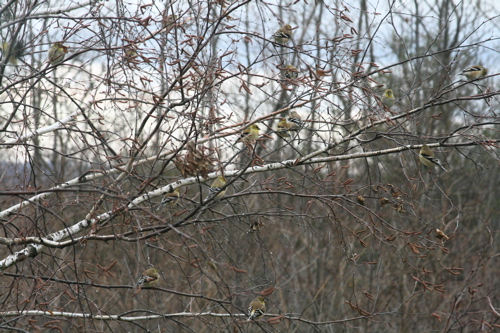
Hello, Zick? Juncos like suet dough. They like it a lot. Here's my feathery butt. Cute, yes? Feed me.There's been a big influx of goldfinches lately. They love the gray birches we have planted all around the house, and they work on the seed cones as they wait for a place at the feeders.
Junco tracks give silent testament to the wildlife value of gray birches. Think of birches as showering food all winter long, and you have them from a junco's eye view. No wonder juncos like snow. It makes their food so easy to see.

I have to confess that the junco tracks are a bit more concentrated around the front door, where I throw suet dough several times a day.These are the tracks of a single dawn, in the twilight hours before I get up, put on my rubber clogs, and go out to slop the juncoes. Yes, it's ridiculous. We have a lot of birds at Indigo Hill. And I love each and every one of them, down to their little pink toenails. Don't think they don't know it. In cold like this, in late February, when the daffodils should be blooming, as should the Norway maples, they make me feel needed.Have a wonderful weekend. Ours started yesterday, with a snow day. Just another four-day weekend for my barely-educated kids. When people ask, "You must home-school, right?" I answer, "Yes, in the winter, whether I like it or not."
[Back to Top]