Background Switcher (Hidden)

Showing posts with label cold spring weather. Show all posts

Zick's Bluebird Survival School: Update on Our Alumni

Friday, May 26, 2023

0 comments


I'm sweating. I just finished planting my snap beans, which means it's warm enough to do such a thing at long last, on May 24. The cold, miserable early May we endured is a nasty memory now, though I still start my morning walks with long pants and a decent jacket.  I have been collecting sweet reminders of the work I did in the first three days of May, to save some little souls when the weather turned horrible and the skies opened up for three straight days.

I coined the term "Perma-rain" while watching this sluggish and apparently endless storm factory squatting over us.


The only way it changed was to get bigger, pumping continuous rain over the chilled land.


Out by the oilwell at the end of my meadow, five baby bluebirds had just hatched on May 1. This was the first box I visited, and I had a syringe of warm baby bird formula against my chest as I trudged out, bundled in a down jacket. It was that cold. 

When it's that cold, parent bluebirds can't find insects for their babies, so I stepped in to supplement. Liam made this video for me on May 2. These were lucky birds, just a long walk down the meadow from my house.


But there were more out on the county roads, and I gathered my gear and steeled myself for what I knew I'd find this frigid wet morning. The first box I checked out on my trail on May 2, next to a little Methodist churchyard cemetery, broke my heart clean in two.  Five bluebird lives, wasted by the rain. I got there too late to save them.


It's a hard photo to look at, but I want you to understand what motivates me, because I'm sure a lot of people think crazy, running around hand-feeding bunches of baby bluebirds in their boxes. Maybe that's crazy in some people's books. Should I just shrug and say, "Tough luck!" to the 27  baby bluebirds that I knew were in my boxes when the weather turned horrible? C'est la vie, this is what happens to early nests?

Should I pretend I don't know what's happening in those boxes?  Or should I do something crazy and try to save them all?

 I'm not crazy. I prefer to think of it as an overdeveloped sense of responsibility to the birds nesting in my boxes. As it turned out, these were the only ones that died due to weather, but for me, that was five too many. I knew I'd lose all the rest if I didn't act.


Bug omelet is baked ground eggshell, egg, milk, dried flies from Carolina Biological Supply
all fried up. Very stanky, but it brings baby bluebirds back to life toot sweet!


I fed bug omelet to all the babies on my trail on May 2 and 3, three times a day, until I had to leave at 1:30 on May 3 to work at the New River Birding and Nature Festival in Fayetteville WV. Talk about cutting it close! It stopped raining and started to warm up only late the afternoon of May 3, and the weather somehow magically held until I got back. If we'd had another day of rain and 40's, with me away, they might have died, and all that work and all these little lives would have gone to waste. 

What I'm going to do now is take you around to the nestboxes with babies, and show you what was in there on May 2, and then I'll show you what happened with each of those broods. This post has taken me days to put together and write--very nitpicky work. I hope you enjoy it.

These five babies along my township road were the very first to hatch, and too old to feed! I shot this photo through the entry hole. They were too suspicious; they might have jumped out of the box had I opened it and tried to feed them. So I left a jar lid of mealworms on the roof of the box, and the parents completely ignored the food for a day and a half.  D'oh!!! How to get food to them? OK. Maybe food on the roof of the box just doesn't make sense to them. On the second day, I placed a fresh dish of wriggly mealworms on the ground underneath the box, and THAT made sense to the adults. They emptied it three times, stuffing those starving babies full. I was elated!


Still kickin' May 3 and finally stuffed with food--they're going to make it! I left a huge slug of mealworms for them right before I left for WV. :)


When I returned from the New River festival on May 8, these lovelies had fledged.  I cleaned the box, and Mom has built a fresh nest as of May 26. On we go!

Next box: When I got way down on Whipple Run the morning of May 2, I found these three sick skinny babies, badly dehydrated from eating earthworms. When it's cold and rainy you'll see birds foraging in the middle of the pavement, picking up earthworms. I'll always wonder how robins thrive on them, because they're a horrible food for bluebirds. Earthworms give bluebirds dysentery. The neat little white fecal sacs that baby birds normally produce fail to form and the nest quickly becomes soaked with wet feces. Chilling follows. Nestling bluebirds fed earthworms in cold wet weather are among the most miserable creatures I know.


The thing, then, is to give them something better than earthworms. Bug omelet and mealworms to the rescue! And a fresh clean nest of dried hairgrass! Muuuch better than the sodden filthy poop-soaked mess they were huddled on. I could feel their relief at being fed and clean at last.

Here they are on May 3, after the nest change and gobs of egg food. I also left huge amounts of mealworms in a jar lid atop the box, and the adults wasted no time in stuffing their babies full. 
What a difference a day, abundant food and a dry nest can make!


And LOOK at them on May 8! Would you ever believe these are the same birds as the ones in the video?


Ahh, they're so beautiful when they're healthy. And that's the impetus, that's the reason I do this--I know I can save them, and the rewards are so very clear and rich, that I am compelled to do it. I see in my mind's eye what they could become and I can't stop until we get there.

Third box: In a nearby box on Stark Hollow Road, more babies were subsisting on earthworms. In this dimly lit photo, you can see the chick on the right has a dead worm pasted across both its nostrils, which must be very uncomfortable. It had tried to swallow it--the two ends of the worm were in its mouth--but it got looped across then dried on.


I took them out of the box, peeled off the worm, and found more earthworm gunk cemented to its sibling's left eye. (middle bird in the photo below). I peeled that off, too. I have to wonder what would have happened had I not removed it. These chicks are developing so fast you do NOT want anything stuck to their vital parts. These photos taken May 2.


I got the idea to prop my cellphone on the steering wheel so I could make a decent video of me feeding Bug Omelet to the babies. This is straightforward, and easy.


What's not easy is having to force-feed babies who won't gape. I have only two or three chances to feed these birds in a day. Each round takes me an hour and a half to complete, getting around to all the boxes. 
I'm not taking "No thank you" for an answer. You're getting fed each round, Pipsqueak, and you're going to eat as much as all your siblings. No time for your finicky stuff.


Followup: Here is the same nestful of five down in Stark Hollow, on May 8. They're out of danger and beautiful. 


Fourth box: The Eddy nest got started early, and the babies were ready for mealworms by the time I got there on May 2. (Babies can't digest the chitin on the larvae until they're at least a week old, which is why I have to feed bug omelet to most of them). I started them off with bug omelet the first day and then left gobs of mealworms atop the box for the parents to divvy out. 


What a beautiful sight greeted me on my return May 8.


The Eddy babies were old enough to sex by the color of their wings. Bet you can tell which are the males. There are three, two of them showing lots of blue, and the lone female is touching my thumb. See how gray her wing is by comparison? It's easy to sex 12 day old babies.


Now, Box 1 again. Back to those babies out by my oilwell, the first ones I fed...
Here they are on May 9, plump and fit. 


Day 9 Oilwell box

By May 11, they were feathering out...

Day 11 Oilwell

and on May 15, I could see that all four were females. What riches!

Day 15 four females Oilwell

These little darlings fledged somewhere around May 20. Phewww! Relief.

All told, there were 21 more baby bluebirds in the world than there would have been had I not intervened. No question in my mind that these babies would have died in that cold rain. I lost five, but kept 21 going until the weather warmed, and that felt really good. 

This is the fourth spring in a row that I've had to feed bluebirds in their boxes. In 2020, I fed them a total of nine days in April and May (Thank God I didn't have to go to WV that year--I'd have lost them all). 2020 is the year by which all others will be measured. Remember all those starving orioles and tanagers and kingbirds that showed up at people's feeders? Yeah. That was 2020. 
2021 was almost as bad. 2022 had only one day of hideousness. 2023 had three. 
Every. Dang. Year. 

The climate is changing so fast, and we are all caught with our pants down. Extremes are extremier. Springs in the Midwest are late and cold and wet as sin now. The normally gray and rainy Pacific Northwest has fried; California has drowned. And the hurricanes down South...well, I guess I'll take the horrible Mays out here in the middle. I'll be thankful it isn't any worse. 

Signing off from CrazyTown,
Yours,

JZ


All the Pretty Birds

Wednesday, May 20, 2020

24 comments
It has been one heck of a spring. April was pretty bad. May was hideous. The weather just will not warm up, and the rain keeps sluicing down.

What did she leave for us on the roof?

Hand-feeding bug omelet to one of many hungry bluebird nestlings. Repeat 3x daily for each box until you drop.

I was tired from a seemingly endless day, another in a succession of rainy mid-May days in the 30’s and 40’s. They have run into a blur in my mind. I usually wake up thinking about what I need to do around 3:30 AM, and get up around 5. Cut oranges for the orioles and make more Zick Dough. Scramble eggs mixed with dried insects and powdered eggshell for bug omelet. Go out, stock the feeders, festooning the yard with orange and grapefruit halves, stocking small hanging feeders with nutritious Zick Dough. Refill the seed feeders, throw seed on the ground. Back inside to pick mealworms out of my fast-dwindling supply. Transfer mealworms, Zick Dough and bug omelet to small carrying cups. Grab a few shots of the multicolored party of birds crawling all over the feeders, then jump in the car to go feed baby bluebirds in seven far-flung boxes on my bluebird trail. At each of the seven boxes, leave food in small crocks on the roof. At three of those boxes, hand-feed bug omelet to the babies, making sure each is stuffed full when I leave.  Head home. 
(This was written May 11, and as I write now I'm back at it on May 20, a carbon copy of that day, pouring and 40's, still feeding bluebirds, but different broods. When will it end?)

Getting divebombed by bluebirds as I approach with bug omelet. Photo by Phoebe Thompson, who helps me on the trail in the afternoons.

On a bad day like today, I get to do this three times. Got to keep those birds alive in the cruelest spring in memory, because I’ve come too far with them to let them die now. It’s not that their parents aren’t working full-time to try to feed them. It’s that there are no insects to be found in this weather. They can’t do it alone. And I feel a great responsibility to help them along. 

Female bluebird taking mealworms from her crock, to feed her young. 

So when I got an enthusiastic Facebook message from my friend Andi in Indiana, my reaction to her good news was not what she might have expected.

 "I currently have a whopping FIFTEEN Baltimore Orioles eating grapes and oranges in my yard.  I have never seen so many in my life! Tonight at closing time there might have been 20. Almost all Baltimore orioles and 3-4 orchards in the mix… Lots of people in this region reporting huge flocks. One lady 20 miles north of here had 30+ at one time—she posted a video or I would not have believed her. Last year I had two and felt lucky to see them!”

My response to Andi’s observation about the whopping crowds of orioles and rose-breasted grosbeaks at those Indiana feeders (and everywhere across the Upper Midwest and Northeast, if the photos on social media are any indication) was uncharacteristically terse. I was far from being happy or excited about a flock of 30 orioles at one feeder. I was heartbroken.

                              Blueberries and banana pieces, with a strip of skin peeled, are a hit with orioles.


Morosely, I responded. “They stop and eat or die. This is ominous.” 

Andi was taken aback. Of course she was! Who says something like that? 

 “Can you explain what you mean?”

“They’re starving from the cold. That’s why you have so many at the feeders.” 

“Oh my gosh.”

An easy way to offer citrus: back to back halves in a big suet cage. 

Wait. Andi, who loves birds and is scrambling to keep her orioles in food, doesn’t realize what’s going on here? If Andi hasn’t grasped the big picture, what about everyone else merrily posting photos of the amazing birds at their feeders? Time to drive the point home.

“It’s got to be an unprecedented mortality event for all insectivores. Tanagers. Orioles. Grosbeaks. Warblers. Vireos. Swallows. Martins. You name it."

“Yeah there’s no bugs available,” Andi replied.

“You’re just seeing the ones that found your feeder. What about all the ones who have nothing? It just makes me so sad. I am comforted that while I see a lot of new birds, I also see the first ones who showed up, and I hope that they will move on when they can.” 

Andi summed it up perfectly. “So, it’s not that there are so many more this year. They are stopping and staying because they’ve found a good food source and the group just keeps getting larger. Oh my gosh I had no idea.”

“Yeah. Most people haven’t connected the dots between the great birds at their feeders and the cold weather.”


“No, I haven’t heard anyone say that.”

“It’s totally weather related. Maybe I’ll have to do another blogpost to explain. I can’t find the time. I will have to feed bluebirds again tomorrow.”

And with that, I literally fell asleep at my keyboard, my finger pressing one keyyyyyyyyyyyyyyyyyyyyyyyyy.

 Andi’s observation really rang my bell. I truly am not here to steal the delight of anyone who’s exulting at the throngs of beautiful new birds at their feeders. But I realize that, while I am keenly attuned to the effects of weather on birds, not everyone is. And I think it’s important for everyone to understand why this is happening. 

My first-ever summer tanagers at my feeders weren't here by choice. When you see an insectivorous summer tanager eating peanuts and sunflower hearts, for God's sake, something is really seriously out of whack in nature. 


He moved on to Zick Dough (what he could get in between gorgings by desperate downy woodpecker parents)

 April and May of 2020 have not seen a sudden, delightful population explosion of scarlet and summer tanagers, Baltimore and orchard orioles and grosbeaks. No, exactly the opposite is happening. The unending cold wet weather is pulling migrating birds down out of the trees and to our feeders. 

My first summer tanager at the feeders.

This is an unprecedented, grindingly cold, wet and insect-poor April and May. Insectivorous birds who normally tweetle away in the treetops, eating caterpillars along their way to their northerly breeding grounds, are being stopped in their tracks by starvation. Driven down to our feeders. They’re beautiful and entertaining, but make no mistake: they are also desperate. And those who scramble to provide food for them are doing hero’s work, keeping them alive so they can continue on their way when the weather finally does what it’s supposed to do in late April...mid May...late May...When will this ever end??  

I have another friend who takes the role of gadfly in many social media discussions. He’s very well-informed, always there with a good point. David commented: “Raises lots of good questions like "why feed birds at all?" Do they need our handouts? For most species, if we just leave them the right habitat, they will be fine. Are we doing it for our entertainment? If so, alternatives like bird baths are much better.”

In theory, I’d agree that bird feeding, on the whole, is something we humans do for our own entertainment. In the crushingly cruel Spring of 2020, however, people who are willing to scramble to buy oranges, mealworms and suet, make Zick Dough and fill feeders several times daily (and feed baby bluebirds in their boxes, if anybody else even does that...) are saving many precious lives. It’s tiring and darned expensive to cater to starving migrants, (think 15 pound bags of navel oranges, cartons of fresh blueberries, mealworms by the 5,000 batch) but the rewards are abundant. Knowing that we’re saving lives and sending them on, after this weeks-long, exhausting halt to their northward journey, keeps us going. That, and the sudden flame of an oriole at eye-level; the whirling pinwheel of black, white and carmine-pink that's a grosbeak.


A blueberry clutched in his left foot.

 And as we gasp at their beauty, I maintain that we should think beyond the intake of breath and connect the dots about why they are there. It's not because we're lucky--though we are lucky to have them in our yards. It's not because we're all suddenly bird feeding geniuses and have the best feeding stations out there. It's because they have to eat.  And there's not much out there to keep them alive when it's raining and cold and insects are hidden, dormant. Even woodpeckers, who rely on gleaning insects this time of year, are hitting bottom of the barrel; I'm throwing corn, peanuts and mixed seed along the roadsides for a small colony of red-headed woodpeckers near my home, and they are gladly taking advantage of it. Yes, I drive around with bug omelet, Zick Dough, mealworms, and mixed seed in my car, and I feed those who need it. Mealworms on Wheels. I'm sure all these red-headed woodpeckers wondered how corn and seed magically appeared on their fenceposts...


Well, when you see red-headed woodpeckers sitting motionless close to the ground, they're probably in trouble. 

After a day of abundant food, much of which they probably cached, they were back up in the trees where they belonged. 


 From there, we should also think of all the insect-dependent species who won't come to our feeders—the warblers and vireos, flycatchers, swallows and martins. The spring of 2020, while it has afforded us never-before-seen feeder birds, fabulous photo-ops of eye-level scarlet tanagers, and feeder bragging rights, is anything but good for hard-hit bird populations. Call me a killjoy if you must. I feel the need to ring the bell for all these beleaguered birds, to shake myself and my readers out of our comfy, self-serving ways (Look at all the pretty birds! Aren't I cool for hosting them, and isn't this just great?)  and take a longer view at how weather and climate change affect the birds we love so much. You're seeing it, right before your eyes. No bugs, no birds. Quit with the pesticides and the Chem-lawn, the lollipop Bradford pears and plant some fruit-bearing natives like shadbush, some happy seed/fruit and caterpillar bearing birches and dogwoods, tupelo, sassafras...

But for now, stay on the mission! Keep those feeders stoked, my friends. You're fighting the good fight for the birds we love. They've never needed you more than they do now. Thank you! 

Tikal Dreaming

Wednesday, April 11, 2007

0 comments
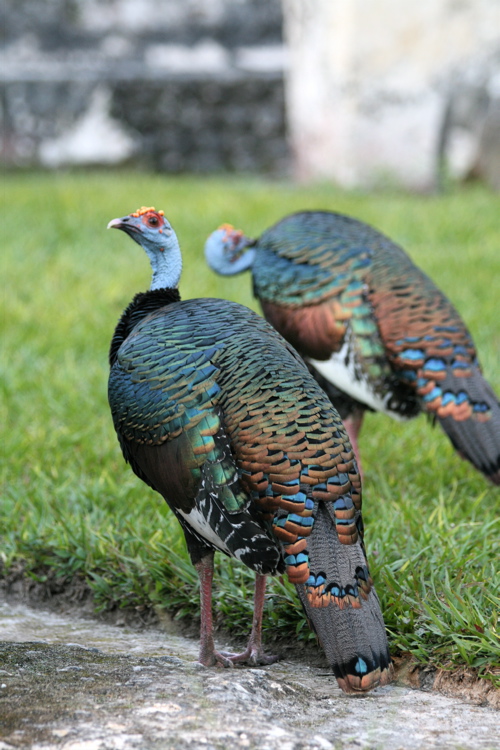
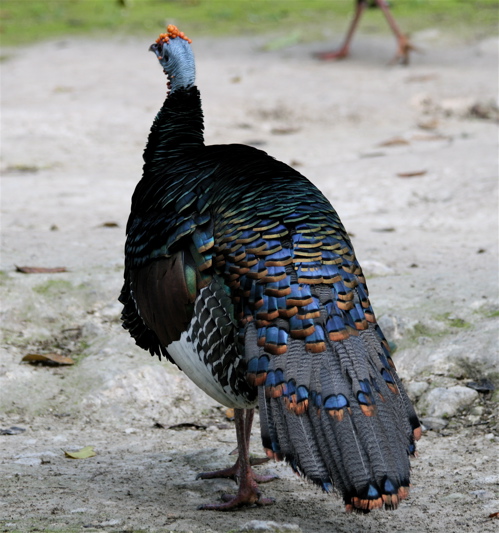
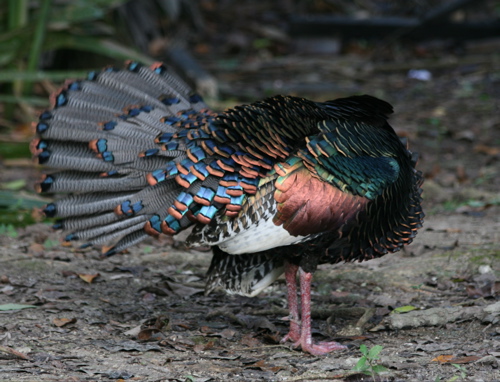
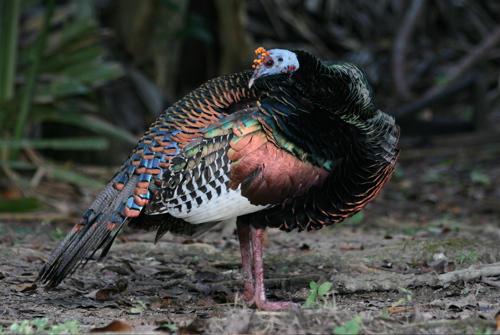
It was a bird I had always dreamt of. The ocellated turkey. A jungle turkey, a turkey not of dry upland hardwoods or pine flatwoods, but of humid tropical lowland forest. Not only that, but it was colorful, extravagantly beautiful, every inch of it a masterwork. I had seen a few poor images of it over the decades, but nothing could have prepared me for how beautiful the ocellated turkey is in life. I saw my first ones in 2006 at Tikal, when I was working with my little Olympus point-and-shoot. On the 2007 trip, I was ready for them with the Canon digital SLR."Ocellated" means "having eyes."

I'm posting about beautiful exotic birds today because it's still only 48 degrees, spitting rain, and I just read that the entire apple and peach crop in our area has been destroyed by freezing temperatures. I am thinking about a late summer and fall without sweet, snappy Honeycrisp apples from Grimm's Green Acres, without local peaches. I am thinking about the irrevocability of night after night of temperatures in the low 20's. I'm thinking about the people who have spent years cultivating these fruit trees, seeing all their effort go to nothing in a single cruel April week. I am thinking about five bluebird eggs, due to hatch tomorrow, in a box in my front yard. I am thinking that I should be able to help somehow, and knowing that I can't.

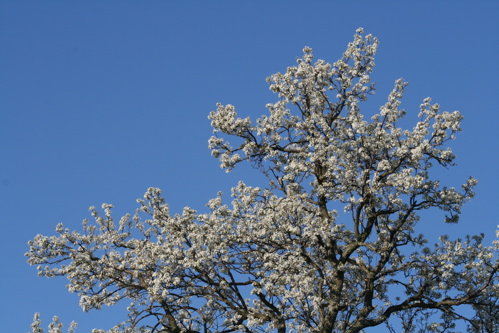
I went to find my asparagus today and the tips of the fat shoots are squishy and brown. My bleeding heart is a flaccid pile of limp yellow spaghetti, dotted with pink. Daffodils are prostrate, their flowers deflated like used Kleenex. The lilac is wearing a limp greenish-black shroud, when it should be opening its first sweet blue blossoms. The birches and willows are clothed in hanging, weird-smelling forest- green scrappets that used to be new leaves. Daylilies are translucent, deflated. The Russian prune hedge, once snow-white, is khaki brown, as is the old gnarly pear. I took pictures of them in their glory, which lasted exactly two days. April 11: There is not a flower or butterfly in the yard. Sometimes it hurts to be tuned into nature.

And so, tropical turkeys. Turkeys who know no season, who are beautiful year-round, who have never felt frost or even chill. Turkeys who wake up to day after warm, sunny day, who give a throbbing love song that sounds like a lawnmower starting up, who toss their electric-blue heads and strut around the ruins. Who sort through thousands of ornate feathers, rearranging them, beautiful and unconscious as Degas' preening dancers.
I was on a quick trip to the restroom (they are few and far-flung at Tikal), getting ready to head down a long trail with Bill and Jeff Gordon. I was hurrying. They were waiting for me. But so was grace. There, walking slowly through deep shadow, were four ocellated turkeys. On the trajectory they were taking, they would emerge into sunlight in a few minutes. Time stood still. I forgot the trail, the guys, the restroom, everything but the turkeys on their slow march toward sunlit glory. I hunkered down and waited, following them at a respectful distance, wallowing in their beauty, "spirit open to the thrust of grace," as Bruce Cockburn wrote.

We should be able to linger, able to stop and gape for awhile, no matter what we are doing, no matter where we are supposed to be. It is the essence of living well. We think our plans and schedules are what matter. I am sure now that it is everything else that happens around our plans that really matters. John Lennon knew it. "Life is what happens while you're busy making other plans." You don't "take a second" to cuddle your child. You cuddle your child, and let everything else wait. You don't "wait until I have time" to call your mom, your husband or your wife. Bruce again: Life's short. Call now. And from Zick: Stop. Gape. Take beauty in when and wherever you find it. Like the lilacs, it could be gone tomorrow.
[Back to Top]