I'm an artist and writer who lives in the Appalachian foothills of Ohio. With this blog, I hope to show what happens when you make room in your life, every day, for the things that bring you joy. Strange...most of them are free.
Thurs. Feb. 27, 2020, 7 PM: "Saving Jemima: Life and Love with a Hard-luck Jay" at
Mt. St. Joseph University Theater, 5701 Delhi Rd., Cincinnati, OH 45233. Doors open 6:30 pm.
For info call Colleen McSwiggin (513) 244-4864
Mar. 11-15, 2020: Bird Friendly Backyard workshop and Saving Jemima talk at Joint Conference, N. Am.
Bluebird Society/Bluebirds Across Nebraska, Holiday Inn Convention Center, Kearney, NE. Right in the middle of
sandhill crane migration! Call (308) 237-5971 for reservations.
Mon. Mar. 23, 2020, 6 PM: "Saving Jemima: Life and Love with a Hard-luck Jay" at Morgan Co. Master Gardeners Event, Twin City Opera House, 15 W. Main St., McConnelsville, OH. Free and open to the public. Call (740) 962-4854 for information.
Sun. Mar. 29, 2020, 3 PM: "Saving Jemima: Life and Love with a Hard-luck Jay" at
Sunday With Friends,, Washington Co. Public Library, 205 Oak Hill St. NE, Abingdon, VA 24210. For more information, call (276) 676-6390
Apr. 30-May 2, 2020: Julie Zickefoose at New River Birding Festival, Opossum Creek Retreat, Fayetteville, WV. Friday night keynote: Saving Jemima. Curtis Loew, miracle curdoggie, presiding.
May 7, 2020, 7 pm: "Saving Jemima: Life and Love with a Hard-luck Jay" at Campus Martius Museum, Washington and Third Streets, Marietta, OH. Booksigning after. If you missed the Esbenshade lecture/ People's Bank talk in November 2019, this is your event!
Weds. May 13 2020, 5:30 PM: "Saving Jemima: Life and Love with a Hard-luck Jay" at Roger Tory Peterson Estuary Center's event at Essex Meadows, 30 Bokum Rd., Essex, CT 06426
This event is open to the public.
Thurs. May 14 2020, 6 PM: "Saving Jemima: Life and Love with a Hard-luck Jay" at New Haven Bird Club's Annual Banquet, Amarante's Restaurant, 62 Cove St., New Haven, CT 06512. This event is open to the public!
Sat. May 16, 2020: "Saving Jemima: Life and Love with a Hard-luck Jay" for Bergen Co. Audubon Society at
Meadowlands Environment Center, 2 DeKorte Park Plz, Lyndhurst, NJ 07071
Time to be announced. Call (201) 460-1700 for more info.
Sun. May 17, 2020, 2 PM: "Saving Jemima: Life and Love with a Hard-luck Jay" at White Memorial Conservation Center, 80 Whitehall Rd., Litchfield, CT 06759. Call (860) 567-0857 for information.
Tues. May 19, 2020, 7 PM: Good Reads on Earth Author Series, by PRI's Living On Earth with Julie Zickefoose and Saving Jemima at Mass Audubon's Drumlin Farm Wildlife Sanctuary, 208 South Great Rd., Lincoln MA 01773. Includes audience participation, and will be taped for airing on public radio! Get the book first, read up and call (781) 259-2200 for information.
Thurs. May 21, 2020 6 pm: Julie Zickefoose, "Saving Jemima: Life and Love with a Hard-luck Jay" at
Bigelow Chapel, Mount Auburn Cemetery, 580 Mt. Auburn St. Cambridge MA 02138. Call (617) 547-7105 for more info.
I'm sweating. I just finished planting my snap beans, which means it's warm enough to do such a thing at long last, on May 24. The cold, miserable early May we endured is a nasty memory now, though I still start my morning walks with long pants and a decent jacket. I have been collecting sweet reminders of the work I did in the first three days of May, to save some little souls when the weather turned horrible and the skies opened up for three straight days.
I coined the term "Perma-rain" while watching this sluggish and apparently endless storm factory squatting over us.
The only way it changed was to get bigger, pumping continuous rain over the chilled land.
Out by the oilwell at the end of my meadow, five baby bluebirds had just hatched on May 1. This was the first box I visited, and I had a syringe of warm baby bird formula against my chest as I trudged out, bundled in a down jacket. It was that cold.
When it's that cold, parent bluebirds can't find insects for their babies, so I stepped in to supplement. Liam made this video for me on May 2. These were lucky birds, just a long walk down the meadow from my house.
But there were more out on the county roads, and I gathered my gear and steeled myself for what I knew I'd find this frigid wet morning. The first box I checked out on my trail on May 2, next to a little Methodist churchyard cemetery, broke my heart clean in two. Five bluebird lives, wasted by the rain. I got there too late to save them.
It's a hard photo to look at, but I want you to understand what motivates me, because I'm sure a lot of people think crazy, running around hand-feeding bunches of baby bluebirds in their boxes. Maybe that's crazy in some people's books. Should I just shrug and say, "Tough luck!" to the 27 baby bluebirds that I knew were in my boxes when the weather turned horrible? C'est la vie, this is what happens to early nests?
Should I pretend I don't know what's happening in those boxes? Or should I do something crazy and try to save them all?
I'm not crazy. I prefer to think of it as an overdeveloped sense of responsibility to the birds nesting in my boxes. As it turned out, these were the only ones that died due to weather, but for me, that was five too many. I knew I'd lose all the rest if I didn't act.
Bug omelet is baked ground eggshell, egg, milk, dried flies from Carolina Biological Supply
all fried up. Very stanky, but it brings baby bluebirds back to life toot sweet!
I fed bug omelet to all the babies on my trail on May 2 and 3, three times a day, until I had to leave at 1:30 on May 3 to work at the New River Birding and Nature Festival in Fayetteville WV. Talk about cutting it close! It stopped raining and started to warm up only late the afternoon of May 3, and the weather somehow magically held until I got back. If we'd had another day of rain and 40's, with me away, they might have died, and all that work and all these little lives would have gone to waste.
What I'm going to do now is take you around to the nestboxes with babies, and show you what was in there on May 2, and then I'll show you what happened with each of those broods. This post has taken me days to put together and write--very nitpicky work. I hope you enjoy it.
These five babies along my township road were the very first to hatch, and too old to feed! I shot this photo through the entry hole. They were too suspicious; they might have jumped out of the box had I opened it and tried to feed them. So I left a jar lid of mealworms on the roof of the box, and the parents completely ignored the food for a day and a half. D'oh!!! How to get food to them? OK. Maybe food on the roof of the box just doesn't make sense to them. On the second day, I placed a fresh dish of wriggly mealworms on the ground underneath the box, and THAT made sense to the adults. They emptied it three times, stuffing those starving babies full. I was elated!
Still kickin' May 3 and finally stuffed with food--they're going to make it! I left a huge slug of mealworms for them right before I left for WV. :)
When I returned from the New River festival on May 8, these lovelies had fledged. I cleaned the box, and Mom has built a fresh nest as of May 26. On we go!
Next box: When I got way down on Whipple Run the morning of May 2, I found these three sick skinny babies, badly dehydrated from eating earthworms. When it's cold and rainy you'll see birds foraging in the middle of the pavement, picking up earthworms. I'll always wonder how robins thrive on them, because they're a horrible food for bluebirds. Earthworms give bluebirds dysentery. The neat little white fecal sacs that baby birds normally produce fail to form and the nest quickly becomes soaked with wet feces. Chilling follows. Nestling bluebirds fed earthworms in cold wet weather are among the most miserable creatures I know.
The thing, then, is to give them something better than earthworms. Bug omelet and mealworms to the rescue! And a fresh clean nest of dried hairgrass! Muuuch better than the sodden filthy poop-soaked mess they were huddled on. I could feel their relief at being fed and clean at last.
Here they are on May 3, after the nest change and gobs of egg food. I also left huge amounts of mealworms in a jar lid atop the box, and the adults wasted no time in stuffing their babies full.
What a difference a day, abundant food and a dry nest can make!
And LOOK at them on May 8! Would you ever believe these are the same birds as the ones in the video?
Ahh, they're so beautiful when they're healthy. And that's the impetus, that's the reason I do this--I know I can save them, and the rewards are so very clear and rich, that I am compelled to do it. I see in my mind's eye what they could become and I can't stop until we get there.
Third box: In a nearby box on Stark Hollow Road, more babies were subsisting on earthworms. In this dimly lit photo, you can see the chick on the right has a dead worm pasted across both its nostrils, which must be very uncomfortable. It had tried to swallow it--the two ends of the worm were in its mouth--but it got looped across then dried on.
I took them out of the box, peeled off the worm, and found more earthworm gunk cemented to its sibling's left eye. (middle bird in the photo below). I peeled that off, too. I have to wonder what would have happened had I not removed it. These chicks are developing so fast you do NOT want anything stuck to their vital parts. These photos taken May 2.
I got the idea to prop my cellphone on the steering wheel so I could make a decent video of me feeding Bug Omelet to the babies. This is straightforward, and easy.
What's not easy is having to force-feed babies who won't gape. I have only two or three chances to feed these birds in a day. Each round takes me an hour and a half to complete, getting around to all the boxes.
I'm not taking "No thank you" for an answer. You're getting fed each round, Pipsqueak, and you're going to eat as much as all your siblings. No time for your finicky stuff.
Followup: Here is the same nestful of five down in Stark Hollow, on May 8. They're out of danger and beautiful.
Fourth box: The Eddy nest got started early, and the babies were ready for mealworms by the time I got there on May 2. (Babies can't digest the chitin on the larvae until they're at least a week old, which is why I have to feed bug omelet to most of them). I started them off with bug omelet the first day and then left gobs of mealworms atop the box for the parents to divvy out.
What a beautiful sight greeted me on my return May 8.
The Eddy babies were old enough to sex by the color of their wings. Bet you can tell which are the males. There are three, two of them showing lots of blue, and the lone female is touching my thumb. See how gray her wing is by comparison? It's easy to sex 12 day old babies.
Now, Box 1 again. Back to those babies out by my oilwell, the first ones I fed...
Here they are on May 9, plump and fit.
Day 9 Oilwell box
By May 11, they were feathering out...
Day 11 Oilwell
and on May 15, I could see that all four were females. What riches!
Day 15 four females Oilwell
These little darlings fledged somewhere around May 20. Phewww! Relief.
All told, there were 21 more baby bluebirds in the world than there would have been had I not intervened. No question in my mind that these babies would have died in that cold rain. I lost five, but kept 21 going until the weather warmed, and that felt really good.
This is the fourth spring in a row that I've had to feed bluebirds in their boxes. In 2020, I fed them a total of nine days in April and May (Thank God I didn't have to go to WV that year--I'd have lost them all). 2020 is the year by which all others will be measured. Remember all those starving orioles and tanagers and kingbirds that showed up at people's feeders? Yeah. That was 2020.
2021 was almost as bad. 2022 had only one day of hideousness. 2023 had three.
Every. Dang. Year.
The climate is changing so fast, and we are all caught with our pants down. Extremes are extremier. Springs in the Midwest are late and cold and wet as sin now. The normally gray and rainy Pacific Northwest has fried; California has drowned. And the hurricanes down South...well, I guess I'll take the horrible Mays out here in the middle. I'll be thankful it isn't any worse.
There are some stories that are too big, too sweet, too wonderful to tell. I've been so busy living these blue jay days, these rare and unrepeatable Jemima days, that I haven't had time to write about her or share it all. I've given myself and my time over to nurturing her and recording her every new behavior with video and photos. She's too big, her story too good, to be passed over, and it's also too big and good to cram into a bunch of blog posts.
Pulling in the clothes at sundown, and the Yard Imp swoops in to have a chat. Photo by Bill Thompson III.
Appearing after a long day mostly away and wilding. I'm so grateful to see her and give her some mealworms and a cool drink! Photo by Bill Thompson III
I've never had a corvid in my care. Raising a corvid is to raising an ordinary songbird
as raising a chimpanzee is to raising an ordinary songbird.
Get the picture? Yes, we see!
But the dam is beginning to crumble and I must write about this bird. Not blogwriting, those choppy little bits meant as captions, but writing writing. I have to tell her story while she's here, while it's fresh, while it's still unfolding, because it would be a sin not to. Was I planning to write about a blue jay this summer? No. I was planning a lot of travel and even more pushing Baby Birds with talks and book signings. And I still have to do that, because I set it all up before Jemima came to me and turned my life upside down. Do I worry about leaving her? Oh yes. For what I'll miss, for what she might do, for everything. For example: As I write, she's chasing an adult jay around the yard, and the adult seems not at all perturbed about it. Maybe even welcoming. What is happening? I have to watch. I try to get photos and fail. If I'm not here, this stuff is still going to go on, and I will miss it. But I'm headed to Massachusetts and Connecticut in mid-July to give a bunch of talks, and miss it I shall. My version of FOMO (Fear of Missing Out). (See "Julie in the Flesh" on the left sidebar of this page for my appearances.)
I'll be frank: my muse has eluded me of late. She can't get through all the other crap that's going on in my anxious brain. Every once in a great while I manage to squeeze out a blogpost, but that's about it. If they seem particularly good lately, it's because a hell of a lot of creative juice is backed up in my pipe, and the drips that manage to get out are extra tasty. It's been a tough year, so I appreciate your bearing with the pauses and interruptions in the blog.
Jemima's World
Like every other creative spirit out there, I yearn to breathe free and do what I do best. But it's going to be awhile before my horizons are clear and I can focus on my real work, get a book proposal out, keep the wolf a little farther away from my door.
This morning as I worked at the drawing table, Jemima came to have breakfast at her Secret Studio Feeder under the shelter of a crank-out window. A screen keeps her from coming in the house.
She'd eaten breakfast, and she started giving the little burt-burt-burt vocalization that means she'd like to have a visit. She hopped up on the struts and fluttered her wings, begging me to take the screen out. "Jemima Iris Jay. You are a free bird. You should not still be asking to come in the house."
She considered that for a moment, then started pecking the soft nylon screen as if she meant to break in. I put my hand against the screen and she only pecked harder. That beak means bidness.
Jays.They are thugs at heart. And they know how to get exactly what they want. I removed the screen and welcomed the prodigal in for a brief visit. The other choice was having a Jemima-sized hole in my screen, and that wouldn't do.
I'll let this video show you just a bit of the uncommon thuggy sweetness that is Jemima Jay. Put that together with aged, extra floppy maple-flavored Bacon, and you have quite a sammitch.
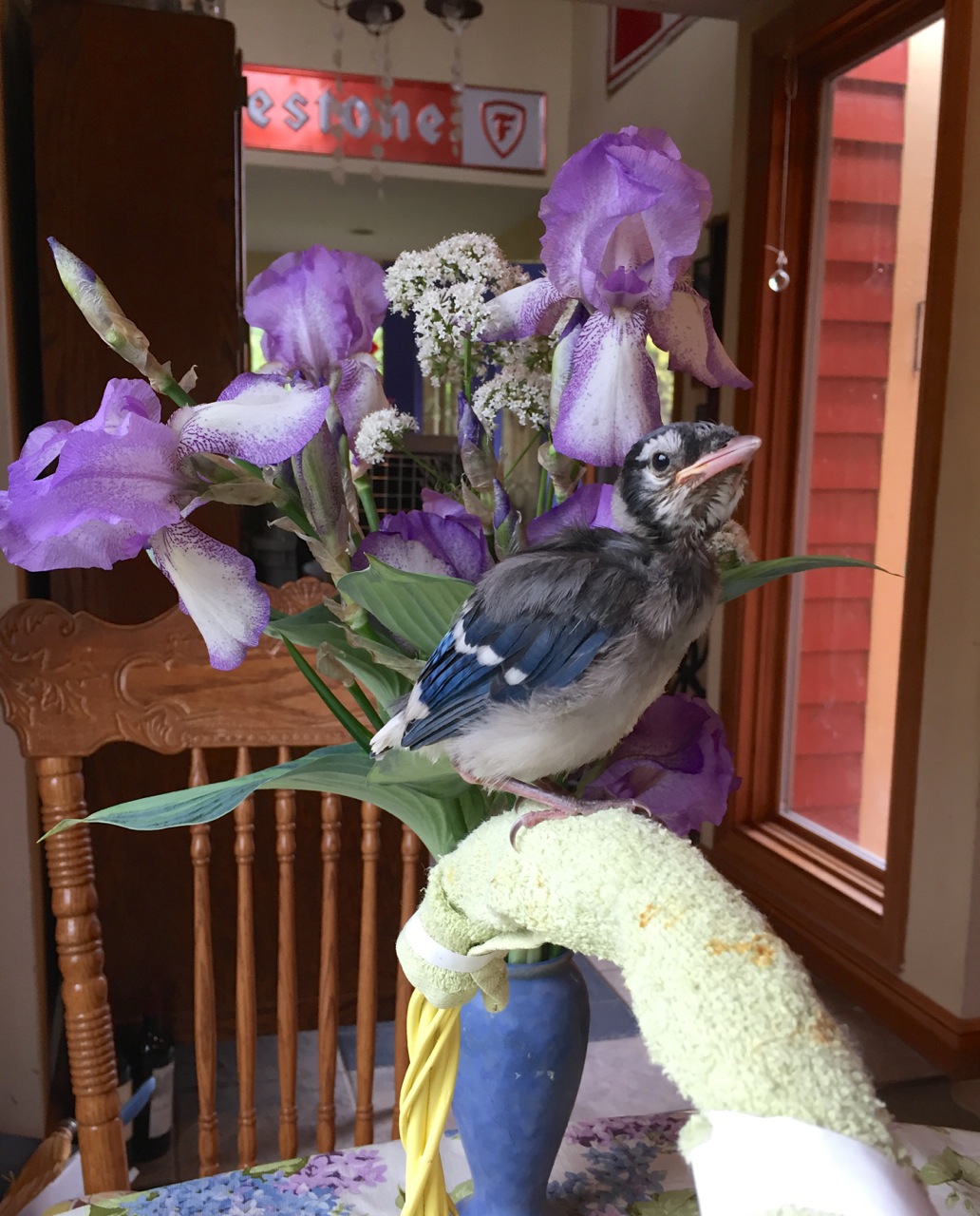
It's been two weeks since I've posted, an eternity in the Zickiverse, but there is an excellent reason for that. I have met my Waterloo, and she came to me as a starving, dehydrated little 12-day-old lump of winsome, found by a kind teacher in the middle of the street and left in a safer spot to wait for parents who never came. I started, via Facebook messages, to give her savior instructions on how and what to feed the tiny jay, and thought I'd make plans to meet in a few days to take the bird if she was successful in keeping it alive. I was planning to take the jay up to Columbus, to turn her over to the Ohio Wildlife Center, which is completely snowed under hundreds of birds and animals, and certainly doesn't need another baby bird to raise. I looked at the photo of this poor waif, sighed and let the wave roll over me. "Just bring her to the Bird Watcher's Digest office. I'll take care of her," I typed. I was doomed, sucked in again, because you can't tell someone who's never done it exactly how to save a small life. These are things you must do yourself.
By the time I'd fed and watered her and medicated her for some unknown ailment that made her listless and turned her droppings seafoam-green; by the time, four days later, her eyes finally showed a little sparkle (which I could see because she was now able to keep them open), I was sunk. I wasn't going to turn her over to anyone. I had to see this bird through.
May 16, ca. Day 12, the day she fell from her nest.
The thing about taking on a baby bird is that if you say yes, that's all you're going to do for the next month, month and a half, or two. I don't think people realize that when they pepper me with pleas for help, assuming that taking care of baby birds is what I do, right? I understand wanting to do the right thing. Getting in touch with someone who can offer help that helps is Step One. But I have to say it's a full-time job being that first stop for so many people. I finally engineered the removal of my home phone number from the state wildlife rehabber lists, had just begun to enjoy the fact that every phone ring didn't have a feathery problem for me to solve, just in time to become, by default, a national baby bird rescue factotum, courtesy of Facebook.
Checking out her new home, May 16 afternoon. She may just know how lucky she is. I sure do.
I am only just grasping what it means to be easily accessible to 4,000 plus acquaintances, plus their friends, and their friends' friends, who are now all able to fire off questions and requests for advice and assistance at any hour, often accompanied by photos that squeeze my heart. Not just baby birds; it's birds fighting windows, birds in dryer vents, birds in cats' claws or found on the sidewalk, having fallen out of an eave. It's anything, and it's raining down on me so thickly I want to wear a hat. Who ya gonna ask? The workload is not trivial. It is causing me to seriously rethink my presence on social media, to think hard about the quality of my days, pre and post Facebook. I'm not taking phone calls all day long. I'm taking Facebook messages. Unless I'm hiding, which I spend more and more time doing. Hiding, and not blogging, because I can't. Between feeding the bird and feeding the Facebook requests for assistance, I'm stretched too thin. It's ridiculous.
Feeling much better, May 20, Day 16.
The work that goes into raising just one baby bird can be all-consuming. Baby birds need to be fed often, every half hour from dawn to dark; they need to be kept scrupulously clean, but they also need attention and love. All of which I gladly do, but I'm never really prepared for how labor-intensive it is to raise just one baby bird. And to be asked for help with dozens upon dozens of others, all day long.
It all makes you kinda tired.
I realize that I don't know how to deal with being immediately accessible to anyone. Everyone. I've been on Facebook since 2009, and it's been a blessing in so many ways. I've become much closer to people with whom I never would have been able to interact. I can see family baby, niece and nephew pictures, catch up with my dear Aunt Toot in Iowa, and yak with James in Honduras as easily as I can yak with Liam, and that's terrific. I can share all the fantastic things I find; teach and learn too. I can toot my horn and sell books and notecards and puzzles and CD's, publicize speaking engagements and workshops and trips. I wouldn't want to render myself unable to do that. So for me there is no going backward here; there's only figuring out how to manage it all going forward. Maybe I have to morph my presence there, become some kind of entity that doesn't accept private messages. But then there's Jemima. And all those people needing help.
She came to me via Facebook message on May 16 when the irises were in bloom, just a few days before Phoebe came home from school, and I didn't name her right away because I wanted my sweet daughter to have the chance. "Iris!" Phoebe said. "Jemima!" Bill said. So Jemima Iris she was named.
With Phoebe, May 23, Day 19 and three days a fledgling.
They fell right smack in love, and I'm sure Phoebe is her favorite person on the planet, the person who has spent the most time loving her and singing with her and appreciating all the cool little things she does. "You always have a pal for me when I come home, Mai." Shrug. I guess I do. Today, I was sent a playlist of Jemima Iris' favorite songs (she's a huge Ed Sheeran fan, "Barcelona" being her all-time favorite), and chastised for not spending enough time deejaying for a jay. Guilty.
For a brief window she was portable, but then she started flying. Took her with us to Liam's crew banquet, where she represented for da boids.
The only time I was able to get a photo of her actually gaping was first thing in the morning. After that, she kept her mouth clamped shut, gaping only long enough to take a bit of food, often ducking and weaving to avoid the syringe. I've fed a lot of baby birds, and I would not call her easy to feed. Each one is as different from the other as snowflakes are.
Day 16 at first light. Neeeeyyaaahhhh! Neeeyaaaaahh!
Jays are omnivores. Once she started picking up her own food, which she did around Day 19, my job was to offer her an ever-changing smorgasbord of things from which she could choose. For a couple of weeks, she ate maddeningly tiny bites of everything, flinging away far more than she took in. Her tongue lashes in and out, and she cocks her head, considering the taste of each morsel. She is at once the most careful and discriminating bird I've ever tried to feed. She seems to be evaluating each new food for suitability, over and over. A bit of a surprise; I'd figured she'd gobble everything down like the jays at the feeder do. Not so. She is quite concerned, apparently, that someone might have slipped poison into her food. You never know. This kind lady who has dropped everything to serve her off perfect china plates could be plotting something.
As a result, I kept supplementing her food with syringe feedings of Mazuri Nestling Formula, beefed up with Repto-Cal (a calcium supplement) until Day 37, which happens to be yesterday. That's a long time to be giving hourly feedings.
But this glorious creature, arrayed in shades of sky and ocean, is the result, and I could not be prouder or happier to have made the journey with Jemima.
She made free in the house, which was messy but necessary, I thought, for her to develop socially as well as physically. Yep, whitewash spots everywhere. No big deal. I'll get 'em after she's released.
photo by Anne Babcock
When left in her flight tent in the garage, she did OK, but screamed when she was lonely and hungry. So I'd pop out there, love her up, feed her, cave in and bring her back in the house. First thing in the morning she was too crazy; I couldn't stand having her go through my art materials and pound them to pieces, so I'd let her fly off her yayas in the tent. Then she spent somewhat quieter afternoons inside.
Chet Baker's been an absolute prince with her, suffering her affections. She latched onto him as the closest thing to a blue jay, and followed him, riding on his back, pounding on his toenails, sticking her beak in his ears...the most he'd do is get up and slowly walk away. What a guy, what a gemmun. To this day she hops right up and gets up in his face, quivering her wings and screeching softly at him with wide-open mouth. I think it's an invitation to play, to interact. He is always kind.
I'm writing this on Release Day, June 11, 2017. It seemed to take an eternity for her to be 100% self-feeding, and there were several days when I was sure she wasn't eating enough, but she refused the syringe, so it was what it was. And then finally on Day 37 I left her alone in the flight tent for most of the day, and she cleaned up all the mealworms in her bowl and nearly all her fruit and vegetable mix, and I knew she was ready to go. If I held her any longer she'd lose her edge. The point isn't to make a welfare case of her. The point is to release her.
I made her last tent breakfast this morning. Freshly molted mealworms, strawberries, raspberries, blueberries, mulberries, sweet corn and cornbread.
Fed her up good in the tent.
Bill caught me topping her off with mealworms.
Then I took her out into the yard and showed her the little feeding station I'd set up in the Japanese maple that was once a bonsai.
And she flew down and helped herself at once.
What a thing that was, to be outside with her in the warm sun and fresh breeze, to watch her play in the limbs of a tree I'd started from seed 35 years ago. You can see her little feeding station behind her.
Chet and I sat out with her all morning. It was so nice out there, listening to her sing. The joy in the bird was palpable. My heart flew with her, because she was no longer captive. And she has all the tools she needs to survive and prosper. Just needed a little help from her friends.
She still goes to mush when Chet walks up.
From the Japanese maple, she flew to the arbor vitaes by the front door. So I made her a little feeding station there as well, with everything she likes and water too.
I put her bathtub in a big planter in case she wanted to bathe.
And when the afternoon got hot, she did. Oh my. She tried to fly and landed in a heap on the ground. She scuttled under a boxwood to hide, knowing it was bad juju to be soaked and flightless outside. First big lesson on outdoor living!
I scooped her up. For better or worse, I'm still her mama. Brought her inside to dry and preen in the sun, in the safety of the kitchen. She's a work in progress. Aren't we all?
Dried out, she went right back to pestering Chet Baker.
I want to PLAY WITH YOU. Are you DEEF???
Hm. That's right. You are deef.
Let Jemima have a look in that ear.
From there, she went to tussling with my antler back-scratcher.
She got her dose of Ed Sheeran today! For me, this little clip embodies the joy Jemima has brought to our lives. She's a scruffy little angel, sent down to cheer us, to buoy our spirits. I watched her work her magic on exam and life-weary Phoebe, who needed exactly this: a little thing to care for and dote on, one she could love and then release to a bright future. I'll always be grateful that Jemima Iris landed in our lives just when she did. Whitewash and all.
I've been busy with bird doings, keeping up with what's going on in my nest boxes. The garden box was hoppin' with frequent feedings and lots of shrilling from the four girls inside.
I empathize heavily with parent birds this time of year, always running, never caught up, the orange diamonds always open for business.
I keep the Spa clean, scrubbing it with Comet every three days, and refilling it with fresh clean water. It's always got a bird or five on it. When that thing finally crumbles you will hear my howl all the way to the poles. The Magnificent Bird Spa hasn't been in production for at least a decade, and I haven't seen anything to equal it. Mrs. Troyer (mom of the garden box girls) found a moment to bathe, and she looked like she needed it.
One of the juvenile phoebes who were raised on our little phoebe shelf hidden under the garage eave gave me a very nice shot for the Fourth of July!
I've just loved having phoebes around the yard this year. I think of Avis and Luther every time I see them. When you raise a species, you keep a special affinity for it for the rest of your days.
I enjoyed watching the garden babes grow up. I tried to get a photo of them without opening the box. The little heads would pop up, then down when they saw me.
So I crept up quietly behind the box, aimed my phone at the opening, and whistled like a bluebird. Ha! Classic shot, taken July 1.
The same bird, having realized her mistake, hunkered down and hiding. You're in no danger, my love.
Meanwhile, out in the meadow, 15-day old tree swallows are growing up. They may be in the box for another week. It takes a long time to grow wings like that.
I made the rounds of my other boxes, finding evidence of blowflies in several nests. This black staining is blowfly droppings, digested bluebird blood. Yeah, yuck.
But in the bottom of the nest were some blowfly pupae that didn't look right to me. Too dry and sort of withered. So I broke one open and found tiny parasitic wasp larvae writhing inside. That pupa will never become a blood-sucking blowfly!
Good on you, wasplet! You can just make out one at the bottom margin of the next shot, right in the middle. Look for its black thorax and clear wings, just below a piece of straw. I carefully put the infested pupae back in the box, so more parasitic wasps would hatch out. Yay!
By July 3, Day 17, the garden girls were looking about ready to go.
And what of the 17-day old "runt" that I transplanted into a brood three days younger?
Here she is on July 2, Day 16, with her wing spread. You can see how much better developed her flight feathers are than the 13-day old foster siblings' are.
Here she is at Day 17, with her 14-day-old siblings. She's the one at lower right, with her head buried under another bird. Hanging in there, not even thinking about fledging, and that is as it should be.
I tried the whistle trick and got a shot of her face, just once. Then she hid again.
The next day, she fell for a whistle and begged. What a July 4 present!
This is a cool photo taken through the box entry hole on July 5, the Runt's Day 19, the rest being Day 16. Pretty sure she's the hulk in the right front. I'm so, so happy that this has worked out. I feel sure she'll stay put until the rest feel like fledging. She'll be more than ready to fly strongly by then!
And on this day, July 5, her biological sisters fledged from the garden box, on day 19!
Here's to my little phone camera, that lets me peek into boxes without frightening babies into the big old world. Here's to sending one more bluebird out into the world, through a little informed and harmless trickery. And here's to hardworking parents everywhere, who do what it takes to get those babies fed and grown and out to seek their fortunes.
Friday, May 26, 2023
0 comments