It's been two weeks since I've posted, an eternity in the Zickiverse, but there is an excellent reason for that. I have met my Waterloo, and she came to me as a starving, dehydrated little 12-day-old lump of winsome, found by a kind teacher in the middle of the street and left in a safer spot to wait for parents who never came. I started, via Facebook messages, to give her savior instructions on how and what to feed the tiny jay, and thought I'd make plans to meet in a few days to take the bird if she was successful in keeping it alive. I was planning to take the jay up to Columbus, to turn her over to the Ohio Wildlife Center, which is completely snowed under hundreds of birds and animals, and certainly doesn't need another baby bird to raise. I looked at the photo of this poor waif, sighed and let the wave roll over me. "Just bring her to the Bird Watcher's Digest office. I'll take care of her," I typed. I was doomed, sucked in again, because you can't tell someone who's never done it exactly how to save a small life. These are things you must do yourself.
By the time I'd fed and watered her and medicated her for some unknown ailment that made her listless and turned her droppings seafoam-green; by the time, four days later, her eyes finally showed a little sparkle (which I could see because she was now able to keep them open), I was sunk. I wasn't going to turn her over to anyone. I had to see this bird through.

May 16, ca. Day 12, the day she fell from her nest.
The thing about taking on a baby bird is that if you say yes, that's all you're going to do for the next month, month and a half, or two. I don't think people realize that when they pepper me with pleas for help, assuming that taking care of baby birds is what I do, right? I understand wanting to do the right thing. Getting in touch with someone who can offer help that helps is Step One. But I have to say it's a full-time job being that first stop for so many people. I finally engineered the removal of my home phone number from the state wildlife rehabber lists, had just begun to enjoy the fact that every phone ring didn't have a feathery problem for me to solve, just in time to become, by default, a national baby bird rescue factotum, courtesy of Facebook.

Checking out her new home, May 16 afternoon. She may just know how lucky she is. I sure do.
I am only just grasping what it means to be easily accessible to 4,000 plus acquaintances, plus their friends, and their friends' friends, who are now all able to fire off questions and requests for advice and assistance at any hour, often accompanied by photos that squeeze my heart. Not just baby birds; it's birds fighting windows, birds in dryer vents, birds in cats' claws or found on the sidewalk, having fallen out of an eave. It's anything, and it's raining down on me so thickly I want to wear a hat. Who ya gonna ask? The workload is not trivial. It is causing me to seriously rethink my presence on social media, to think hard about the quality of my days, pre and post Facebook. I'm not taking phone calls all day long. I'm taking Facebook messages. Unless I'm hiding, which I spend more and more time doing. Hiding, and not blogging, because I can't. Between feeding the bird and feeding the Facebook requests for assistance, I'm stretched too thin. It's ridiculous.

Feeling much better, May 20, Day 16.
The work that goes into raising just one baby bird can be all-consuming. Baby birds need to be fed often, every half hour from dawn to dark; they need to be kept scrupulously clean, but they also need attention and love. All of which I gladly do, but I'm never really prepared for how labor-intensive it is to raise just one baby bird. And to be asked for help with dozens upon dozens of others, all day long.

It all makes you kinda tired.
I realize that I don't know how to deal with being immediately accessible to anyone. Everyone. I've been on Facebook since 2009, and it's been a blessing in so many ways. I've become much closer to people with whom I never would have been able to interact. I can see family baby, niece and nephew pictures, catch up with my dear Aunt Toot in Iowa, and yak with James in Honduras as easily as I can yak with Liam, and that's terrific. I can share all the fantastic things I find; teach and learn too. I can toot my horn and sell books and notecards and puzzles and CD's, publicize speaking engagements and workshops and trips. I wouldn't want to render myself unable to do that. So for me there is no going backward here; there's only figuring out how to manage it all going forward. Maybe I have to morph my presence there, become some kind of entity that doesn't accept private messages. But then there's Jemima. And all those people needing help.
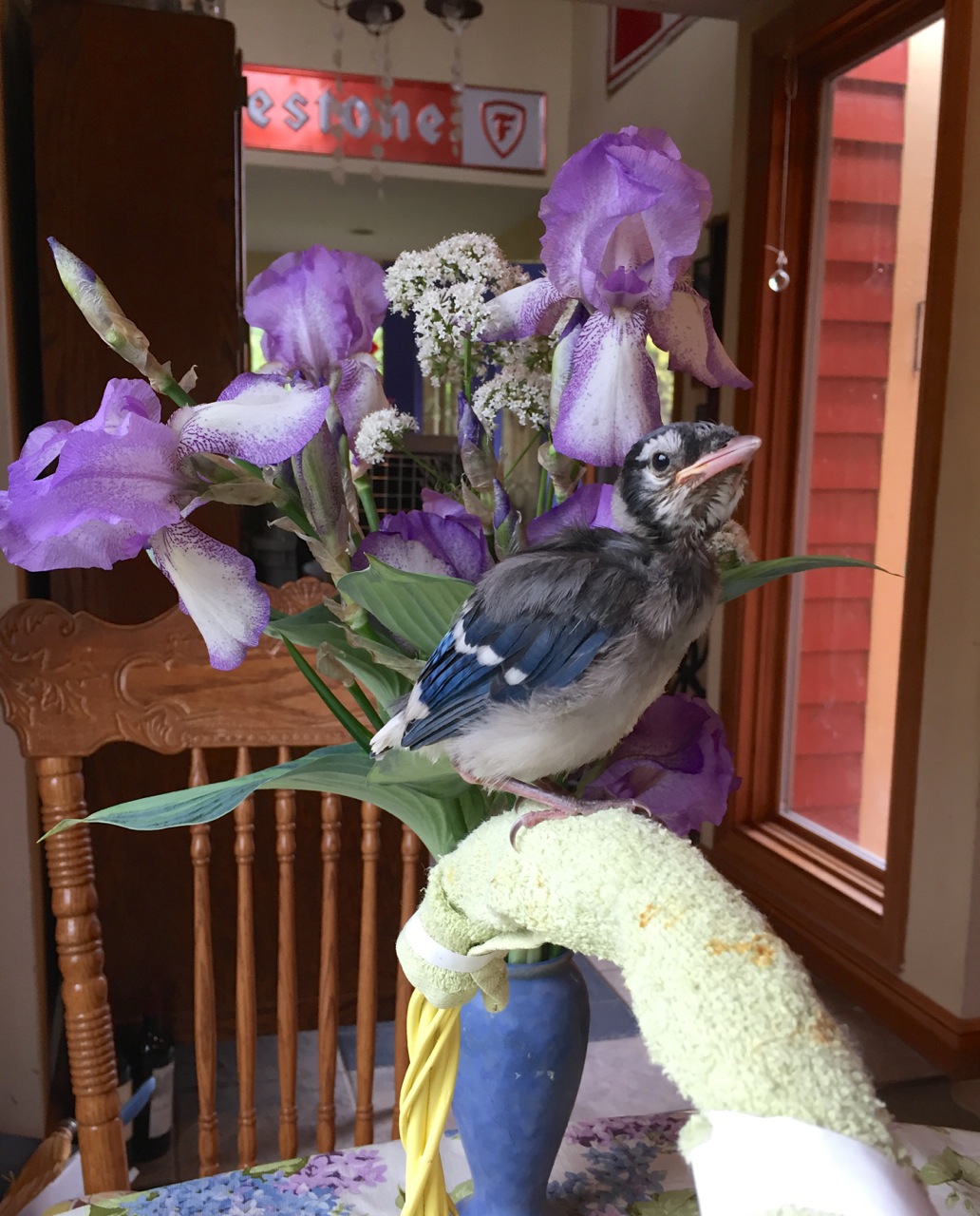
She came to me via Facebook message on May 16 when the irises were in bloom, just a few days before Phoebe came home from school, and I didn't name her right away because I wanted my sweet daughter to have the chance. "Iris!" Phoebe said. "Jemima!" Bill said. So Jemima Iris she was named.

With Phoebe, May 23, Day 19 and three days a fledgling.
They fell right smack in love, and I'm sure Phoebe is her favorite person on the planet, the person who has spent the most time loving her and singing with her and appreciating all the cool little things she does. "You always have a pal for me when I come home, Mai." Shrug. I guess I do. Today, I was sent a playlist of Jemima Iris' favorite songs (she's a huge Ed Sheeran fan, "Barcelona" being her all-time favorite), and chastised for not spending enough time deejaying for a jay. Guilty.
For a brief window she was portable, but then she started flying. Took her with us to Liam's crew banquet, where she represented for da boids.

The only time I was able to get a photo of her actually gaping was first thing in the morning. After that, she kept her mouth clamped shut, gaping only long enough to take a bit of food, often ducking and weaving to avoid the syringe. I've fed a lot of baby birds, and I would not call her easy to feed. Each one is as different from the other as snowflakes are.

Day 16 at first light. Neeeeyyaaahhhh! Neeeyaaaaahh!
Jays are omnivores. Once she started picking up her own food, which she did around Day 19, my job was to offer her an ever-changing smorgasbord of things from which she could choose. For a couple of weeks, she ate maddeningly tiny bites of everything, flinging away far more than she took in. Her tongue lashes in and out, and she cocks her head, considering the taste of each morsel. She is at once the most careful and discriminating bird I've ever tried to feed. She seems to be evaluating each new food for suitability, over and over. A bit of a surprise; I'd figured she'd gobble everything down like the jays at the feeder do. Not so. She is quite concerned, apparently, that someone might have slipped poison into her food. You never know. This kind lady who has dropped everything to serve her off perfect china plates could be plotting something.

As a result, I kept supplementing her food with syringe feedings of Mazuri Nestling Formula, beefed up with Repto-Cal (a calcium supplement) until Day 37, which happens to be yesterday. That's a long time to be giving hourly feedings.
But this glorious creature, arrayed in shades of sky and ocean, is the result, and I could not be prouder or happier to have made the journey with Jemima.

 |
| photo by Anne Babcock |
When left in her flight tent in the garage, she did OK, but screamed when she was lonely and hungry. So I'd pop out there, love her up, feed her, cave in and bring her back in the house. First thing in the morning she was too crazy; I couldn't stand having her go through my art materials and pound them to pieces, so I'd let her fly off her yayas in the tent. Then she spent somewhat quieter afternoons inside.

Chet Baker's been an absolute prince with her, suffering her affections. She latched onto him as the closest thing to a blue jay, and followed him, riding on his back, pounding on his toenails, sticking her beak in his ears...the most he'd do is get up and slowly walk away. What a guy, what a gemmun. To this day she hops right up and gets up in his face, quivering her wings and screeching softly at him with wide-open mouth. I think it's an invitation to play, to interact. He is always kind.
I'm writing this on Release Day, June 11, 2017. It seemed to take an eternity for her to be 100% self-feeding, and there were several days when I was sure she wasn't eating enough, but she refused the syringe, so it was what it was. And then finally on Day 37 I left her alone in the flight tent for most of the day, and she cleaned up all the mealworms in her bowl and nearly all her fruit and vegetable mix, and I knew she was ready to go. If I held her any longer she'd lose her edge. The point isn't to make a welfare case of her. The point is to release her.
I made her last tent breakfast this morning. Freshly molted mealworms, strawberries, raspberries, blueberries, mulberries, sweet corn and cornbread.

Fed her up good in the tent.

Bill caught me topping her off with mealworms.

Then I took her out into the yard and showed her the little feeding station I'd set up in the Japanese maple that was once a bonsai.

And she flew down and helped herself at once.

Chet and I sat out with her all morning. It was so nice out there, listening to her sing. The joy in the bird was palpable. My heart flew with her, because she was no longer captive. And she has all the tools she needs to survive and prosper. Just needed a little help from her friends.

She still goes to mush when Chet walks up.

From the Japanese maple, she flew to the arbor vitaes by the front door. So I made her a little feeding station there as well, with everything she likes and water too.

I put her bathtub in a big planter in case she wanted to bathe.

And when the afternoon got hot, she did. Oh my. She tried to fly and landed in a heap on the ground. She scuttled under a boxwood to hide, knowing it was bad juju to be soaked and flightless outside. First big lesson on outdoor living!

I scooped her up. For better or worse, I'm still her mama. Brought her inside to dry and preen in the sun, in the safety of the kitchen. She's a work in progress. Aren't we all?
Dried out, she went right back to pestering Chet Baker.

I want to PLAY WITH YOU. Are you DEEF???

Hm. That's right. You are deef.

Let Jemima have a look in that ear.
From there, she went to tussling with my antler back-scratcher.
She got her dose of Ed Sheeran today! For me, this little clip embodies the joy Jemima has brought to our lives. She's a scruffy little angel, sent down to cheer us, to buoy our spirits. I watched her work her magic on exam and life-weary Phoebe, who needed exactly this: a little thing to care for and dote on, one she could love and then release to a bright future. I'll always be grateful that Jemima Iris landed in our lives just when she did. Whitewash and all.









Sunday, June 11, 2017
22 comments