“Look! There are caterpillars on every rock! Think they’re
eating the lichens?”
“Ehhh. I doubt it.” The words floated down from Keith
Corliss, my co-leader on the Prairie Ramble at the Potholes and Prairies
Birding Festival near Chase Lake in east-central North Dakota. Though the
prairie grass was soaked, I was prepared with a full rainsuit, and Keith’s playful
skepticism was all the impetus I needed to get personal with some larvae, to
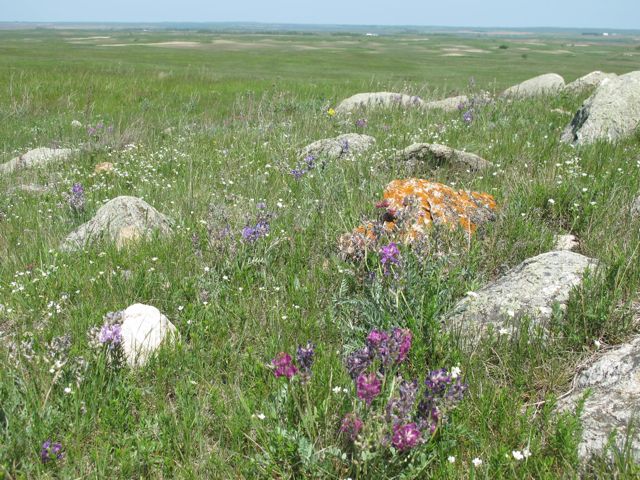
get on down and ground-truth my growing suspicion. The unplowed prairie we were
exploring under heavy skies and spitting rain was dotted with boulders large
and small, and on each rock I had spotted some interesting caterpillars, army
green and chartreuse chevrons running up their backs. Given that caterpillars
are eating machines, I suspected that they must have been consuming the lichens
that covered the rocks, and had expressed as much to the group. But now I had
to be sure.
I took off my glasses and went nose-to-nose with two
caterpillars. I held my breath and gazed, trying not to interrupt their
caterpillary doings. Sure enough, there was a small avenue of rock, grazed
almost clean of lichens, in front of each one. Behind them, small brown pellets
of frass. I crowed with delight and struggled back to my feet. “They ARE eating
the lichens! Look! You can see where they’ve grazed the rock clean!” No one
else got down on their stomach to see. I think they believed me. Either that or
kneeling in wet grass wasn’t their cup of tea.
Delight at this discovery led only to more questions. What
kind of moth or butterfly would these lichen-eating caterpillars become? I was
burning to know. And it was at this juncture that, only a handful of years ago,
my inquiry would have stalled and stopped. Books that could have addressed the
question simply didn’t exist. Stephen Ingraham whipped out his iPhone. Out here
in the middle of nowhere, he somehow picked up a signal. Well, there wasn’t
much to stop it.
“See what you get with ‘lichen-eating caterpillar!”
Everyone crowded around.
“There’s a painted lichen moth caterpillar, but I don’t have
enough bars to get an image just yet.”
My heart was racing. Just the thought that we’d turned the
key and opened the door with nothing more than curiosity, an iPhone and the
wide North Dakota sky above us electrified me.
Back on the bus, Stephen unearthed an iPad from his pack and
handed it forward. There on the screen was a stunningly beautiful salmon and
orange moth, its wings folded tentlike over its back: the painted lichen moth. Ooh’s
and aah’s hung in the air. Curiosity and gratification came full circle and
collided in cyberspace, somewhere far above my head. As someone who spends much
of every day and most of my life wondering about natural phenomena I observe
around me, I felt like a cave man presented with fire for the first time. We
can walk around with a computer in our pocket, one that can tell us if there
exists a caterpillar that eats lichens, (Yes! There is!) then tell us its range
(Yep, central North Dakota!) and then show us in vivid color what it grows up
to be (A glorious orangey pink moth, zigzagged in black). We have a portable Rosetta
Stone.
Rick Bohn, a
Carrington photographer, naturalist and Prairie Ramble leader, said he’d seen
that moth before, but had never known what its caterpillar looked like. At the
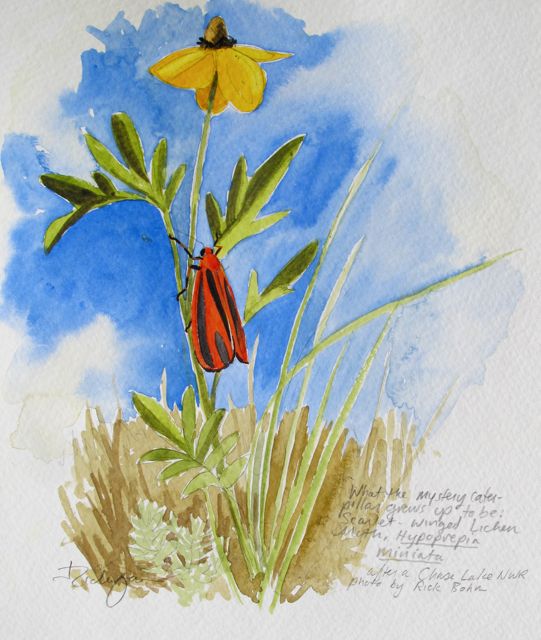
Chase Lake Nature Center, Rick produced a gorgeous photo of gray coneflower,
with a gaudy painted lichen moth clinging to its stem. We’d guessed right on
what this caterpillar would become. The last piece of the puzzle fell into
perfect place.
photo by Rick Bohn
There has never been a better time to be a naturalist.
Social media have spawned what are essentially support groups for bird,
butterfly, plant, mammal, arachnid and dragonfly enthusiasts, to name just a
few. Every day, I peruse posted photos of butterflies and birds and help
identify them where I can, bringing each observer just a little closer to
conversance with Ohio’s fauna. In my turn, I’ll “tag” friends on photos to ask
for ID’s on flowers and insects and often get them within minutes.
So many people have digital cameras now, and it’s so easy to
upload and share photos, that there is an unpaid army of observers out there,
reporting to Central Command in the form of such social media sites. The Ohio
Lepidopterist’s Society is in the process of teaming with Facebook’s
Butterflying Ohio page to expand the horizons of its knowledge, using photos
submitted by experts and beginners alike to fatten county and state checklists,
and to get a better grasp of what’s flying when. Rare bird record committees
are receiving better, faster documentation of strays than ever before. News
flies out about the latest discovery and up-to-the-minute coordinates of a rare
bird’s location are shared even as birders drive to the scene.
Just a couple of weeks before the Potholes festival, Bill
and I had been hot on the trail of nesting northern hawk-owls in Soldotna,
Alaska, where we were working at the Kenai Birding Festival. We had a reliable report
of a hawk-owl nest on the edge of a golf course right in town, and we stole a
few moments from our festival work to see if we could find it. It would be a
lusted-after life bird for me. Arriving at the scene, we found the nest tree,
but there was no sign of the hawk-owls. A woman pulled up in an enormous black
SUV as we walked down the street in front of her house. Seeing our scope and
binoculars, she asked us what we were searching for.
“We received a report of nesting owls here, and we were
hoping to see them.”
“Oh, THOSE THINGS! Are you here to get rid of them for me? I
hope so! Because I keep calling the Fish and Wildlife Service! Those things are
so NOISY!!”
It developed that she had had an owl family in her backyard
all spring, and the begging calls of the juveniles had “driven her crazy” for several weeks. She said she’d called
the state wildlife department and the Fish and Wildlife Service, asking someone
to come remove the birds.
The effort not to roll my eyes became intense, then supreme.
I tried to appear sympathetic, all the while wondering how she and I could both
be members of the species Homo sapiens.
Wondering how someone with so little appreciation for nature wound up on the
Kenai Peninsula, where you must regularly stop to let moose and caribou cross
the roads in the subdivisions; where bald eagles are more common than robins in
my neighborhood. An incredibly
cool owl, the most unusual North American owl; a streamlined, hard-feathered
day-flying owl I want so desperately just to see for a moment. And here she is,
with northern hawk-owls feeding young
in her yard, and she is not enthralled but annoyed? Then came the final blow.
She took a cellphone out of her purse and scrolled to a photo of a hawk-owl
sitting atop a spruce in her yard. It wasn’t a very good photo, but it was a
northern hawk-owl all right, long tail, barred belly and all. Arrggh.
“Yes, that’s the bird we’re looking for. You’re a very lucky
person to have them nesting in your yard. They’re extremely rare.”
“Well, you can HAVE them!! And the Fish and Wildlife people
won’t do ANYTHING about it!”
Well, I should hope they wouldn’t. Last I checked, the
services offered by the US Fish and Wildlife Service did not include removing
threatened owls from backyards. This anecdote may seem incidental to my story,
but hang with me for a moment. Practically everyone has technology now. A
person who doesn’t know a hawk-owl from a handsaw can now take a tiny cellphone
camera out of her pocket and produce a recognizable photo of one of North
America’s most sought after birds. And she can use that photo to torture a
couple from Ohio (who went back home without seeing said bird).
Take it a step further, and someone who is mildly interested
in nature can find out with a few clicks what a strange bug on the window screen
might be. Now give the same tools to avid naturalists, and they can find out
what sort of caterpillar eats lichens on a boulder in the middle of literally
nowhere in North Dakota, and then what kind of beautiful moth it grows up to
be. Technology supplies answers, but it isn’t an answer in itself, and it
certainly can’t make us smarter or more appreciative of nature. Rather, it’s
been successfully argued that it competes with nature for our full attention,
to our detriment. Technology is a tool, and in the right hands it has awesome
power. The catch? You still have to be interested and informed enough to ask
the right questions. Curiosity is the hot-burning engine that propels a good
naturalist, and it can’t be replaced or supplanted by any gizmo, no matter how powerful.
It’s not how, or how quickly, the question gets answered. It’s asking it in the
first place.
Julie Zickefoose, author of The Bluebird Effect: Uncommon Bonds with Common Birds, got an iPhone
from Bill for her last birthday. She held out as long as she could, but the
Lichen Moth Incident tipped her over the edge.
If you liked this piece, you can read my column, "True Nature," in every issue of Bird Watcher's Digest. Click
HERE to subscribe. And you can hear me read the piece (Episode 29)
HERE.












Sunday, June 8, 2014
14 comments