
photo by Mary Ferracci
I've borrowed this wonderful photo from
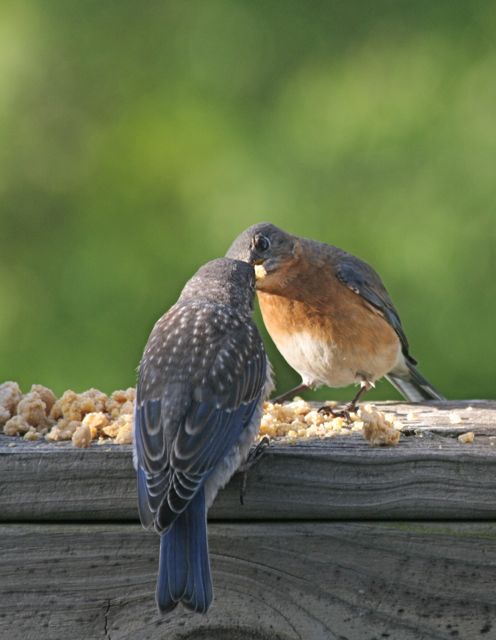
Mary's View. It's a bluebird from her yard in North Carolina who is hooked on Zick Dough. See anything wrong with this picture? It jumps right out at the Science Chimp. He's not putting weight on his left foot, and the toes are swollen. He's in pain. And it's all my fault.
I've been quietly working this winter, learning about bird nutrition, perfecting a recipe, trying to right some wrongs. I've posted before about the joys and drawbacks of feeding the homemade suet dough that a lot of people are calling Zick Dough. And I've said before that I feel a little squeamy about having my name on that recipe, even moreso since I figured out that it can give birds who eat too much of it a painful case of gout. You can read about that in the original posts,
"Uh-Oh, Zick Dough" and
"Crack is a Better Name for It." If you're just joining us for this story, I'll recap:
I've been feeding homemade suet dough for years. The basic recipe has always been:
OLD ZICK DOUGH
1 cup peanut butter
1 cup lard
2 cups yellow cornmeal
2 cups quick oats
1 cup flour
And the birds in my yard have gobbled it up, everything from chickadees, tits and nuthatches to woodpeckers, cardinals, sparrows, towhees and bluebirds. Bluebirds are the biggest fans of Zick Dough. And therein lies the problem.
As I've explained, eastern bluebirds are the ultimate addictive personalities. Given an easy food source, they will exploit it to the exclusion of almost everything else. If you stop and think about it, the recipe above is anything but a complete diet. It's fat, some limited protein, and carbohydrates, and it's really rich. It's kind of like living on, well, oats, lard and peanut butter.

Here is the foot of a female bluebird who gorged on Zick Dough all winter and into the spring of 2009. She can't put weight on it. It hurts. She's got gout. Or metabolic bone disease. Or something bad. And I strongly believe it was due to an improper diet, and I felt, and still feel, terrible about that.
The short-term answer was to suspend all feeding of Zick Dough. And her foot recovered, sort of. The swelling went down, but she had a permanently stiff middle toe, as if she were giving me the finger for feeding her low-value food. And I deserve it.
That bluebird disappeared sometime in the fall of 2009. I don't know what happened to her, but I'm sure that if she could come back to my feeder, she would have by now. I have to think that having a stiff foot was a handicap, and I'm ready to take the blame if she died before her time. I'll never know. All I know is she was here for years, and now she's gone. Maybe she was really old, and that's why she ate so much of the easy stuff.

photo by Mary Ferracci
I don't think it's a coincidence that a bluebird in North Carolina who also gorges on Zick Dough has the same problem. And that's my problem, and that of anyone who feeds this stuff to their backyard birds. Maybe that's you, too.
So. I'm cruising along early this winter, feeding my first batch of Zick Dough, enjoying my bluebirds and all the others, and so glad to be able to help them through the worst winter in memory. I didn't start feeding it until it got really cold--Christmas, for goodness' sake--and I planned to suspend feeding it the moment it got reliably warm. My suspicion is that feeding this rich food in warm weather is what got Gouty into trouble. So feeding it only in really cold weather was my interim answer to the problem.
One fine morning I get a Google Alert for Zick Dough (it's really out there on the Internet.) It's a piece written for the
Maryland Bluebird Society's "Chatter" by Felicia Lovelett.
I devour it with great interest. In it, she cites my post,
"Uh-oh, Zick Dough" in which I describe possible gout in my bluebird visitors. And she points out that suet dough mixes are very low in calcium, high in phosphorus, and "contain proteins that are relatively low in biological value." Further, she suggests that "Gouty" may have had Metabolic Bone Disease. Well, whether it was gout or MBD, there's no doubt she was all messed up, and I had good reason to suspect it was the steady diet of Zick Dough that messed her up. A male bluebird in my yard, also a heavy imbiber, had the same problem. And both recovered when I withheld the Zick Dough.
Ms. Lovelett suggests basing suet dough on a "formulated diet that provides adequate calcium, high quality proteins and other essential nutrients." And she mentions unmedicated chick starter as a base.

Chick starter is an extruded pellet that crumbles easily. It's formulated to encourage growth and strong bones in young domestic chicks, kind of like puppy chow for birds. It's got a lot more nutritional oomph than yellow cornmeal, oats, peanut butter or lard.

My very next trip was to the feed store, where I bought a small (20-pound) bag of DuMor unmedicated chick starter. (You definitely want to check the label--the last thing we want is to give antibiotics to wild birds!) I spent some time fiddling around with proportions and finally came up with this:
NEW ZICK DOUGH: SMALL BATCH
Melt in the microwave and stir together:
1 cup peanut butter
1 cup lard
In a large mixing bowl, combine
2 cups chick starter
2 cups quick oats
1 cup yellow cornmeal and
1 cup flour
Add melted lard/peanut butter mixture to the combined dry ingredients and mix well.
I made a small batch first, and laid out two piles of Original Recipe and New Improved. It was a gas, watching the birds sample both.

Yes, it looks different...Some, like the titmice, tried the new but preferred the old mix. One female cardinal stuck to the old mix. The other cardinals preferred the new recipe.

Of my pair of bluebirds, the female liked the old mix, and her mate liked the new.

Importantly, they all accepted it immediately, and the switch to the new recipe was seamless and instant. I really hadn't expected it to be that easy. I figured out that the tufted titmice just like bigger chunks to carry off, and the new mix is more crumbly, so they can't find a big wad as easily with the new recipe.

All the birds are perfectly happy with the new mix, and everyone is eating better this winter.
While I'm at it, I'm going to pass along my secrets for mixing Zick Dough in large batches. Here's my quintupled recipe.
NEW ZICK DOUGH: BIG BATCH
5 cups (1 40 oz jar) peanut butter
5 cups (1/3 of the 64-oz bucket) of lard (Wal-Mart, in the Shortening aisle)
10 cups chick starter (available at any feed store)
10 cups quick oats
5 cups yellow cornmeal
5 cups flour
Measuring peanut butter and lard by the cup is a pain in the butt. Instead of measuring, I just use a bowl scraper to empty out a 40-oz jar of PB into a medium-sized mixing bowl. It takes up half the bowl.

Then, I fill the rest of the bowl with lard.

This saves a lot of time and mess in trying to stuff peanut butter and lard into a measuring cup. There's no way to do that without getting it all over you.
Put the bowl in the microwave and melt the mix down (about 5 minutes on High). Stir it together.
Have all the dry ingredients--chick starter, oats, cornmeal and flour--well blended in a lobster pot before pouring in the molten peanut butter/lard mixture.

Stir well with your heaviest spoon, making sure you get down to the bottom. I finish by working it with my hands. I sit on the floor with the lobster pot between my knees and Zick Dough up to my elbows, but I will spare you a photo of that.

The great thing about chick starter is it keeps the mix from getting so gummy and ensures a lovely texture to the final product. And it nourishes your birds. It's a win-win all around.
Mmm, good enough to sample. And yes, I do. I like to make sure it tastes good.

Disclaimer: Even New Zick Dough is too rich to be fed once the weather warms up. The birds will still beg, but please suspend feeding once it warms up and send them off to get the live insect protein they need. Here's Gouty, about three weeks after I suspended feeding Zick Dough. She's using both feet, and looks a lot better, no?

The last thing I want to do is pretend I have the final answer here. Like life, the Zick Dough recipe is a work in progress. I'll be watching to see how my birds fare this spring, having had a winter's worth of New Zick Dough. If your birds are hooked on Zick Dough, please find a feed store and pick up some chick starter--one 20-pound bag should last you all winter--and mix up the new recipe. It's easier to mix, smells lovely, and offers better nutrition to the birds we all love so well.

Thanks to Mary Ferracci for her photos and her friendship. And to Felicia Lovelett, for the chick starter idea. Answer my email, willya?
 photo by Mary Ferracci
I've borrowed this wonderful photo from Mary's View. It's a bluebird from her yard in North Carolina who is hooked on Zick Dough. See anything wrong with this picture? It jumps right out at the Science Chimp. He's not putting weight on his left foot, and the toes are swollen. He's in pain. And it's all my fault.
I've been quietly working this winter, learning about bird nutrition, perfecting a recipe, trying to right some wrongs. I've posted before about the joys and drawbacks of feeding the homemade suet dough that a lot of people are calling Zick Dough. And I've said before that I feel a little squeamy about having my name on that recipe, even moreso since I figured out that it can give birds who eat too much of it a painful case of gout. You can read about that in the original posts, "Uh-Oh, Zick Dough" and "Crack is a Better Name for It." If you're just joining us for this story, I'll recap:
I've been feeding homemade suet dough for years. The basic recipe has always been:
OLD ZICK DOUGH
1 cup peanut butter
1 cup lard
2 cups yellow cornmeal
2 cups quick oats
1 cup flour
And the birds in my yard have gobbled it up, everything from chickadees, tits and nuthatches to woodpeckers, cardinals, sparrows, towhees and bluebirds. Bluebirds are the biggest fans of Zick Dough. And therein lies the problem.
As I've explained, eastern bluebirds are the ultimate addictive personalities. Given an easy food source, they will exploit it to the exclusion of almost everything else. If you stop and think about it, the recipe above is anything but a complete diet. It's fat, some limited protein, and carbohydrates, and it's really rich. It's kind of like living on, well, oats, lard and peanut butter.
photo by Mary Ferracci
I've borrowed this wonderful photo from Mary's View. It's a bluebird from her yard in North Carolina who is hooked on Zick Dough. See anything wrong with this picture? It jumps right out at the Science Chimp. He's not putting weight on his left foot, and the toes are swollen. He's in pain. And it's all my fault.
I've been quietly working this winter, learning about bird nutrition, perfecting a recipe, trying to right some wrongs. I've posted before about the joys and drawbacks of feeding the homemade suet dough that a lot of people are calling Zick Dough. And I've said before that I feel a little squeamy about having my name on that recipe, even moreso since I figured out that it can give birds who eat too much of it a painful case of gout. You can read about that in the original posts, "Uh-Oh, Zick Dough" and "Crack is a Better Name for It." If you're just joining us for this story, I'll recap:
I've been feeding homemade suet dough for years. The basic recipe has always been:
OLD ZICK DOUGH
1 cup peanut butter
1 cup lard
2 cups yellow cornmeal
2 cups quick oats
1 cup flour
And the birds in my yard have gobbled it up, everything from chickadees, tits and nuthatches to woodpeckers, cardinals, sparrows, towhees and bluebirds. Bluebirds are the biggest fans of Zick Dough. And therein lies the problem.
As I've explained, eastern bluebirds are the ultimate addictive personalities. Given an easy food source, they will exploit it to the exclusion of almost everything else. If you stop and think about it, the recipe above is anything but a complete diet. It's fat, some limited protein, and carbohydrates, and it's really rich. It's kind of like living on, well, oats, lard and peanut butter.
 Here is the foot of a female bluebird who gorged on Zick Dough all winter and into the spring of 2009. She can't put weight on it. It hurts. She's got gout. Or metabolic bone disease. Or something bad. And I strongly believe it was due to an improper diet, and I felt, and still feel, terrible about that.
The short-term answer was to suspend all feeding of Zick Dough. And her foot recovered, sort of. The swelling went down, but she had a permanently stiff middle toe, as if she were giving me the finger for feeding her low-value food. And I deserve it.
That bluebird disappeared sometime in the fall of 2009. I don't know what happened to her, but I'm sure that if she could come back to my feeder, she would have by now. I have to think that having a stiff foot was a handicap, and I'm ready to take the blame if she died before her time. I'll never know. All I know is she was here for years, and now she's gone. Maybe she was really old, and that's why she ate so much of the easy stuff.
Here is the foot of a female bluebird who gorged on Zick Dough all winter and into the spring of 2009. She can't put weight on it. It hurts. She's got gout. Or metabolic bone disease. Or something bad. And I strongly believe it was due to an improper diet, and I felt, and still feel, terrible about that.
The short-term answer was to suspend all feeding of Zick Dough. And her foot recovered, sort of. The swelling went down, but she had a permanently stiff middle toe, as if she were giving me the finger for feeding her low-value food. And I deserve it.
That bluebird disappeared sometime in the fall of 2009. I don't know what happened to her, but I'm sure that if she could come back to my feeder, she would have by now. I have to think that having a stiff foot was a handicap, and I'm ready to take the blame if she died before her time. I'll never know. All I know is she was here for years, and now she's gone. Maybe she was really old, and that's why she ate so much of the easy stuff.
 photo by Mary Ferracci
I don't think it's a coincidence that a bluebird in North Carolina who also gorges on Zick Dough has the same problem. And that's my problem, and that of anyone who feeds this stuff to their backyard birds. Maybe that's you, too.
So. I'm cruising along early this winter, feeding my first batch of Zick Dough, enjoying my bluebirds and all the others, and so glad to be able to help them through the worst winter in memory. I didn't start feeding it until it got really cold--Christmas, for goodness' sake--and I planned to suspend feeding it the moment it got reliably warm. My suspicion is that feeding this rich food in warm weather is what got Gouty into trouble. So feeding it only in really cold weather was my interim answer to the problem.
One fine morning I get a Google Alert for Zick Dough (it's really out there on the Internet.) It's a piece written for the Maryland Bluebird Society's "Chatter" by Felicia Lovelett.
I devour it with great interest. In it, she cites my post, "Uh-oh, Zick Dough" in which I describe possible gout in my bluebird visitors. And she points out that suet dough mixes are very low in calcium, high in phosphorus, and "contain proteins that are relatively low in biological value." Further, she suggests that "Gouty" may have had Metabolic Bone Disease. Well, whether it was gout or MBD, there's no doubt she was all messed up, and I had good reason to suspect it was the steady diet of Zick Dough that messed her up. A male bluebird in my yard, also a heavy imbiber, had the same problem. And both recovered when I withheld the Zick Dough.
Ms. Lovelett suggests basing suet dough on a "formulated diet that provides adequate calcium, high quality proteins and other essential nutrients." And she mentions unmedicated chick starter as a base.
photo by Mary Ferracci
I don't think it's a coincidence that a bluebird in North Carolina who also gorges on Zick Dough has the same problem. And that's my problem, and that of anyone who feeds this stuff to their backyard birds. Maybe that's you, too.
So. I'm cruising along early this winter, feeding my first batch of Zick Dough, enjoying my bluebirds and all the others, and so glad to be able to help them through the worst winter in memory. I didn't start feeding it until it got really cold--Christmas, for goodness' sake--and I planned to suspend feeding it the moment it got reliably warm. My suspicion is that feeding this rich food in warm weather is what got Gouty into trouble. So feeding it only in really cold weather was my interim answer to the problem.
One fine morning I get a Google Alert for Zick Dough (it's really out there on the Internet.) It's a piece written for the Maryland Bluebird Society's "Chatter" by Felicia Lovelett.
I devour it with great interest. In it, she cites my post, "Uh-oh, Zick Dough" in which I describe possible gout in my bluebird visitors. And she points out that suet dough mixes are very low in calcium, high in phosphorus, and "contain proteins that are relatively low in biological value." Further, she suggests that "Gouty" may have had Metabolic Bone Disease. Well, whether it was gout or MBD, there's no doubt she was all messed up, and I had good reason to suspect it was the steady diet of Zick Dough that messed her up. A male bluebird in my yard, also a heavy imbiber, had the same problem. And both recovered when I withheld the Zick Dough.
Ms. Lovelett suggests basing suet dough on a "formulated diet that provides adequate calcium, high quality proteins and other essential nutrients." And she mentions unmedicated chick starter as a base.  Chick starter is an extruded pellet that crumbles easily. It's formulated to encourage growth and strong bones in young domestic chicks, kind of like puppy chow for birds. It's got a lot more nutritional oomph than yellow cornmeal, oats, peanut butter or lard.
 My very next trip was to the feed store, where I bought a small (20-pound) bag of DuMor unmedicated chick starter. (You definitely want to check the label--the last thing we want is to give antibiotics to wild birds!) I spent some time fiddling around with proportions and finally came up with this:
NEW ZICK DOUGH: SMALL BATCH
Melt in the microwave and stir together:
1 cup peanut butter
1 cup lard
In a large mixing bowl, combine
2 cups chick starter
2 cups quick oats
1 cup yellow cornmeal and
1 cup flour
Add melted lard/peanut butter mixture to the combined dry ingredients and mix well.
I made a small batch first, and laid out two piles of Original Recipe and New Improved. It was a gas, watching the birds sample both.
My very next trip was to the feed store, where I bought a small (20-pound) bag of DuMor unmedicated chick starter. (You definitely want to check the label--the last thing we want is to give antibiotics to wild birds!) I spent some time fiddling around with proportions and finally came up with this:
NEW ZICK DOUGH: SMALL BATCH
Melt in the microwave and stir together:
1 cup peanut butter
1 cup lard
In a large mixing bowl, combine
2 cups chick starter
2 cups quick oats
1 cup yellow cornmeal and
1 cup flour
Add melted lard/peanut butter mixture to the combined dry ingredients and mix well.
I made a small batch first, and laid out two piles of Original Recipe and New Improved. It was a gas, watching the birds sample both.
 Yes, it looks different...Some, like the titmice, tried the new but preferred the old mix. One female cardinal stuck to the old mix. The other cardinals preferred the new recipe.
 Of my pair of bluebirds, the female liked the old mix, and her mate liked the new.
 Importantly, they all accepted it immediately, and the switch to the new recipe was seamless and instant. I really hadn't expected it to be that easy. I figured out that the tufted titmice just like bigger chunks to carry off, and the new mix is more crumbly, so they can't find a big wad as easily with the new recipe.
 All the birds are perfectly happy with the new mix, and everyone is eating better this winter.
While I'm at it, I'm going to pass along my secrets for mixing Zick Dough in large batches. Here's my quintupled recipe.
NEW ZICK DOUGH: BIG BATCH
5 cups (1 40 oz jar) peanut butter
5 cups (1/3 of the 64-oz bucket) of lard (Wal-Mart, in the Shortening aisle)
10 cups chick starter (available at any feed store)
10 cups quick oats
5 cups yellow cornmeal
5 cups flour
Measuring peanut butter and lard by the cup is a pain in the butt. Instead of measuring, I just use a bowl scraper to empty out a 40-oz jar of PB into a medium-sized mixing bowl. It takes up half the bowl.
All the birds are perfectly happy with the new mix, and everyone is eating better this winter.
While I'm at it, I'm going to pass along my secrets for mixing Zick Dough in large batches. Here's my quintupled recipe.
NEW ZICK DOUGH: BIG BATCH
5 cups (1 40 oz jar) peanut butter
5 cups (1/3 of the 64-oz bucket) of lard (Wal-Mart, in the Shortening aisle)
10 cups chick starter (available at any feed store)
10 cups quick oats
5 cups yellow cornmeal
5 cups flour
Measuring peanut butter and lard by the cup is a pain in the butt. Instead of measuring, I just use a bowl scraper to empty out a 40-oz jar of PB into a medium-sized mixing bowl. It takes up half the bowl.  Then, I fill the rest of the bowl with lard.
 This saves a lot of time and mess in trying to stuff peanut butter and lard into a measuring cup. There's no way to do that without getting it all over you.
Put the bowl in the microwave and melt the mix down (about 5 minutes on High). Stir it together.
Have all the dry ingredients--chick starter, oats, cornmeal and flour--well blended in a lobster pot before pouring in the molten peanut butter/lard mixture.
This saves a lot of time and mess in trying to stuff peanut butter and lard into a measuring cup. There's no way to do that without getting it all over you.
Put the bowl in the microwave and melt the mix down (about 5 minutes on High). Stir it together.
Have all the dry ingredients--chick starter, oats, cornmeal and flour--well blended in a lobster pot before pouring in the molten peanut butter/lard mixture. Stir well with your heaviest spoon, making sure you get down to the bottom. I finish by working it with my hands. I sit on the floor with the lobster pot between my knees and Zick Dough up to my elbows, but I will spare you a photo of that.
 The great thing about chick starter is it keeps the mix from getting so gummy and ensures a lovely texture to the final product. And it nourishes your birds. It's a win-win all around.
Mmm, good enough to sample. And yes, I do. I like to make sure it tastes good.
The great thing about chick starter is it keeps the mix from getting so gummy and ensures a lovely texture to the final product. And it nourishes your birds. It's a win-win all around.
Mmm, good enough to sample. And yes, I do. I like to make sure it tastes good.
 Disclaimer: Even New Zick Dough is too rich to be fed once the weather warms up. The birds will still beg, but please suspend feeding once it warms up and send them off to get the live insect protein they need. Here's Gouty, about three weeks after I suspended feeding Zick Dough. She's using both feet, and looks a lot better, no?
 The last thing I want to do is pretend I have the final answer here. Like life, the Zick Dough recipe is a work in progress. I'll be watching to see how my birds fare this spring, having had a winter's worth of New Zick Dough. If your birds are hooked on Zick Dough, please find a feed store and pick up some chick starter--one 20-pound bag should last you all winter--and mix up the new recipe. It's easier to mix, smells lovely, and offers better nutrition to the birds we all love so well.
 Thanks to Mary Ferracci for her photos and her friendship. And to Felicia Lovelett, for the chick starter idea. Answer my email, willya?









Sunday, March 7, 2010
64 comments