Background Switcher (Hidden)

Showing posts with label scarlet tanager. Show all posts

Tanagers Eating Weird Stuff

Wednesday, November 6, 2024

0 comments

I have huge dark Chamaecyparis trees hanging over my north studio windows. This is bad. It cuts my light. Gosh, they were so tiny when I planted them 30 years ago! Who'd think they'd shoot up to 20' plus, and get so thick and plumy? In desperation to get my view back I have limbed them up, but their bushy tops still cut a ton of light, especially on those dark winter days when the sun seems to set at 3 pm. Good times! 

 One of the good things about having huge dark Chamaecyparis trees hanging over my north studio windows, however, is the intimate look they give me into the lives of birds. They feel safe in those dark trees and they do things most people don’t get to see, right at eye level. It’s my mini canopy walk, I guess. I’m perched on my high drafting chair and they’re a good 12’ off the ground, and I’m looking right into their eyes. One of the more thrilling birds who perched in there was a Cooper's hawk, on April 6, 2023.
                                                                                   

Most are songbirds, though, like this hatch-year female scarlet tanager who just calmly studied me as I looked back through the big lens. She was but a few feet away, and I was moving slowly, as always, so as not to frighten her. Sept. 16, 2024. My Canon is permanently to my left on the drawing table as I write or draw, and I've perfected a very fluid, slow way of hoisting it to my eye.


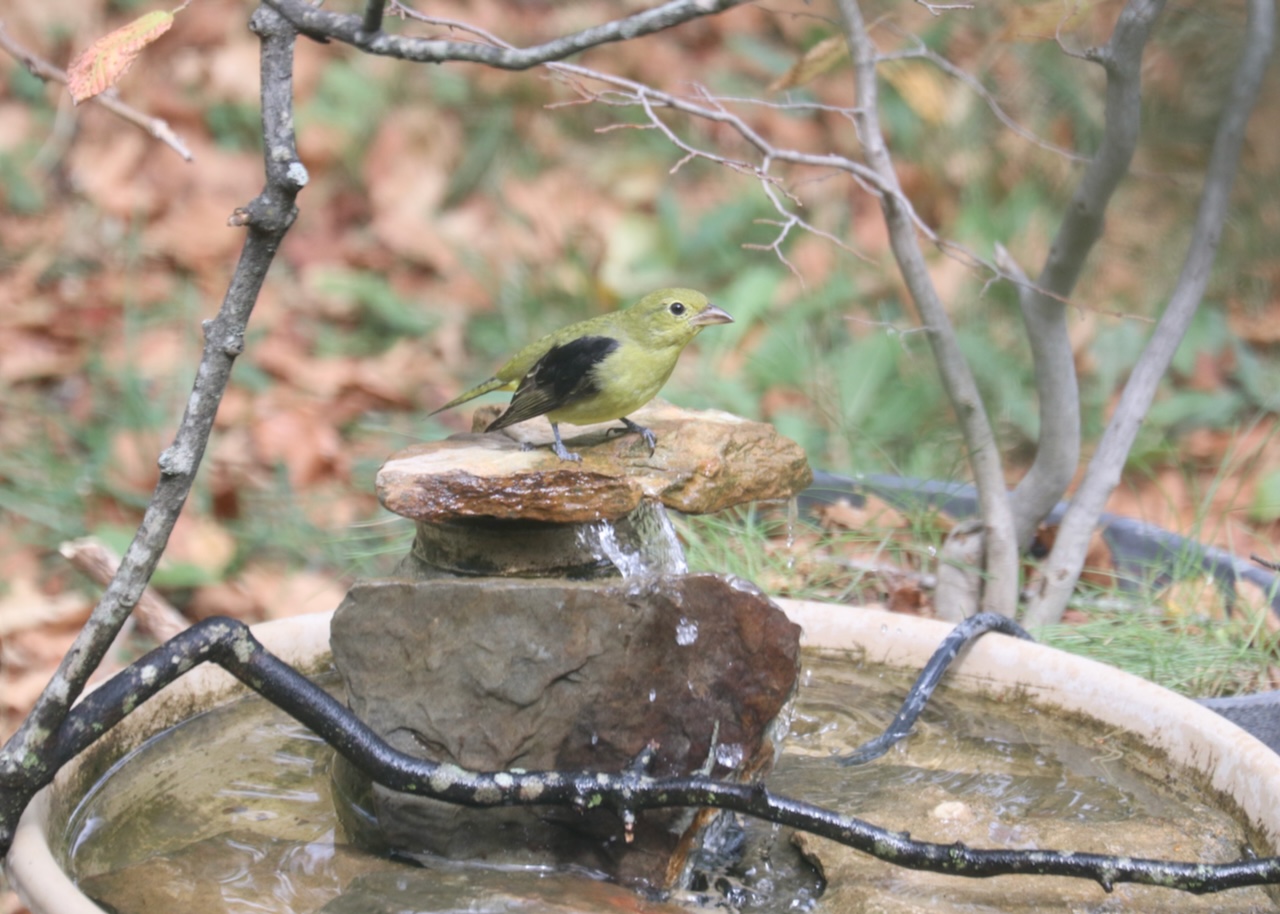
The water features, especially the trickling WarblerFall, draw in forest birds like nobody's business, especially during fall migration. Look at this gorgeous young male scarlet tanager molting into his first adult plumage on Sept. 16, 2024. He starts with the lesser coverts and will gradually replace the fresh flight feathers with jet black ones. And by next spring, he'll be replacing those green body feathers with brilliant scarlet ones. 
I like how he looks like he's wearing a cape around his shoulders. 


On Sept. 22, I was shocked to see a young male scarlet tanager eating a brown marmorated stinkbug, which would have to be the most odious mouthful a bird could ingest. But there he was, crunching it down like a toasted almond. 

Maybe a little gag reflex happening here, but the bug went down the hatch. Zow! 


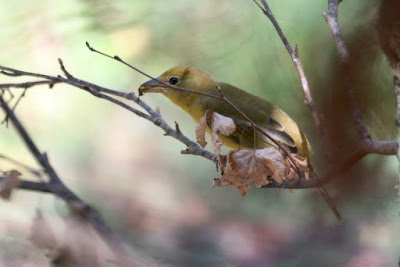
The same day, I was thrilled to bits to see a young male summer tanager come in to drink at the WarblerFall, then perch in the Chamecyparis! Unlike the scarlet, summer tanagers don't breed on my land, though I do have the mix of Virginia pine and deciduous trees they seem to like. 


Summer tanagers are a late summer and fall phenomenon here, and they are almost always hunting hymenopterans when they're here. I've had them catching yellowjackets off the deck railing! 


Summer tanagers have an old folk name of "bee bird"  because they are notorious for staking out beehives and feasting on their occupants, often catching them in air. My old friend Hank had one spend a Connecticut winter at his beehives in Old Lyme, living on honeybees. He was happy to donate bees, but he did offer other foods, hoping to cut the damage. This is where the extra long, strong beak of the summer tanager comes in really handy. It's good to distance your eyes and face from an angry bee, wasp or hornet. 
This young bird was looking for something, and there was plenty of what he was looking for in my yard.


I have mentioned the absolute Jobian plague of yellowjackets that ruled my life and land all summer. I couldn't go anywhere without having to walk through swarms of yellowjackets, which spent the summer coursing low over the ground, looking for prey, and stinging me and Curtis. Curtis was stung nine times, and I was stung four times, and it was a huge drag. Yellowjacket stings hurt for a couple days and then itch for a week or more. I came to loathe those insects, which always seemed to be in between me and what I was trying to do. There were three huge ground nests in my backyard alone. In September, I accidentally mowed over a nest and got two yellowjackets down inside my hiking boots, stinging the blue-eyed crap out of me as I tried to stop the rider mower and slap them out of my socks. That was fun.


So I was thrilled to see the summer tanager chewin' on a yellowjacket in one of my birch trees.


He masticated that thing into a pulp before he swallowed it, stinger first. You want to make really sure the wasp's head is separated from its body before you pass it through your tender esophagus. Just looking at this photo hurts me, but that bird certainly knows what he's doing. Anyway, my theory as to why summer tanagers have evolved that big honkin' beak is to help them in their quest for stinging insects--an unexploited resource! They can quickly and safely process a large stinging insect with a long, strong beak. From seeing bees hit my windshield and leave a clear puddle of nectar, I imagine that they are sometimes quite sweet to eat, though I doubt I'll ever find out. 


Score two tanagers and a couple cool sightings of Tanagers Eating Weird Stuff for the WarblerFall!

If you haven't got your plans yet, by all means go to warblerfall.com and join the growing family of folks who know the magic attraction of moving water.

And remember, a WarblerFall makes a fabulous holiday gift. All you have to do is fill in your credit card info, and your recipient's email, and the plans will be emailed to your friend. You'll have to give them a heads up to look for it in their email.

Crazy cool bird sightings will follow! Thanks for your support. 

The Family that Bathes Together...

Monday, August 21, 2023

0 comments

On mornings when it's getting hot fast, I always give the WarblerFall a quick scrub. I change out the rocks to clean ones (all I have to do is leave them in the sun between cleanings, and its heat does my work for me!), scrub the basin with a Magic Eraser, and rinse and refill with clean water. It only takes a few minutes to make the bath fresh, clean and sparkling again. Thank you, Sun!

I knew there would be serious action today, August 21, with a humid high of 88.

Sure enough, along came a baby cardinal, a female. 

She still has the blackish bill she was born with. She's likely still being fed by her parents.

She had such fun in the cool bath it wasn't long before her parents came to join her!

I was thrilled to get the whole family in one shot. That doesn't happen often.

The 'rents look considerably less fresh-faced than she does. Well, they've probably been feeding her for 50 days. I know. I've done it. Baby cardinals beg for forever, and then add a few weeks. 

Mom Cardinal was down to the last two feathers in her crest. Maybe she pulled them out in frustration...

Anyway, I'm projecting. The little family was having a nice bath together, and it was Baby's idea.

Then someone new showed up, startling everyone!

It was a male scarlet tanager! Mom didn't mind. She was just happy to be able to take a bath without anyone clamoring at her for something.

Dad Cardinal made a classic dad move, rudely crowding the tanager, who protested with a little squeal.

The tanager, a juvenile male, held his own.

At length, the Cardinal family left, and the tanager was finally able to take a long soaker.

At one point a female American goldfinch joined him, looking like a mini-me!

Finally even the goldfinch left. Every time I looked out the window for the next ten minutes, the tanager was there, soaking. It was sweet to see him enjoy the bath so very much. 


The WarblerFall got a nice shoutout last week on the Martha Stewart website!
They called to interview me and I had to tell them about the WarblerFall.


I sent them photos, but they didn't use them. The WarblerFall beats all the bird baths featured in the article by a country mile. I'm not bragging here. It just does. It's the best bird bath you can get. I've had 28 species in mine just this summer. My friend Briana at The Hungry Little Birdie in Michigan hit 42 species for the summer today with a young Blackburnian warbler! I'm waiting for my friend and neighbor Laura to tally up her species. I think she'll blow us both out of the shallow pool. ***see end of post for an update!

                                              photo courtesy The Hungry Little Birdie

I got a SWEET pair of juvenile Kentucky warblers recently, though! The female arrived first and poked around the shade garden amid the ferns and pink Angelonia (a new favorite flower!)


And then she came to the WarblerFall!


soon to be joined by her splendid brother, here perched on a tomato cage. Oh man, I love this warbler. This pair were probably hatched and fledged just a few hundred yards away, in my orchard, where their handsome daddy scolded me every morning as I walked by their nest. I saw at least two fledglings being fed, and then along come these jewels on 27 July. My cup runneth over--KEWA was species #25 in the WarblerFall this summer. 


 The best part about the WarblerFall, after the ridiculous bird diversity it attracts, is that you make it yourself, and customize it to your liking. 
But please take close note of the type of rock and shallow depth of the water in our creations.

I'd recommend getting your WarblerFall built as soon as you can, because fall migration is coming into full swing. Just ask that young tanager! Migrating is thirsty work, and warblers, tanagers, vireos and finches are delighted to find cool running water to bathe in on these hot, hot August days. 
September is even better, and October holds such surprises! Kinglets, anyone?

See what the fuss is about at https://warblerfall.com

Here's an update from my neighbor Laura, whose trail cameras capture the most outrageous things.
She's got two baths, one with a recirculating pump and one without. The classic WarblerFall with a pump has 43 species for this season, so she has edged me out by a long shot, and she has only one more than Briana in Michigan. 

We'll start you off easy. Here is a photo from August 8, 2023.
An older female Baltimore oriole and a two-year-old rose-breasted grosbeak bathe together.


Here is Laura's trailcam photo from early July 2023. Not one, but FIVE blue-winged warblers consider a bath. This has to be a pair with their three fledglings. Can you stand it? 


And the piece de resistance: SEVEN species at the bath at one time, 13 September 2022. From left, Laura identified them as common yellowthroat (male); scarlet tanager imm (big bird in front with pale bill); a bay-breasted warbler in the water behind the tanager; an imm. Tennessee warbler on the rim in back; an imm. chestnut-sided warbler in the water to the right; a tufted titmouse on the rock; and a song sparrow at the far right. I just squealed when I saw this. Thank you, Laura, for this insane clown posse of birds in your WarblerFall!


Making It Through the Winter

Tuesday, January 14, 2014

10 comments
That cold snap that blew in the night of January 5, that was a thing. The afternoon before, it was raining and almost 50 degrees, and I knew it was time to act. I was sure I couldn't heat the greenhouse adequately through temperatures in the teens, much less the negative single digits. So out it all came, carried in relays into the downstairs bathroom and my studio. Because I wound up losing about two-thirds of my plants in the big freeze of November 24, it wasn't all that much trouble. Well, nothing is too much trouble where me and the plants I love are concerned. I sometimes catch myself working like a draft horse to keep these plants alive and wonder why I bother. Yes, I felt pretty ridiculous evacuating the greenhouse, but what was my choice?

So there they are (about half of them) luxuriating in the bathroom while it's zero degrees and below outside. You can just see the back side of the greenhouse through the window. Good news is the gas line didn't freeze this time. Bad news is the heater I have isn't big enough to keep the greenhouse warm in those conditions. It's a work in progress, this new greenhouse, and Mr. Murphy and his cruel law keeps close watch over all proceedings. A new leak in the roof rained down on my hundred-dollar freeze alert unit that I was so proud of, which ruined it and put our phones out for a week until I figured out what had happened. Nice. Hi-tech is great, until a raindrop hits it.


I kept them inside for a week, until the coldest weather blew through, which made the bathroom a pretty nice place to be. That gave me a chance to clean out the greenhouse, throw out all the dead plants and take the soil from their pots for recycling. It was time to get rid of the Shelves of Death, lined with row upon row of pots studded with stems that I finally admitted were not going to send out shoots. I became expert at checking for life in root and stem. I didn't find much. What lived, lived, and a lot of what lived wound up dying anyway.

So here, I'm focusing on what I do have. 
"Grossersorten," a rangy single pink geranium, lost a few leaves but never batted an eye. It's blooming now.


Next to it, an amaryllis that was a Christmas present from Elsa and Laura.


It wasted no time getting big and beautiful in the unaccustomed confines of the greenhouse. Usually amaryllis have to do their thing on kitchen tables. Clearly, it's getting just what it needed.


Another grand survivor, my 24-year-old Mammilaria cactus. It seemed to take the freeze as a challenge to throw out bigger and more beautiful blooms.


I lost my old Wonderboom fig bonsai, but this new recruit is doing beautifully and I've become quite fond of it.


Lots of new healthy growth, and no scale as yet.


This gardenia is taking its own sweet time, tantalizing me, dropping buds here and there just before they open, then making more. Arrggggh.


But two have finally opened and there is no better scent. 


What a grand plant. I hope I can keep her in the manner to which she'd become accustomed.
Acid, acid, acid, that's the soil they love. This one is f-f-f-fusssssy.


The jasmine is going nuts. Not fussy, and perfuming its space as specified in its job description. 


The fresh green leaves are so much more beautiful than the ones they had before the freeze. Jasmines hate getting very cold, and their leaves go yellow. These leaves have never felt the sting of cold.


I didn't see this little pot of Bellis perennis, or English daisy, on the floor of the greenhouse when I evacuated, and it froze solid in the cold snap. Only days later its dark-green translucent leaves had come back to life, and it was throwing out flowers! I dug these plants on the lawn of the Fayetteville WV courthouse a year and a half ago. Bellis perennis is a longtime European invader that establishes itself in some lawns. I haven't quite been able to figure out why it does well in some places and not others. As far as I can see, it does no harm, and I find it very beautiful.  I've been trying to establish it in our lawn for years. These are the best plants I've had yet. The beat goes on.


The same thing happened to these Buttercrunch lettuces. Froze translucent, then bounced back.


The dwarf pomegranate continues to delight me. I downsized its pot from the gallon container it was in, and once it's established will downsize it again as I train it as a tropical bonsai. Its flowers are opening, throwing out crepey petals and stamens, and I hope it will choose to form fruit. Gotta get in there and pollinate them, probably...


Speaking of pollination, I noticed that my grapefruit's flowers were falling off without forming fruit. So I schnoodled around in them with my pinky and played bee.


It worked--I probably have a dozen fruits now on a "tree" that's not even a foot tall. Whoops. Brood reduction is in order. That's it in the left-hand blue pot, below. Imagine it with a dozen full-sized grapefruit. Where's that Tilapia in Grapefruit sauce recipe, anyway? I might need it in a year or so.


Yep, things are happening in the greenhouse. It's got an aura of life again. I like going in. I find myself singing, "Hello Ladies!" when I do. I haven't yet taken to spending evenings down there. I still have a little PTSD about that, I think. Make that a lot.


I was most thrilled to see the first bud open on one of my stellar Graffiti geraniums that lived through the freeze. I was absolutely sure I'd lost the red one. I figured the pink one, which I wasn't all that crazy about, was the one that made it.  I got that plant on May 1, 2006, and I sure hated to lose it. I had a tiny cutting that I thought was the red one, and a big plant that somehow survived which I was sure was the pink. The tiny cutting died yesterday without rooting. And the same day, the big plant opened its flower.


When the bud opened, it was just the color of a scarlet tanager. I can't even describe how happy I was to know it had survived. It's such a good red, a brilliant, clear, happy, firepink red.


I always plant it out in a pot next to the Bird Spa, hoping to one day see this again. 
It happened June 22, 2009.
 It could happen again.


That's become a mantra this winter. It happened once. It could happen again. I won't say the mantra has gotten me through. Mantras may work for some people, but I need living things. The plants that lived through it all and came back, the new plants who've come to live and flourish here, my family (which includes Chet) and friends and love and running and the very occasional sunny day and that little church on the hilltop, that's what's gotten me through. 
[Back to Top]