Showing posts with label ivory-billed woodpecker. Show all posts
A Painting for Sara: Watercolor Demo
For years, I've been painting a scene each year for the Wilson Ornithological Society's Willliam and Nancy Klamm Service Award recipient. I get to paint their favorite birds for ornithologists. I love doing that. Always love a challenge, and a keen audience. I've painted everything from goldfinches to great tinamous, and have loved every second of it.
This was 2011's Klamm award for Dr. Charles Blem and Leann Blem. They did the definitive nesting study of prothonotary warblers, and gave outstanding service to the Wilson Ornithological Society. I knew I wanted to paint something that evoked nesting, and I had this notion of a bird tugging at the wiry petioles of red maple flowers. First I had to find out if they used those in their nests, and then if male prothonotaries gather nesting material. Affirmative on both counts. I knew I wanted a dark, rather dull-colored background for the glowing orange bird. So I chose the water's surface on a dark and rainy day. The Blems loved the painting. Score!
In 2010, Dr. Jerome Jackson, pre-eminent expert on ivory-billed woodpeckers, received the award.
I'd worked closely with him to create this painting for an article he'd written for The Auk, the journal of the American Ornithologists' Union. It would be the cover of the journal. The emails, sketches and jpegs flew between us, and it was a thrill, honor and delight to collaborate with Dr. Jackson on this rather complex painting. (The reflection of the flying bird drove me NUTS). So it was a great surprise for him to receive the original as his award!
Well, Sara Morris, who is the ornithologist and college professor who has been commissioning these paintings all these years, and who has been the one to deal with me and also the one who gets to open the big flat box when it's all done, wanted a painting for herself at long last. She had been given the Koessler Distinguished Faculty Award at Canisius College in Buffalo, New York, where she lights the intellectual fires of students every day. And she decided to use the award to commission a painting from me!
I cackled with glee at the prospect of painting something for Sara. She loves all the same birds I do. Would it be a collared redstart, a Blackburnian warbler, or a magnolia warbler?
Magnolia warbler finally won out. Whoot!! I love those little birds! I was down for it. And I knew I wanted to create a scene that evoked the sights and scents of Hog Island Audubon Camp off Bremen, Maine, to which Sara has devoted so much of her expertise and enthusiasm and knowledge over the years.
It doesn't look like much, I know, but it's all encoded in the first concept sketch. I love this stage of creating a painting. Looking at it, I shoulda stuck closer to this composition! Ah well.
Would the male be singing? The female looking on adoringly? Hmm.
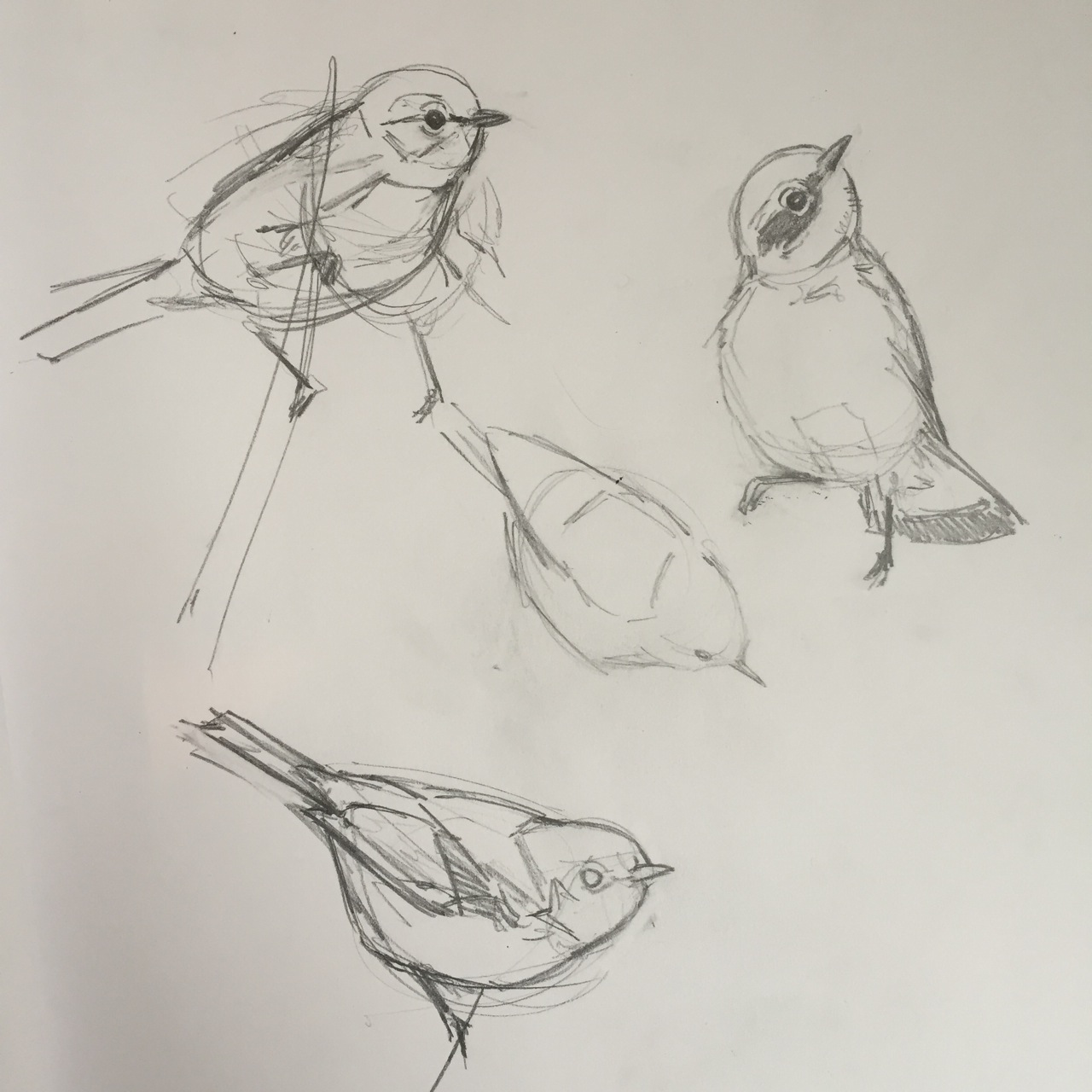
No, I don't think so. The female would be making her own weather, and she'd be front and center, because I've heard Dr. Morris give a wonderful talk about female birds and why they look and act as they do.
All that worked out, it was time to draw the forest and ferns.
You can see the masking film over the birds, and some of the masking fluid on tree trunks and branches.
It's all dry and ready to be painted over.
I'd mask out some tree trunks, and some areas that I wanted to be lit by sun, and the birds, of course. I was thinking hard about what order I'd paint everything. I burn a lot of mental wood in this construction phase. In the photo above, I've put a few tentative needles on paper, and the ugly truth has hit me that these spruce branches are going to look like they're floating on air if I don't mask at least some of those needles out and lay a good juicy background wash behind them. Then, once it dries, I'll paint the dark needles right atop the background wash. The ones I've masked out will survive the background wash, and be lighter in tone than it will be. Crappity crap crap. Ugh. I hate masking needles. But mask I did. I promised myself I wouldn't get totally anal about it and mask every damn needle. Been there, done that.
Kissing that test branch goodbye, I sprayed down the stretched sheet of watercolor paper with clear water. Quickly and boldly, I painted in the sky and water wash. Not much of it would show in the finished painting, but I needed to have light, bright sky and water blue coming through the trees.
While everything was wettish, I laid in the sunshine. It looks really weird, I know, but you have to paint the lightest, brightest values first, and really juice them up, because watercolor dries paler than it goes on. You can always darken something, but it's really hard to lighten something. This stage of the painting amazes me, because it looks nothing at all like the finished piece. That's part of what's so cool about taking photos as you go. You can capture your terror on beholding what you've wrought.
While that was wet, I laid in some dark areas. You can see now that I masked out some understory trash and hay-scented ferns in the lower right corner. Quickly, I brought in some dark green shadows so those masked features would pop out when I finally removed the mask and painted them. It's the wet on wet work that gives this area such life.
Time to define the path through the ferns. Some darker green and some spruce-needle flooring goes in.
This wet on wet work is really fun, but it's also a bit nerve wracking, because you're juggling so many things at once, before everything dries and you can't get those beautiful diffuse washes any more. See the masked-out edges on the upper right of the ferns? Those are going to be bright yellow, like sun, later on.
I continue hacking away at the distant trees. That's kind of fun, because I keep it pretty loose. I'm basically just printing the patterns with the tip of a large flat brush. I am definitely not giving this forest an every-needle treatment. It's going to be hard enough work just painting masses of foliage. You can see the masked masses of foliage shining through the dark background trees.
I take a break to photograph a robin who has plopped into the midst of my Gartenmeister fuchsia. Wow. It's so beautiful out there, so many birds flying through. That looks like a painting itself. Robins. SO beautiful. So lucky to have this thrush be a common bird. But I always drop everything when there's one on the lawn out my studio window, or dipping into the Bird Spa.
I keep filling in the forest. Then I start on the near spruce branches. I want to get them done, and forget to take photos as I work. You can see the masked needles sticking out as pale in the photo below.
I peel off the masking fluid and paint in the paler needles in the branch clusters. I'm really glad I took the time to mask them out, lay in a good background wash, and paint the branches carefully, because they're going to have to hold the birds up, so they need to have a certain amount of realism so they're as believable as the birds.
I peel off the masking compound in the background forest. At this point the forest looks like absolute crap, but I will save it. So much to do yet.
This is my process. I throw some fat into the fire, it flares up, I pull it back out. Repeat until painting is under control or goes up in flames.
Honestly, I haven't had a painting go up in flames in years. I am a dogged thinker and worker. By the time brush and paint hit wet paper, I've thought out most of the pitfalls I know I'll run into, and I'm ready for them. (But see branch masking debacle, above. It's always somethin'). Ach, there's still so much to do, all over this piece. Writing about painting it makes me remember the effort and angst that goes into making something look loose and effortless. Oh, and I worked on this piece off and on from October 27-November 7, getting to the point with each session where I couldn't look at it any more, and going off to do something else. They don't usually take that long, but I don't usually tackle a spruce forest with hay-scented fern understory, either. I knew, even as I planned the painting, that I needed to lose myself for a week or so in the fragrant little universe of Hog Island in summer.
To be continued...
|
Widget for blogger by Way2Blogging | Via Spice Up Your Blog Gadgets
|
Painting Imperial Woodpeckers-Part II
Tuesday, May 14, 2013
6 commentsWhy do I mask all those nitty pine needles, and cuss for hours trying to clean up the boo boo's that masking fluid always leaves?
Because, with enough cussing, it winds up looking cool. Realistic. Ooh! Almost time to paint the birds!! It's been a long day, and I've got more to do on the habitat first. I go into the second day of painting, still cleaning up pine needles.
Those rough scumbled edges on the trunk shadow are deliberate. I want to make sure it still looks like a painting, not a photograph. I want the paint and the process to show around the edges.
I'm excited to start the birds. I always start on the feet. They're non-threatening, fun, hard to mess up, a good place to start. I have to get in the mood to switch from habitat to birds.
Huge claws, and from what I can tell from skins, they were pale--horn-colored, perhaps-- as were the scutes on the legs and feet. I recall Nancy Tanner, widow of ivory-bill authority James Tanner, telling me that ivory-billed woodpeckers had very pale, whitish feet and claws, so I go with her advice and my hunch.
Here she comes, emerging from the clouds. The strongly recurved crest is typical of a female imperial woodpecker. Female ivory-bills showed it too, to a lesser extent.
I try to convey how bouncy it looks in the video. I decide to paint all the blacks on the male, too. I'm guessing on eye color. I have always thought their eyes would be more white than yellow, though most artists depict them as strong golden-yellow. I tend to follow George Sutton's lead, because he painted ivory-bills from life. That's as close as I'll come to knowing the eye color of the imperial.
See how, in painting the sky wash, I've swept a little blue in where I know the white wing patch of the climbing bird will be? I knew I wanted that white patch against blue. These decisions must be made quickly. Wet washes won't wait.
Here comes the red of the male's crest.
That's why I've made him emerging from the hole--so I can put that red against the tree trunk.
Shadows on the birds, highlights in Chinese white stroked across their foreheads and shoulders...I think I'm done. Never mind the pinkish sky here--snapped late at night under incandescent and flourescent light.
The next morning, when the sun finally breaks through, I take the piece outside to photograph it with my Canon 7D. It does such a good job, handheld, that I can see the texture of the watercolor paper (140 lb. cold press Winsor-Newton) in the jpeg. And it nails the colors. Amazing color shifts occur under flourescent and incandescent light. Pardon the progress photos--they were snapped in varying light conditions (mostly poor) and some with my iPhone. I was working so fast I could hardly stop to photograph it. When it's going well I don't stop even to eat. I keep a jar of almonds on the table and keep going.
That's how I work best--with a wicked deadline. See the painting and my review for The Wall Street Journal here.
Or, if you click on this image, you can probably read it right now.
Photo by Myra Owens, kindly scanned and sent to me. Couldn't find a Weekend WSJ in Marietta...but some hard copies are on their way as we speak.
|
Widget for blogger by Way2Blogging | Via Spice Up Your Blog Gadgets
|
Painting Imperial Woodpeckers
Saturday, May 11, 2013
13 comments
I am excited.
photo by Myra Owens, thank you!! If you click on it, you can read it!
In their Weekend May 11-12, 2013 edition, The Wall Street Journal published my first book review, and one of my paintings to accompany it. It's a review of Tim Gallagher's excellent book, Imperial Dreams, about his quest for the most likely extinct imperial woodpecker in the Sierra Madre Range of northern Mexico.
You can read the review at this link.
Longtime readers know that April and May are crazy life-in-a-blender months for me and my family. To the usual mix of nature festival speaking engagements, teaching and travel, add the track meets of our two (ack!) teenagers, various banquets and ceremonies and functions. And then put spring migration and wildflowers and morels and the endless phone calls and now endless Facebook questions about baby birds and nests and what do I do with this bat/bird/injured turtle?
All of which I answer
So I wrote this review and the editor liked it so much he wondered if I might illustrate it too? When could I get a painting to him?
Um, third week of May?
Hm. Not soon enough. We may need to go to print earlier.
Um, first of May? (sweeping an arm across the drawing table to clear it)
Because I really, really wanted to paint this bird for this newspaper.
So I didn't fool around. I got down to deal with it.
Coming to the concept and drawing took a couple of days. Over and over, I watched the only photographic record of the imperial woodpecker, a video made by William Rhein in 1956. I was almost born in 1956.
I decided to paint a nesting pair. Why not? It's a fantasy, right? A what-if scenario. What if these incredible birds were still alive somewhere and breeding in the Sierra Madres? I went there to live for three days. At least in my painting. The sketch is very basic, but it's got all the information I need encoded. I know where the darks will be, how it will roll out.
I masked out the birds's heads, a bunch of Apache pine needles and branches and got busy.
Pasted that paper down and sprayed it down and threw on a sky wash. They come out how they come out. There's no going back over a wash like that.
Ghosted in a mountain range from one of Tim Gallagher's photos. I love the purples and mauves. And laid in the suggestion of more pines behind them.
I decided to put in a couple of big emergent pines to further darken the backdrop against the foreground needles. In the end, those foreground needles would take longer to paint (and correct) than the whole rest of the durn painting. It is ever thus. Grass, pine needles...big old pain in the butt for a watercolor painter.
You can see that I've masked the parts of the birds I don't want to get blue--their heads, backs and white wing patch on the climbing bird. And you can see the ghosted masked pine needles.
I have yet to remove the masking compound ( a rubber cement like liquid).
I put some needles overhead, too, to make it look more like what I saw in the film.
I can't wait to get to the bark of the Apache pine. It's so fluid and colorful. So I start striping varying shades of brown with a big round brush, just moving my hand and brush freely from the elbow, running up and down the trunk.
I want sun on that trunk. And the way to get sun on the trunk is to give it deep shadow. It really starts to pop when I wash in the shadows.
If I want the pine needles to pop, I've got to bring some darks in behind them.
|
Widget for blogger by Way2Blogging | Via Spice Up Your Blog Gadgets
|
I Didn't Get a Picture
Thursday, May 29, 2008
24 comments
This post is for all the ivory-billed woodpecker seekers out there, whether they slog through bayous or dream from their chairs.
As you know, I carry my camera wherever I go, and I've gotten pretty fast on the draw, shooting marginally acceptable to OK to pretty good pictures of the jittery likes of warblers and wild turkeys as well as mushrooms, butterflies, blowfly larvae, and rainbows.
But there are some times when you can't get a picture. Naturally, they are the times when you'd most like to have one. Hence the dedication of this post.
On my last day in the Upper Peninsula of Michigan, I was driving south on Route 123, just north of its intersection with Route 28, on my way from Paradise to Sault Ste. Marie. Several animals crossed the road, bounding and running, perhaps a quarter-mile up ahead. I didn't see much remarkable about the first two; I'm assuming, since they didn't catch my eye, that they were deer, but I couldn't swear to that, since my attention was focused like a laser on the third animal. The first two animals were darting and zigging erratically as they ran. The third was loping, a kind of rocking-horse gait, taking a more direct path, different from the other animals'. It was very long-legged, with a longish neck held erect, and pricked ears. A bushy tail, held low at a 45-degree angle, flowed behind it. It was solid, coal black. I believe it was chasing the first two animals. Whaaa?
Not my photo, though I wish it were. This is a National Park Service photo. But it's exactly what I saw. Aggggghhhh!
It was more than twice the size of any coyote I've ever seen, and entirely too dark. Good of it, to be a black morph animal; no confusing that with a little blonde songdog. Gasping, I realized that I had just seen my first timber wolf.
I slammed on the brakes as I whizzed by where it leapt up a small bank and disappeared in the yard of a deserted log cabin, backed by extensive woodland. I backed up, fishtailing wildly, and pulled into the driveway, looking all around me at the woodland edge, hoping hoping hoping to catch another glimpse of my life wolf. The woods were silent, giving nothing away. I am sure it wheeled around, panting, in dense cover and was watching me. I scanned with my binoculars, looking hardest where it's hardest to see. Nothing. That is how the wolf would have it.
Shaking, exhilarated, I drove on another half-mile when I saw a middle-aged couple with trash bags, picking up litter along the roadside. They looked kind and were dressed for the weather. I figured they lived there, to care that much, and I was right. I pulled over and rolled down the window.
"Excuse me. May I ask you a question?"
"Sure."
"Could I have just seen a wolf?"
"OHH, yeah!" the man replied, smiling broadly. "They're here, even though the DNR will tell you they aren't. They don't want to admit it. But they've been killing our neighbors' dogs two roads over, and when they showed the DNR biologist the tracks he denied it. They (the biologists) don't want them here if they don't have radio collars on."
"So, do you hear them howling?"
"Oh, yes, and coyotes too. You can tell the difference!"
I described my sighting and they smiled and nodded. Yep. That was a wolf. It was really nice to have confirmation from people who live right where I saw the animal, people who know enough and care enough about nature to pick up others' refuse along the road.
A friend with extensive UP experience advises that there is an estimated population of 500 wolves there at present. He's seen them in Canada, but never on the UP, and he was just about as excited as I was to hear of it. That I was given to see one of the few, and a coal-black one at that, seemed like an extravagant gift, a surprise party for my soul.

Photo of a black Denali wolf by Ron Niebrugge, at wildnatureimages.com. Used by permission of the photographer. Thank you, Ron and Janine!
Thank you, Bob Pettit, college biology professor, WPBO board member and hardworking 20th Anniversary Spring Fling organizer, for inviting me to Michigan, for taking good care of me wherever I went, including feeding me pasties, and for arranging to have a wolf chase a couple of deer across my path as I left. I know you had something to do with it. You arranged everything else. Long live Bob, the Whitefish Point Bird Observatory, the Spring Fling, the little cedar in the waterfall, the ivory-billed woodpecker, and the coal-black wolf on Route 123.
As you know, I carry my camera wherever I go, and I've gotten pretty fast on the draw, shooting marginally acceptable to OK to pretty good pictures of the jittery likes of warblers and wild turkeys as well as mushrooms, butterflies, blowfly larvae, and rainbows.
But there are some times when you can't get a picture. Naturally, they are the times when you'd most like to have one. Hence the dedication of this post.
On my last day in the Upper Peninsula of Michigan, I was driving south on Route 123, just north of its intersection with Route 28, on my way from Paradise to Sault Ste. Marie. Several animals crossed the road, bounding and running, perhaps a quarter-mile up ahead. I didn't see much remarkable about the first two; I'm assuming, since they didn't catch my eye, that they were deer, but I couldn't swear to that, since my attention was focused like a laser on the third animal. The first two animals were darting and zigging erratically as they ran. The third was loping, a kind of rocking-horse gait, taking a more direct path, different from the other animals'. It was very long-legged, with a longish neck held erect, and pricked ears. A bushy tail, held low at a 45-degree angle, flowed behind it. It was solid, coal black. I believe it was chasing the first two animals. Whaaa?
Not my photo, though I wish it were. This is a National Park Service photo. But it's exactly what I saw. Aggggghhhh!
It was more than twice the size of any coyote I've ever seen, and entirely too dark. Good of it, to be a black morph animal; no confusing that with a little blonde songdog. Gasping, I realized that I had just seen my first timber wolf.
I slammed on the brakes as I whizzed by where it leapt up a small bank and disappeared in the yard of a deserted log cabin, backed by extensive woodland. I backed up, fishtailing wildly, and pulled into the driveway, looking all around me at the woodland edge, hoping hoping hoping to catch another glimpse of my life wolf. The woods were silent, giving nothing away. I am sure it wheeled around, panting, in dense cover and was watching me. I scanned with my binoculars, looking hardest where it's hardest to see. Nothing. That is how the wolf would have it.
Shaking, exhilarated, I drove on another half-mile when I saw a middle-aged couple with trash bags, picking up litter along the roadside. They looked kind and were dressed for the weather. I figured they lived there, to care that much, and I was right. I pulled over and rolled down the window.
"Excuse me. May I ask you a question?"
"Sure."
"Could I have just seen a wolf?"
"OHH, yeah!" the man replied, smiling broadly. "They're here, even though the DNR will tell you they aren't. They don't want to admit it. But they've been killing our neighbors' dogs two roads over, and when they showed the DNR biologist the tracks he denied it. They (the biologists) don't want them here if they don't have radio collars on."
"So, do you hear them howling?"
"Oh, yes, and coyotes too. You can tell the difference!"
I described my sighting and they smiled and nodded. Yep. That was a wolf. It was really nice to have confirmation from people who live right where I saw the animal, people who know enough and care enough about nature to pick up others' refuse along the road.
A friend with extensive UP experience advises that there is an estimated population of 500 wolves there at present. He's seen them in Canada, but never on the UP, and he was just about as excited as I was to hear of it. That I was given to see one of the few, and a coal-black one at that, seemed like an extravagant gift, a surprise party for my soul.
Photo of a black Denali wolf by Ron Niebrugge, at wildnatureimages.com. Used by permission of the photographer. Thank you, Ron and Janine!
Thank you, Bob Pettit, college biology professor, WPBO board member and hardworking 20th Anniversary Spring Fling organizer, for inviting me to Michigan, for taking good care of me wherever I went, including feeding me pasties, and for arranging to have a wolf chase a couple of deer across my path as I left. I know you had something to do with it. You arranged everything else. Long live Bob, the Whitefish Point Bird Observatory, the Spring Fling, the little cedar in the waterfall, the ivory-billed woodpecker, and the coal-black wolf on Route 123.
|
Widget for blogger by Way2Blogging | Via Spice Up Your Blog Gadgets
|


Thursday, November 10, 2016
6 comments