For years, I've been painting a scene each year for the Wilson Ornithological Society's Willliam and Nancy Klamm Service Award recipient. I get to paint their favorite birds for ornithologists. I love doing that. Always love a challenge, and a keen audience. I've painted everything from goldfinches to great tinamous, and have loved every second of it.

This was 2011's Klamm award for Dr. Charles Blem and Leann Blem. They did the definitive nesting study of prothonotary warblers, and gave outstanding service to the Wilson Ornithological Society. I knew I wanted to paint something that evoked nesting, and I had this notion of a bird tugging at the wiry petioles of red maple flowers. First I had to find out if they used those in their nests, and then if male prothonotaries gather nesting material. Affirmative on both counts. I knew I wanted a dark, rather dull-colored background for the glowing orange bird. So I chose the water's surface on a dark and rainy day. The Blems loved the painting. Score!
In 2010, Dr. Jerome Jackson, pre-eminent expert on ivory-billed woodpeckers, received the award.
I'd worked closely with him to create this painting for an article he'd written for The Auk, the journal of the American Ornithologists' Union. It would be the cover of the journal. The emails, sketches and jpegs flew between us, and it was a thrill, honor and delight to collaborate with Dr. Jackson on this rather complex painting. (The reflection of the flying bird drove me NUTS). So it was a great surprise for him to receive the original as his award!
Well, Sara Morris, who is the ornithologist and college professor who has been commissioning these paintings all these years, and who has been the one to deal with me and also the one who gets to open the big flat box when it's all done, wanted a painting for herself at long last. She had been given the Koessler Distinguished Faculty Award at Canisius College in Buffalo, New York, where she lights the intellectual fires of students every day. And she decided to use the award to commission a painting from me!
I cackled with glee at the prospect of painting something for Sara. She loves all the same birds I do. Would it be a collared redstart, a Blackburnian warbler, or a magnolia warbler?
Magnolia warbler finally won out. Whoot!! I love those little birds! I was down for it. And I knew I wanted to create a scene that evoked the sights and scents of Hog Island Audubon Camp off Bremen, Maine, to which Sara has devoted so much of her expertise and enthusiasm and knowledge over the years.
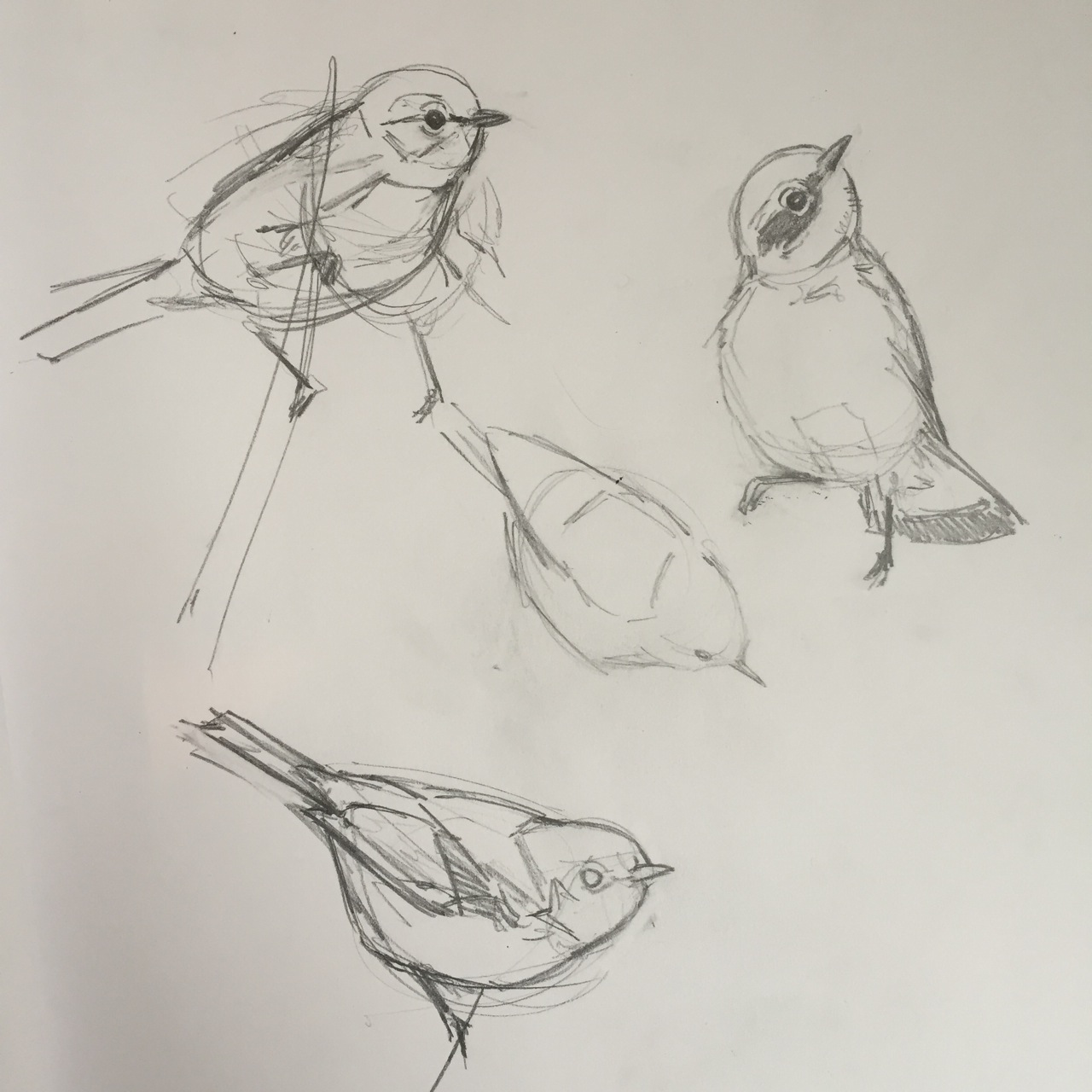
It doesn't look like much, I know, but it's all encoded in the first concept sketch. I love this stage of creating a painting. Looking at it, I shoulda stuck closer to this composition! Ah well.
Would the male be singing? The female looking on adoringly? Hmm.
No, I don't think so. The female would be making her own weather, and she'd be front and center, because I've heard Dr. Morris give a wonderful talk about female birds and why they look and act as they do.
All that worked out, it was time to draw the forest and ferns.
You can see the masking film over the birds, and some of the masking fluid on tree trunks and branches.
It's all dry and ready to be painted over.
I'd mask out some tree trunks, and some areas that I wanted to be lit by sun, and the birds, of course. I was thinking hard about what order I'd paint everything. I burn a lot of mental wood in this construction phase. In the photo above, I've put a few tentative needles on paper, and the ugly truth has hit me that these spruce branches are going to look like they're floating on air if I don't mask at least some of those needles out and lay a good juicy background wash behind them. Then, once it dries, I'll paint the dark needles right atop the background wash. The ones I've masked out will survive the background wash, and be lighter in tone than it will be. Crappity crap crap. Ugh. I hate masking needles. But mask I did. I promised myself I wouldn't get totally anal about it and mask every damn needle. Been there, done that.

Kissing that test branch goodbye, I sprayed down the stretched sheet of watercolor paper with clear water. Quickly and boldly, I painted in the sky and water wash. Not much of it would show in the finished painting, but I needed to have light, bright sky and water blue coming through the trees.
While everything was wettish, I laid in the sunshine. It looks really weird, I know, but you have to paint the lightest, brightest values first, and really juice them up, because watercolor dries paler than it goes on. You can always darken something, but it's really hard to lighten something. This stage of the painting amazes me, because it looks nothing at all like the finished piece. That's part of what's so cool about taking photos as you go. You can capture your terror on beholding what you've wrought.
While that was wet, I laid in some dark areas. You can see now that I masked out some understory trash and hay-scented ferns in the lower right corner. Quickly, I brought in some dark green shadows so those masked features would pop out when I finally removed the mask and painted them. It's the wet on wet work that gives this area such life.
Time to define the path through the ferns. Some darker green and some spruce-needle flooring goes in.
This wet on wet work is really fun, but it's also a bit nerve wracking, because you're juggling so many things at once, before everything dries and you can't get those beautiful diffuse washes any more. See the masked-out edges on the upper right of the ferns? Those are going to be bright yellow, like sun, later on.
I continue hacking away at the distant trees. That's kind of fun, because I keep it pretty loose. I'm basically just printing the patterns with the tip of a large flat brush. I am definitely not giving this forest an every-needle treatment. It's going to be hard enough work just painting masses of foliage. You can see the masked masses of foliage shining through the dark background trees.
I take a break to photograph a robin who has plopped into the midst of my Gartenmeister fuchsia. Wow. It's so beautiful out there, so many birds flying through. That looks like a painting itself. Robins. SO beautiful. So lucky to have this thrush be a common bird. But I always drop everything when there's one on the lawn out my studio window, or dipping into the Bird Spa.
I keep filling in the forest. Then I start on the near spruce branches. I want to get them done, and forget to take photos as I work. You can see the masked needles sticking out as pale in the photo below.
I peel off the masking fluid and paint in the paler needles in the branch clusters. I'm really glad I took the time to mask them out, lay in a good background wash, and paint the branches carefully, because they're going to have to hold the birds up, so they need to have a certain amount of realism so they're as believable as the birds.
I peel off the masking compound in the background forest. At this point the forest looks like absolute crap, but I will save it. So much to do yet.
This is my process. I throw some fat into the fire, it flares up, I pull it back out. Repeat until painting is under control or goes up in flames.

Honestly, I haven't had a painting go up in flames in years. I am a dogged thinker and worker. By the time brush and paint hit wet paper, I've thought out most of the pitfalls I know I'll run into, and I'm ready for them. (But see branch masking debacle, above. It's always somethin'). Ach, there's still so much to do, all over this piece. Writing about painting it makes me remember the effort and angst that goes into making something look loose and effortless. Oh, and I worked on this piece off and on from October 27-November 7, getting to the point with each session where I couldn't look at it any more, and going off to do something else. They don't usually take that long, but I don't usually tackle a spruce forest with hay-scented fern understory, either. I knew, even as I planned the painting, that I needed to lose myself for a week or so in the fragrant little universe of Hog Island in summer.
To be continued...








Thursday, September 3, 2020
12 comments