Background Switcher (Hidden)

Showing posts with label Wilson Ornithological Society. Show all posts

How to Paint a Bunting

Thursday, September 3, 2020

12 comments

 I'm telling about the execution of my most recent Klamm Award commission for the Wilson Ornithological Society. Each year, the Society commissions me to paint something (a bird and associated stuff) for the winner. The recipient in 2020 is John Kricher, multitalented author of  the recently updated A Neotropical Companion, a classic in the natural history field, and now author of the just-published, lavishly illustrated Peterson Guide to Bird Behavior. 

John's wife, Martha Vaughan, was in on the secret award, and she selected a bird that's one of his favorites--a painted bunting! John and Martha are avid bird art enthusiasts, and they already own a few of my pieces, so I was thrilled beyond thrilled to paint something to surprise John.


I emailed Martha to ask if there was any particular setting she'd like me to use. Yes! She and John had lived in Sunbury, GA, south of Savannah, for parts of ten years and had fond memories of both the coastal marsh and of getting to know painted buntings. She asked for a " 'Georgia On My Mind' setting: a palmetto and some Spanish moss, a bit of tidal river marsh."

Well all right! But I wanted to get it exactly right, so I went back to Martha, asking if she might be able to lay her hands on any reference photos. 

"Luckily when we sold our condo and left Sunbury, GA , John gave me a big file of photos that he had taken over the times we spent there.  I uploaded that file and skimmed it for photos that give a sense of what you are looking for.  I have attached six photos that should help you get the ambience of the region and of our marsh, which we both dearly miss.  I included some that actually have painted buntings in them since John really liked them and getting photos of them."

She sent some real beauties. Here is one of John's photos of a painted bunting in palmetto. Now, the first thing I notice about this is the relative scale of bird to plant. Palmettos are big plants, and there's really no way to get an entire, recognizable palmetto in a painting of buntings, if the bird is perched in the palmetto. You can get pieces of palmetto, but that's about it.

And so began many days of thumbnail sketches, trying to figure out how to incorporate 
"a palmetto and some Spanish moss, a bit of tidal river marsh."


I was delighted to get a photo of a bunting next to Spanish moss, and some kind of oak or holly with more proportionately sized leaves. This would be an important shot, going forward. 


But first I had to bash away at palmettos. They are absolutely lovely plants. But they're just huge. 


I was so tempted by this gorgeous shot. But if it were sitting in a palmetto, the bunting would be approximately the size of the word "alamy" in this photo. How to do this??


I remember the evening when the epiphany hit me that I had to push the palmetto into the middle distance and use the broad-leaved shrub as their perch. That would take care of the morass I was in, of trying to figure out how to scale everything properly. I went to bed happy at last, slept on it, got up the next morning and drew the final composition.

I thought the Georgia marsh so very beautiful, and the few times I'd seen painted buntings, they were near great expanses of marsh and water. So I decided to make the marsh the co-star of the painting. 

As I wrote to John and Martha:

Putting it all together turned out to be the work of weeks, all internal, all thinking and stewing and throwing sketch after sketch into the circular file. The thing that was throwing me was scale. Palmettos are huge plants, and I loved the graphic possibilities of brilliant little birds against their massive fronds. If I drew that, though, I couldn’t figure out how to give “a bit of salt marsh” through them, and also include Spanish moss. I took those three elements: palmetto, Spanish moss, and marsh, and mashed them together in every way I could come up with. Thanks to the tiny-bird-large-frond issue, the palmetto always overpowered the composition and the birds, too. I realized that what I (and probably you) loved the most was the “bit of salt marsh,” that feeling of place, exactly where the birds make their living. So I backed up and started over. Composed the marsh landscape. Then figured out how to work in palmetto in the middle distance, and put the Spanish moss in the front with the birds, because it was in scale with the birds, at least, and wouldn’t take over the composition. I’m not sure what the shiny-leaved thing is—yaupon? Oak? It made a fine foil for the birds, so in it went.


As I often do, I started on the rattiest, thorniest, hardest part first: the Spanish moss. Ugggh! My moss wasn't looking very good. How do I do this??
I masked out the palmettos with masking compound, which makes them look yellowish.


Define, define, define. Take a break and paint a sunset sky. This sky went in in a matter of minutes. Since I knew there would be a big dark oak over most of it, I didn't worry too much about the right side. Just enough to suggest the continuity of colors behind the tree. Fun!


As long as I was on a roll, I decided to paint the marsh. Now you see where the masking compound comes in. 


To spotlight the palmettos, I worked in some darks behind them--coastal scrub.


Bringing the marsh greens and the dark coastal shrubbery up behind the Spanish moss sure helped tie the painting together. 
As a painter you just have to have faith that you're going to be able to pull your fat out of the fire.  Speaking of which, the palmettos...errgh. Time to peel off the masking compound and get painting on those.


Oh man, the nitty gritty interface of all those leaves and the dark background, cleaning up all the messy bits, figuring out who overlaps whom...


That part wrestled to the ground, the tree began to grow. 


And as it grew, a funny thing happened -- the sunset began to sing.


Running the dark line of trees beyond the marsh helped tie the scene together. And a few judiciously placed dark marsh edges defined the channel, which glows with the same colors as the sunset. Ahh.


Let's put a bird on it. No other bird in the U.S.  has the precise shade of sea-green as the female painted bunting. 


And needless to say there is no more colorful bird in the States than the male painted bunting. 


It is unreal in any setting. What a miracle it is! It would all be too much without the royal blue head!


More Spanish moss, please, and longer...


Now the humid breeze is blowing, and I am slapping greenheads.


The birds and the glowing channel, and the little catwalk we'd use to get out to the boat, if we had one.


I worked late into the night, cleaning up palmettos and Spanish moss...


I think it's done. As usual, painting the birds was the very least of it. From my letter to John and Martha:

 For me, it’s all about the setting, about the experience of seeing the bird. I could cop out and do a vignette with a washy background and some sprig of plant, but what would that say about painted buntings? What would that say to you? I wanted to take you back to the marsh view you loved and miss so much. I wanted you to feel the humid sea breeze, smell the marsh, and see the sunset again; to enjoy the lurid colors of painted buntings, colors found on no other birds in North America, and do all that without having to slap a single greenhead. I hope you get to go back in real life, but also hope that this painting takes you there each time you look at it. 

As framed by the Wilson Ornithological Society for presentation to John Kricher: 

 
With all that dark matting it looks to me like a window, looking out on a fabulous fantasy scene! 

Yes, I Still Paint Birds!

Wednesday, August 26, 2020

15 comments


I am a very lucky bird painter. Every year, the Wilson Ornithological Society commissions a painting from me for their Robert and Nancy Klamm Award for service to the Society. The bird depicted is usually one that the receiving ornithologist has studied or just has a passion for. That's a thrill to me, to paint for ornithologists, to try to capture a scene that will say a lot about the species and, in doing that, perhaps delight them. It's a privilege to do it. 

I know I've done at least a dozen of these over the years, and probably more, but my memory fails me. I went back into my emails to 2015, and searched my computer for jpegs of prior paintings, and between that and my hazy memory, I came up with ten commissions that I remember doing and for which I have photos. An early one was this great tinamou from 2008. That was FUN. Just had to show those highly polished turquoise eggs that make NO SENSE whatsoever for a ground-nester in Neotropical Predatorville, but somehow still exist, persist, and produce baby tinamous. Maybe the eggs are so beautiful, like precious treasure, to make the bird stay invested in sitting on them nonstop so nothing eats them. A just-so story from my hazy mind. Who can say why tinamous polish their turquoise eggs?


I really enjoyed painting this prothonotary warbler in the rain, 2012. I was thinking about what would be nice with its glowing golden color, and I settled on a rainy gray day, because green just seems to compete. As I sketched, I wondered if they ever used red maple flower petioles in their nests. Eastern bluebirds, also cavity nesters, like them and use them as a springy mattress in their nests, and it seemed to me that would be a good nesting material for a swamp bird (red maples being swamp trees). So I took a gamble and painted a male tugging on one against a rainy, watery backdrop.  (First ascertaining that the male participates in nest building). Turns out, the award recipient knew that they DO use red maple petioles in their nests, and he was delighted with the little natural history factoid that informed the painting.


Sometimes the bird in question is one so deeply familiar to me that I have only to look out the window to sketch and observe it. Such was the American goldfinch pair, pictured in chicory on my own road. It was  done in 2013, in a looser watercolor style, and I had fun with it. 


I thought the recipient of a house wren, being an ornithologist, might enjoy an intimate, Baby Birds-style look into the nest, so I did a sort of decorative take on a nest that was in a box in my driveway in 2014. Pretty sure I painted this in 2017.


In the summer of 2019, I painted an American kestrel in a newly-mown field that I frequent. It's the monarch meadow, mown down in late June, before it springs back up to delight me and the butterflies in August. I felt I had to paint the kestrel in flight, though I struggled with myself, wanting to depict its ornate plumage close up, as in a sitting pose. Flying won out, because for me, it's as much about the setting as it is the bird itself. I wanted to paint a big space for that beautiful little dart to traverse. I have been playing with some of the more difficult colors in sky washes and having fun with that. Like, how do you make a blue sky grade to yellow without its going green in the middle? Well might you ask.

The answer is that you don't let the two colors touch enough to mix. You leave a sort of buffer of wet Chinese white, that serves to keep them from commingling and making a green band across the sky. The two colors kiss, but don't embrace. Chinese white is a solid body pigment and it settles into the paper and keeps the other pigments from spreading too much. At least that's how I think it works. Still, the effect is of a gradual gradation, and that's what I was after.


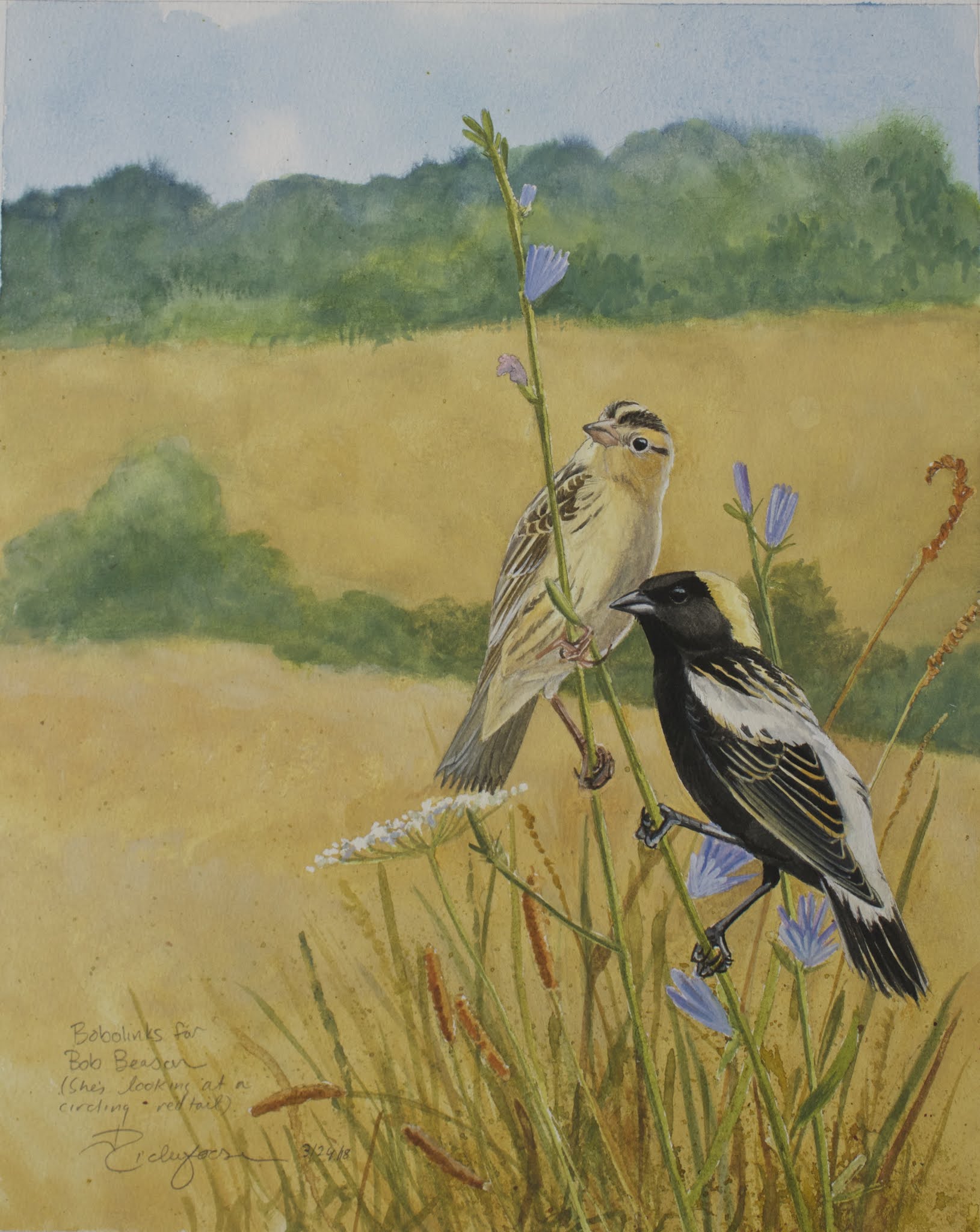
I loved doing the fieldwork for this one! Bobolinks, pictured with chicory and Queen Anne's lace in a place I know in McConnellsville, Ohio. 
I like the dreamy nature of this one. In each of my paintings, I try to do something new, to stretch myself a bit and learn something. That keeps it fresh and fun. That, and the fact that I do maybe two commissions a year.


One of the most special Klamm award paintings in my memory was this oversized piece featuring life-sized swamp and song sparrows for the late Jed Burtt, a great spirit, great teacher and a legend in Ohio ornithology. I raced the clock in late fall 2015 as his heart was failing, and got it done in time to send him photos  of it in progress and finished. He got to receive and enjoy the framed original too.  I remember picking colored black raspberry leaves and deertongue and bringing it into the studio before Thanksgiving. I had to be careful to paint the birds in fresh fall plumage, with that gorgeous buffy bloom, to match the autumnal state of the leaves. Sparrows are never lovelier than in autumn.


So that's a stroll through some of my Wilson Ornithological Society Klamm Award favorites. I thought it would be fun to give you a step-by-step of my latest, which was just gifted to a recipient who happens to be a friend.  I'll tell the story of how that painting evolved and came to be in the next posts.


A Painting for Sara: Watercolor Demo

Thursday, November 10, 2016

6 comments
For years, I've been painting a scene each year for the Wilson Ornithological Society's Willliam and Nancy Klamm Service Award recipient. I get to paint their favorite birds for ornithologists. I love doing that. Always love a challenge, and a keen audience. I've painted everything from goldfinches to great tinamous, and have loved every second of it.


This was 2011's Klamm award for Dr. Charles Blem and Leann Blem. They did the definitive nesting study of  prothonotary warblers, and gave outstanding service to the Wilson Ornithological Society. I knew I wanted to paint something that evoked nesting, and I had this notion of a bird tugging at the wiry petioles of red maple flowers. First I had to find out if they used those in their nests, and then if male prothonotaries gather nesting material. Affirmative on both counts. I knew I wanted a dark, rather dull-colored background for the glowing orange bird. So I chose the water's surface on a dark and rainy day. The Blems loved the painting. Score!

In 2010, Dr. Jerome Jackson, pre-eminent expert on ivory-billed woodpeckers, received the award. 
I'd worked closely with him to create this painting for an article he'd written for The Auk, the journal of the American Ornithologists' Union.  It would be the cover of the journal. The emails, sketches and jpegs flew between us, and it was a thrill, honor and delight to collaborate with Dr. Jackson on this rather complex painting. (The reflection of the flying bird drove me NUTS). So it was a great surprise for him to receive the original as his award!


Well, Sara Morris, who is the ornithologist and college professor who has been commissioning these paintings all these years, and who has been the one to deal with me and also the one who gets to open the big flat box when it's all done, wanted a painting for herself at long last. She had been given the Koessler Distinguished Faculty Award at Canisius College in Buffalo, New York, where she lights the intellectual fires of students every day. And she decided to use the award to commission a painting from me! 

  I cackled with glee at the prospect of painting something for Sara. She loves all the same birds I do. Would it be a collared redstart, a Blackburnian warbler, or a magnolia warbler?

Magnolia warbler finally won out. Whoot!! I love those little birds! I was down for it. And I knew I wanted to create a scene that evoked the sights and scents of Hog Island Audubon Camp off Bremen, Maine, to which Sara has devoted so much of her expertise and enthusiasm and knowledge over the years. 


It doesn't look like much, I know, but it's all encoded in the first concept sketch. I love this stage of creating a painting.  Looking at it, I shoulda stuck closer to this composition! Ah well. 


Would the male be singing? The female looking on adoringly? Hmm.


No, I don't think so. The female would be making her own weather, and she'd be front and center, because I've heard Dr. Morris give a wonderful talk about female birds and why they look and act as they do.

All that worked out, it was time to draw the forest and ferns.

  
You can see the masking film over the birds, and some of the masking fluid on tree trunks and branches.
 It's all dry and ready to be painted over. 

I'd mask out some tree trunks, and some areas that I wanted to be lit by sun, and the birds, of course. I was thinking hard about what order I'd paint everything. I burn a lot of mental wood in this construction phase.  In the photo above, I've put a few tentative needles on paper, and the ugly truth has hit me that these spruce branches are going to look like they're floating on air if I don't mask at least some of those needles out and lay a good juicy background wash behind them.  Then,  once it dries, I'll paint the dark needles right atop the background wash.  The ones I've masked out will survive the background wash, and be lighter in tone than it will be. Crappity crap crap. Ugh. I hate masking needles. But mask I did.  I promised myself I wouldn't get totally anal about it and mask every damn needle. Been there, done that. 


Kissing that test branch goodbye, I sprayed down the stretched sheet of watercolor paper with clear water. Quickly and boldly, I painted in the sky and water wash. Not much of it would show in the finished painting, but I needed to have light, bright sky and water blue coming through the trees. 


While everything was wettish, I laid in the sunshine. It looks really weird, I know, but you have to paint the lightest, brightest values first, and really juice them up, because watercolor dries paler than it goes on. You can always darken something, but it's really hard to lighten something. This stage of the painting amazes me, because it looks nothing at all like the finished piece. That's part of what's so cool about taking photos as you go. You can capture your terror on beholding what you've wrought.


While that was wet, I laid in some dark areas. You can see now that I masked out some understory trash and hay-scented ferns in the lower right corner. Quickly, I brought in some dark green shadows so those masked features would pop out when I finally removed the mask and painted them. It's the wet on wet work that gives this area such life. 

Time to define the path through the ferns. Some darker green and some spruce-needle flooring goes in. 


This wet on wet work is really fun, but it's also a bit nerve wracking, because you're juggling so many things at once, before everything dries and you can't get those beautiful diffuse washes any more. See the masked-out edges on the upper right of the ferns? Those are going to be bright yellow, like sun, later on. 


I continue hacking away at the distant trees. That's kind of fun, because I keep it pretty loose. I'm basically just printing the patterns with the tip of a large flat brush. I am definitely not giving this forest an every-needle treatment. It's going to be hard enough work just painting masses of foliage.  You can see the masked masses of foliage shining through the dark background trees. 


I take a break to photograph a robin who has plopped into the midst of my Gartenmeister fuchsia. Wow. It's so beautiful out there, so many birds flying through. That looks like a painting itself. Robins. SO beautiful. So lucky to have this thrush be a common bird. But I always drop everything when there's one on the lawn out my studio window, or dipping into the Bird Spa. 


I keep filling in the forest. Then I start on the near spruce branches. I want to get them done, and forget to take photos as I work.  You can see the masked needles sticking out as pale in the photo below. 


I peel off the masking fluid and paint in the paler needles in the branch clusters. I'm really glad I took the time to mask them out, lay in a good background wash, and paint the branches carefully, because they're going to have to hold the birds up, so they need to have a certain amount of realism so they're as believable as the birds. 


I peel off the masking compound in the background forest. At this point the forest looks like absolute crap, but I will save it. So much to do yet.

This is my process. I throw some fat into the fire, it flares up, I pull it back out. Repeat until painting is under control or goes up in flames.


Honestly, I haven't had a painting go up in flames in years. I am a dogged thinker and worker. By the time brush and paint hit wet paper, I've thought out most of the pitfalls I know I'll run into, and I'm ready for them. (But see branch masking debacle, above. It's always somethin'). Ach, there's still so much to do, all over this piece. Writing about painting it makes me remember the effort and angst that goes into making something look loose and effortless. Oh, and I worked on this piece off and on from October 27-November 7, getting to the point with each session where I couldn't look at it any more, and going off to do something else. They don't usually take that long, but I don't usually tackle a spruce forest with hay-scented fern understory, either. I knew, even as I planned the painting, that I needed to lose myself for a week or so in the fragrant little universe of Hog Island in summer. 

To be continued...


[Back to Top]