Background Switcher (Hidden)

Showing posts with label Sandhill cranes. Show all posts

Tennessee Sandhill Crane Hunt...Proposed Again

Tuesday, July 30, 2013

13 comments


It's baaaack.

After a two-year moratorium, Tennessee is once again proposing a hunt on its wintering sandhill cranes.


The Eastern Flyway sandhill crane population has recovered from near extinction in the last 70 years—in our lifetime--and state game managers have taken notice. Their reasoning appears pretty simple: There are enough cranes around now to shoot some. My reasoning is simple too. Does that mean they must be shot? Is giving a small set of hunters one more bird species to aim at ultimately going to be worth the ill will and polarization of camps between the growing throngs of wildlife watchers and the shrinking ranks of hunters?  For the fact-checkers out there: The USFWS estimates that 33 states saw declines in hunting license sales over the last two decades. Massachusetts alone has seen a 50 percent falloff in hunting license sales in that period. Yes, hunting is declining. Maybe if we offer more species that can be shot...

So let's follow this line of reasoning. There are enough cranes out there now to shoot some without causing another population crash. All right then. There are surely enough red-tailed hawks sitting along the nation's highways to shoot some of them. Robins? Those things are everywhere, and tasty, too. And come to think of it, new great blue heron rookeries are popping up all over the place. A little fishy-tasting, but with the right marinade...

photo by Cyndi Routledge

Ultimately, the proposal to hunt Tennessee’s sandhill cranes is about hubris. It’s about manipulating wild populations as we see fit, about tilting the balance of nature toward huntable species by feeding them artificial foods and encouraging them to hang around to provide us a little sport. Try as I might, I cannot cram the lanky four-foot length of a sandhill crane into the slot in my brain marked “Game Species.” They’re too tall, too graceful, too ancient and yes, much too magical. There goes my heart again. Head says: They reproduce too slowly,  producing one colt per year if they’re lucky. 


watercolor by JZ


 Ducks and geese can lay a dozen eggs; a crane lays two, and only one colt usually survives. That youngster is still heavily dependent on its parents for guidance in its first winter of life, and yet we’re proposing to let hunters shoot right into those family units. For sport. For fun. For food, maybe, if they have enough strong marinade.  Pretty gamey, I’m told. I intend never to find out for myself.


We should not be marinating the meat of sandhill cranes. We should be looking up at them alive and flying, our heads thrown back in wonder, gratitude and awe. We should be searching their cloud-gray numbers for the big white cranes who travel with them, and are at risk of being shot, their  precious genes squandered in the mud of a cornfield.
Photo by Vickie Henderson

In my view, the great irony in this whole proposal to hunt cranes is that the majority of people who are aware cranes exist feel exactly as I do, vastly outnumbering those who would like to take a shot at one. Note to Tennessee, Kentucky and Wisconsin: Those cranes you're proposing to shoot are everyone's cranes, not just yours. They may breed in Wisconsin and pass through the southern states, but they belong to everyone, and your proposal to let a small subset of hunters fire on them is not popular with the majority who want them left alone. You are shooting yourself in the foot.

People who believe strongly in their perceived right to hunt whatever they wish can be  persuasive in characterizing birders and wildlife watchers as soft-headed and silly for having an emotional connection to birds and animals, for being guided by heart and not head. I believe to my core that it is desirable to hold some species sacred. I feel that way about sandhill cranes because I have observed, from Nebraska to New Mexico, from Michigan to Ohio, that they are potent ambassadors for wild things and wild places to the many thousands of people who are moved by them. These are not necessarily birders, just ordinary people who are stirred by the sight and sound of cranes. Cranes, I submit, are worth infinitely more alive than dead. Just ask the director of the Lillian Annette Rowe Sanctuary on Nebraska's Platte River, where sandhill crane tourism brings 15,000 visitors from all 50 states and 46 foreign countries; brings more than $10 million into the local economy every year. All without firing a single shot. Wildlife watching is the fastest growing sector in tourism.

I'd love to do this experiment. Take 1,000 people who know what a sandhill crane is. What percentage of them do you think would want to bring one down with a gun? What percentage would simply want to watch one fly overhead? We haven't even begun to tap the tourism potential of live Eastern Flyway cranes, and states are already proposing to shoot them?


My Israeli friend Jonathan Meyrav, who was a founder of the Hula Valley Birding Festival, which celebrates the masses of common cranes which winter in Israel's strip of marshland, recoiled when I told him of American hunting seasons, existing and proposed, on cranes. "Absurd!" he said. 

Yes. Absurd. But real, and about to be rammed down our throats. We must make our objections known, quickly.

Here's what to do.


IMMEDIATE COMMENTS NEEDED!
Now is the time to express your opinion about the proposed Sandhill Crane hunt in Tennessee: 
Please, if you haven't already read OM CEO Joe Duff's Field Journal entry from July 24th regarding the proposed Sandhill Crane hunt in Tennessee.

1) The USFWS has posted the proposed rule for a Tennessee Sandhill season in the Federal Register. The Federal public comment period ends AUGUST 5, 2013.  Go to http://www.regulations.gov/#!documentDetail;D=FWS-HQ-MB-2013-0057-0052, click on the blue "Comment Now" button and follow the instructions to submit comments on Docket No. FWS-HQ-MB-2013-0057.  (To read the section concerning Sandhill Cranes scroll down to #9 Sandhill Cranes)

2) On the state level, Tennessee Wildlife Resource Agency (TWRA) is accepting comments until AUGUST 10, 2013. Email comments toTWRA.Comment@tn.gov (with the subject line "Sandhill Crane"), Ed Carter (ed.carter@tn.gov), TWRA Director,and/or Dr. Jeff McMillin (jeff.mcmillin@tn.gov), TFWC Chairman.  Letters may also be mailed to the Tennessee Wildlife Resources Agency, Attn. Sandhill Crane Hunt, P.O. Box 40747, Nashville TN 37204.  

If recommended by TWRA, a vote on the season by the TN Fish and Wildlife Commission will take place on August 22 and 23 in Knoxville, TN

For more information go to http://kyc4sandhillcranes.com/eastern-states/tennessee/

Thank you, and please spread the word!

I've borrowed this from Operation Migration's appeal. Thank you to all who are fighting this proposal, and thank you to all who act.

JZ


Kentucky's Crane Hunt

Tuesday, June 14, 2011

18 comments

For those of you who've been following the drama unfolding in Kentucky regarding a sandhill crane hunt, there's bad news. An eight-member commission unanimously approved the hunt proposal in early June.  Which wasn't a surprise, since everyone on the commission is a hunter. Thousands of letters and emails of protest apparently fell on deaf ears. Not surprising, but certainly disappointing. Shooting could start as early as mid-December 2011.

However.

Kentucky's wildlife offices have been flooded with protests, whether written, telephoned or emailed. It's probably of little use to further bombard Commissioner Jon Gassett with your good letters. Go ahead and check out his company, Southern Wildlife Resources LLC .  Now, I don't know much about conflict of interest or what taxpayer-paid state employees should or shouldn't be doing on their own time, but it looks to me as if he's offering the same services his Department of Fish and Wildlife does, only for personal profit. Brokering land to hunters, hooking them up with guide services...all for a fee. It isn't hard even for a simple bird painter to divine that Commissioner Gassett stands to gain financially from a crane hunt in Kentucky. No wonder his state office answering machine has a message on it expounding on the delicious meat of the sandhill crane. No, let's not write any more letters to Dr. Gassett. That dog don't hunt. Or rather, he does.

How about writing the Governor? And how about taking a few minutes to do it now? Here's an easy, quick link to a comment form on Kentucky Governor Steve Beshear's web site. He'll be deciding on the proposal TODAY, June 15. Let's give him a respectful little burst of opposition, huh?

                                    http://www.governor.ky.gov/contact/contact.htm


Photo by Cyndi Routledge

 These birds belong to all of us, not just a few hundred gunmen. Why should they get to unilaterally decide that the sandhill crane will be a game bird in Kentucky? 

We must make our voices heard.
As always, thank you for caring. And especially for acting.

Tennessee Tables Crane Hunt!

Sunday, January 23, 2011

6 comments


On Friday, January 21, the Tennessee Wildlife Resources Agency voted to table the proposal to open season on sandhill cranes for two years. More than 100 people packed the Nashville hall to present hunting arguments both pro and con, but the con's carried the day, buoyed by the thousands of letters, emails, calls and comments received by TWRA since October. Remember my first post in October, when I told you TWRA Commissioner Michael Chase had received exactly one letter of dissent, from concerned Tennesseean Janet McKnight? You changed that.


photo by Vickie Henderson

The Tennesseean has an article about the meeting and the decision. The lack of good data about this eastern flyway crane population was central to the arguments against the hunt. In deciding against instituting a hunting season now, TWRA recognized that a hunt proposal perhaps partially based on one year's huge (and likely unrepeatable) apparent gain in crane numbers is premature. To recap, here are the crane counts for the past six years:

2006: 14,158
2007: 14,698
2008: 12,945
2009: 20,191
2010: 48,505

And this just in--the January 2011 count. Well, would you look at that: back down to an unprecendented low.

2011: 11,000

It's been cold and snowy in Tennessee this winter, and the low 2011 count likely means that many of the  cranes have pushed farther south. Midwinter counts can be misleading in both directions. A long-lived, slow-reproducing bird in which only 30% of nesting pairs manage to raise a single chick each year (or, to put it another, more sobering way, a species which raises an average of .33 chicks per pair per year) is not subject to sudden population explosions. It is, however, quite vulnerable to population crashes. We need to keep that in mind when we're putting it in the crosshairs.
photo by Vickie Henderson


Some biologists are now speculating that the freakishly high January 2010 count was the result of a weather event that froze all open water at Indiana's Jasper-Pulaski Fish and Wildlife Area, sending the cranes that normally winter there packing farther south to Tennessee. As many as 30,000 sandhill cranes may gather at the Indiana refuge in a big winter. And guess what?

As many as 30,000 people may come to see them at J-P in a single season--200 people per day. Sounds like a nice ratio: A crane for every human. But not... a crane in every pot. A flying, calling, purring crane, winging high overhead or stepping gracefully through the corn stubble.


Cranes will be flying, calling and purring, safe from gunshots, for at least two more years in Tennessee. They'll be drawing thousands of visitors to Hiwassee Refuge to enjoy them--and eat, bunk in hotels, and shop at local businesses while they're at it.

If crane enthusiasts, spearheaded by the Tennessee Ornithological Society's Melinda Welton and Vickie Henderson, have their way, they'll be safe for much longer than that. Vickie has drawn up a petition to the U.S. Fish and Wildlife Service to take another look at its Management Plan for the Eastern Population of Sandhill Cranes. To take the provision for hunting seasons along the Eastern Flyway out of it, at least until more is known about this population's dynamics, movements, and reproductive viability.

Here's the petition site. Please, sign it.


 photo by Vickie Henderson

Tell the U.S. Fish and Wildlife Service that you don't want to see sandhill cranes gunned down in the Eastern Flyway.


photo by Vickie Henderson


Oh. And thank you for writing, calling, emailing, voting, signing. I think you know now that you've made a difference.

 Special thanks to Janet McKnight for first alerting this hermit to the proposal to hunt Tennessee's sandhill cranes.  Thanks to Gary Loucks , Melinda Welton, Vickie Henderson and Cyndi Lawrence Routledge for fighting the good fight on their own home turf. Never underestimate the power of uppity women (and men). We're going to need them--remember, this is just a reprieve in Tennessee. Kentucky's just proposed its own sandhill crane hunt and, not surprisingly, isn't accepting public comment. Well, that doesn't stop anyone from calling and writing their legislators, does it?  Here's one place to start.     


Kentucky Department of Fish and Wildlife Resources
1 Sportsman's Lane
Frankfort, KY  40601 800-858-1549                


Out on Whitefish Point

Thursday, May 22, 2008

13 comments
I was in Michigan to speak at Whitefish Point Bird Observatory's annual Spring Fling at the end of April. These are hardy people, with a different way of defining "spring" than we have down here in subtropical Ohio. They go by the calendar, not by the weather, and if the calendar says it's spring, well then it is. They go out.
wintergear
I love nautical disaster art. I find myself wondering what it might be like to look at a beautiful work of art, having lived through a disaster. Hey, it wasn't teal blue out there. It was PITCH BLACK and you couldn't see your hand in front of your face. But that's a really nice painting.
shipwrecksign

Whitefish Point is famous as the place where the Edmund Fitzgerald went down, taking 29 souls with it. This billboard is for my friend Grady, who loves shipwrecks most of all. Well, at least he did when I saw him last. He may have moved on to trainwrecks by now.

whitefishlight

Among birders, Whitefish Point is famous for being a fabulous migrant trap, welcoming tired birds who've winged across Superior in the fall, and stacking up apprehensive birds (especially raptors) who don't much feel like facing the crossing in spring. Either way, it works real well for birdwatchers. I spent a fun afternoon watching hawks on the WPBO platform. A goshawk made my day!

sandhills

Sandhill cranes breed sparingly here. I was lucky to spot a couple of pairs, prospecting for nest sites.

But it's the pines along the shore that hold the big treasure for birders.

notsalt

I had to keep reminding myself that I was not on a beach in Cape Cod, so similar was the vegetation.
whitefishwaves

There's something disorienting about not having the tang of salt and fish in your nostrils when you're walking on dune vegetation.

Looking out at Superior, I got a graphic demonstration of how shifting lake ice can plow up gravel and make landforms. It was like seeing a glacier in miniature. Here, a tiny moraine.
When glaciers plowed along the land, they picked up ridges of gravel and sand. At their terminus, they piled up these deposits as they melted. The same thing's happening here, on a miniature scale, and seasonally.

howiceformsland

The beach rocks were so beautiful that I dared not start to look for a favorite. Even so, my
pockets were heavy when I left. The more closely I looked, the more beautiful the stones became. I couldn't get over the mix of blue, pink, flecked granite, and terra cotta. Phoo. Imagine having that in your landscaping, or your aquarium! Pebble lust.

.beachrocks

My friend, festival organizer Bob Pettit, told me of seeing people staggering out with bagsful of the lovely water-worn stones, even though they're not supposed to.
whitefishbeachmoraine

modelafender

You get the feeling that people have been here for a very long time, and in the cool temperatures and acid conditions, their traces linger. Here's a Model A fender, the same kind I used to sit on as a child, clinging to the headlight strut, as my friend Billy Jones drove us around the neighborhood in the evening. I wondered if there might be an entire Model A in that hummock under the birches.

I was soon to find out that the dune forest hid even greater riches.

Crane Confrontation

Wednesday, December 5, 2007

1 comments
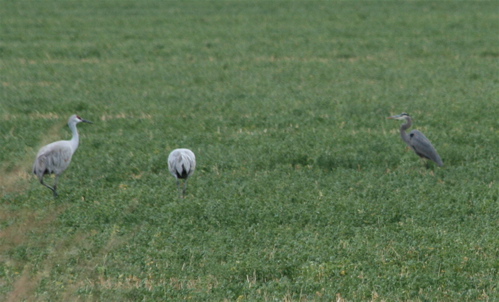
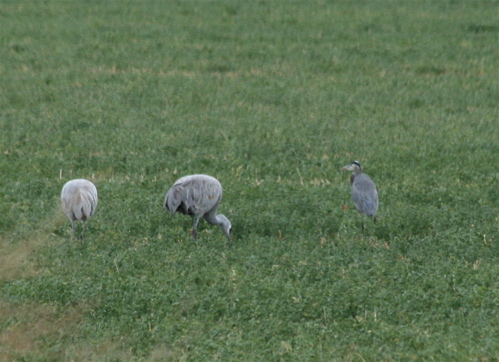
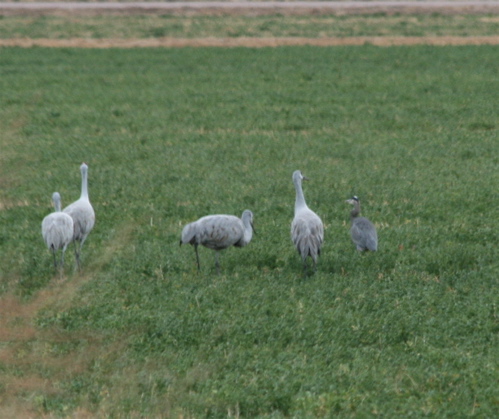
Watching the sandhill cranes at Bosque del Apache NWR is an education in itself. They travel in family groups, often two adults with their two kids from the year, and they talk constantly, gutteral, resonant purrs from the adults, and tweedling chirps from the juveniles. Seeing them pal around must be hard for a solitary great blue heron. I watched in amazement (and remembered to shoot pictures) as a lone heron flew over to join a small family group of greater sandhill cranes. What could he have been thinking?He's in their personal space. The cranes dawdle over closer to him. How touching. Or not. I had a pretty good hunch that the cranes would send the heron packing, and sure enough, when they got closer, they raised their stately necks and inclined their bills, giving a clear cross-species threat to the heron.
You can see that the heron is already gathering its neck in for takeoff. Wise move.

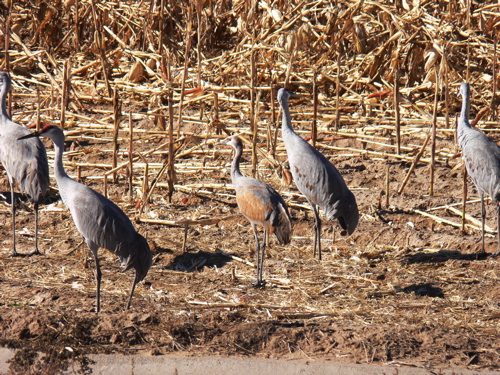
Cranes, by the way, fly with necks extended, and that's a quick and easy way to tell them from herons in flight. Cranes also lack a functional hallux, or hind toe, so they can't land in a tree like a heron can. They are open country birds, who can't perch but must stand on solid ground or in shallow water. This impacts their habitat preferences and natural history in lots of ways. (Thanks to Paul Tebbel for some thought-provoking conversation on cranes while we drove around in his truck).There are two species of sandhill crane at Bosque del Apache, the greater and lesser sandhill cranes. Lesser sandhills are much smaller than greaters (the bird in the middle with brown wings is a lesser sandhill). They also tend to "paint" their wings more heavily with iron oxide, so they really stand out in a crowd. Yes: cranes decorate their feathers by painting them with red-staining mud. That's why you'll only see the stain on the parts of their bodies they can reach.
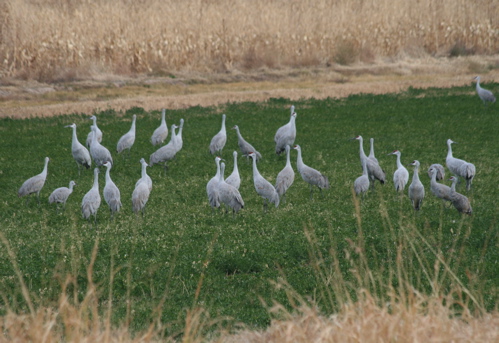
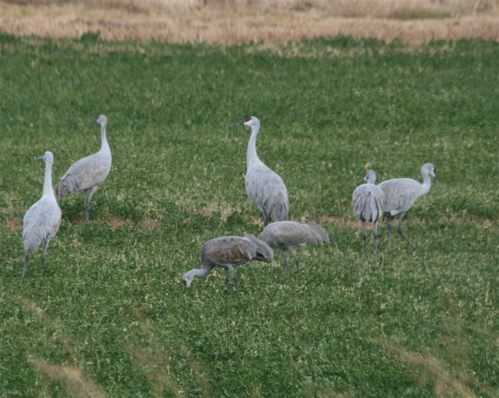
Cranes on green, a lovely sight. The second bird from the left is probably a lesser sandhill crane. In the photo below, the brown-winged lesser sandhills are easy to pick out, markedly smaller than the pale greaters. How I miss their resonant calls. Cranes are addictive.

It was a snowy day here; the kids were home from school, and so was Bill. What a nice feeling, to have us all together in a warm house. Kids played outside much of the day. Bill built them a mogul right before dark and they caught some sweet air going over it in the toboggan. Baker frisked around for about ten minutes at a time and then came in all shivery and grunty, wanting to be wrapped in a down comforter. I got some cute pictures of him googling along in the snow. All in all, we got about 8", and there are high hats on all the bluebird houses. I shoveled out the cardinals before dark, and left some corn for the deer out under the pines. Did two watercolors, diverting myself between washes with an excellent and thought-provoking discussion of sandhill crane hunting. You guys are the bomb. Thoughts were firing back and forth in private e-mails, too, about aesthetics and hunting and whether we have the right to hunt cranes. Nobody hunts flamingoes. What if sandhill cranes were lucky enough to be pink?

Time to fix dinner--a chicken, but not a prairie chicken. Life is full of ironies. Stay warm.

The Wariest of Birds

Tuesday, December 4, 2007

6 comments
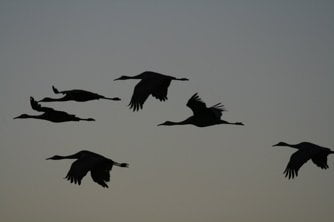
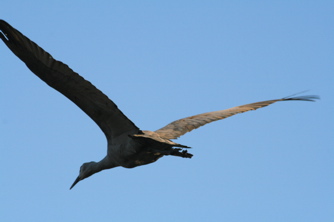
Small technical detail: I'm suddenly being spammed at the rate of 100 messages every ten minutes, comments on archived blog posts, from "Anonymous." I've been forced to disallow anonymous comments on my blog, or risk losing email function. You will need to have a Google account to comment now. It's easy to sign up. If you're accustomed to commenting as Anonymous, just think up a random name for yourself, click "Other," and you should be good to go.A rare close flyover. There's nothing quite like hearing the crane's sonorous purr right overhead, along with the rush of its huge slaty pinions. If you've never heard that call, please go to Susan's blog, where she has a wonderful video, with sound, of a huge crane flyover.

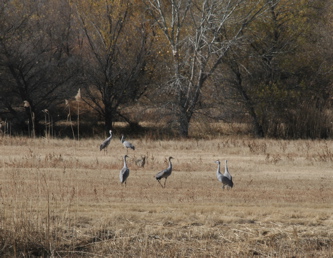
See the coyote, third from the left?

The kids and I were watching a bunch of cranes out in a field when I noticed that their necks were unnaturally straight, and they had ceased feeding. "I'll bet there's a coyote around, kids!" And sure enough, a few pans of the scope revealed a pair of pointed ears in a patch of brush.

The coyotes were eating a carcass out in the field, and they really didn't pose much threat to the cranes, as long as the birds were aware of them. It's hard to sneak past a sandhill crane.

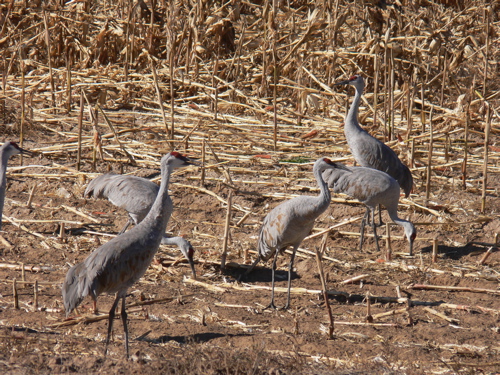
The kids were enthralled to watch a predator/prey interaction. Liam especially glued himself to the scope and fretted while Phoebe took a turn. "She's hogging it! She's had it for a hundred thousand million minutes!" We had the best time out on the refuge together. Once they settled into the slow but punctuated pace of nature watching, they were happy to while away the hours, peeking through the scope, playing with rocks and sticks and water while I looked for the next cool bird or animal to watch.The cranes walk along the roads atop the dikes at Bosque, and they often seem to stand vehicles down, in no hurry to clear the way. It's so good to see them rule the place, when they're hunted for sport all along their flyway. Yes. Sandhill cranes are shot for sport (and occasionally for food) in every state they migrate through. There are seasons and bag limits on sandhill cranes all along their migratory route. If you don't believe me, just Google "Sandhill crane hunt." If you're sensitive, don't. Most birders, who will travel hundreds of miles to watch their migration gatherings, don't know that these "ancient birds" that they admire so much are targets for hunters, and are as shocked as I was to learn it. I think they need to know it, and I often bring it up when I'm among crane fans, even though it doesn't do much for my popularity. Talking about crane hunting in such circles has roughly the same effect as cutting a giant fart at a cocktail party.
I've got an article mostly written about it, but I'm pretty sure the usual outlets for my stuff won't be interested. Maybe it's one for the next book. The thought of bringing these long-lived, monogamous, family-oriented and highly intelligent birds down for sport or roasting makes me physically ill. But then a lot of what's done in the name of sport hunting makes me ill. I know I'm getting crankier as I get older, and more conservative about speaking out because it might just be crankiness at work. But there's something about sport hunting of sandhill cranes that strikes me as fundamentally, indefensibly, sickeningly wrong.It's clear to me, if not to most state game and fish departments, that a sandhill crane is worth infinitely more alive than dead. (The same could be said of vanishing prairie chickens and sage grouse, both greatly admired by birders, hard as heck to find, and inexplicably, still hunted.)
Just go to the Platte River in Nebraska in March if you don't think so. Crowd into a blind with dozens of other paying customers, and hear their awe and stunned gasps at the beauty of the flocks sleeping and rising off the river at dawn. Here, a trio flies past the visitor center at Bosque, past people who are paying just to admire them, and let them go on their way.

It does explain why sandhill cranes almost never allow a person within gunshot range; why they are the wariest of birds. Imagine how wonderful crane watching could be if they could relax around us, the way we relax around them.
Can we find it in our hearts to just let them be?
[Back to Top]