
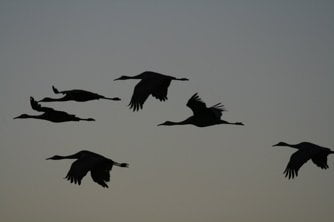
photo by Vickie Henderson
The Tennesseean has an article about the meeting and the decision. The lack of good data about this eastern flyway crane population was central to the arguments against the hunt. In deciding against instituting a hunting season now, TWRA recognized that a hunt proposal perhaps partially based on one year's huge (and likely unrepeatable) apparent gain in crane numbers is premature. To recap, here are the crane counts for the past six years:
2006: 14,158
2007: 14,698
2008: 12,945
2009: 20,191
2010: 48,505
And this just in--the January 2011 count. Well, would you look at that: back down to an unprecendented low.
2011: 11,000
It's been cold and snowy in Tennessee this winter, and the low 2011 count likely means that many of the cranes have pushed farther south. Midwinter counts can be misleading in both directions. A long-lived, slow-reproducing bird in which only 30% of nesting pairs manage to raise a single chick each year (or, to put it another, more sobering way, a species which raises an average of .33 chicks per pair per year) is not subject to sudden population explosions. It is, however, quite vulnerable to population crashes. We need to keep that in mind when we're putting it in the crosshairs.

photo by Vickie Henderson
Some biologists are now speculating that the freakishly high January 2010 count was the result of a weather event that froze all open water at Indiana's Jasper-Pulaski Fish and Wildlife Area, sending the cranes that normally winter there packing farther south to Tennessee. As many as 30,000 sandhill cranes may gather at the Indiana refuge in a big winter. And guess what?
As many as 30,000 people may come to see them at J-P in a single season--200 people per day. Sounds like a nice ratio: A crane for every human. But not... a crane in every pot. A flying, calling, purring crane, winging high overhead or stepping gracefully through the corn stubble.

If crane enthusiasts, spearheaded by the Tennessee Ornithological Society's Melinda Welton and Vickie Henderson, have their way, they'll be safe for much longer than that. Vickie has drawn up a petition to the U.S. Fish and Wildlife Service to take another look at its Management Plan for the Eastern Population of Sandhill Cranes. To take the provision for hunting seasons along the Eastern Flyway out of it, at least until more is known about this population's dynamics, movements, and reproductive viability.
Here's the petition site. Please, sign it.


photo by Vickie Henderson
Oh. And thank you for writing, calling, emailing, voting, signing. I think you know now that you've made a difference.

Special thanks to Janet McKnight for first alerting this hermit to the proposal to hunt Tennessee's sandhill cranes. Thanks to Gary Loucks , Melinda Welton, Vickie Henderson and Cyndi Lawrence Routledge for fighting the good fight on their own home turf. Never underestimate the power of uppity women (and men). We're going to need them--remember, this is just a reprieve in Tennessee. Kentucky's just proposed its own sandhill crane hunt and, not surprisingly, isn't accepting public comment. Well, that doesn't stop anyone from calling and writing their legislators, does it? Here's one place to start.
Kentucky Department of Fish and Wildlife Resources
1 Sportsman's Lane
Frankfort, KY 40601 800-858-1549
Remember, sign that petition.








Sunday, January 23, 2011
6 comments