Background Switcher (Hidden)

Showing posts with label crane hunting. Show all posts

The Crane Battle Moves to Kentucky

Monday, March 14, 2011

13 comments

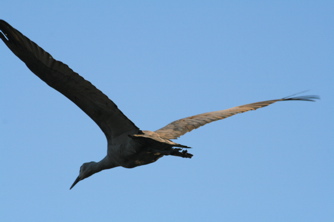
I cropped off the heads, with their big grins. Hunters tell me it's not hard to get your daily limit with such a huge, slow-flying target. 

We now interrupt our regularly scheduled inspection of armadillo carcasses with this important action alert for wildlife enthusiasts everywhere.  MARCH 15, 2011 is the deadline for public comment on a proposal to hunt sandhill cranes in Kentucky. That's TOMORROW. If you wrote to Tennessee in the campaign this winter, you can cut and paste and change "Tennessee" to "Kentucky." If not, please read my letter, crib bits of it in your own words if you wish, avoiding overly sentimental or confrontational wording,  and politely email Mr. Gassett at this address:    jon.gassett@ky.gov


Copy your letter to FW_Suggestions@ky.gov


Do it now, please, for the cranes. We fought them back in Tennessee; there's a two-year stay on their proposal. We can fight them back in Kentucky, too. The Kentucky Ornithological Society and the Beckham Bird Club have both come out strongly against the hunting season.  Kentucky Dept. of Fish and Wildlife Commissioner Jon Gassett has indicated that if enough people write in protest, the proposed hunting season--due to start this December-- will be reconsidered. Nobody owns these cranes--they're free for all to enjoy. If you think it's wrong to shoot them, please take the time to email Mr. Gassett. THANK YOU!


March 14, 2011

Kentucky Department of Fish and Wildlife 
Jon Gassett, Commissioner
 One Sportsman's Lane
 Frankfort, Kentucky 40601

Dear Mr. Gassett,
I am a writer, naturalist and artist with a special interest in human/bird interactions.
 For my new book, due out in 2012 from Houghton Mifflin Harcourt, I’ve been researching sandhill crane hunting. The sandhill crane has the lowest recruitment rate (average number of young birds joining a population each season) of any bird now hunted in North America. Historic recruitment rates of all migratory sandhill crane populations range from 7.5% to a high of 11%.

 Since 1975, hunting in the Central Flyway has taken around 20,000 cranes annually (E.M. Martin, U.S. FWS report). This represents 6% of the estimated mid-continental spring population of 322,700 birds for the same two decades. Given the projected recruitment rate, harvesting 6% of the population each year in the US alone seems to me to be cutting it too close to the edge. Kills in Canada, Alaska and Mexico are not included in the count. What about all the other birds that die from inexperience, disease, natural predation and accidents? Further, the crane take in Mexico is a free-for-all: neither regulated nor recorded.

 Hunting sandhill cranes in Kentucky is a bad idea from a public relations standpoint, considering the growing cadre of birders and nature enthusiasts for whom cranes are a touchstone species. How can Kentucky possibly garner enough revenue from crane hunting to offset the outrage when birdwatchers find out that the cranes they love and travel to see are being shot? Hunting is on a steady downturn, and nonconsumptive wildlife pursuits are on a tremendous upswing. Nationwide, wildlife watchers now outspend hunters 6 to 1. The explosion in digital photography allows people to stalk wildlife without harming it. Initiating a hunting season on a large, charismatic species like a crane is no way to resuscitate hunting. It is, however, an excellent way to alienate nonconsumptive wildlife enthusiasts, and further polarize the camps.

 Texas and North Dakota together account for 88% of the total yearly kill of sandhill cranes. There is evidence that a unique Canadian prairie population of lesser sandhill cranes is being selectively wiped out, since they migrate over the most heavily hunted areas of Texas. It should go without saying that the incidental kill of endangered whooping cranes is an unacceptable cost of adding another state to the shooting gallery all along both species’ migration route. Of the Central Flyway states, Nebraska alone holds out in protecting the cranes, having proven by its longstanding Festival of the Cranes in Kearney that a crane is worth infinitely more alive and purring in the sky with its family than thudding, broken and bleeding, into a cornfield.  Just ask Bill Taddicken, director of the Lillian Annette Rowe Sanctuary on the Platte River in Kearney. Crane tourism brings that little town around $10 million each year in revenue, without a single shot being fired. 

Proposing a hunting season on a bird with that kind of ecotourism potential simply doesn't make sense. Giving a few hundred hunters something else to shoot, in my opinion, cannot be worth the blowback from tens of thousands of people who are willing to travel and spend just to watch the birds fly over.  Please reconsider this proposal, and consider taking a lesson from what happened in Tennessee. Letters and emails by the thousand poured into the commissioners' offices, protesting its crane hunting proposal. Even more telling, the support the Tennessee Wildlife Resources Commission was expecting from its hunting community simply never materialized. I've received letters and emails from a number of avid hunters who find the concept of shooting cranes repugnant. TWRC's response to the outcry was a two-year stay on the proposed season. I feel certain that, given Tennessee's 18-year track record of celebrating cranes in a tremendously successful festival, the opposition will only be stronger in 2013. I would encourage the the Kentucky Department of Fish and Wildlife to take Tennessee's example as an indication that offering sandhill cranes for hunting will create far more public relations trouble than it's worth. 

Sincerely, 


Julie Zickefoose


The Wariest of Birds

Tuesday, December 4, 2007

6 comments
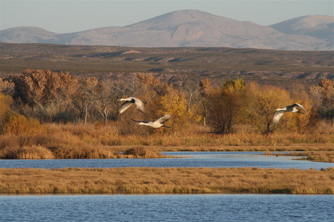
Small technical detail: I'm suddenly being spammed at the rate of 100 messages every ten minutes, comments on archived blog posts, from "Anonymous." I've been forced to disallow anonymous comments on my blog, or risk losing email function. You will need to have a Google account to comment now. It's easy to sign up. If you're accustomed to commenting as Anonymous, just think up a random name for yourself, click "Other," and you should be good to go.A rare close flyover. There's nothing quite like hearing the crane's sonorous purr right overhead, along with the rush of its huge slaty pinions. If you've never heard that call, please go to Susan's blog, where she has a wonderful video, with sound, of a huge crane flyover.

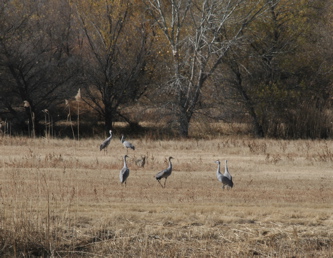
See the coyote, third from the left?

The kids and I were watching a bunch of cranes out in a field when I noticed that their necks were unnaturally straight, and they had ceased feeding. "I'll bet there's a coyote around, kids!" And sure enough, a few pans of the scope revealed a pair of pointed ears in a patch of brush.

The coyotes were eating a carcass out in the field, and they really didn't pose much threat to the cranes, as long as the birds were aware of them. It's hard to sneak past a sandhill crane.

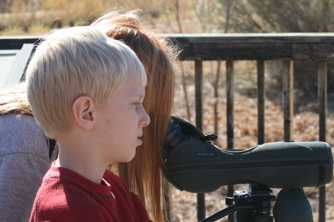
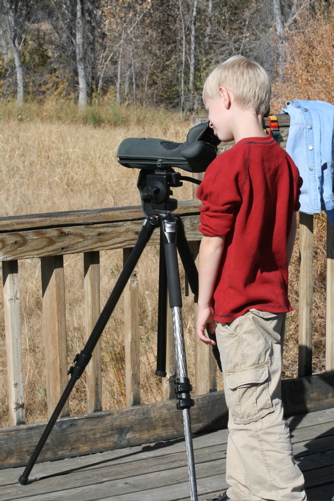
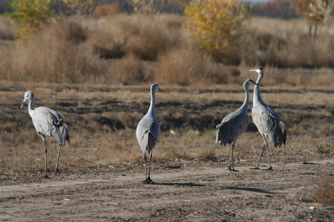
The kids were enthralled to watch a predator/prey interaction. Liam especially glued himself to the scope and fretted while Phoebe took a turn. "She's hogging it! She's had it for a hundred thousand million minutes!" We had the best time out on the refuge together. Once they settled into the slow but punctuated pace of nature watching, they were happy to while away the hours, peeking through the scope, playing with rocks and sticks and water while I looked for the next cool bird or animal to watch.The cranes walk along the roads atop the dikes at Bosque, and they often seem to stand vehicles down, in no hurry to clear the way. It's so good to see them rule the place, when they're hunted for sport all along their flyway. Yes. Sandhill cranes are shot for sport (and occasionally for food) in every state they migrate through. There are seasons and bag limits on sandhill cranes all along their migratory route. If you don't believe me, just Google "Sandhill crane hunt." If you're sensitive, don't. Most birders, who will travel hundreds of miles to watch their migration gatherings, don't know that these "ancient birds" that they admire so much are targets for hunters, and are as shocked as I was to learn it. I think they need to know it, and I often bring it up when I'm among crane fans, even though it doesn't do much for my popularity. Talking about crane hunting in such circles has roughly the same effect as cutting a giant fart at a cocktail party.
I've got an article mostly written about it, but I'm pretty sure the usual outlets for my stuff won't be interested. Maybe it's one for the next book. The thought of bringing these long-lived, monogamous, family-oriented and highly intelligent birds down for sport or roasting makes me physically ill. But then a lot of what's done in the name of sport hunting makes me ill. I know I'm getting crankier as I get older, and more conservative about speaking out because it might just be crankiness at work. But there's something about sport hunting of sandhill cranes that strikes me as fundamentally, indefensibly, sickeningly wrong.It's clear to me, if not to most state game and fish departments, that a sandhill crane is worth infinitely more alive than dead. (The same could be said of vanishing prairie chickens and sage grouse, both greatly admired by birders, hard as heck to find, and inexplicably, still hunted.)
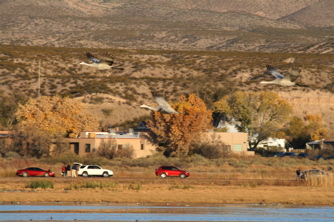
Just go to the Platte River in Nebraska in March if you don't think so. Crowd into a blind with dozens of other paying customers, and hear their awe and stunned gasps at the beauty of the flocks sleeping and rising off the river at dawn. Here, a trio flies past the visitor center at Bosque, past people who are paying just to admire them, and let them go on their way.

It does explain why sandhill cranes almost never allow a person within gunshot range; why they are the wariest of birds. Imagine how wonderful crane watching could be if they could relax around us, the way we relax around them.
Can we find it in our hearts to just let them be?
[Back to Top]