Background Switcher (Hidden)

Showing posts with label ecotourism. Show all posts

Welcome to Oz

Tuesday, September 13, 2016

8 comments
When you sit for 16.5 hours at a stretch on a jet flying through what seems like endless night, flying with the turning of the earth such that it stays dark almost the entire time, you can do many things. First, of course, you could choose to suffer, because you're in business class wedged in with not much room to spare. But suffering is relative, and this is not real suffering, but imagined suffering. You're on a jet, coming from two weeks' safari in South Africa, for Pete's sake. You are not suffering.

Second, you could sleep. You try. No, you can't sleep, bolt upright in an aisle seat. Scratch "sleep." Let it go.

Next, you could read. You have a good book, but everyone around you is sleeping, or trying to, and it seems rude to turn on your light. Hmm.

OK. What about watching movies? Well, you could do that, but after 1.3 of them, you're done partaking, because you'd rather be doing something productive than weeping over the plight of a young Irish immigrant, or trying to figure out what's so great about The Big Lebowski (dumb guys screaming at each other, far as I could tell). Let's face it. You're not equipped to be a movie buff.

I know what. You could edit photos. You can lose yourself for the eight-hour battery life of your laptop, sifting through the incredible images grabbed and saved by your Canon 7D. Yep. That's what you'll do. This is why I lug my laptop wherever I go. It alleviates suffering. It actually makes the flight home  enjoyable!

So I'm going to try something here, picking chunks of photos winnowed in that endless night from the 2016 Zicktrip to South Africa. I'm going to try to keep it short and sweet and let the images do most of the talking. On this trip, I worked with Holbrook Travel to deliver six natural history freaks from America into the capable hands of Lawson's Birding, Wildlife and Custom Safaris for a trip none of us will ever forget.


Our guide for the Cape portion was Lawson's natural history guide Kim Wright, well-versed in flora, fauna and avifauna, and despite being native to South Africa, just as freshly agog as we were at it all. Lovely combination!


First stop for the bleary, weary group was Kirstenbosch Botanical Gardens outside Cape Town. It's the perfect anodyne to dark, stressful, cramped, and colorless jet travel--well-lit, soothing, spacious and colorful. You can wander and look and wonder at will. Off we go!

I could not resist this freshly-minted human and its attentive mother doing a photoshoot. And I remembered that particular tilt of the head that says, "I'm done posing for you."


Pulling back for the whole scene...


The late-afternoon sun was setting behind Table Mountain as we staggered up to the protea gardens at the top of Kirstenbosch.

A Karoo prinia, our companion for much of the trip, gave its endless, ringing tzing tzing tzing tzing from an aloe tip.


Cape sugarbirds, a much-sought endemic that depends on protea blossoms for its insect and nectar diet, posed atop enormous protea blossoms. This is a 20" bird, with tail, if you'd like some scale.


Heather flopped down with me to dig the pink Oxalis "weeds" in the lawn. We were definitely not in Pennsylvania any more!


The flopping, which I admit starting, proved contagious, and I knew right off the bat we'd have a lot of fun as a group! Gordon, Heather, Cat and Kate, all in a row, letting their cellphone cameras make the low-angle shots.


Watsonia looks over the Cape Town vista and our very happy campers.


Helmeted guineafowl remains vigilant, and screechy.


Silvertree glows in the late light. 


But there were birds amidst the botanical splendors! Oh! Oh! What was THAT singing in the Melianthus major?


Not a southern dusky flycatcher, like this one...

Not a sleepy spotted eagle owl...


It must have been a southern double-collared sunbird!
Here, plying a fresh pincushion protea for nectar. 


 Sunbirds are rather difficult to photograph, only partly because they're quick-moving. Most of the problem is that direct sunlight creates such high contrast in their reflective plumage that it's difficult to capture their local color. Deep afternoon shade, though, proved the ticket.  This remains one of my favorite photos from the trip. Behold the southern double-collared sunbird, knocking our eyes out as it sings while flashing its rarely-seen armament--candy yellow epaulets!


No, we're not in Ohio any more, and the fun is only beginning! My soul began a joyful inner squeeee! that kept up the entire trip. I occasionally released it out of my mouth, when it all got to be too much.

The Best of South Africa With Zick: It's Now or Never

Saturday, April 9, 2016

1 comments
It don't rain but it pours. I've been kiiinda busy with the new book, Baby Birds, coming out on Tuesday April 12. That means all the orders I've taken from you fabulous supportive readers are going out on Monday!! I just got a message from my friend Cynni, Postmaster at the Lower Salem Post Office, that I've spent $802.61 there in postage in the last two weeks. That ought to help save some jobs and help it stay open, in this climate of rampant rural school and post office shut-downs. I feel good about that, and you should, too. 

I'm really excited to launch this book. Won't lie: I've been nose to the grindstone for a very long time,  finishing the paintings for the book over the last two years, then, last spring, going into hyper-production mode,  getting all the writing and art turned in; dotting the last i's, answering editorial queries, getting the art scanned, proofing color...the project of 13 years all coming to fruition. It takes a full year from the time I turn everything in to when the finished book arrives. Because I was involved in every aspect of production, that year FLEW by, seemed like nothing.

Other things have been whooshing past my head in the meantime. Like the deadline for deposits on my next trip to South Africa. Holbrook Travel got an urgent message from our service partner in  South Africa last night, that our reservations at Kruger Park are going to be cancelled if they don't receive deposit money by early next week. ARRK!! Kruger is like that, because everybody wants to go there. You have to book at least a year in advance. They've been holding our booking for several months now. I haven't been sitting on my hands, y'all. But it got past us.

So. I'm making a last-ditch pitch. If you've always wanted to go to South Africa, and you think you might like to go with an excitable Science Chimp pointing out everything from dung beetles to marabou storks to fruit bats, the time to decide is NOW.

Arm-twisting...

At the Three Rondavels with part of 2016's intrepid crew.  (The part that didn't mind abysses. You will note that I'm on the safe side of the view!)

I can guarantee you maximum fun and beauty abounding. 


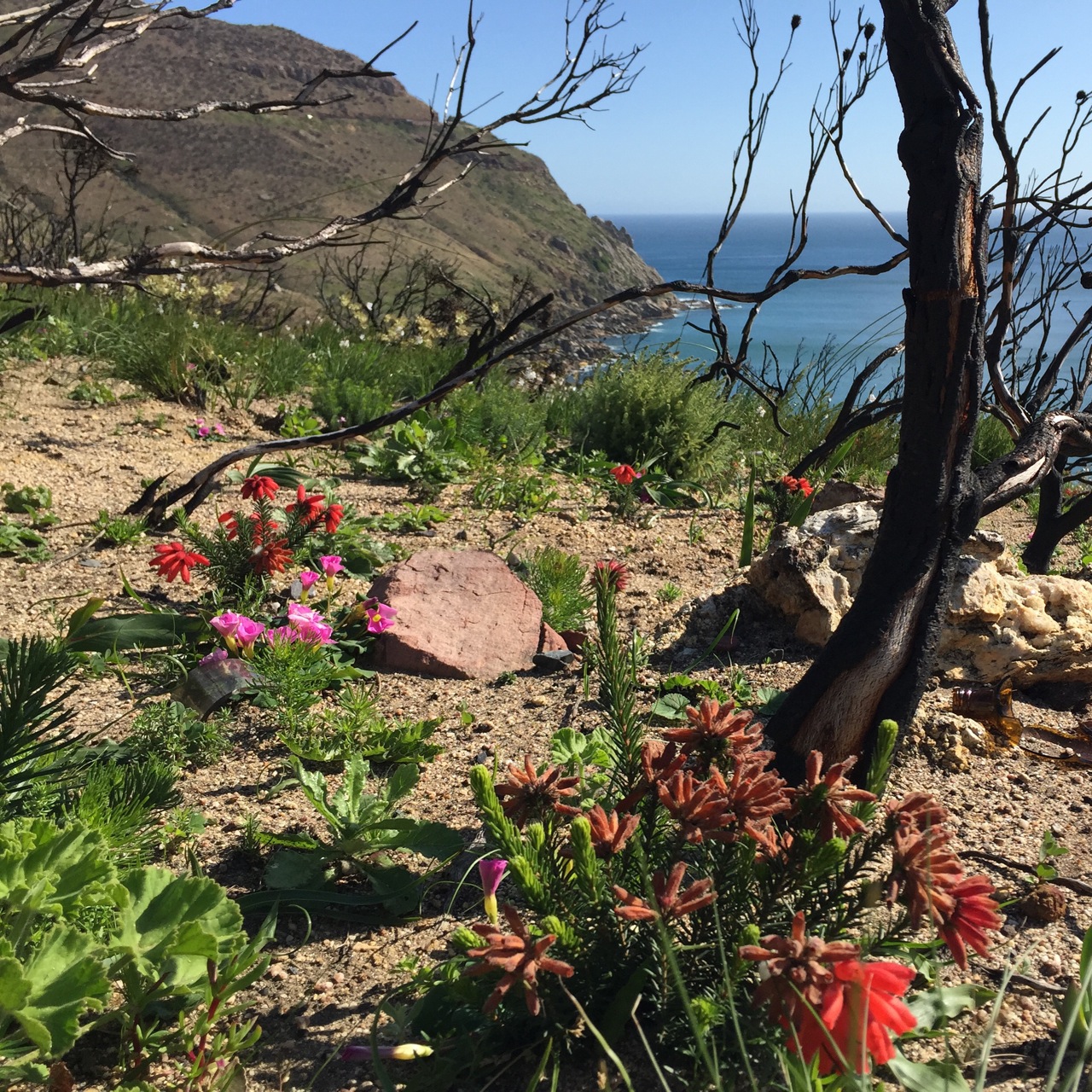
Wildflowers in the Near-Karoo. Me: STOP STOP STOP LOOK AT THAT (piles out, drops to crouch)


 Endangered blue cranes dancing like nobody's watching. DANCING. Floating up as if yanked by a string, bouncing, their tail ribbons undulating. Might be the world's most beautiful crane, and that's saying something.


Bontebok with calf, awash in wildflowers.


Bizarre, fantastic, eye-popping wildflowers. Get down low and your mind will blow.


Cape sugarbird with proteas. How much would this bouquet cost in New York City? And that's without the endemic bird!


Epauletted fruit bat sp., Skukuza Rest Camp, Kruger Park, delicate ears swiveling, green-gold orbs looking right into my bat-lovin' soul. Needless to say, I really, really want to see them again. And I'd love to stand beneath them, with you. We'll try to keep our mouths shut.


Greater flamingos at rest, Strandfontein Wetlands.


Dassie Man, Hermanus. He's feeding the hyraxes (hyraces?) while southern right whales spout just offshore. Amazing place, whale watching from land!!  I'll know better than to try to strike up a conversation this time.


Pickin' up an Angulate Tortoise and carryin' him across, West Coast National Park. A
 Zick's gotta do what a Zick's gotta do.


One o' them dassies, contemplating his sirenian/elephant ancestry. Or just digesting.


More proteas. This time with southern double-collared sunbird, Kierstenbosch Botanical Garden. 


Waterhole action at Kruger Park. It's a different aspect, over to the east in Kruger, a bit sere and dry. But there are animals. Animals of your dreams. Birds, too. We look at them all.


I never thought I'd see this in my lifetime. But then I never thought I'd see any of this. 
Grateful. And I really want to go again, and take a small group along. We still have a few spaces, and we need to finalize so we don't lose our accomodations. I'm sorry to push. Life's going by faster than I can run right now.

Want to come along? The trip runs from Aug. 24-Sept. 9 2016. It's a small, artisan trip, one safari vehicle. We'll have Kim Wright along to help us with the nutso botany on the Cape portion, and my great pal Leon Marais for the Kruger section. It will be choice!

Click HERE for more information. 

If you have any trouble getting through, just email debbieATholbrooktravelDOTcom
A little code there, to foil roving spambots. Substitute@ and . for the all-caps words and you're good to go.

And thank you. Back to the race!

Hummingbird Yoga

Sunday, March 15, 2015

8 comments
Before I raised four orphaned ruby-throats from Day 12 through adulthood, I admit that I thought of hummingbirds differently than I thought of larger birds. 

As if a rufous-tailed hummingbird, being 1/4 the size of a Passerini tanager, would somehow have but a quarter of its presence, a quarter of its character, a quarter of its brains.


Being the ultimate advocate for bird intelligence, I can't say why I harbored this prejudice for so long, but I suspect it's one many people unconsciously cultivate. Hummingbirds zip around so fast, and are insect-like and bizarre in aspect. I had trouble believing they were real birds, and so I had trouble connecting with them. I guess I assumed their brains were a bit insectile, as well; that they might not be capable of making the kind of connections, having the kind of synthetic intelligence that "real" birds do.

When I raised them, a story told in The Bluebird Effect: Uncommon Bonds With Common Birds,
I realized that hummingbirds are every bit as intelligent and sentient as other birds. They are 110% BIRD. Boiled down to the essence of birdiness. Smart, opportunistic, fierce. Intense.

So when a bronze-tailed plumeleteer in Cope's garden not far from Limon, Costa Rica, stopped for a few minutes of peaceful hummingbird yoga, I was all eyes. Not just for his radiant teal gorget and bronzy forked tail, but for his sunbathing behavior.


We bring our tiny coral-pink foot up over our very long wing


  and groom our forehead and cheek.


We assume an upright stance, and let our aquamarine throat expand.


As we feel the sun penetrating our feathers, heating up our soul, we begin to keel over.


We allow the heat to reach our inner being


and we raise our feathers and hold our tiny self in Sun Salutation


until our skinny red turkeylike neck shows. Part of the exercise is embracing our vulnerability.


We hold this position for a long time, then slowly raise ourself high and proud again. 


Renewed in body and spirit, we look around for someone to pierce.


Back at it, the business of being a hummingbird.


Others shared his spotlight.

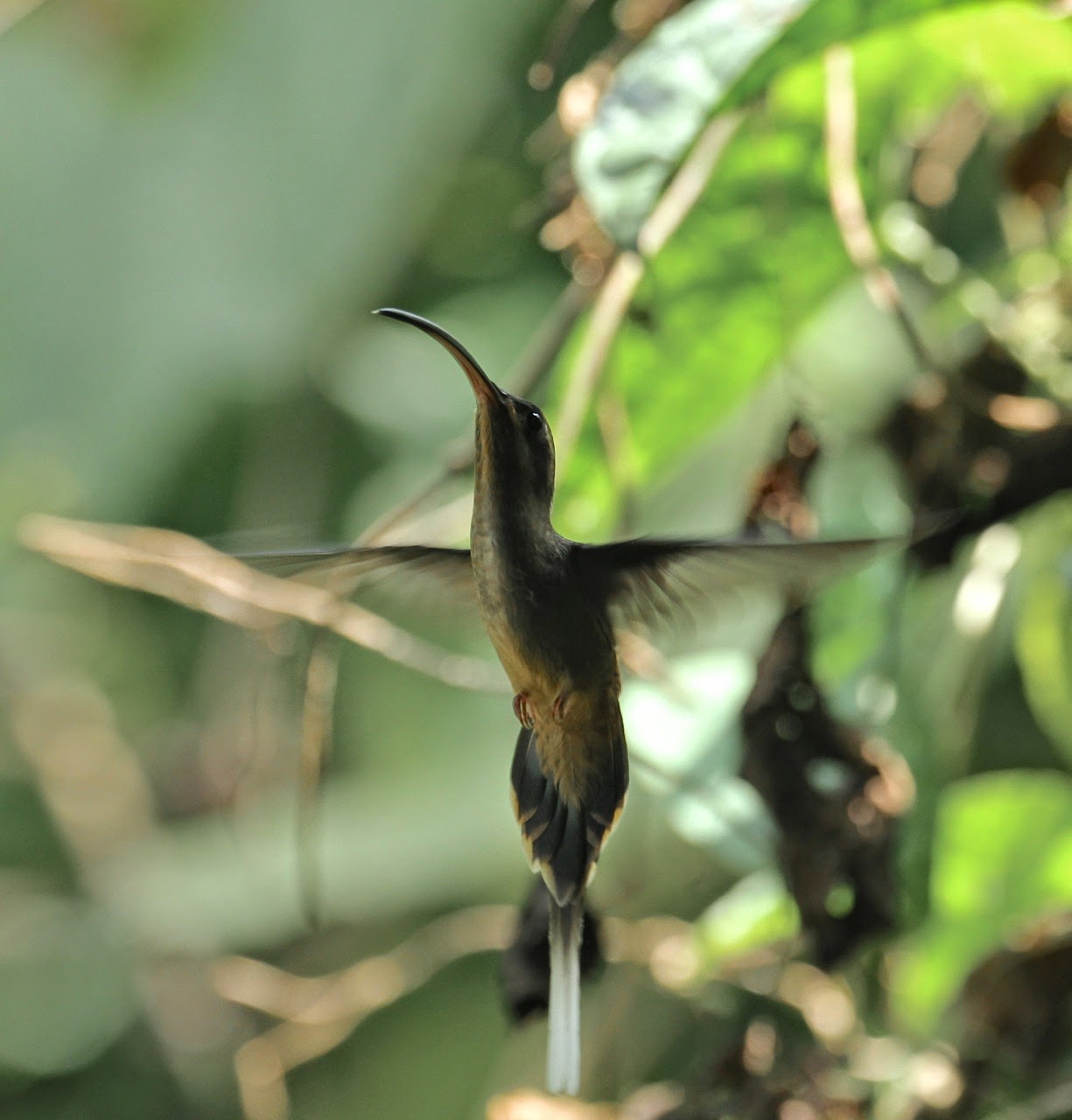
A long-billed hermit. Hermits swoop in headlong, seemingly flying sideways in a perpetual dive, those ribbonlike white tail streamers fluttering behind them, swoopy and thrilling. I've rarely seen them perch.


But in full hover, they look like strange angels. I like this moody shot, the catch light in her eye, the feet held like a prayer, or a plea.


It's extremely difficult to capture sharp images of these birds in flight. My camera fires and fires; it focuses on the vegetation behind the dimly-lit subject. I laugh and mutter and cuss, and one out of every two dozen shots might pan out. All hail digital, where everything is free and the delete button gets warm to the touch.
 The closest thing to which I can compare shooting hummingbirds is playing a very intense video game, but for real. Addictive and very, very fun.

You who practice yoga and play video games will probably have already figured out that I do neither.
But I can imagine it.

One of the prizes of the day? A female green-breasted mango who zipped in at warp speed, with a surprise Indian blanket for a tail. 
Oh my, oh my oh my. Can't you stay awhile?


 Capturing them: the path to a happy madness.

Forget those little bug-birds now.
 Focus on me, a splendid bull Montezuma oropendola, twice the size and weight of my several mates.
My malar wattles, engorged; my cheeks electric blue.
See me, and you've seen a real bird. 


Thanks again to the wonderful artist Cope, who has made this little paradise for birds and bird photographers alike.

The Wariest of Birds

Tuesday, December 4, 2007

6 comments
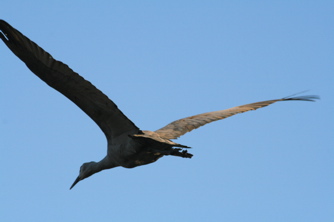
Small technical detail: I'm suddenly being spammed at the rate of 100 messages every ten minutes, comments on archived blog posts, from "Anonymous." I've been forced to disallow anonymous comments on my blog, or risk losing email function. You will need to have a Google account to comment now. It's easy to sign up. If you're accustomed to commenting as Anonymous, just think up a random name for yourself, click "Other," and you should be good to go.A rare close flyover. There's nothing quite like hearing the crane's sonorous purr right overhead, along with the rush of its huge slaty pinions. If you've never heard that call, please go to Susan's blog, where she has a wonderful video, with sound, of a huge crane flyover.

See the coyote, third from the left?

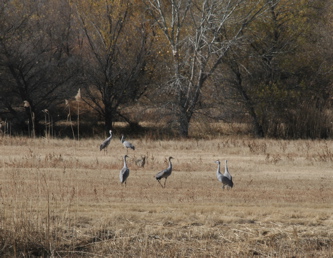
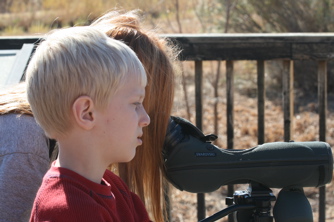
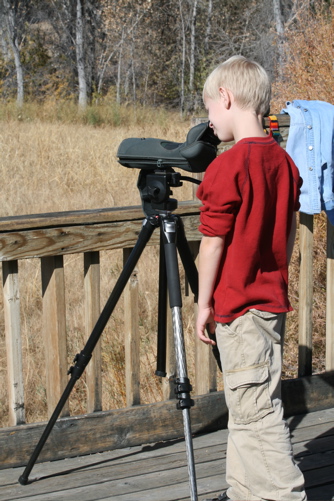
The kids and I were watching a bunch of cranes out in a field when I noticed that their necks were unnaturally straight, and they had ceased feeding. "I'll bet there's a coyote around, kids!" And sure enough, a few pans of the scope revealed a pair of pointed ears in a patch of brush.
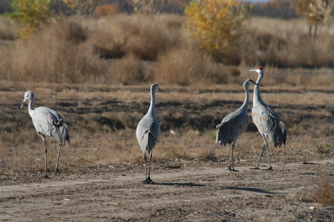
The coyotes were eating a carcass out in the field, and they really didn't pose much threat to the cranes, as long as the birds were aware of them. It's hard to sneak past a sandhill crane.
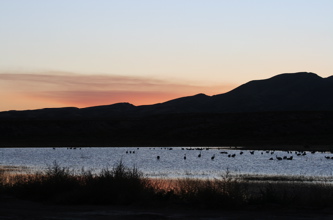
The kids were enthralled to watch a predator/prey interaction. Liam especially glued himself to the scope and fretted while Phoebe took a turn. "She's hogging it! She's had it for a hundred thousand million minutes!" We had the best time out on the refuge together. Once they settled into the slow but punctuated pace of nature watching, they were happy to while away the hours, peeking through the scope, playing with rocks and sticks and water while I looked for the next cool bird or animal to watch.The cranes walk along the roads atop the dikes at Bosque, and they often seem to stand vehicles down, in no hurry to clear the way. It's so good to see them rule the place, when they're hunted for sport all along their flyway. Yes. Sandhill cranes are shot for sport (and occasionally for food) in every state they migrate through. There are seasons and bag limits on sandhill cranes all along their migratory route. If you don't believe me, just Google "Sandhill crane hunt." If you're sensitive, don't. Most birders, who will travel hundreds of miles to watch their migration gatherings, don't know that these "ancient birds" that they admire so much are targets for hunters, and are as shocked as I was to learn it. I think they need to know it, and I often bring it up when I'm among crane fans, even though it doesn't do much for my popularity. Talking about crane hunting in such circles has roughly the same effect as cutting a giant fart at a cocktail party.
I've got an article mostly written about it, but I'm pretty sure the usual outlets for my stuff won't be interested. Maybe it's one for the next book. The thought of bringing these long-lived, monogamous, family-oriented and highly intelligent birds down for sport or roasting makes me physically ill. But then a lot of what's done in the name of sport hunting makes me ill. I know I'm getting crankier as I get older, and more conservative about speaking out because it might just be crankiness at work. But there's something about sport hunting of sandhill cranes that strikes me as fundamentally, indefensibly, sickeningly wrong.It's clear to me, if not to most state game and fish departments, that a sandhill crane is worth infinitely more alive than dead. (The same could be said of vanishing prairie chickens and sage grouse, both greatly admired by birders, hard as heck to find, and inexplicably, still hunted.)
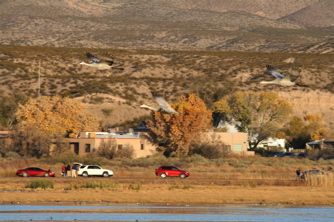
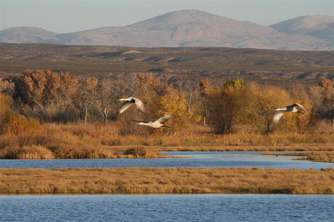
Just go to the Platte River in Nebraska in March if you don't think so. Crowd into a blind with dozens of other paying customers, and hear their awe and stunned gasps at the beauty of the flocks sleeping and rising off the river at dawn. Here, a trio flies past the visitor center at Bosque, past people who are paying just to admire them, and let them go on their way.

It does explain why sandhill cranes almost never allow a person within gunshot range; why they are the wariest of birds. Imagine how wonderful crane watching could be if they could relax around us, the way we relax around them.
Can we find it in our hearts to just let them be?
[Back to Top]