Background Switcher (Hidden)

Showing posts with label hairy woodpecker. Show all posts

Can We Talk about Woodpeckers?

Monday, January 16, 2023

11 comments


This is a very good time of year to talk about woodpeckers. It's the best time of year to watch them, with no leaves to hide them, and with feeders luring them in, right to our yards.

I had a red-bellied woodpecker years ago who I called Ruby, for the little red feathers on her forehead. She became incredibly tame, almost like a pet. It was Ruby, hitting my studio window in 2009, who inspired my crop netting window screen, placed about 10" out from the windows on a PVC frame, that has saved countless lives in the years since. It's normally all but invisible. Only occasionally does a wet snow give me this view from the studio!


To find out how to screen your windows with crop netting (trust me, I can photograph right through it!), go here: https://bwdmagazine.com/downloads/JZ_COL_True_Nature.pdf

 I thought I was seeing Ruby's ghost when this bejeweled female (see her tiny red bindi?) showed up just outside the studio window. Lovely! 


This is one of the reddest red-bellies I've ever beheld. He's absolutely suffused with red! And really has a red belly. Generally when you see extra color, you can guess that a bird is older, or has more testosterone than the rest, or both. I've been looking for this gentleman and haven't seen him since I took this photo.


But that's OK. I've got plenty of glam woodpeckers to admire this winter. I'd love to think that this peanut and suet loving adult female yellow-bellied sapsucker is the same little gal I've had since she showed up in her brown weeds as a juvenile in November 2018. She'd be in her fifth winter now, and I think this brilliant plumage she's sporting lines up with that pretty well. She acts the same, uses the same perches; perches very close to my studio window and is totally unperturbed by me moving and photographing her just inside. 


She is a lot less aggressive than some sapsuckers I've observed, sharing the Lifelong Suet Feeder with a Carolina chickadee


and taking her own sweet time when a male hairy woodpecker (who is just about exactly her size) shows up. 


She even shares it peacefully with a downy woodpecker. The Lifelong Suet Feeder is made right here in Ohio by my friend Link Llewellyn. It's not cheap, but no raccoon is ever going to get suet out of it, and you can take it apart, wipe it off, and chuck the whole thing in the dishwasher. Definitely the cleanest way to feed suet, keeping the fat off the feathers, and that and the coon proof features is the whole point for me.


I'm so happy to have these gorgeous woodpeckers here. Even had a yellow-shafted flicker drilling for ants in the yard today, January 15!  Woodpeckers are so animated, such fun to watch, and so easy to attract with suet and peanut halves. (Except for flickers, who resist my efforts to charm them). 

And they hate starlings, too!


While Oscar was here, the queen of woodpeckers made an appearance just off the feeding area. It was so wonderful to show this majestic to him from the warmth of the studio, to watch him watching her through binoculars. 
It's a pileated, and that golden-brown forehead says it's a female. 


In all the years I've fed woodpeckers, I've never had a pileated come in to eat. I keep a regular suet cage as well as the fancy Lifetime suet feeders, and I keep hoping that one day I'll look out to see a monstrous crow-sized woodpecker clinging to the suet feeder or hitching up the post. I can dream!

From left: Downy, red-bellied, hairy.

Until then, I'm happy with what I have. I keep trying to snag the perfect woodpecker combo. I love comparing sizes between hairy and red-bellied, hairy and downy. 

When you see them together (hairy on the left, below; downy on the right) it's such fun to wonder how these not-very-closely related woodpeckers evolved nearly identical plumage. Get this: they aren't even in the same genus any more; hairy has been put in genus Leuconotopicus, while the downy stays in Picoides. The going theory is that downies are hairy mimics. One study by Cornell University's Elliot Miller postulates that the downy is trying to look like the more aggressive hairy for some dominance advantage that is not clear to me. Why would a downy woodpecker need to mimic a hairy? Are hairies poisonous to eat? (I'm only half kidding here. Birds are weird, and so is science, and that's why I love them both).


It's just another of the mysteries that common birds have all locked up. I like wondering about them.

If you do, too, subscribe to BWD Magazine here.  I write a column and few other things for every issue, and help edit it, too. The March/April 2023 issue is in final production! and psst...I know the cover artist...


My Bird Feeder Clients

Tuesday, April 13, 2021

7 comments

 As I write, the wind is roaring again, and the newly flowering maples are tossing their heads and arms like they're at a rave. Practically every minute, something changes out there. A fox sparrow arrives and beats up a house sparrow.  My beautiful red-winged blackbird comes in for peanuts, as he has for several springs running. 


It's not every redwing that will climb on a peanut feeder. He's special!


Yeah baby! Get you some peanuts! And then he flies off to his territory at the nearest pond, about a half mile away as the redwing flies. Fergus the Frog's pond, if you must know.


On March 30, my darling male chipping sparrow returned from wherever he spent the winter. He immediately checked out every single feeder (all new to him). 


and fearlessly worked his way under the protective dome over this hanging platform. 


I just love birds' intelligence and adaptibility. He checked for Zick Dough where it used to be before it was mobbed with house finches, and finding none, decided to take advantage of what was there. I can't wait to see if his funny little mate with the spiky eyebrows comes back again this spring. 


You see, I have deeply personal feelings about the birds who come to my feeders. I follow them from year to year. They're my friends, and that's nothing to minimize in a pandemic.  So when I see them under threat as a result of something I am doing, it bothers me deeply. 

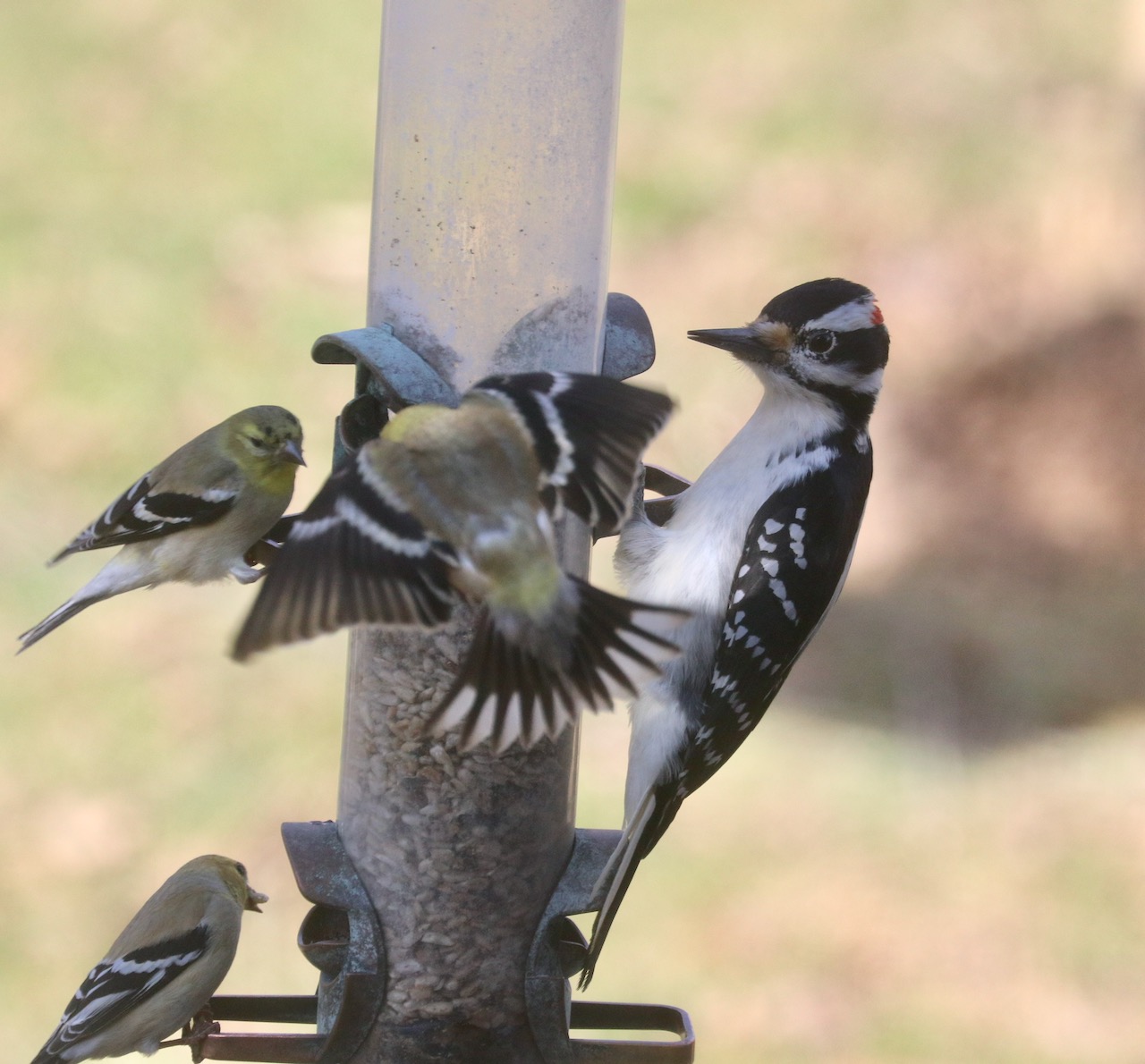
This old photo from March 8, of my beloved male hairy woodpecker mobbed by goldfinches at a tube feeder, is hard for me to look at now that I've made the connection between tube feeders and disease transmission. You can see the messed up eye on the lowest left goldfinch.


And his mate, with a sick goldfinch on the opposite port! You can see that scabby eye..the woodpecker perhaps saved from infection by her longer bill, which allows her to dip into the seed without contacting the port. However they have escaped it, I am so grateful. But this is what fuels my ferocious focus on taking the vectors out of the equation.


What fuels it is my love for all of them. 


This is a much safer way to feed. No ports to contact. Just bird and peanut and gone.


And what of the ones who brought this contagion? Why have I treated and (hope to) release now 18 American goldfinches, and no house finches? Well, this is something I've been thinking about a LOT. 
I see house finches with symptoms. And here's the thing: I can't even come close to catching them.

I'm trying to figure out what's going on. From what I have observed, house finches seem to be managing better with the disease than goldfinches. 
This is the first mass infection of goldfinches I've witnessed. I've never seen more than one or two American goldfinches with conjunctivitis, before this late winter/early spring of 2021. 

And suddenly they are overwhelmed. First one eye closes, and then the second. And when the second closes (which can take a couple of weeks), the bird is helpless, and it's then that I can capture it. IF it is a goldfinch.

But house finches seem to go on with the disease, seem to be able to continue to see well enough to get by. I suspect this is at least partly behavioral (as in, they have learned how to rub their eyes on perches to open them when they get stuck shut). But it may also be that house finches are building up some kind of partial resistance to the disease that the naive immune systems of American goldfinches as yet lack. They may be able to live with it, as goldfinches can't. I ache for their suffering. Their eyes look so sore, and the feathers around them are always matted and messy, as if they've been rubbing them, trying to get their eyes open. 

I'm not a scientist. My observations are all anecdotal. But I can't help but keep chewing on this problem. 

One thing that's not going to happen: these goldfinches I've worked so hard to get back to radiant health are not going to find tube feeders to share with house finches when they finally ply the sky again. They're going to have to go out and find the foods they're supposed to be eating. Or take the occasional treat from my hanging platform feeders. Watching like a hawk. So far, so good. Three birds twittering in the foyer cage, the last remaining. Two will be released tomorrow, April 14. That will leave one, #19. 

Captured April 7, Hey 19 was sitting on the platform feeder with two healthy goldfinches, his eyes completely shut. He was able to open them just enough to get there, but, once fed, he just ran out of steam. I crept up and nabbed him by hand. He'd spend almost two days in intensive care, with tiny dishes of food and medicated water, and droppers of medicated water given by hand, before he could see again.

He was completely blind until April 9, when both eyes opened blearily and he could make out his surroundings. These photos were taken that day, when he had graduated from his plastic Critter Keeper to the big cage. I always love to see their eyes open, see them see again. It keeps me going.


In this photo you can see I've lightly cut the tips of his right tail feathers, just enough to tell me who he is, in case I catch more that would be caged with him. Sincerely hoping he's the last of the last of the last. He'll be with me until April 28, and then maybe, just maybe, this epidemic will have run its course. 


So far, I've taken in 19 goldfinches. I lost one after a week to what I suspect was a secondary fungal infection that Tylan doesn't touch. Hey. 18 out of 19 ain't bad. I'll take it! I love these little chitterbugs.


What Makes a Blue Jay Raise Its Crest?

Monday, November 26, 2018

7 comments
One thing I have noticed about blue jays, having watched them closely for a year and a half now, is that they almost never raise their crests unless they are agitated, angry or (as in this bird) simply fluffing all their feathers. It's rare enough that I was thrilled to get this photo.


So it amuses me to see artists' depictions of blue jays with their crests invariably, perkily, straight up. They have a crest, the thinking seems to go. So they must keep it up, right? Wrong. Blue jay crests are raised only very rarely, and for specific reasons.


 I bought this decorative plate at a consignment store in Hendersonville, NC this April. I'm sort of building a collection of blue jay stuff (in a very desultory way; my collecting gene is weak). Not on purpose, just picking things up as I find them, or as people give them to me. Knowing blue jays as I do, though, I look at it and wonder what those cute babies did to make their mama so mad. I worry that Baby 2 is about to peck the eyes out of drowsy Baby 1. Maybe that's why Baby 1's eyes are shut. Also if I saw a blue jay with underparts that white I'd flip out and name it Glacier and take a million photos of it. Sorry. I've been living among blue jays too long. I've gotten a bit testy.

Now, cardinal crest rules are completely different from jay crest rules. Cardinals raise their crests all the time, and it doesn't necessarily indicate anger or agitation. It can, but they also raise them when they're singing and eating and just looking around being chubbeh, like here. A very roundish cardinal.


I was thinking about how long it had been since I had been able to catch a jay with its crest up when something changed in our yard.  Suddenly everyone was going around with tall crests.


They were flighty and agitated.


Even the hairy woodpecker, usually a mellow bird, had some big hair going on.


This is how birds tell each other that something evil  this way goes.


And this is the cause. On Nov. 17, this adult male sharp-shinned hawk spent most of the day hanging out in the woods just beyond and to the north of the feeders.  If you click on this heavily obstructed photo, you can see the glint in his garnet-red eye.


He normally strafes the feeders several times a day, then disappears into the orchard. I always thrill to see him, even as I worry about my jays. But on this sunny warmish day, he was oddly relaxed, sitting with one foot pulled up into the floof of his belly feathers. Perhaps he had a full crop.


All the birds know that as long as he's puffed up and standing on one leg, he's not going to launch an immediate attack. But oh, that eye. You don't want that eye to fix on you, don't want the pupil to draw down to a pinpoint, because you might suddenly become lunch.

So after a period of utter panic and sitting frozen still, they gingerly resume their activity, but they all keep one eye on the hawk the entire time. Hairy Woodpecker is looking directly at him. She keeps her crest fluffed to tell all the other birds to beware.


The jays were almost nonchalant about the hawk. After all, they weigh nearly as much as he does (3 oz to the male sharpie's 3-4 oz). Hard to believe that hawk weighs only that much. A female sharpie can weigh up to 7.7 oz. I can't say I've seen jays virtually ignoring a big female sharpie!

They did, however, pay him the homage of keeping their crests up as long as he was around.

He returned for another camp-out on November  22, one of those dull gray days when not much seems to be happening. And up went the crests again.


It's the birds' nonverbal way of saying danger perches, preening and dozing, in a nearby tree.


When he mounted to the top of an elm, all the jays' alarm bells went off at once.


And when he finally took off to the northwest, a salvo of jeers followed him.


He'd be back, and next time, I'd witness his work.


Yes it is a cliffhanger, but a very small one. I'll be back, too. :)

Painting so hard on the LAST TWO illustrations for Saving Jemima. I made it through the Ecuador trip and Thanksgiving and Liam's coming home, and now I'm back at the drawing table, working with joy and verve again. Unstructured time for composition, thought and drawing...it's a beautiful thing.

I have a list of stuff I have to get back to when those paintings are done. So if you have sent me an email asking about a possible speaking gig, and I haven't replied, please know that there's a stack of email not being ignored, but simply waiting to be answered. First things first. Gotta finish this book!


[Back to Top]