Background Switcher (Hidden)

Showing posts with label bird feeding. Show all posts

Snob Feeding with Zick Dough

Sunday, February 13, 2022

6 comments


Let's face it. Along with the fabulous birds we all want to see, the sapsuckers with their velvet berets, there's a lot of riffraff in the winter bird feeding world. 

One starling at the Zick Dough is unique and beautiful.


Eight starlings is expensive. Dirty, too. Then 30...ugh! Starlings can take a fine homemade food like Zick Dough and turn it into pounds of poop faster than any bird alive. 


We fill up our guts then we turn it into @#$# 
Then we get rid of it


If you go listen, and I hope you will, you will understand something of my musical roots, and my sense of humor. Best sung in a roomful of filthy hippies who gleefully shout the backup lines.

Anyway, I like to keep my homemade Zick Dough Improved away from starlings. The way to do this is to offer it in a place starlings (and house sparrows) fear to go. These imported birds know we hate them, and they won't generally enter a feeder that looks like a trap, or that brings them too close to people.

Back in Jemima Jay days, soon after her release in June 2017, I devised a little feeder she could use, that other birds hesitated to exploit.


It's under the crank-out window right by my studio drawing table. I stocked it with things like pecan halves and chicken breast and basmati rice, fresh corn, snap peas...the buffet was deluxe and she thrived on it.  It was our little secret! 


Of course, given such fabulous fare, it didn't take long for Jemima's  little feeder to catch on with the other birds. This was mostly fine with me, and it's had wonderful consequences of late.

I've simplified the offerings, keeping it to Zick Dough Improved. See bottom of post for recipe. 

The Snob Feeder was easy to make.  It's just a canning strainer with a handle, and a black alligator style clip from the hardware store. Why a strainer? Well, rain goes through it, so you don't make Zick Dough Soup every time it rains. That said, I feed small amounts frequently, and withhold the food if it's really pouring. 

 I've clipped the strainer to the shelf bracket that supports my big bird screen--a panel of black crop netting strung across a frame of PVC pipe, which prevents birds from killing themselves on my big studio window. 
For more on that, go here:

It's easy to access! I just crank out the studio window, put a handful of Zick Dough in the strainer, and go back to work. 
Now I'm going to show you who benefited from the inside knowledge of my little "Snob Feeder."

Here's the male white-breasted nuthatch who made an appearance in my last post about ice storms. If you click on the photo you can see he's missing a couple primary feathers on his right wing--pulled out by getting stuck in ice in his roost hole overnight. 
You can also see that the birds have made a hole in the screen that they duck in and out of. :)


 Here's my adorable little female red-breasted nuthatch. Squee!! They're so much smaller than the white-breasted nuthatch, and red-breasts are only here in SE Ohio in winter.


Needless to say, tufted titmice are my most enthusiastic customers, as are Carolina chickadees. They both jump for joy for Zick Dough!


Cardinals love Zick Dough too, but my window feeder pictures aren't so hot. So here's a nice old couple. Look at all the red on that female, speaking of  her advanced age and the higher testosterone levels that come with it. The higher the T, the stronger her color.


Now, white-throated sparrows aren't folks you'd normally think would clamber into a food strainer right next to a window, but...


after thinking about it and watching other birds enjoying this intriguing looking food, like this buff-striped bird is doing, I have several who have made the leap! Here's a pretty white- striped morph. Studies have shown that, while they may not be as attractive to our eye, buff-striped males make better dads. :)


Speaking of sparrows, my sweet little song sparrow Ball, hand-raised last fall and still with me, loves Zick dough! He remembers it from when he was a babe.


If you click on the photo you will see the fault bar across his tail that is his nametag.


This fox sparrow will eat the Zick Dough I sprinkle on the ground below, but he's a little too shy to come in to the feeder. Having him this close is a thrill. Pardon the photo--the bird screen was iced up. 


Same for the eastern towhees. I have SEVEN this winter! Never have had more than a couple. I love these two huge sparrow species!


This lovely male downy woodpecker likes to come and go by the hole in the netting. He's welcome.


This might be his mate. I like the way she hangs down to get her treat.


Dark-eyed juncos are another ground feeder one wouldn't expect would climb into a homemade feeder, but here's one feasting.


Carolina wrens are regular. Like any insectivore, they need nourishing food to survive such hard winters as this one.


This beautiful American tree sparrow is thinking hard about coming in for Zick dough...


but settles for the dried mealworms I toss onto the snow several times a day. The birds were a bit slow to catch onto this new treat (just like me). But it's so nice to have something nourishing to offer the birds when it stays so cold for weeks at a time. 


Towhees, juncos and tree sparrows dig them! 


Pro-tip (I'm full of them today!)  The photo below was taken at Tractor Supply. Here's the choice. You can buy 17 oz. (just a hair over ONE POUND) of dried mealworms in the wild bird feeding section for $19.99. That's about $20/lb. I don't think the birds give a hoot about the "berry flavor" they add. That's just to get YOU to buy it for $20/lb.

OR you could walk to the chicken feeding section in back, and buy FIVE POUNDS of the same thing for $39.99. That's about $7/lb.

Your choice. They keep well. I tried to buy them first from my friend Tim Vocke at thenaturesway.com but he tells me that all dried mealworms are coming out of China these days. He's my first resort for live mealworms for my rehab birds. 


I hope this photo essay has shown you that you can cultivate personal relationships with birds using the snob feeding concept. Offer fabulous high quality, high protein food in small amounts, and make them work for it. Bring them in right up close to a window where you spend most of your time. They'll learn to recognize and trust you, watch your rhythms and anticipate your moves, and you'll get an intimate look into their lives. 

This is the fourth winter this beautiful female yellow-bellied sapsucker has spent with me.


I have had the great pleasure of getting to know her, teaching her how to eat strange things, and watching her slip into full adult plumage.


She brings me joy. Long may she run.

Here's that recipe.

 ZICK DOUGH IMPROVED: SMALL BATCH 

Melt in the microwave and stir together: 
1 cup peanut butter 
1 cup lard 

In a large mixing bowl, combine 
2 cups unmedicated chick starter 
2 cups quick oats 
1 cup yellow cornmeal 
 1 cup flour

Add melted lard/peanut butter mixture slowly to the combined dry ingredients and mix well.
Stir constantly.Stop adding the melted fats when the mix is crumbly and a little dry.
                                                    If you have extra PB/lard, just save it for the next batch.
                                                        You can adjust the texture with a little  extra flour.

NOTE: This is a COLD WEATHER OFFERING ONLY.  It's too rich to feed once the weather warms up. If you do feed in spring, keep it to cold snaps. It should be regarded as a treat in warmer weather, NOT a steady diet. 


Most frequently asked questions, to save time: 

I don't want to use lard. Can I substitute vegetable shortening?
You can, but the birds won't like it. I've done the side-by-side multi-species taste tests.

Isn't white flour bad for birds?
No.

I'm going to use organic almond flour and all-natural hand-ground peanut-butter.
Knock your$elf out! I u$e $tore brand wheat flour and PB becau$e I'm feeding a LOT of bird$$$$

Messages from Bill

Tuesday, May 18, 2021

22 comments

           One of the hard things about losing someone is that you keep thinking they're going to get back in touch with you--that you're going to get a message here pretty soon. But you listen and watch and stay open, and though they're on your mind so much, the messages mostly never arrive. You have to slowly let go of that thought that you're going to hear their voice or get a strong feeling that they're near. I guess thinking and hoping that that might happen is one way we forestall grief, hold off the emptiness.

   And then there are the days when things happen. You let yourself think that you've just gotten a message, that you're still accompanied, that there might still be a connection.

  The whole time I've lived here--29 years now--I've maintained a "yard list" of all the birds that have flown over, stopped by, bred, or visited this sanctuary. New additions have slowed to a trickle, but I have to say that the species I'm adding now are the coolest of the cool, and that makes up for the years between new additions. Bill was always prognosticating on the next species we were going to get. Me, I'm pretty Zen about it. What shows up, shows up. But oh, the thrill of discovery! The surprise! 

 On May 10, I went out to feed the bluebirds in the yard and the meadow. Both pairs are feeding fledglings now, and I have been subsidizing them once a day, early on each freezing-cold morning. I figure it's hard enough to feed four or five fledglings without temperatures starting out in the 30's every morning. I was leaning against the garage, watching the bluebirds through binoculars, when I saw something that looked like a dark stick in the middle of the meadow.  

 It was a shorebird, and it wasn't a woodcock or a killdeer. It wasn't even a Wilson's snipe, which was species #188 on May 2, 2013. It wasn't a black-bellied plover (#182, May 18, 2006). It was a solitary sandpiper, and it was species #198 for the sanctuary! 

It was poking around looking for food in the little swale that Bill always said would be perfect for a pond. He and I had quite a few discussions about whether making a pond was even feasible. I maintained that the sandy loam there was the wrong soil to hold water, and furthermore that there wasn't enough runoff to fill it, much less keep it wet long enough to even raise a tadpole. I still think that. I go back and forth, back and forth. I would LOVE to put in a shallow frog pond, to serve as a vernal pool for all the wonderful amphibians we have. But I just don't think there's sufficient water, and I'm sure the soil is too permeable for this wonderful notion to work. So now I'm thinking about how much a liner would cost, because I'm still thinking about it.

Here's a little digiscoped video (I just hand-held the phone up to the scope's eyepiece, so it's pretty shaky) of the solitary sandpiper messing about in Bill's little wishful pool. 


That gracious and beautiful visitor stayed long enough for me to charge the house and grab my scope and long lens.


Solitary sandpipers are such pretty birds. They have a constellation of stars flung across a dusky back, a nice white eye ring, and a long, tapered shape that is distinctive. They bob and weave like an oversized spotted sandpiper, but they aren't quite as compulsive about it. More elegant, more restrained.
 
This was an amazing thing to see, walking right next to Bill's grave. Did he send it to me?
 
 
The sandpiper wasn't saying. It took flight with a three-part rolling trill and arrowed out, to disappear over the northeast horizon. 
 
 
I was so glad I was there to see that. It would have been so easy to miss it. And hearing its wild woodland call over the meadow made my day.
 
I came back inside from watching the sandpiper, sat down at my drawing table, and glanced out, as I do 5,000 times a day, to see this...


Who came up with this design? Is there a flashier bird in the world than a red-headed woodpecker? Durn thing looks like a stuffed toy out there!
It occurred to me that I had just come in from seeing a brand new species right by Bill's grave, and now here was his favorite bird, flying and hitching around like it owned the yard.

Perching like a hieroglyph on the feeder post

 
Using all the feeders, as red-heads will..they are fearless, inventive and inquisitive birds


Speaking of inventive, this is how I feed sunflower hearts now that tube feeders have been taken out of service. The mesh, intended for black oil sunflower seed, is too small to admit the new improved fatter shelled seeds, but it's perfect for the hearts! No ports to spread house finch disease--it's working well! I had sidelined this feeder because black oil sunflower wouldn't fit through the mesh, but it's back in service now.


Little character was shuttling peanuts, one by one, to storage in the crevices in a telephone pole out in the yard.

Making the place ring with its churring growl, kerr kerr kerr!

With the solitary sandpiper and the red-headed woodpecker visiting on the same day, I had the feeling that Bill was reaching through the veil. Phoebe's immediate response: "He's saying BUILD THE DAMN POND, WOMAN!"


Yeah, well, I still have to think about it for awhile. Ohio can be pretty stingy with rain in the spring and summer. I just tipped ten gallons of rainwater into the two tadpole puddles I'm tending now, which are full of all the American toad eggs I saved from the driveway! With all the rain we got last week they were still actively drying up, and they're in straight clay, in the shade. Hard times for frogs and those who lug 40-pound jugs of water to their squiggly offspring. I take them out in the garden cart, three at a time. It's all I can do to hold the cart back with 120 pounds of water in it as we go down the steep hill. Do I really want to sign on to a large vernal pool all the way out the meadow? Kinda thinking I have enough to care for now...

But Bill, I just wanted you to know I got your messages, and your beautiful messengers. Thank you for sending them. We miss you more than ever.


My Bird Feeder Clients

Tuesday, April 13, 2021

7 comments

 As I write, the wind is roaring again, and the newly flowering maples are tossing their heads and arms like they're at a rave. Practically every minute, something changes out there. A fox sparrow arrives and beats up a house sparrow.  My beautiful red-winged blackbird comes in for peanuts, as he has for several springs running. 


It's not every redwing that will climb on a peanut feeder. He's special!


Yeah baby! Get you some peanuts! And then he flies off to his territory at the nearest pond, about a half mile away as the redwing flies. Fergus the Frog's pond, if you must know.


On March 30, my darling male chipping sparrow returned from wherever he spent the winter. He immediately checked out every single feeder (all new to him). 


and fearlessly worked his way under the protective dome over this hanging platform. 


I just love birds' intelligence and adaptibility. He checked for Zick Dough where it used to be before it was mobbed with house finches, and finding none, decided to take advantage of what was there. I can't wait to see if his funny little mate with the spiky eyebrows comes back again this spring. 


You see, I have deeply personal feelings about the birds who come to my feeders. I follow them from year to year. They're my friends, and that's nothing to minimize in a pandemic.  So when I see them under threat as a result of something I am doing, it bothers me deeply. 

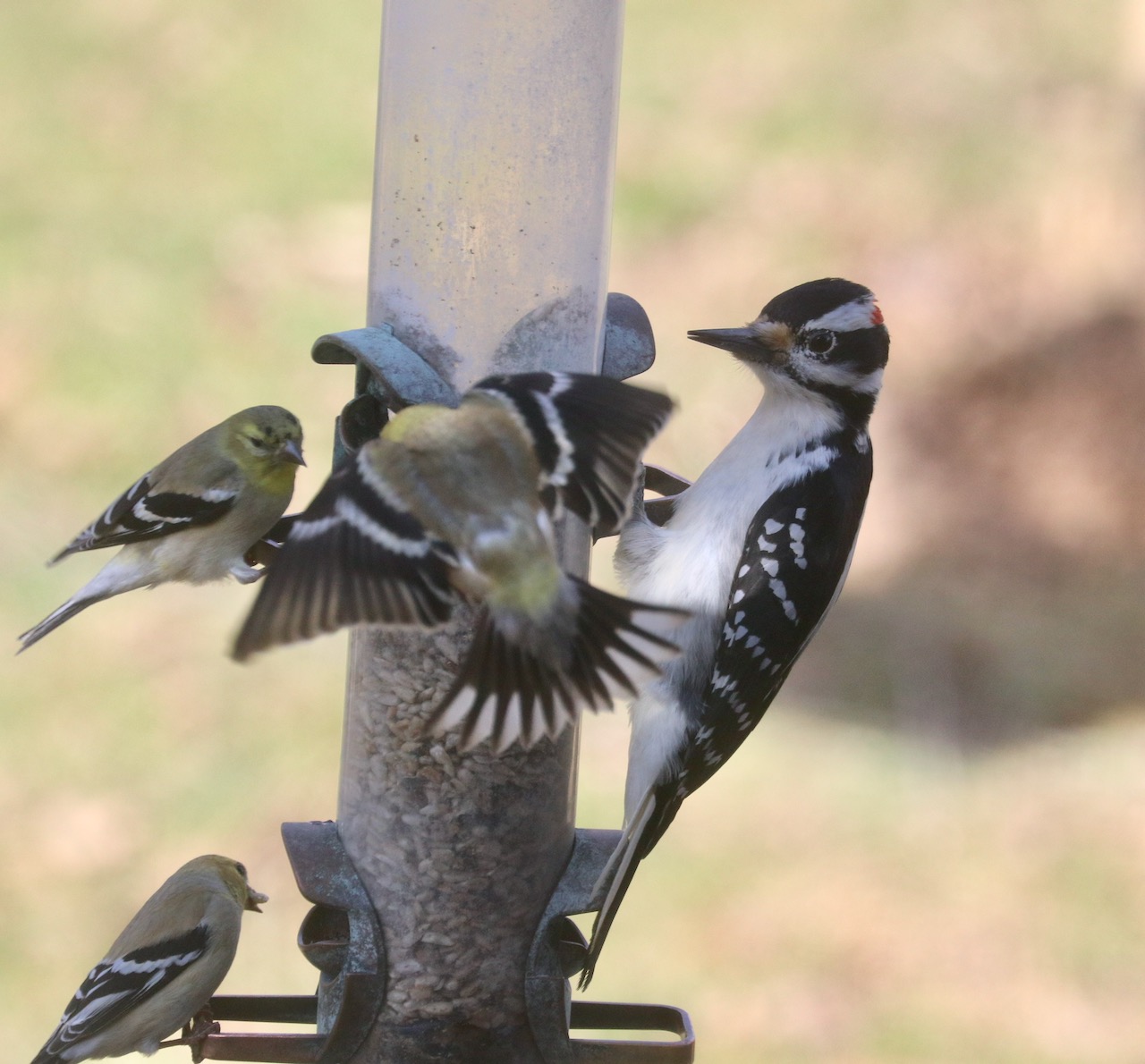
This old photo from March 8, of my beloved male hairy woodpecker mobbed by goldfinches at a tube feeder, is hard for me to look at now that I've made the connection between tube feeders and disease transmission. You can see the messed up eye on the lowest left goldfinch.


And his mate, with a sick goldfinch on the opposite port! You can see that scabby eye..the woodpecker perhaps saved from infection by her longer bill, which allows her to dip into the seed without contacting the port. However they have escaped it, I am so grateful. But this is what fuels my ferocious focus on taking the vectors out of the equation.


What fuels it is my love for all of them. 


This is a much safer way to feed. No ports to contact. Just bird and peanut and gone.


And what of the ones who brought this contagion? Why have I treated and (hope to) release now 18 American goldfinches, and no house finches? Well, this is something I've been thinking about a LOT. 
I see house finches with symptoms. And here's the thing: I can't even come close to catching them.

I'm trying to figure out what's going on. From what I have observed, house finches seem to be managing better with the disease than goldfinches. 
This is the first mass infection of goldfinches I've witnessed. I've never seen more than one or two American goldfinches with conjunctivitis, before this late winter/early spring of 2021. 

And suddenly they are overwhelmed. First one eye closes, and then the second. And when the second closes (which can take a couple of weeks), the bird is helpless, and it's then that I can capture it. IF it is a goldfinch.

But house finches seem to go on with the disease, seem to be able to continue to see well enough to get by. I suspect this is at least partly behavioral (as in, they have learned how to rub their eyes on perches to open them when they get stuck shut). But it may also be that house finches are building up some kind of partial resistance to the disease that the naive immune systems of American goldfinches as yet lack. They may be able to live with it, as goldfinches can't. I ache for their suffering. Their eyes look so sore, and the feathers around them are always matted and messy, as if they've been rubbing them, trying to get their eyes open. 

I'm not a scientist. My observations are all anecdotal. But I can't help but keep chewing on this problem. 

One thing that's not going to happen: these goldfinches I've worked so hard to get back to radiant health are not going to find tube feeders to share with house finches when they finally ply the sky again. They're going to have to go out and find the foods they're supposed to be eating. Or take the occasional treat from my hanging platform feeders. Watching like a hawk. So far, so good. Three birds twittering in the foyer cage, the last remaining. Two will be released tomorrow, April 14. That will leave one, #19. 

Captured April 7, Hey 19 was sitting on the platform feeder with two healthy goldfinches, his eyes completely shut. He was able to open them just enough to get there, but, once fed, he just ran out of steam. I crept up and nabbed him by hand. He'd spend almost two days in intensive care, with tiny dishes of food and medicated water, and droppers of medicated water given by hand, before he could see again.

He was completely blind until April 9, when both eyes opened blearily and he could make out his surroundings. These photos were taken that day, when he had graduated from his plastic Critter Keeper to the big cage. I always love to see their eyes open, see them see again. It keeps me going.


In this photo you can see I've lightly cut the tips of his right tail feathers, just enough to tell me who he is, in case I catch more that would be caged with him. Sincerely hoping he's the last of the last of the last. He'll be with me until April 28, and then maybe, just maybe, this epidemic will have run its course. 


So far, I've taken in 19 goldfinches. I lost one after a week to what I suspect was a secondary fungal infection that Tylan doesn't touch. Hey. 18 out of 19 ain't bad. I'll take it! I love these little chitterbugs.


[Back to Top]