Showing posts with label Zick Dough Improved. Show all posts
Snob Feeding with Zick Dough
Let's face it. Along with the fabulous birds we all want to see, the sapsuckers with their velvet berets, there's a lot of riffraff in the winter bird feeding world.
One starling at the Zick Dough is unique and beautiful.
Eight starlings is expensive. Dirty, too. Then 30...ugh! Starlings can take a fine homemade food like Zick Dough and turn it into pounds of poop faster than any bird alive.
We fill up our guts then we turn it into @#$#
Then we get rid of it
to quote the Holy Modal Rounders in "Slurf Song"
If you go listen, and I hope you will, you will understand something of my musical roots, and my sense of humor. Best sung in a roomful of filthy hippies who gleefully shout the backup lines.
Anyway, I like to keep my homemade Zick Dough Improved away from starlings. The way to do this is to offer it in a place starlings (and house sparrows) fear to go. These imported birds know we hate them, and they won't generally enter a feeder that looks like a trap, or that brings them too close to people.
Back in Jemima Jay days, soon after her release in June 2017, I devised a little feeder she could use, that other birds hesitated to exploit.
It's under the crank-out window right by my studio drawing table. I stocked it with things like pecan halves and chicken breast and basmati rice, fresh corn, snap peas...the buffet was deluxe and she thrived on it. It was our little secret!
Of course, given such fabulous fare, it didn't take long for Jemima's little feeder to catch on with the other birds. This was mostly fine with me, and it's had wonderful consequences of late.I've simplified the offerings, keeping it to Zick Dough Improved. See bottom of post for recipe.
The Snob Feeder was easy to make. It's just a canning strainer with a handle, and a black alligator style clip from the hardware store. Why a strainer? Well, rain goes through it, so you don't make Zick Dough Soup every time it rains. That said, I feed small amounts frequently, and withhold the food if it's really pouring.
I've clipped the strainer to the shelf bracket that supports my big bird screen--a panel of black crop netting strung across a frame of PVC pipe, which prevents birds from killing themselves on my big studio window.
For more on that, go here:
It's easy to access! I just crank out the studio window, put a handful of Zick Dough in the strainer, and go back to work.
Now I'm going to show you who benefited from the inside knowledge of my little "Snob Feeder."
Here's the male white-breasted nuthatch who made an appearance in my last post about ice storms. If you click on the photo you can see he's missing a couple primary feathers on his right wing--pulled out by getting stuck in ice in his roost hole overnight.
You can also see that the birds have made a hole in the screen that they duck in and out of. :)
Here's my adorable little female red-breasted nuthatch. Squee!! They're so much smaller than the white-breasted nuthatch, and red-breasts are only here in SE Ohio in winter.
Needless to say, tufted titmice are my most enthusiastic customers, as are Carolina chickadees. They both jump for joy for Zick Dough!
Cardinals love Zick Dough too, but my window feeder pictures aren't so hot. So here's a nice old couple. Look at all the red on that female, speaking of her advanced age and the higher testosterone levels that come with it. The higher the T, the stronger her color.
Now, white-throated sparrows aren't folks you'd normally think would clamber into a food strainer right next to a window, but...
after thinking about it and watching other birds enjoying this intriguing looking food, like this buff-striped bird is doing, I have several who have made the leap! Here's a pretty white- striped morph. Studies have shown that, while they may not be as attractive to our eye, buff-striped males make better dads. :)
Speaking of sparrows, my sweet little song sparrow Ball, hand-raised last fall and still with me, loves Zick dough! He remembers it from when he was a babe.
If you click on the photo you will see the fault bar across his tail that is his nametag.
This fox sparrow will eat the Zick Dough I sprinkle on the ground below, but he's a little too shy to come in to the feeder. Having him this close is a thrill. Pardon the photo--the bird screen was iced up.
Same for the eastern towhees. I have SEVEN this winter! Never have had more than a couple. I love these two huge sparrow species!
This lovely male downy woodpecker likes to come and go by the hole in the netting. He's welcome.
This might be his mate. I like the way she hangs down to get her treat.
Dark-eyed juncos are another ground feeder one wouldn't expect would climb into a homemade feeder, but here's one feasting.
Carolina wrens are regular. Like any insectivore, they need nourishing food to survive such hard winters as this one.
This beautiful American tree sparrow is thinking hard about coming in for Zick dough...
but settles for the dried mealworms I toss onto the snow several times a day. The birds were a bit slow to catch onto this new treat (just like me). But it's so nice to have something nourishing to offer the birds when it stays so cold for weeks at a time.
Towhees, juncos and tree sparrows dig them!
Pro-tip (I'm full of them today!) The photo below was taken at Tractor Supply. Here's the choice. You can buy 17 oz. (just a hair over ONE POUND) of dried mealworms in the wild bird feeding section for $19.99. That's about $20/lb. I don't think the birds give a hoot about the "berry flavor" they add. That's just to get YOU to buy it for $20/lb.
OR you could walk to the chicken feeding section in back, and buy FIVE POUNDS of the same thing for $39.99. That's about $7/lb.
Your choice. They keep well. I tried to buy them first from my friend Tim Vocke at thenaturesway.com but he tells me that all dried mealworms are coming out of China these days. He's my first resort for live mealworms for my rehab birds.
I hope this photo essay has shown you that you can cultivate personal relationships with birds using the snob feeding concept. Offer fabulous high quality, high protein food in small amounts, and make them work for it. Bring them in right up close to a window where you spend most of your time. They'll learn to recognize and trust you, watch your rhythms and anticipate your moves, and you'll get an intimate look into their lives.
This is the fourth winter this beautiful female yellow-bellied sapsucker has spent with me.
I have had the great pleasure of getting to know her, teaching her how to eat strange things, and watching her slip into full adult plumage.
She brings me joy. Long may she run.
Here's that recipe.
ZICK DOUGH IMPROVED: SMALL BATCH
Melt in the microwave and stir together:
1 cup peanut butter
1 cup lard
In a large mixing bowl, combine
2 cups unmedicated chick starter
2 cups quick oats
1 cup yellow cornmeal
1 cup flour
Add melted lard/peanut butter mixture slowly to the combined dry ingredients and mix well.
Stir constantly.Stop adding the melted fats when the mix is crumbly and a little dry.
If you have extra PB/lard, just save it for the next batch.
You can adjust the texture with a little extra flour.
NOTE: This is a COLD WEATHER OFFERING ONLY. It's too rich to feed once the weather warms up. If you do feed in spring, keep it to cold snaps. It should be regarded as a treat in warmer weather, NOT a steady diet.
Most frequently asked questions, to save time:
I don't want to use lard. Can I substitute vegetable shortening?
You can, but the birds won't like it. I've done the side-by-side multi-species taste tests.
Isn't white flour bad for birds?
No.
I'm going to use organic almond flour and all-natural hand-ground peanut-butter.
Knock your$elf out! I u$e $tore brand wheat flour and PB becau$e I'm feeding a LOT of bird$$$$
|
Widget for blogger by Way2Blogging | Via Spice Up Your Blog Gadgets
|
What to Feed Orioles...and What NOT to Feed
Wednesday, May 6, 2020
11 comments
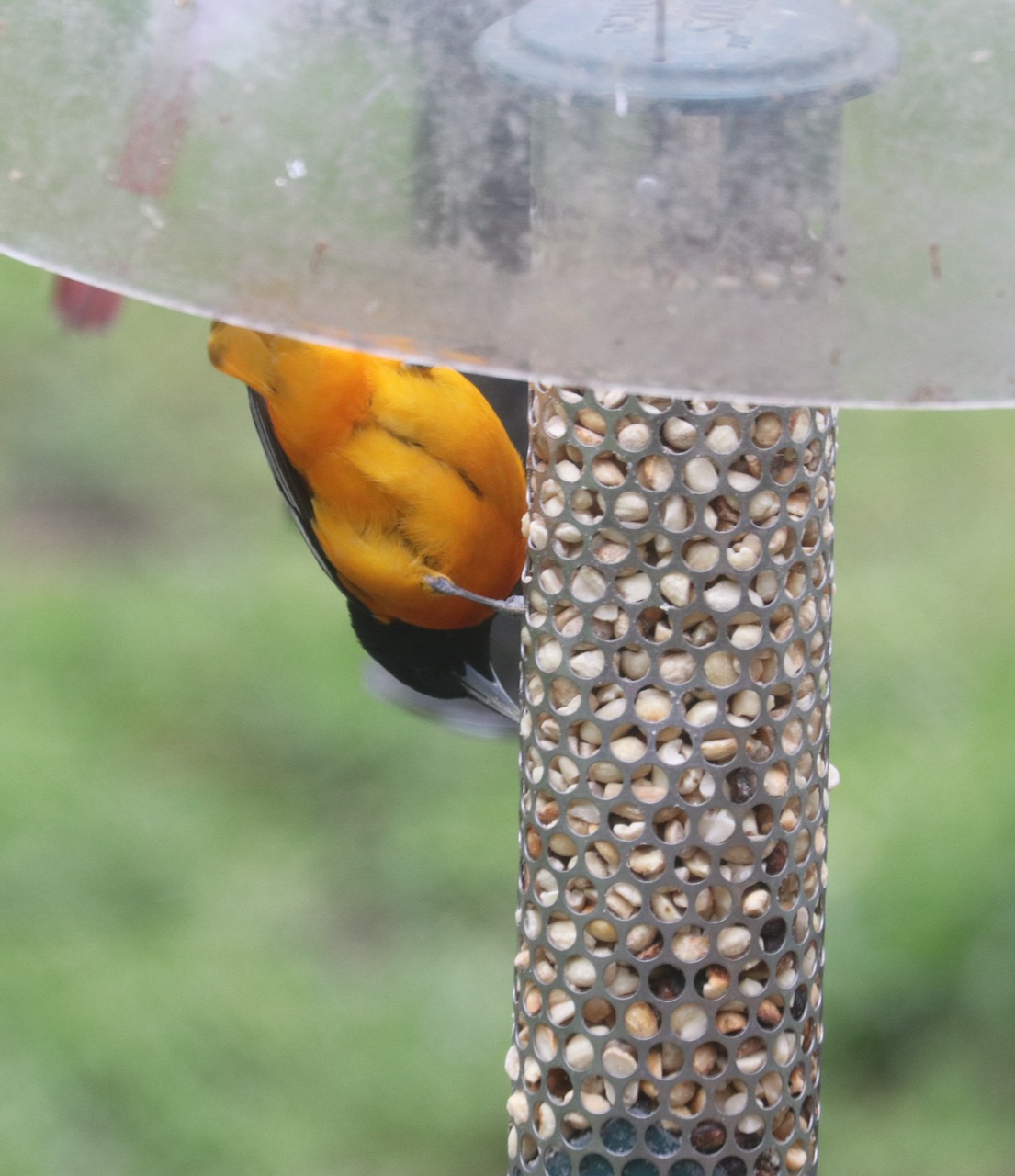
This is an unusual sight: a Baltimore oriole eating sunflower chips with a cardinal. Another unusual sight: the same oriole, eating peanuts!
But then, this is an unusual spring. April was terrible: cold and wet. I had high hopes for May, but it was 38 at wakeup this morning, May 6, in southeast Ohio, and the birds are hurting. I lay awake all night figuring out ways to help them. I've got to go on another Zickpotition to feed baby bluebirds in their boxes today. My third such trip this nesting cycle. I hate that I have to do that, but it's that or clean the dead little ones out of my boxes, and that I really don't want to do.
When it's cold and wet, bluebirds and other insectivores have a terrible time finding enough food for their young. So I help. If you haven't seen the video yet, click here: http://tinyurl.com/zicklife
These orioles are migrants, and they normally make their living like this. Here, he's spreading apart a dead leaf wad with his opened bill, looking for caterpillars or spiders.
But in this craptastic weather, the orioles are forced to mooch.
I had literally two tiny Clementines in the house when they blew in.
Do you like my oriole orange feeder? It was a gift from my sweet dear friend Kim Beard, last October. It happens to have a prong on it that works for impaling a small orange. :)
The wee clementines were disappearing fast. So as I lay awake all night, it occurred to me that the orioles might accept grapefruit. And they did, though they shake their heads at the sourness. This is a young male, who still has some olive-brown immature plumage around his eyes.
The first thing I did when I got up this morning was make a double batch of Zick Dough. Here's the recipe:
Zick Dough Improved
1 cup peanut butter
1 cup lard (can be bought in large tubs at Walmart)
Melt the fats together in microwave until liquid.
Combine dry ingredients:
2 cups chick starter (make sure it's unmedicated; available at feed store)
1 cup cornmeal
1 cup flour
Add melted fats and stir until crumbly. Does not need refrigeration. Serve in hanging plexi dome feeder so it stays dry. Serve in winter, or during unseasonably cold spells in spring and summer. It is too rich for a steady diet and can possibly cause issues with gout, but it's great for pulling birds through hard times. So feed sparingly, and only when needed.
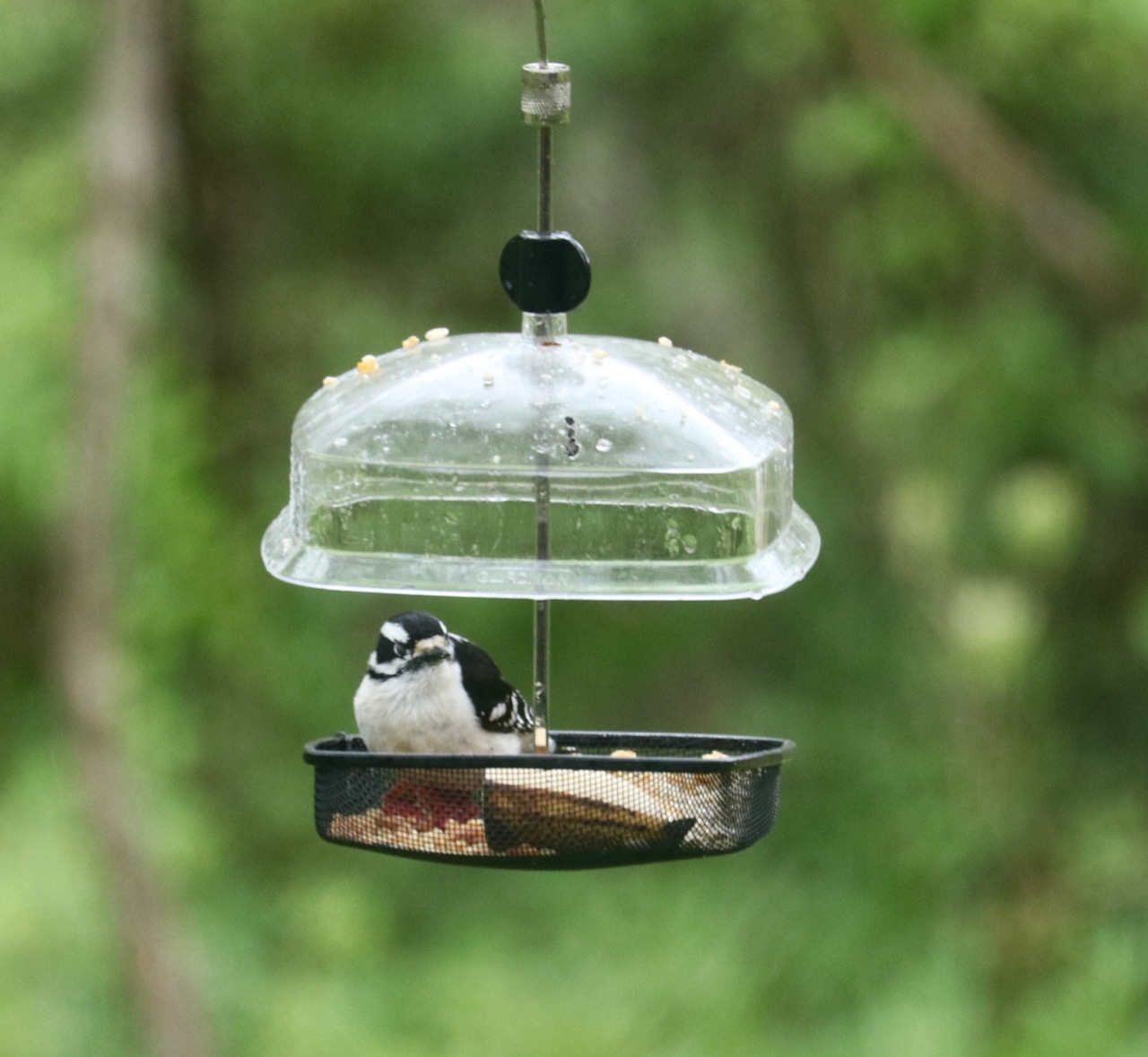
Here's a hanging plexi dome feeder I got at White's Mill in Athens OH. Has a screen bottom so water won't collect, and an adjustable dome so you can keep starlings out by lowering it so only cute little natives like this female downy woodpecker can wiggle in. Such an awesome little feeder!
While I was lying awake this morning, I got this idea that I might entice the orioles to take higher-quality fare than orange pulp by using a little birdy psychology. So as soon as the batch had set, I stuffed an exhausted Clementine skin with fresh warm ZickDough.
The older male oriole came down, tasted it, and approved. I was squealing with joy from inside my studio blind.
When an older female dropped in, she was attracted to the Clementine, but didn't consider ZickDough fit for consumption. You can see her spreading her mandibles, trying to get down past the dough to the fruit pulp. Oh well. Two out of three ain't bad.
Between the ZickDough and the grapefruit, I've got them covered until I can get some big navel oranges today. I also ordered 3,000 mealworms from thenaturesway.com , my favorite supplier of mealworms. Tell Tim Vocke that Zick sent you!
(I don't normally feed mealworms to the birds in my yard. But in a spring like this one, they can make the difference between life and death for nestlings).
You will notice that I am NOT feeding grape jelly to these birds. I do not consider straight grape jelly a fit food for any wild bird. It is practically pure refined sugar, full of artificial color, and not a fit food for any bird. I hope that if you are feeding grape jelly to orioles you will stop and consider my warning. I've been rehabilitating and experimenting with feeding wild birds since 1982, and I would never, ever feed straight processed grape jelly to one of my clients. If I did, I'd expect to see it keel over from liver damage in short order.
You will see a lot of people recommending feeding jelly to orioles. This is classic anthropocentric behavior. I enjoy it, so I do it. I don't even think about whether it's good for the birds. It brings them in, they like it, and that's enough for me. Well, just because a bird will eat something doesn't mean they SHOULD eat it.
No, there aren't any studies as yet to prove me right, but you can ask any avian dietitian if they'd feed jelly to orioles. You'd get an "absolutely NOT!" And neither are there targeted studies to back up the assertion that Red Dye #40, as found in artificial hummingbird "food," is harmful, and I think there's now solid agreement on that score (except from the manufacturers who continue to make money on it).
For more information on that, see my blogpost, Red Alert for Hummingbirds.
And, at the risk of making this post a real linkfarm, I wanted to let you know that I'll be raising money for monarch butterfly research this Saturday, May 9! Mark Garland, my dear friend from Cape May, NJ, has asked me to bird around my home and contribute my sightings to his Virtual World Series of Birding team, The Monarchists. We have an AMAZING team of 15 people. They are:
Lu Ann Daniels, Ron Rollet, Elle McGee, Bert Hixon, Michael O-Brien, Louise Zemaitis, Meg Hedeen, Mark Garland, Dick Walton, Erik Bruhnke, Drew Lanham, me, Seth Benz, Geoff Heeter, and Scott Weidensaul.
Talk about good company! If you'd like to contribute to our knowledge and research on monarch butterfly migration, you can donate a per-bird amount (any amount is fine! A penny! Whatever!) at this link:
Thank you, as always, for reading and enjoying this wonderful spring with me.
|
Widget for blogger by Way2Blogging | Via Spice Up Your Blog Gadgets
|
The Wren's Pajamas
Thursday, November 2, 2017
13 comments
Every once in awhile, I get sent a photo like these.
What's that little speckled thing in my planter? I only see it at night.
![]() |
| Thanks to Melissa from DC for this adorable conundrum. Zick loves a conundrum. |
There are these things that appear on my porch every night. What in the world are they?
| Thanks to Sharon from Brunswick for this lovely shot from Maine. A puzzled friend sent it to her, and she sent it to me. Even though she knew what it was. |
Pinecones? Mice? Fair question! Read on.
Carolina wrens possess a plumage characteristic that's seldom seen, and even more seldom photographed. I've been trying to catch it with my camera for years, and a cooperative bird on Dean's Fork finally granted me an audience in the warm end of October sun.
When I saw the wren preening, I decided to wait and see what might be revealed.
You can see the gray bases of the bird's back feathers here as it raises them.
And then, shazzam! the secret Carolina wren polka-dots are suddenly revealed! Do click on the photos for greater detail.
You never see these white spots on a sleek, moving Carolina wren. The bird has to raise and spread its back and rump feathers on purpose. Only then are they revealed.
Having brought them out, the wren leaves them out. And we can also admire the dots and dashes on the leading edge of its primaries.
I believe that these spangles serve a purpose in camouflaging sleeping birds. Otherwise, why would they sleep with their backs turned to any possible observer? To me, these roosting wrens look like lots of things, most of all pinecones or mushrooms, but not much like birds. And I suspect that's the point of those unexpected spots. Were these birds tucked into a tree cavity or rock crevice instead of a metal awning, they'd simply disappear, become part of the scenery.
![]() |
It was a true treat to see a Carolina wren in its pajamas during the day. I'd only seen it once before, on a subzero day when this little one tried to catch some rays in between bites of Zick Dough.
It's finally nasty here. 40 and raining. Time to make the Zick Dough!
Now you have seen the Wren's Pajamas.
|
Widget for blogger by Way2Blogging | Via Spice Up Your Blog Gadgets
|
Survivor Peg
Wednesday, March 11, 2015
12 comments
I got home from Costa Rica late Tuesday, March 3. Wednesday was a blur of scrambling around catching up, waiting for my lost suitcase to find its way home, waiting for The Biggest Snow of the Year to hit. The snow started that evening and piled up to about 13" overnight and the next day.
The feeders were mobbed. I was so glad Bill had bought more seed while I was away. I got up early and suited up to shovel out the greenhouse and my paths to the compost, bird bath and feeders. The power was off, of course; we almost never have snow without losing power out here. Bill worked for a couple of hours shoveling out the walk and setting up and running extension cords to our Honda generator, which I had bought with literally my last $700 after a nine-day power outage two summers ago. I'd had it. I was done playing Pioneer. Life was hard for awhile after that, but I am very glad I bought it. Life's better now.
We plugged in the generator, only to have the power come back on. I unplugged everything and put the cords away. I had just finished doing that when the power went off again for the rest of the day. That was funny.
We watched the birds filling up on our offerings, and it felt good.
Even with all the beauty surrounding us, I began to fret. I hadn't seen Peg since I'd gotten back from Costa Rica. Peg is a crippled blue jay who was injured, perhaps by a hawk, in November 2013 with a break high on her right leg. I saw her right afterward, stumbling around with blood on her feathers, watched her slowly heal and adapt to living her life with only one functional leg--a tall order for a blue jay, for any bird. To my astonishment she migrated north in the spring of 2014, and returned here in November, to spend this winter with us, too. Though we see them year-round in Ohio, blue jays do migrate. Our breeders are replaced by birds from farther north, while ours go south in winter. You see them migrating in big flocks in September. Peg probably breeds somewhere in Canada. I am agog that she has made it this long, being unable to process food in her feet, hop on the ground, perch normally, or preen very well. She can't even scratch her face. Imagine.
Peg in January 2015
Peg hadn't been coming in since the boys had run out of Zick Dough partway into my trip. And now this, this Snowmageddon.
And then I saw her.
Uh-oh.
Oh, Peggy, my Peggy! She looked horrible. Her feathers damp and disheveled, something going on on her back...had the Cooper's hawk grabbed her??
She kept shivering her wings in that hopeless way of sickly birds, but made no move to preen them into order. My heart fell to my feet to see my sweet little friend brought so low. And the temperature due to plunge below zero tonight.
But I didn't stand there crying.
Though I had worlds to do to get ready for a talk and a flight to Massachusetts the next day, I dropped everything to make more Zick Dough for my Peggy girl. Because the power was still off, I melted the peanut butter and lard over a low flame on the gas stove, then hand-mixed it in a triple batch in a big lobster pot on the floor, like I always used to do. (That link goes to an amusing video). And you know what? That's a heck of a lot easier, faster and cleaner than trying to get it all in the KitchenAid mixer bowl, and trying to keep it there as the mixer throws it all over the counter. The trick, I discovered, is to keep it to a triple batch, and not try a quadrupled or even quintupled batch, like I used to do. It mixes up like a dream by hand when tripled. Bigger than that, and it's just too much to mix by hand without bending your best spoon.
But you can't get any more than a triple batch in a big Kitchenaid anyway. So why use the mixer at all? Hand-mix it. Big pot. Boom. You're done.
I put the still-warm dough out and called to Peg by name, but she flew weakly into the woods, and I never saw her eating it. I had to resign myself to the possibility that I'd never see her again. I had already photographed her, because I follow the arcs of birds I know, whether they're good or bad, happy or sad. I want to know what happens to my loved ones. My heart ached.
The next morning, before I left, I put piles of Zick Dough out on the deck, knowing the starlings would annihilate it before Peg could get to it. She was nowhere in sight. I waited around, hoping for a Peg sighting, but was skunked. I was there, however, to document my first instance of the strictly vegetarian house finches sampling the lard mix!
Caught him with the dough in his bill! Snow and below zero temperatures will do that to you.
Then I left for the airport. The boys kept putting the dough out while I was gone, but they never saw Peg.
I had a great trip to Massachusetts, speaking at the Mass Birders' Meeting at Bentley University in Waltham, reconnecting with wonderful friends like my birding mentor Bob Stymeist! You would think, having shown me my first Swainson's thrush and vagrant Townsend's warbler in 1977, that he might look older, but he's aged like fine wine. Whatta guy. He told me he'd come across my common eider specimen at the Harvard Museum of Comparative Zoology, and said it was the best one in the collection. To which I replied, "It's hard to screw up an eider. Two-inch deep feathers will cover a multitude of sins." Imagine him coming across my specimen, noticing that someone had done a particularly good job on it; seeing my name on the tag, and remembering having shown me my first Swainson's thrush. How sweet is that? Even sweeter: being able to thank him in person for being so kind to a bouncing, undoubtedly pretty annoying, 19-year-old baby birder. Here we are now, all growed up, not 19 any more.
I had a wonderful visit with my sister and niece, took a hike with Phoebe and hilarious, wonderful grand-nephews Will and Max, then came home on March 9. I looked anxiously for Peg. No joy. Same all through the pouring rain of March 10. She was nowhere to be found.
March 11 had a surprise for me. I'd been faithfully putting out Zick Dough at the appointed, agreed-upon hour, and this time, Peggy kept the appointment.
Whatever had happened to her back in the snowstorm had resolved. Maybe it was just ice after all.
Lord knows she doesn't need another injury. I checked out her good foot. Looked better than the last time I saw her.
And, in the manner of all jays, she stuffed in just a little more for the road.
I love you, Peg. Wherever you've been hiding, welcome back. I'll keep you in Zick Dough until it's time to migrate. Promise.
PEG!! March 11, 2015, alive, preparing to cache some Zick Dough, and as well as she can be.
I wouldn't have given you a nickel for her on March 5. But there's life in the old girl yet.
Is it any wonder I love her so?
She's the subject of my next column, "True Nature," in Bird Watcher's Digest's May/June issue. You can subscribe here.
|
Widget for blogger by Way2Blogging | Via Spice Up Your Blog Gadgets
|


Sunday, February 13, 2022
6 comments