Background Switcher (Hidden)

Showing posts with label winter bird feeding. Show all posts

Three Practical Winter Bird Feeding Hacks I Wish I'd Thought of Years Ago

Wednesday, January 24, 2024

0 comments

 TIP ONE: Don't waste the Zick Dough! (Recipe below).

I had spent part of my morning trying to foil starlings by bringing the lid of a two-part Zick Dough feeder lower and lower, trying to exclude those filthy birds who are not content to gobble all the expensive food; they also crap in my feeders AND heated birdbath.  One starling was managing to wriggle through despite the drastically lowered dome. Arrrghhhh!!

Finally I put a great big deep Plexiglas dome over the whole affair, and I was watching with amusement while the tufted titmice figured it out immediately, and everybody else just dithered. I could probably rank my feeder birds in order by intelligence, and TUTI would be the KING. Tufted titmice were the first birds to cross the field from the woods to take seed from a feeder at this house in the winter of 1992, and they are always the first to try anything new, and master it. The others just watch the titmice.

The Plexi dome proved far too daunting for anyone but the titmice, so I settled for lowering the top of my teeny Zick Dough feeder  even more until only the little birds and the birds that can cling upside down could comfortably land and get inside.

No problema for the clever Carolina wren!

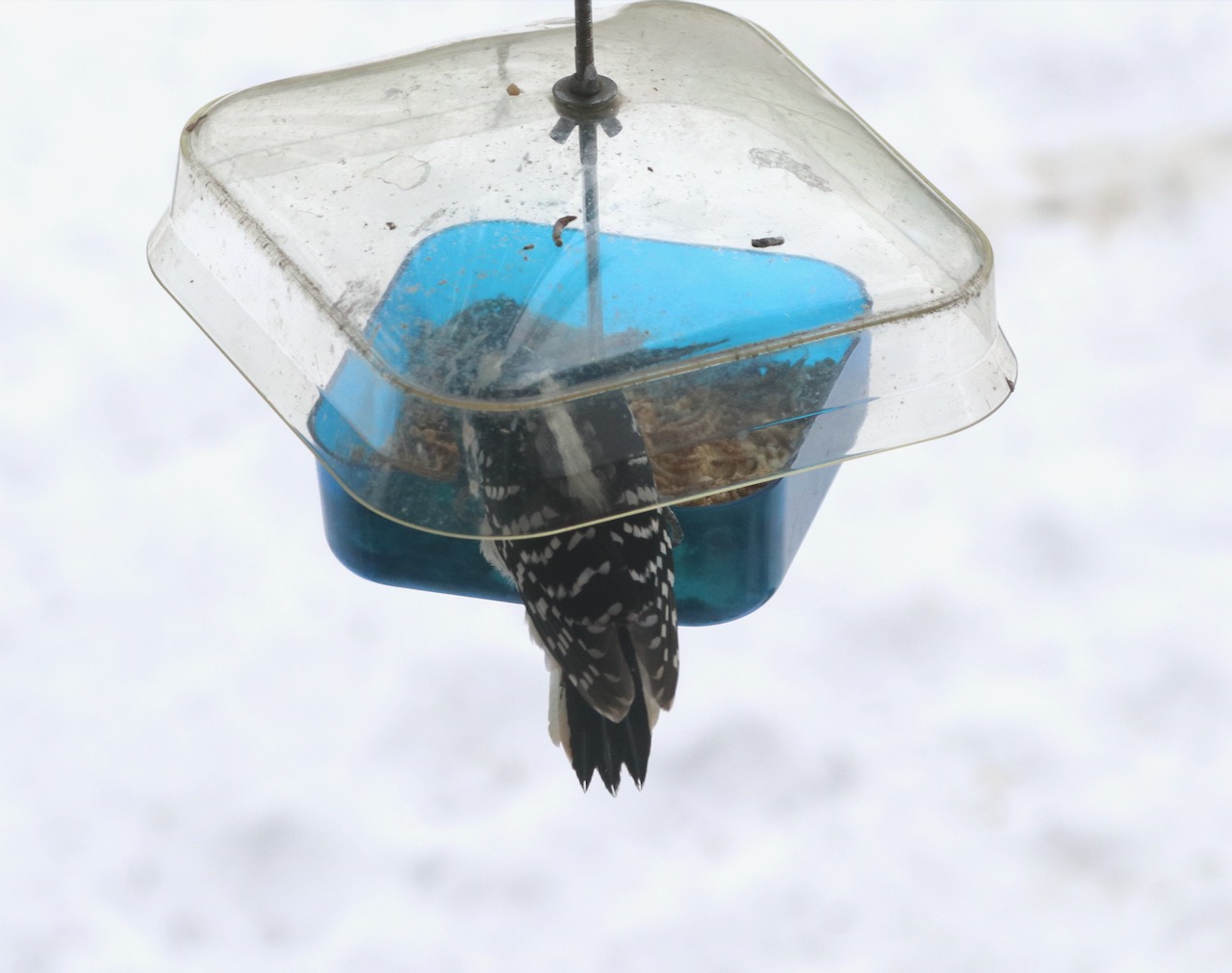
Female hairy woodpecker: Well, how do I work this?

                     She figured it out! So good to see only the birds I want eating the really good stuff: Zick                           dough and dried mealworms! So: Get you a feeder with wingnuts and a top you can lower                                   way down, and feed Zick Dough and dried mealworms in that one. 

TIP TWO:

I'll share an innovation born of sheer exasperation with the starlings. I was dumping and cleaning and refilling my heated dog dish bird waterer twice a day. Here is the result of ONE DAY of starling use: 

Of course just as much goes into the water, turning it into disgusting disease-spreading fecal soup. UGH I HATE having starlings at the feeders! And cleaning birdbaths in single-digit weather is NOT among my favorite activities! Out here in the sticks, starlings are a huge problem ONLY when snow covers the ground, or the temperature dips into the 20's. As soon as the snow cover melts and the temperatures rise above freezing, starlings leave to make their living honestly, grubbing in the soil for larvae. But these last couple weeks have been tough, with starlings mobbing, gobbling, and pooping on everything.

It suddenly occurred to me as I washed the bird bath yet again that, instead of using solid rocks to protect most of the water's surface, I should use something unstable, lightweight and movable. Something the starlings couldn't stand on while they took their massive dumps into the water and onto the rocks.

I ran to the greenhouse and got a lightweight plastic plant saucer and floated it on the surface of the heated water.
                                        
C'est voila!! The saucer floats and moves around, and the starlings don't want to sit in it. They will tip it, and water runs into it, which they drink. The rest of the birds drink around the edges.

I haven't changed the water in two days and there is NO poop in it! Here, a starling and a rare winter brown-headed cowbird drink clean water, for once! It ain't pretty, but it gets the job done.


And a third Most Excellent Dead of Winter Feeding Tip:  

For 30 years, I've toted a big muck bucket full of jars of different feeds from my detached garage, where they're stored, to the feeding station. I do this three times a day in hideously cold weather like what we've been enjoying the last two weeks. Let me admit: it's good for my step count, but it gets old.

Finally it occurred to me that I should store the feed out by the feeders. Duh. I mean, why didn't I think of this 30 years ago?
I took one of my stout galvanized trash cans out to the feeding station area and filled it with peanut and protein powder jars that are themselves full of the jillion different bird foods I offer. 


Like the floating saucer, it ain't pretty, but it do get the job done.
Of course, this tip does not apply anywhere there are bears, and it certainly works best when the coons are sleeping like little angels in their tree cavities.


While I'm at it:

Zick Dough, Improved

Combine dry ingredients: 

2 C chick starter, unmedicated 
2 C quick oats 
3 C flour (Start with 2, and add more if need be)
 1 ½ C yellow cornmeal 

 Melt together in microwave: 

1 C lard 
1 C peanut butter

 Slowly add liquid fats to dry mixture while stirring or mixing on low until dough forms. If it’s too gummy, add a little more flour and cornmeal until it’s soft, dry and crumbly. Serve as a treat in a small dish with a plexi dome to protect from rain. Store at room temperature in jars. Offer only below 55 degrees, as it’s too rich for summer feeding.

From Bird to Borb

Wednesday, January 25, 2023

5 comments

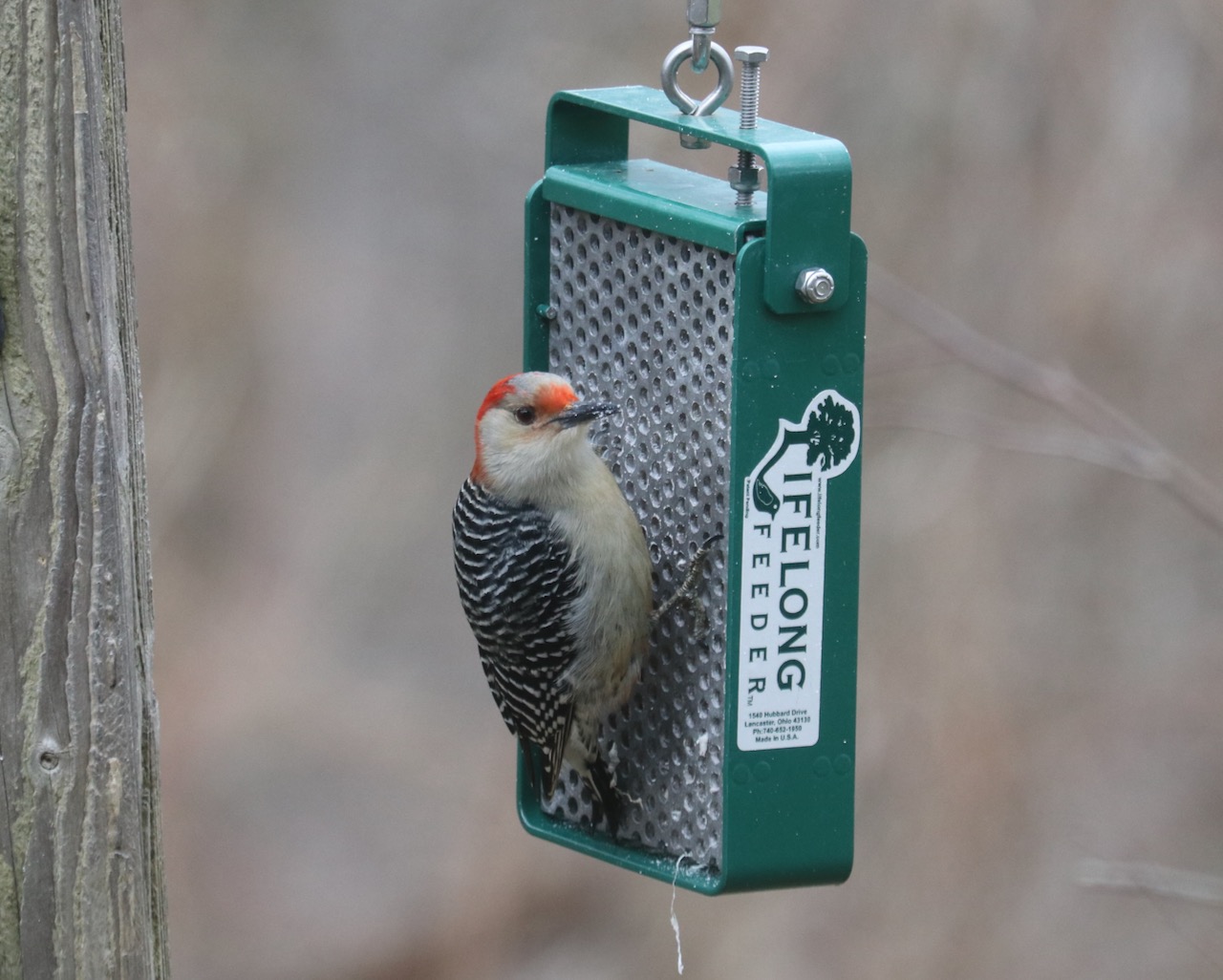
I like to look at the individual birds who come to my feeders, to tell them apart from each other. This is my oldest female red-bellied woodpecker. See how she has a brilliant red forecrown (nares) and a rather narrow gray forehead? 


She also has a red V poking down into the gray forehead over on the right. I wonder if she got old enough, if the bright red would spread up from her forecrown and meet the red coming from her hindcrown?
Older females have more testosterone which makes for brighter coloration. Think of red feathering as warpaint. Brighter birds do better in conflicts. Older females can hold their own against rivals better than younger females. 


Right after she left, another female redbelly came. This one is younger, with a limited amount of golden orange, not red, in the nares and a very wide gray crown band. Almost like she's got a really receding hairline, right? 


A starling plumped down on the hook over her head and she underwent a startling transformation.
The bird became...


a borb.


I am not one to use cute names for birds, but THIS is a BORB.


Only when the starling turned its pointy end away did she relax a bit into a birdier shape.


Maybe I can eat a little more, he's busy...


Better keep the blimp going in case he tries to come over here.


Just another gray morning, gazing out at the feeders. I eat my Cheerios first thing, take Curtis on a good hike, fill the feeders, and race into the studio to watch the first flurry of activity as everybody descends and the titmice and jays bear off the peanuts in the shell first.

Fourteen cardinals in a steady count; here are half of them.


The next day there were 26. Exponential cardinal proliferation.
I wonder how they all get the idea at the same time to come to my feeders. Snow smokes out the flame.


This is the time of year I can't do without my bird feeders. I buy six pounds 
of raw suet at a time, slice it up to the right thickness to fit in the Lifelong Suet Feeder, and store it in baggies in the freezer.


Survivor Peg

Wednesday, March 11, 2015

12 comments
I got home from Costa Rica late Tuesday, March 3. Wednesday was a blur of scrambling around catching up, waiting for my lost suitcase to find its way home, waiting for The Biggest Snow of the Year to hit. The snow started that evening and piled up to about 13" overnight and the next day. 


The feeders were mobbed. I was so glad Bill had bought more seed while I was away. I got up early and suited up to shovel out the greenhouse and my paths to the compost, bird bath and feeders. The power was off, of course; we almost never have snow without losing power out here. Bill worked for a couple of hours shoveling out the walk and setting up and running extension cords to our Honda generator, which I had bought with literally my last $700 after a nine-day power outage two summers ago. I'd had it. I was done playing Pioneer. Life was hard for awhile after that, but I am very glad I bought it. Life's better now.

We plugged in the generator, only to have the power come back on. I unplugged everything and put the cords away. I had just finished doing that when the power went off again for the rest of the day. That was funny. 


We watched the birds filling up on our offerings, and it felt good. 


Even with all the beauty surrounding us, I began to fret. I hadn't seen Peg since I'd gotten back from Costa Rica. Peg is a crippled blue jay who was injured, perhaps by a hawk, in November 2013 with a break high on her right leg. I saw her right afterward, stumbling around with blood on her feathers, watched her slowly heal and adapt to living her life with only one functional leg--a tall order for a blue jay, for any bird. To my astonishment she migrated north in the spring of 2014, and returned here in November, to spend this winter with us, too. Though we see them year-round in Ohio, blue jays do migrate. Our breeders are replaced by birds from farther north, while ours go south in winter. You see them migrating in big flocks in September. Peg probably breeds somewhere in Canada. I am agog that she has made it this long, being unable to process food in her feet, hop on the ground, perch normally, or preen very well. She can't even scratch her face. Imagine.


Peg in January 2015

 Peg hadn't been coming in since the boys had run out of Zick Dough partway into my trip. And now this, this Snowmageddon. 

And then I saw her.


Uh-oh.


Oh, Peggy, my Peggy! She looked horrible. Her feathers damp and disheveled, something going on on her back...had the Cooper's hawk grabbed her??

She kept shivering her wings in that hopeless way of sickly birds, but made no move to preen them into order. My heart fell to my feet to see my sweet little friend brought so low.  And the temperature due to plunge below zero tonight.

 But I didn't stand there crying.


Though I had worlds to do to get ready for a talk and a flight to Massachusetts the next day, I dropped everything to make more Zick Dough  for my Peggy girl. Because the power was still off, I melted the peanut butter and lard over a low flame on the gas stove, then hand-mixed it in a triple batch in a big lobster pot on the floor, like I always used to do.  (That link goes to an amusing video). And you know what? That's a heck of a lot easier, faster and cleaner than trying to get it all in the KitchenAid mixer bowl, and trying to keep it there as the mixer throws it all over the counter. The trick, I discovered, is to keep it to a triple batch, and not try a quadrupled or even quintupled batch, like I used to do. It mixes up like a dream by hand when tripled. Bigger than that, and it's just too much to mix by hand without bending your best spoon.
But you can't get any more than a triple batch in a big Kitchenaid anyway. So why use the mixer at all? Hand-mix it. Big pot. Boom. You're done.

I put the still-warm dough out and called to Peg by name, but she flew weakly into the woods, and I never saw her eating it. I had to resign myself to the possibility that I'd never see her again. I had already photographed her, because I follow the arcs of birds I know, whether they're good or bad, happy or sad. I want to know what happens to my loved ones. My heart ached.

The next morning, before I left, I put piles of Zick Dough out on the deck, knowing the starlings would annihilate it before Peg could get to it. She was nowhere in sight. I waited around, hoping for a Peg sighting, but was skunked. I was there, however, to document my first instance of the strictly vegetarian house finches sampling the lard mix!
Caught him with the dough in his bill! Snow and below zero temperatures will do that to you.


Then I left for the airport. The boys kept putting the dough out while I was gone, but they never saw Peg.

I had a great trip to Massachusetts, speaking at the Mass Birders' Meeting at Bentley University in Waltham, reconnecting with wonderful friends like my birding mentor Bob Stymeist! You would think, having shown me my first Swainson's thrush and vagrant Townsend's warbler in 1977, that he might look older, but he's aged like fine wine. Whatta guy. He told me he'd come across my common eider specimen at the Harvard Museum of Comparative Zoology, and said it was the best one in the collection. To which I replied, "It's hard to screw up an eider. Two-inch deep feathers will cover a multitude of sins."  Imagine him coming across my specimen, noticing that someone had done a particularly good job on it; seeing my name on the tag, and remembering having shown me my first Swainson's thrush. How sweet is that? Even sweeter: being able to thank him in person for being so kind to a bouncing, undoubtedly pretty annoying, 19-year-old baby birder. Here we are now, all growed up, not 19 any more.


I had a wonderful visit with my sister and niece, took a hike with Phoebe and hilarious, wonderful grand-nephews Will and Max, then came home on March 9. I looked anxiously for Peg. No joy. Same all through the pouring rain of March 10. She was nowhere to be found.


March 11 had a surprise for me. I'd been faithfully putting out Zick Dough at the appointed, agreed-upon hour, and this time, Peggy kept the appointment.
Whatever had happened to her back in the snowstorm had resolved. Maybe it was just ice after all.


Lord knows she doesn't need another injury. I checked out her good foot. Looked better than the last time I saw her.

 Peg filled her gular pouch, then filled it again.


And, in the manner of all jays, she stuffed in just a little more for the road.


I love you, Peg. Wherever you've been hiding, welcome back. I'll keep you in Zick Dough until it's time to migrate. Promise.


PEG!! March 11, 2015, alive, preparing to cache some Zick Dough, and as well as she can be.

 I wouldn't have given you a nickel for her on March 5. But there's life in the old girl yet. 

Is it any wonder I love her so?

She's the subject of my next column, "True Nature," in Bird Watcher's Digest's May/June issue. You can subscribe here. 
[Back to Top]