Background Switcher (Hidden)

Showing posts with label blue-winged warbler. Show all posts

West Virginia's Peak Moments

Sunday, June 26, 2022

4 comments

   I put so much stuff up on Instagram. And then that goes to Facebook. I feel like I'm posting something every day, little bits and bites. I will confess that I forget about this blog for weeks at a time, because the square hole in my dwindling brain that says, "Share wonderful things" is constantly being filled. I pound the peg in and go on my way. 

But Lord knows there are people I love who just don't do social media, who are missing out on the daily birdsong Zicktorials and evening primroses popping open that are going on over at instagram.com/juliezickefoose

and when I think about them I get to feeling guilty, like I'm letting them down. Yes. This is a stealthy way of trying to get even my loved ones who don't run around with their nose in their phones to check out that Instagram feed (which you can do on your computer as well as your phone) because it's so rich, so frequently updated, such fun, and I just don't have the hours now to post to the blog like I used to. Still putting out content! Just not here so much, any more.

I wanted to share some images from my big rig that I made at the New River Birding and Nature Festival this May. Just moments that I thought you'd appreciate. West Virginia was not as stingy with her sunshine as she usually is, and we had four days of beautiful weather to chase and enjoy birds. 

The BSA camp called Summit, in Bechtel, WV, which we were lucky to explore, is an astounding place, with big grassy fields that don't get mowed too often. It's in very light to no use most of the year until the yearly Jamboree, when something like 26,000 Boy Scouts flood in to do Jamboree things. Here, horned larks are nesting in peace!! Oh how I love their tinkling songs and heavy black theatrical makeup. 


This male was using a signpost as a song perch. 


Singing along from atop a lightpost was an eastern meadowlark, always a thrilling sound. Any grassland bird in heavily forested WV is kind of a big deal. Summit also hosts grasshopper sparrows and their earthy buzz.


And it was at Summit that I finally saw my first eastern black bears! a mama and three cubbies.
A lousy shot of a cub shinnying up a tree. Oh, was I thrilled to see this!
And glad it wasn't in my backyard. Y'all can keep 'em in WV.


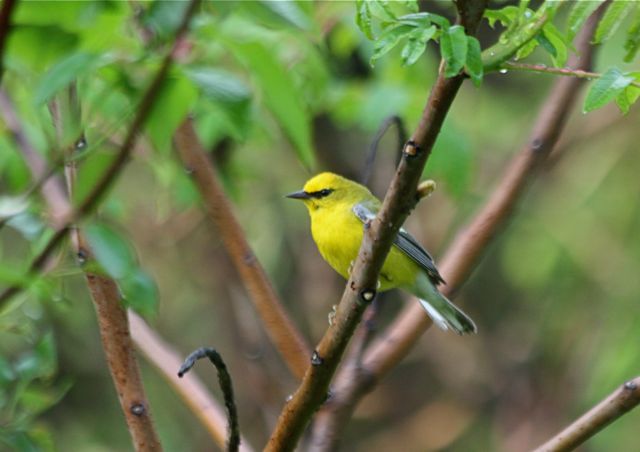
Blue-winged warblers in WV often have a yellow tinge to their white wingbars, which tells of genetic mixing with golden-winged warblers. This figures: there are still golden-winged warblers breeding in WV, which is more than I can say for Ohio. Golden-wings need clearcuts, believe it or not, with young saplings springing up. 


See those yellow-tipped wingbars? Somebody's been doing some interspecies marrying. 


A confiding yellow-throated vireo held us in thrall.


His song: Three-eight...Cheerio! is so distinctive, burry and cheery. 


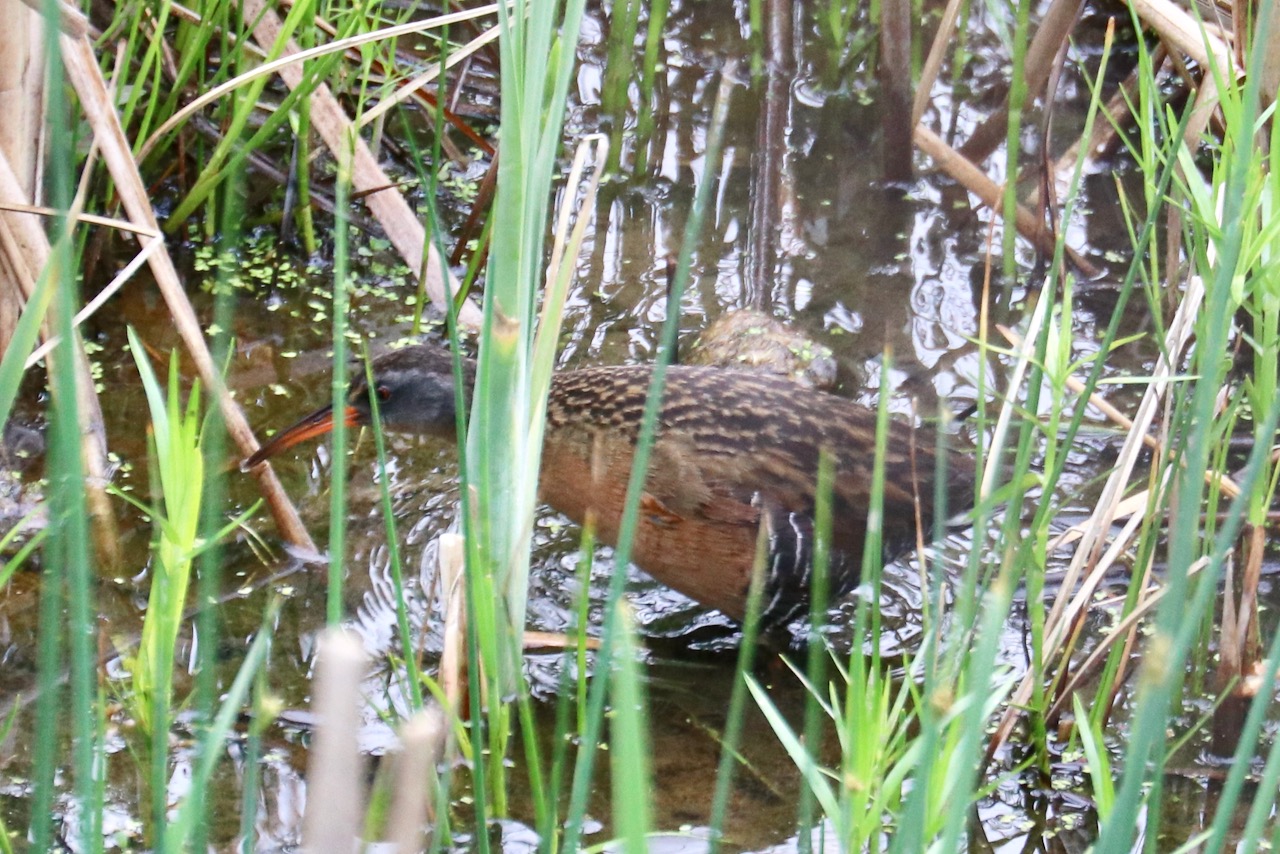
Summit Camp also yielded a beautiful Virginia rail, who called repeatedly as he slipped between the cattails and sedges.


Oink oink oink oink oink oink oink!!


Again--seeing any rail in foresty WV is kind of a big deal. How lucky and grateful we were to benefit from birding the extensive habitat at BSA's Summit Camp. It made me itch to get out there and canvas those breeding birds!


These gobblers were trying very hard to add their names to the list of successful breeders at Summit. Don't miss the lyre-leaved sage painting the field a misty blue.


Don't let her get into the woods--you'll lose her!


Cranberry Glades way up on the mountaintop produced for us a surprise mourning warbler who seemed to think he'd been hired as a greeter for festival participants, so lustily did he sing and display near the entrance to its fabled boardwalk. Grateful. I have worked this festival for 20 years, and I've never seen a mourning warbler do that anywhere. Having waited for long periods and chased this famously skulky species through thick raspberry tangles, getting only glimpses of leg or tail, this bold little feller was particularly sweet to watch.


I'd have loved to see him down futzing about amidst the Viola cucullata (Swamp blue violet or Cuckoopint).

Northern waterthrushes sang everywhere! They like fens and bogs, as opposed to fast running streams preferred by their Louisiana cousins. 


We were way out the end of the boardwalk when a little squall blew in. Nothing else to do but bundle the camera under the coat. But then the sun came out again over the bog.


The visitor's center had rose-breasted grosbeaks at the feeders. 


Inside, a quilt map that charmed me almost to death.


If there's anything more quintessentially American and particularly West Virginian than a quilt map, I haven't seen it. 


Just a note: I'm writing a LOT for BWD Magazine, and eagerly anticipating the first issue (July/August 2022) that will be mailed (squeeeee) July 1! And magazines being magazines, we are closing up content on the September/October issue now. Gonna be frank: the need to be putting together the next issue before the current one even mails is a bit frightening, and I'm going to be adjusting to the increased pressure for some time. If you'd like to see what we're up to and subscribe, please go to bwdmagazine.com 


Late Summer Riches

Tuesday, August 10, 2021

9 comments


Psst. Anybody know what this bird might be? It's a great quiz, a real booger. Puzzle on that one for awhile, make your guesses, write 'em down. It was spotted in my orchard, having been raised in a nest nearby. Its parents scolded me for weeks, and kept scolding even after it (and its siblings, I'm going to presume) were flying and hopping around and scolding me themselves, like this little chap is doing. I'll tell you at the bottom of the post, so as not to spoil the game.

This one's a lot easier to ID. See the rose flush coming in on the breast? What a little beauty--a newly fledged male rose-breasted grosbeak, so young his bill is still blackish--just like a young cardinal's. I'm not sure where he came from, because I didn't hear rosebreasts singing anywhere nearby this spring--not even down Dean's Fork, where I've had as many as five singing males in past years. Once they're flying, juveniles can disperse for many miles.

Younguns are everywhere. Here's a stripling rabbit, bug eyed and slender, perfect of fur and form.

 
And a stripling youth, watering the thirsty golden raspberries: rhubarb at his feet, tuberoses and mint in the foreground. Oh, how the Heritage Bed has grown! Every year I chop a fresh border out of the lawn, growing it out into the mown space. Much more fun to make food and flowers than grass.

We carved us up a whole lot of wisteria this summer. Wisteria has its place on the porches of Victorian homes, if you're willing to cut it back ferociously, and stop those shoots from coming up everywhere. It has no place here, but it's taken over a hill. We battled some of it back this summer. I shudder to think what this place will look like if the next inhabitants aren't feisty scrappers like we are.

I'm so enjoying the last week or two of his residence at home. It's been quite a ride. We've gotten to know each other so much better, and that has been a blessing. 

 
 But we were talking about birds, weren't we? Here's a newly fledged indigo bunting, calling for its parents in a sumac in the meadow. Spit! Spit! Spit! You should click on this one to see its grumpy face.

 
A young rubythroat, sticking out her rice-noodle tongue.
 
 
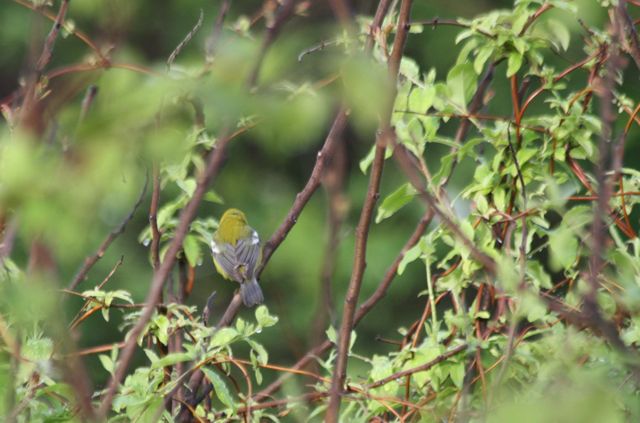
A young blue-winged warbler, contemplating my new bird fountain. Oh, what a thrill it was to see one of the two pairs of blue-wings that bred in the meadow flip out and flutter before me the day their babies fledged! And I loved to hear the males trading songs and insults all through the spring and early summer. Riches!! Gold coins!


There's such a parade of birds by the window, even though I'm not feeding them much at all any more. Water is the attractant, water and native plants and bright flowers everywhere, and all the insects they attract.  This old male cardinal has a bum right wing, likely from a poorly healed broken coracoid, but he's making it through his second summer with us pretty well. Nice to be able to take a cool dip on a hot day.
 
 
I've  greatly enjoyed watching two fledgling robins foraging on cutworms that they pull out of the clover and crabgrass in the lawn.  
 
 
Such an ornate and extravagant plumage. I wish they kept that spotty breast, like Europe's mistle thrush does. 
 
 
Not a single earthworm to be seen in this drought, but they make do nicely on cutworms, crickets and grasshoppers. I'm astounded how many they pull out of the "lawn." You won't see that happening on a Chemlawn! Nor will there be many moths at your porch light.
 
 
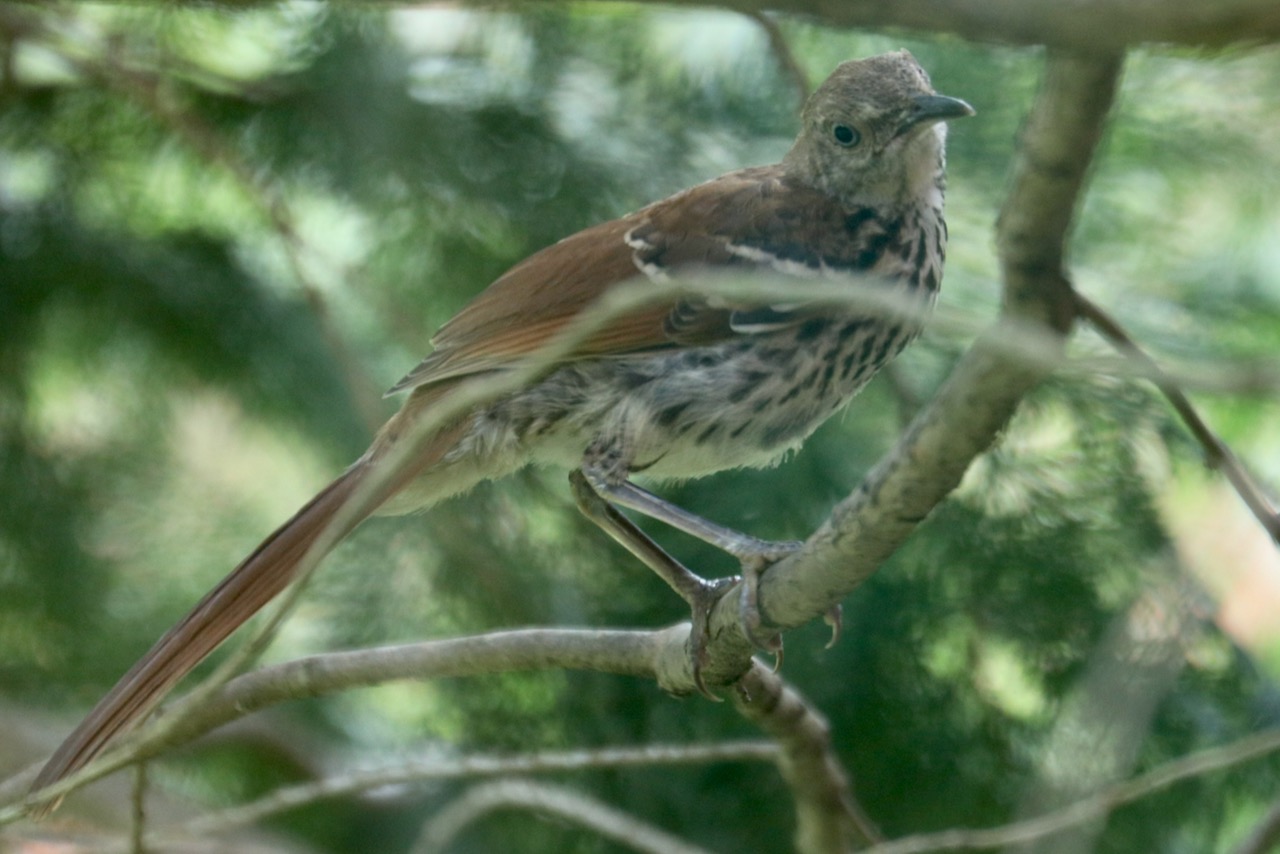
Another cutworm fan: a baby brown thrasher. No, they don't look their absolute best yet, but I love the young ones so. I love watching them learn to be birds.
 
 
 A messy, molty blue jay at the bath, one of a pair of hardworking parents who raised a couple nice babies on the place this summer. I didn't know either of them from before. So it goes. You get everybody nicely identified and wait breathlessly, and then all the ones you know leave, and new ones come in that you can't tell from anyone else. At least that's what happens in southeast Ohio. I miss Frost, who stayed two winters and  bred here once, but he's gone. I miss them all. It's been a lean summer for jays. One small but significant reason to look forward to November! That's when the jays come back to me.

 
A brood of Carolina wrens has been popping all about my new bird fountain. (I have yet to tell you about that, but I will). They love to investigate the rocks I leave lying about, crawling under and around them. If there's a little hole or cave, a Carolina wren is going to go in it.

Here's a baby American redstart preparing to bathe. Oh, they love water!

And they love my golden Chamaecyparis trees, that set off the red siding so nicely. 
 
 
All right. Are you ready with your possible ID's of the mystery baby in the first photo? That all-over olive creature with no identifying marks whatsoever? Because here it is (lower right) with its beautiful daddy. 
 
 
It's a lousy photo, but come on. Getting two Kentucky warblers in any shot is a lagniappe.
Having them breed in your old orchard somewhere in southeast Ohio is, too.


It's been a heck of a summer for breeding birds (and me) here. I've been here to document and confirm breeding of Kentucky, hooded, black and white, prairie, blue-winged, American redstart, and common yellowthroat, among the warblers. Pine warblers, Louisiana waterthrushes, ovenbirds and worm-eating warblers nested, but I never was able to see fledglings. Doesn't mean they didn't fledge! There were others, of course, but those are just the ones I could confirm. Other species confirmed breeding this summer were indigo bunting, blue-gray gnatcatcher, eastern wood-pewee, eastern phoebe, orchard oriole (only the second nest in 29 years!), chipping sparrow,  northern cardinal, Carolina chickadee, eastern bluebird (duh!), blue jay, tufted titmouse, eastern towhee, yellow-billed cuckoo, Carolina wren, American robin, downy and hairy woodpeckers, red-bellied woodpeckers, broad-winged hawks, red-tailed hawks, barred owl, and eastern screech-owl. That's a whole lotta creeping around in the woods, and I feel blessed to have been here to do it. From the way it's looking, I'll be here to document lots of other things, too, for the foreseeable future. A bit sad not to be traveling--I miss my family! but fine with the confinement, because there's always so much to learn, see, and marvel at.
 

Warbler Photography, Quick and Dirty

Wednesday, May 27, 2009

4 comments
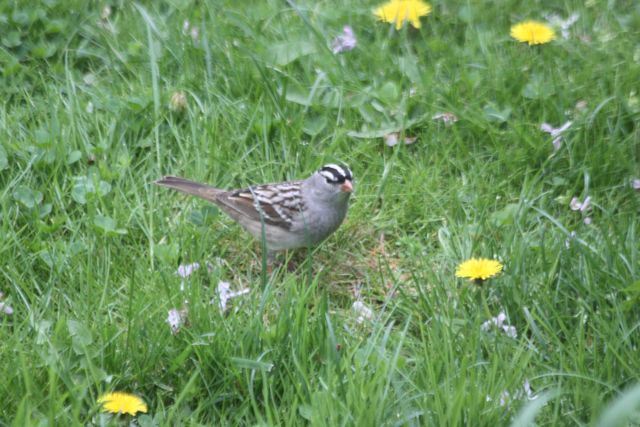
A migrant white-crowned sparrow hops amongst the dandelions and spent lilac flowers.

It's here, that time of spring when everything happens too fast. There were still migrant blackpoll warblers singing this morning, sounding, as Jeff Gordon points out, like a bike wheel out of true: tsit tsit tsit tsit tsit.
I look at my spring bird photos and know I must post them before they go bad.

We won't go bad. We stay around all year.


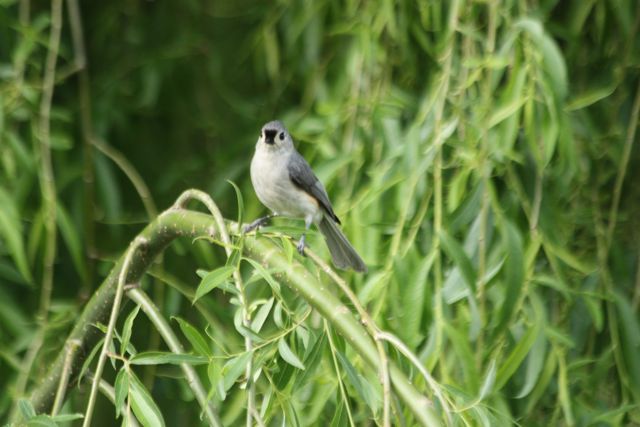
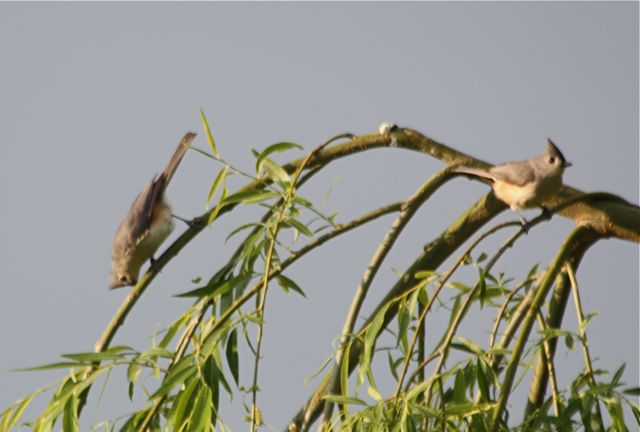
One of the cuter tufted titmouse displays--presenting the fluffy butt. Good thing they're both presenting at the same time. Nobody gets insulted.


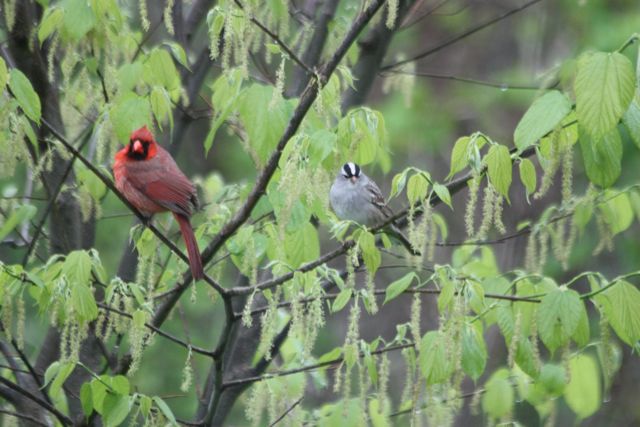
A cardinal sits with a white-crowned sparrow. That little crown stands out like a logo--you can identify this bird at a ridiculous distance.


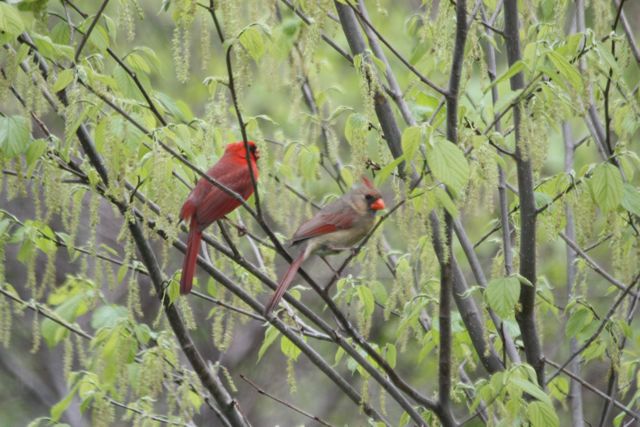
This pair of cardinals is always exchanging sweet seed kisses.


Meanwhile, the blue-winged warblers are making our old decrepit orchard a wonderful place to be. Part of the courting razzmatazz of the blue-winged warbler is spectacular chases, looping in and out of low prickly vegetation.

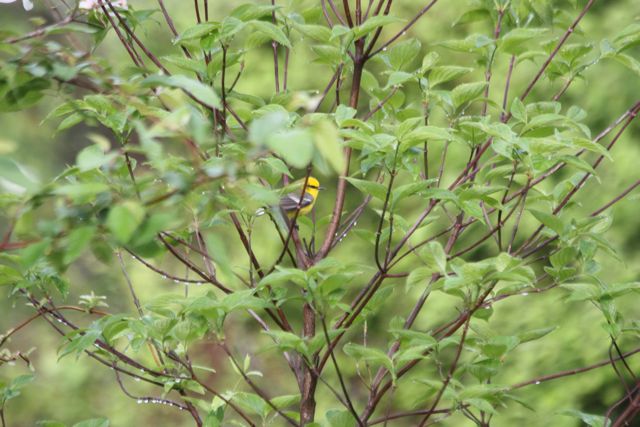
Most of the looks you get are like this:


and then they're off again. But sometimes you get a clear look at the warbler's disappearing tail.


or its back as it pauses to catch its breath.


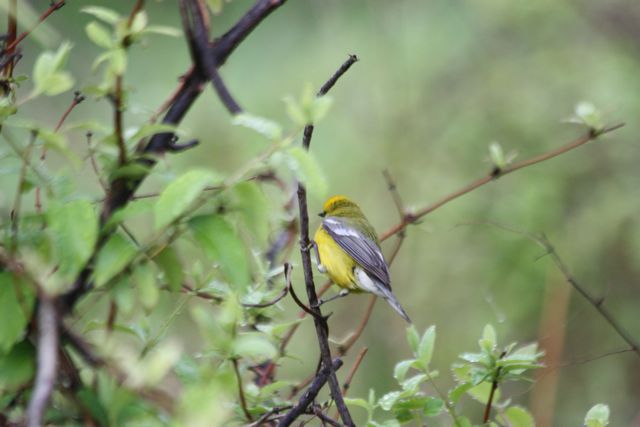
And then sometimes, if you stand around in the briar patch for an hour or so, waiting and taking dozens of pictures, one pauses long enough for you to fumble the manual focus onto it before it wings away again. Autofocus is not an option, with so much bramble in the way. The camera will pick an extraneous twig and focus on that instead of the bird. Maybe I'm weird, but I absolutely love trying to get my lens on a warbler and manually focus him into a decent image. Maybe because it's almost impossible. I love a challenge.

This isn't publishable, but it's good enough for me, and a heck of a nice way to spend a morning before the bus comes.

[Back to Top]