Background Switcher (Hidden)

Showing posts with label tufted titmouse. Show all posts

The Devil and the Titmouse: Hickory Horned Devil, End of August

Saturday, October 15, 2022

3 comments

This post is about feet, birds, and scary doo-dads.

Someone on Facebook (who may or may not like to sing about gnus) asked "Whatever happened to the Hickory Horned Devil?" which was her subtle way of pointing out that I hadn't posted about it in awhile. 
Life gets in the way, is all I have to say, but the Devil kept chugging along. And thank goodness I've already uploaded all my photos, so all I have to do is find time to sit down and write about them!


These photos date from Aug 28-30 when the caterpillar was busy assuming titanic proportions, despite periodic rain.


It was also producing huge frass pellets, in bulk. I shook them out of the sleeve every time I came to photograph the beast.
These are rain-swollen, but still!


Every once in awhile it's good to put your hand in the photo to show the thing's actual size.


The rarely seen frontal view of the real head and face--unassuming, caterpillary, unlike the "face" it presents to predators.


I've turned this photo right-side up, for the Alice-in-Wonderland hookah effect. HHD's spend their days hanging upside down along twigs, where they are practically impossible to see.


This, then, is the typical pose. Even though you're looking right at it, the cream and black bands along its velvety sides break up the form so you can barely see it amidst the sunlit leaves, and the countershaded pale back further flattens the form and makes it disappear. Its first and best defense is camouflage!


I am fascinated by its feet, which have Velcro-like surfaces and stick unbelievably well to branches, and to each other. There is so much to be learned from invertebrate architecture. See, this thing is so heavy and vulnerable that falling out of a tall tree could mean rupture and certain death. Not to mention giving it the uncertain job of finding the right tree to laboriously climb again...So it moves very, very slowly and makes sure it has a deathgrip with some part of its body before it makes a move. 


The hind section, shown here in closeup. It reminds me very much of a potholder. My aging brain spat out "Gripperdoodle" when I was trying to describe it, and Gripperdoodle it remained. Maybe entomologists have a better name, but probably not. Oh right. Modified anal prolegs. That thing is like a vise off the back of the big worm.


I'm not sure what the roughened pads on the three sides of the gripperdoodle are all about. Well, maybe that is keratin, to strengthen the structure. Yeah. You can't have an effective gripper if it's squishy! They feel like hard plastic, like a weatherproof car floormat.

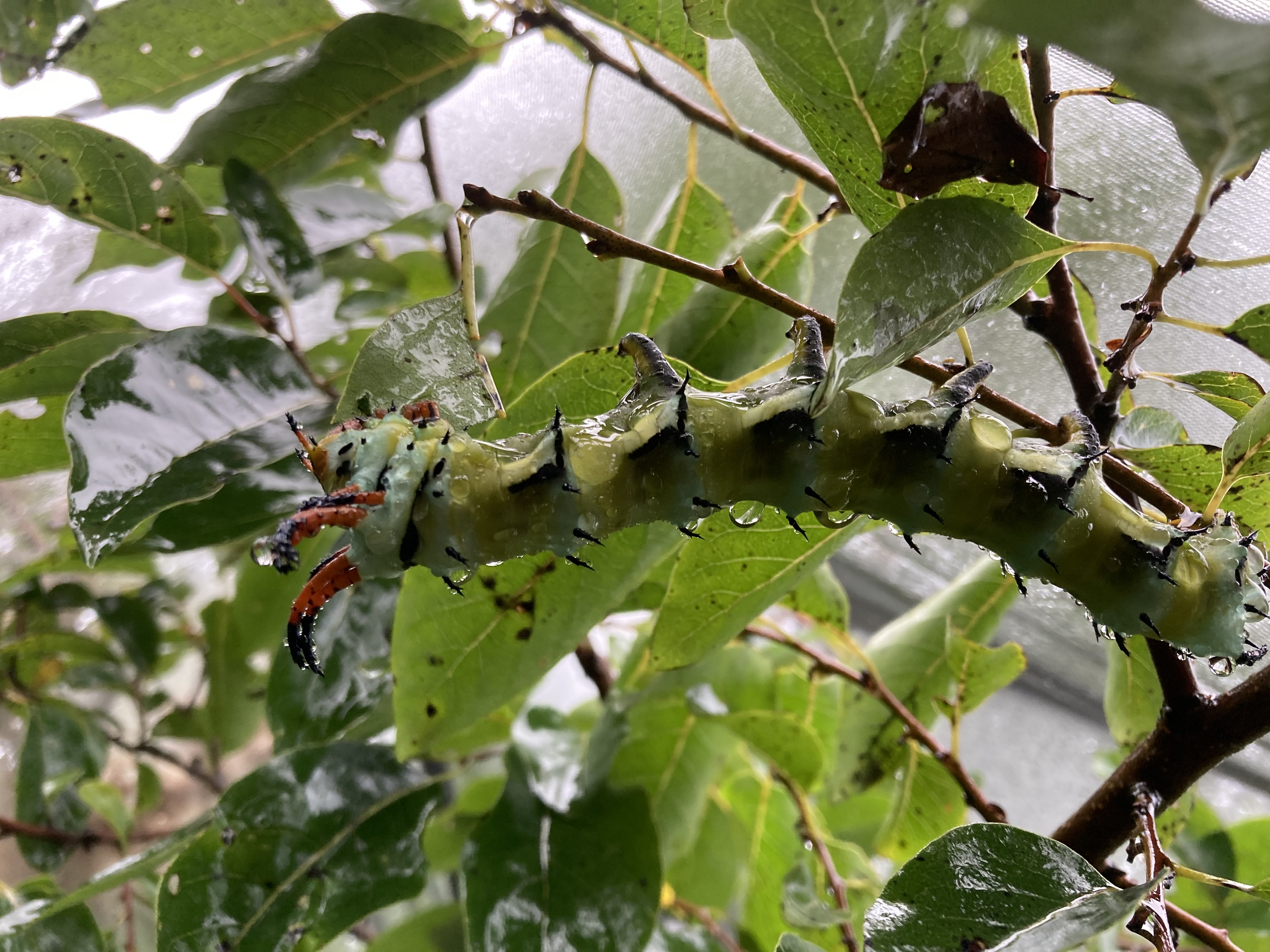
Eatin' in the rain. Just eatin' in the rain...


The caterpillar's false face on Sept. 1. The actual head is the shiny orange beanie atop the devil's "head." I just love this view. But why be so ornate, so prongy, so freaky? 


Titmice and chickadees, that's why. They don't mind taking their food in oversized packages. I'll never forget seeing this Carolina chickadee rip into a silken cocoon in the Chute on our land and pull out a huge pupa. I don't know if my from-memory rendering of the pupa will suffice for ID (it looks pretty bad), but I suspect this would have been a luna, given that the cocoon was in a tree and not underground. It sure isn't going to be a luna moth now.


From my book,  The Bluebird Effect: Uncommon Bonds with Common Birds.


I will borrow here from a Facebook post by Cynthia Mullens on the Mountain State Birders page. This young tufted titmouse has found a most unfortunate imperial moth caterpillar and is pecking away at it. 


The green goo indicates that the enterprising titmouse has scored on the caterpillar and will probably end up eating it. Even if it judges the beast too big to grapple with, the caterpillar is done for. Imperial moth caterpillars are big and impressive, but they have nothing by way of defense--no stinging hairs, no pokey horns, no false eyes or scary faces.

photo by Cynthia Mullens, used by permission

The HHD has that all covered.


There's a lot of bird food in that sea-green tube, but there are also spines, and they're concentrated at the head end.

Any bird that comes at this beast from behind gets a dose of 
BLAAA BOOGA BOOGA


which is plenty enough to scare a pecking titmouse or chickadee away. Cuckoos and jays, I suspect, are unfazed by such things, or by lusty thrashing, which is why sleeving the branch was the way to go. The thing I was even more afraid of was parasitic wasps and flies, so a fine mesh sleeve just made sense any way I looked at it. It took the worry out of watching this marvelous being develop.


Knowing the HHD could hang in peace, and that it would be there the next time I came calling, meant the world to me, and gave me peace of mind.


Titmouse, in a Bad Way

Wednesday, December 1, 2021

3 comments

 I'm not sure what little voice told me to go back out to the greenhouse late on the afternoon of November 29. I didn't have any particular mission there. I'd watered that morning. I just wanted to go back out. As I opened the sliding door to the little patio, there was a squeak and a flutter, and a tufted titmouse sort of trundled out of a pile of sycamore leaves that had blown up against the house. Dark was coming on, and I figure it had been planning to roost there. Oh dear! No titmouse in its right mind roosts on the ground, unless it has no other choice. This one was fluttering in a tight circle, its head tilted far over to the side. Something bad had happened to it. What were the chances it would fetch up against the very door I use the most? Was it chance, or something else? Birds know. They know.

 I fetched my butterfly net and dropped it over the little bird. It was in a bad way. I put it in a plastic Critter Keeper and pulled back to observe it. Tipping over on its side, it was stargazing, with an inverted head. Uh-oh. That looked like traumatic brain injury to me. Whatever had happened to it, it would need food, so I prepared a little dish of Zick Dough and crushed sunflower hearts. The poor bird began to eat before I could even withdraw my hand, something that I would learn is typical of titmice. They are survivors, fighters. It took a sunflower heart, tried to tuck it in its toes, but couldn't get its head to cooperate, so it dug into the Zick Dough. I was so touched by its will to live that I pledged on the spot to do whatever it took to get it back into the wild. And if it wasn't going to make it, at least it would have had a warm place to sleep, and a full belly before it died.


The Intake Video...I had a feeling it wasn't going to die! But neither was I prepared for what happened next.

From the get-go, I got a strong male energy from this bird, so I'm going to switch its pronouns to he/his. Some may laugh at me. They may go ahead. So far, I've batted 100, even with sexually monomorphic birds like brown thrashers, song sparrows, and blue jays. We raised three brown thrasher nestlings a few years back. By the first evening I knew I had two females and a male. Harper, Melba and Cletus. And who first found his voice on June 22?  Cletus. And the other two remained silent. Same with the three song sparrows I just raised. Two males and a female. Ball, Bob and Baby, the only female. I just knew. 

                                             Cletus sings quietly, June 22, 2015, on his 37th day of life. 


The sight that greeted me the next morning, after this promising beginning, was shocking. The poor titmouse's head was completely inverted, and any attempt at moving caused him to flip over on his back. Holding the bird up to the light, I could see its left eye flicking back and forth, a condition called nystagmus. I've had it with the three cases of vertigo I've endured, and it is no fun at all. The world spins around you and all you can do is close your eyes and try not to throw up. 

Shila pointed out to me that the day or two after a car accident are usually worse than the day of the accident, as the body assesses what just happened to it. So it was for this bird. Though titmice are savvy birds and not typically victims of window strikes, one could surmise that perhaps a raptor had made a pass through the yard and scared him into a window collision. Brain swelling could easily cause the torticollis and nystagmus. I wanted to alleviate that, so as soon as offices opened at 8 I started calling around to locate Metacam, an NSAID that veterinarians use for brain trauma. It's what they give window-struck birds that squads of volunteers collect in the streets of big cities during migration. I'm grateful for the local veterinarian who is willing to sell me the drugs I need!

By 10 AM, I had charged to town, grabbed the meds, bought a flame-orange reflective dog collar, picked out and tied a Christmas tree on top of the car, and had the first dose of Metacam in the titmouse. Still Nov. 30 was rough. I had to hand-feed the bird hourly from dawn to dark. And he looked so pathetic, all twisted up and unable to move, that it was hard not to lose hope. And hard not to wonder how long we'd have to keep this up.


I had good reason to wonder.  I remembered a case like this from way back in my Connecticut life, a bird named Sunshine.

 He was a white-throated sparrow, named by the little daughters of the woman who'd picked him up, and he had severe torticollis. I wouldn't discover the cause for several days: a deep wound right at the base of his skull, likely inflicted by a cat. I guess that qualifies as a traumatic brain injury! I got him on April 23, 1991, and it took twelve days of hourly hand-feeding and physical therapy (gently turning his head the way it didn't want to go) until the bird could self- feed again. By the 19th day, he was ready for release. Against all odds, I had a viable, releasable white-throated sparrow where once there was a sad little lump of feathers with an upside-down head. 

Click on the picture to read his story.


I released Sunshine on May 11, long after all the local white-throats had departed for Canada. I didn't see him again until the next afternoon. And on the morning of May 14, I awoke to his song--he had been singing in the cage and I knew it well. 
From The Bluebird Effect: Uncommon Bonds with Common Birds

"I pulled on my clothes and walked out into the yard to listen to this small bird's hymn to the silence. Had the cat had its way, his song would have been forever stilled. I was changed, transformed by these three weeks of feeding, massaging, and hoping for a sparrow. Such work is its own reward. I knelt to pull some weeds from the neglected garden on the east side of the house, the May sun warming my back. Sunshine flew closer, to a maple just overhead, and sang. I smiled up at him, finished weeding, and moved to the iris bed in the front yard, happy to be in the company of a wild white-throated sparrow. He followed, perching in the top of a white pine just over a stone wall from where I was weeding. And he sang.

"For the next two days, Sunshine would follow me around the yard, singing from the closest perch he could find. I don't know why he did it; whether, like a newly captured, hand-fed falcon, he'd (bonded with) me in those three weeks of intensive feeding and therapy; whether he considered me a substitute mate, parent, or rival. I know far better than to make the anthorpomorphic leap to say he was trying to thank me. What does a bird know of gratitude? Perhaps quite a lot more than we think. I can only say that he followed me, singing, and in signing, touched an inarticulate place in my heart. By May 18, he was gone, headed north, I hoped, tracking his own course once again."


Based on that experience, which was both grueling and transformative, I had reason to be hopeful about this titmouse. I was unshakably determined to see him through to whatever outcome Fate would decree.


The Best Thing I've Ever Bought

Sunday, January 11, 2015

25 comments
You know that good feeling you get when you find something that WORKS? It may not be expensive or particularly beautiful, but it just WORKS.

I was reading galleys for Bird Watcher's Digest, which I've been doing since about 1991 in my position as Contributing Editor. I read the copy for science accuracy as well as flow and pesky typos. So, if somebody's written an article about their trip to Costa Rica, and they mention seeing a seriema,

lifted from Wikipedia.org

I'll go 

THERE ARE NO SERIEMAS IN COSTA RICA 

in big red letters in the margin. 
That kind of thing.

I happened upon a column called "My Way: The Water Bowl" in the Jan/Feb 2015 issue. It was by BWD subscriber Lorna McKerness. A resident of Alberta, Canada, she's faced with below-freezing temperatures for much of the year, and she'd hit upon the idea of using a heated dog water bowl as a year-round bird bath. She had tried any number of commercial products, but they were often very expensive and lasted little more than a year in those punishing environs. In the article, she said she was at the feed store buying two more, and the woman behind her in line added a heated dog water bowl to her order, too. That made Lorna happy.

Within a day or two of reading that, I found myself in the feed store, as I often do, and I was in the process of buying several hundred pounds of fancy food for the birds I adore, so that none would go hungry


and I remembered Ms. McKerness' piece, and lo and behold, down on the lowest shelf around the corner I found my next purchase.
It comes in green or swimming-pool blue. Neither of which would be colors I'd choose, but hey. The point in the dead of winter is not necessarily beauty. It's providing open water for thirsty birds.
All I'd have to do is plug it in and run an outdoor extension cord to a GFCI-equipped outdoor outlet. I could do that. I'd put it right where the (frost-vulnerable) Magnificent Bird Spa reigns supreme in warmer temperatures.


The price was right: $22.99. I grabbed one.

That same afternoon, the feeders filled up with pine siskins


and a pretty yellow-trimmed pine siskin was the first taker on the new bowl! 
Pine siskins are big drinkers.


As you can see, I've stacked three big flat rocks in the bowl to make a flat, level surface for a bird to stand on should it wish to bathe. I'd had my doubts about the slippery plastic as a friendly perching surface, but the siskin didn't hesitate. He was thirsty. 

Since installing it November 3, 2014, I've had the best time documenting the heated dog dish's inaugural winter. Herewith follows a gallery of ugly photos of beautiful birds slaking their thirst.

American goldfinches:


A pair of bathing house sparrows. Here you can see the coil-protected cord.


A tufted titmouse drinks. We're having a banner year for TUTI's.


A female white-breasted nuthatch, with her shadow-grey cap, appreciates the flat rock for perching. She has very long toenails and doesn't like the slippery plastic.


One of the very first visitors to the new bowl was Peg, a blue jay of whom I've grown very fond.


Peg has but one usable leg (you can see her useless right leg dangling). I'll tell her story in another post dedicated to her. Seeing her getting fresh water in freezing temperatures makes me feel good. 


I was on the phone with Bill, who was calling from Uganda, when a yellow-shafted flicker hopped up to the bowl! We hurriedly ended the conversation so I could document this spectacular visitor.


 Oh how I love a flicker. Probably my favorite bird to paint of all. This is a girl. No black moustache. Please appreciate those googly eyes all over her breast and belly. Swoon.


As you might have surmised, I am totally in love with my ugly green heated dog bowl, and I dream of manufacturing something similar, but more beautiful--rock-colored, rock-shaped.  I'll say this--with its simple round reservoir and smooth surfaces, it's a snap to clean and refill--the work of a minute. I just bring a bucket of hot water out, give it a little scrub, then rinse it and the rocks and refill. Maybe it doesn't need beautification. The birds do that. Maybe I need to stick to writing about them and painting them.

I am not the only one who likes watching the birds and chipmunks use the heated dish. (Yes, this post is from 2015, when I had Chet Baker stealing my seat each time I got up. I miss The Bacon.)


Now the ante's upped. I'm going for more and more thrilling birds. Managed to snap only the male, but for a fleeting moment a pair of eastern bluebirds graced the bowl. I just know I'll get a flock on some warm winter day...


If I've given you something you can use in this post, something that's not necessarily beautiful, but that WORKS, that makes me happy. But what would make me happier is your subscribing to BWD, where I've found Lorna's article and so many more useful, informative and awesome articles over the 44 years I've been associated with it. It's a print magazine you can hold in your hands, and also available digitally. With its rebirth in July, 2022, it's now full-sized and more beautiful and informative than ever. I am Advising Editor and I write a column and usually something else for each issue, as well as contributing art for its pages. 

Maybe it'll be the best thing you've ever bought.

Click here to learn more and subscribe.


Titmouse Tufts

Tuesday, June 2, 2009

22 comments

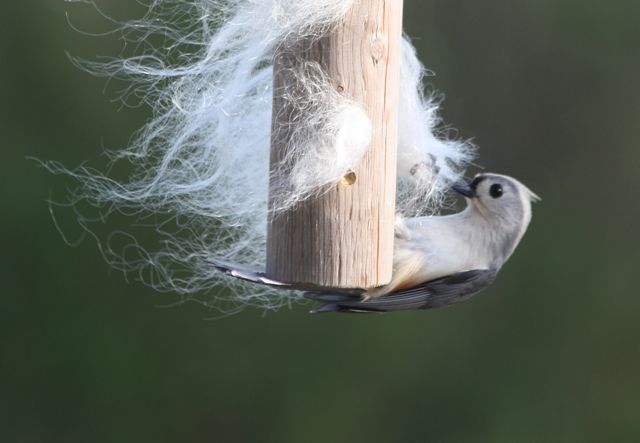
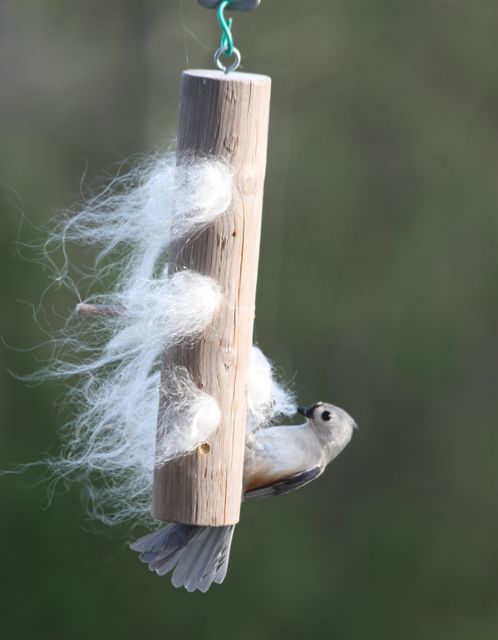
If there is a bird with a passion for fur, it is the tufted titmouse. Titmice are notorious in certain very small circles for their penchant for pulling fur or hair off animals. Bird Watcher's Digest once published a story from a man who was lying in a hammock trying to get a nap, and this titmouse kept flying down and yanking his hair out. They'll pull hair out of the tail of a sleeping dog. One of the best things I ever saw was a tufted titmouse on a country road in Connecticut, hopping between the legs of a turkey vulture that was feeding on a possum carcass. The titmouse was pulling hair out of the carcass right under the vulture's chin.

You can draw birds into your yard with food, sure, but it's really interesting to use other commodities they want, like eggshells (they eat them for calcium), water, nest sites, and nesting material. By providing the universal things birds need, you stand a chance of getting many more species, including ones which don't eat seed, like warblers, swallows, vireos and tanagers, to name a few.

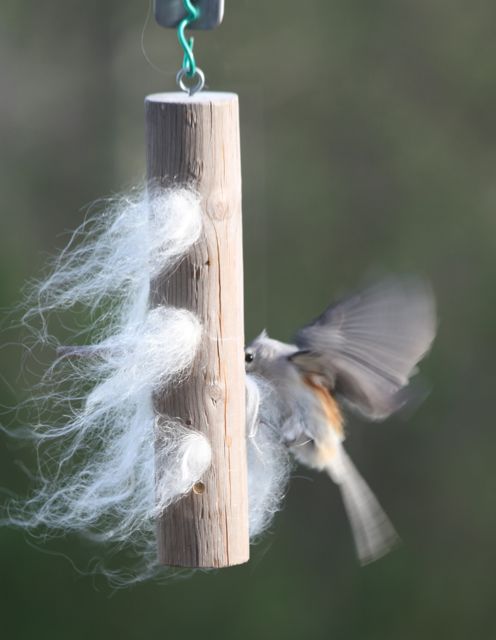
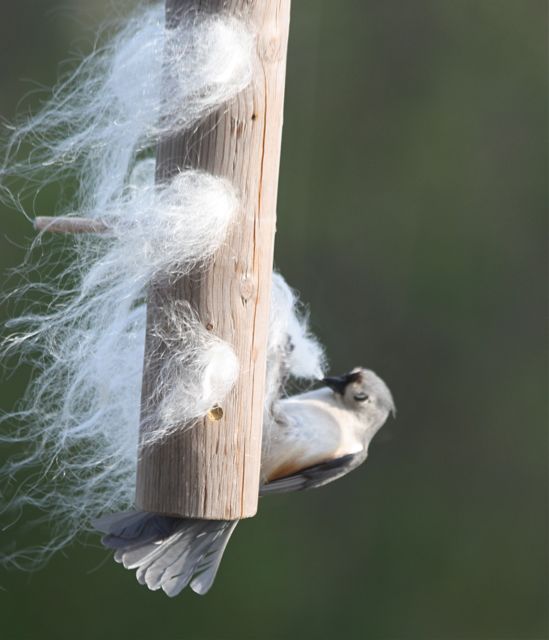
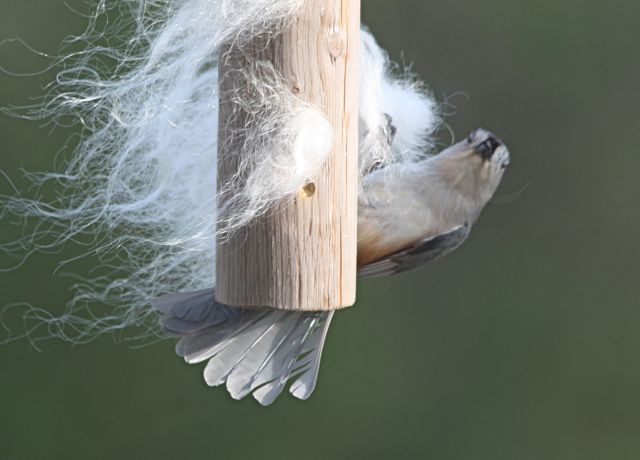
Bill of the Birds got this groovy nesting material dispenser from a manufacturer (Loretta's Blue Star) who wanted us to test it. It's just a cylinder of wood with holes drilled through it. It came with a package of mohair and a sort of crochet hook with which you pull the mohair through the holes. Unfortunately we can't find any trace of the manufacturer to get more mohair, because this one titmouse just cleaned us out.
It went into a frenzy of hair gathering.

Durn stuff gets in your eyes. I love this shot.


We could never figure out where she was taking it, except deep into the woods. I yearn to have another titmouse nest in our bird boxes; we've had one in 17 years and I'm dying to paint the babies. Paint portraits of the babies as they grow. Not paint the babies.  But maybe if we keep putting the high-ticket stuff out, we'll luck out.

Pfft! Hair!

A low-tech version of this dispenser is a little wicker basket stuffed with animal hair--dog or horse coat trimmings, even beauty salon sweepings. I don't recommend dryer lint Hollofil since they are much too absorbent and will soak a nest if they get wet. Lord knows we have a lot of Hollofil around here that could be going to some use.

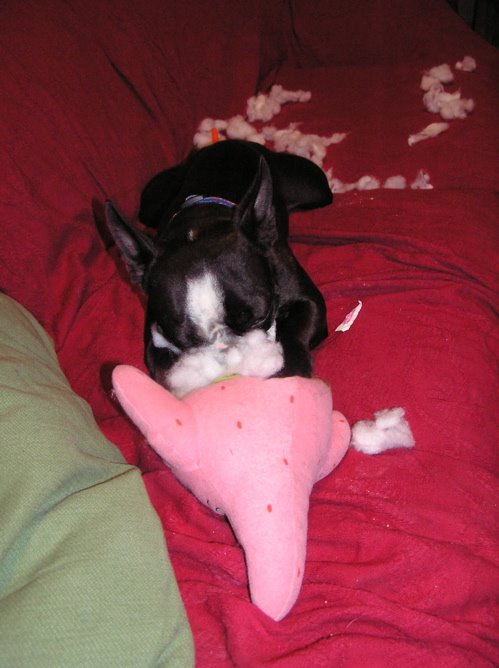
Patrick Star bites the schnitzel.

Warbler Photography, Quick and Dirty

Wednesday, May 27, 2009

4 comments
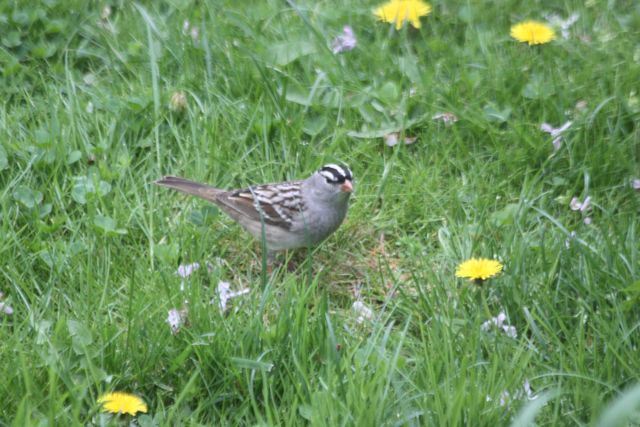
A migrant white-crowned sparrow hops amongst the dandelions and spent lilac flowers.

It's here, that time of spring when everything happens too fast. There were still migrant blackpoll warblers singing this morning, sounding, as Jeff Gordon points out, like a bike wheel out of true: tsit tsit tsit tsit tsit.

I look at my spring bird photos and know I must post them before they go bad.

We won't go bad. We stay around all year.


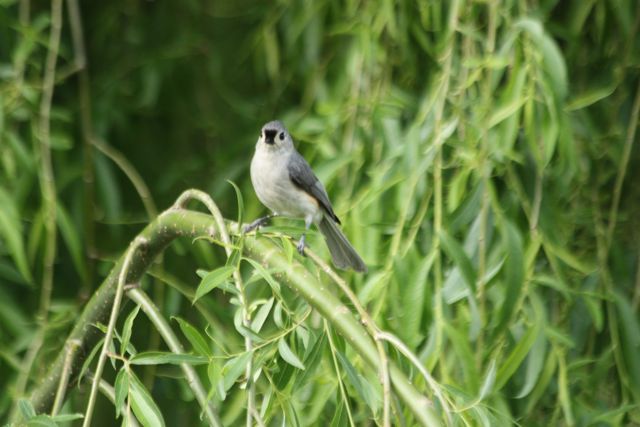
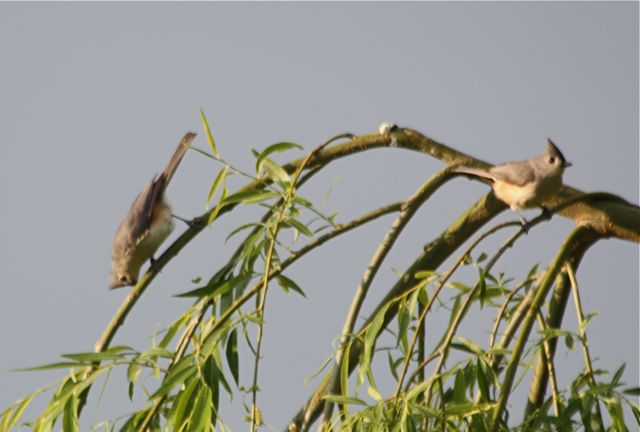
One of the cuter tufted titmouse displays--presenting the fluffy butt. Good thing they're both presenting at the same time. Nobody gets insulted.


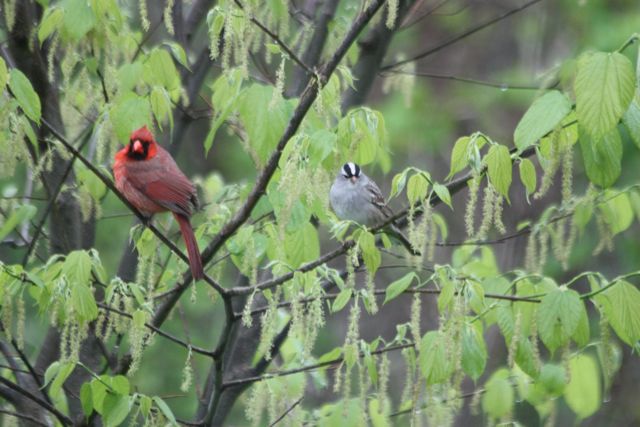
A cardinal sits with a white-crowned sparrow. That little crown stands out like a logo--you can identify this bird at a ridiculous distance.


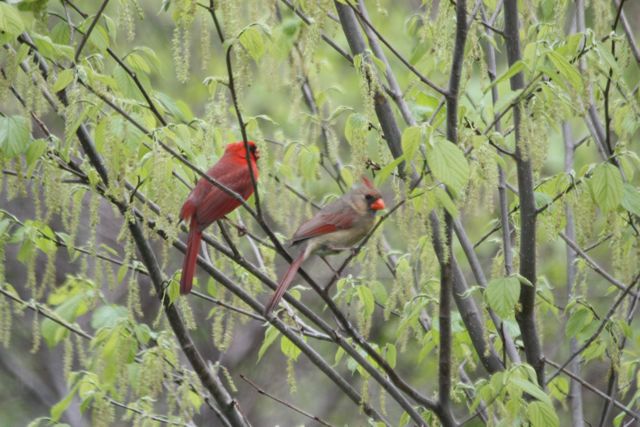
This pair of cardinals is always exchanging sweet seed kisses.


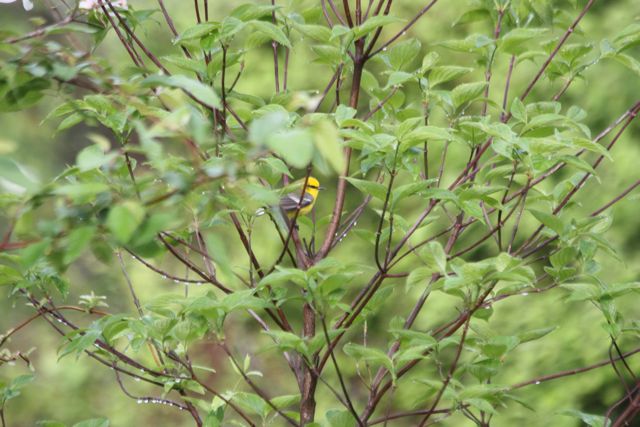
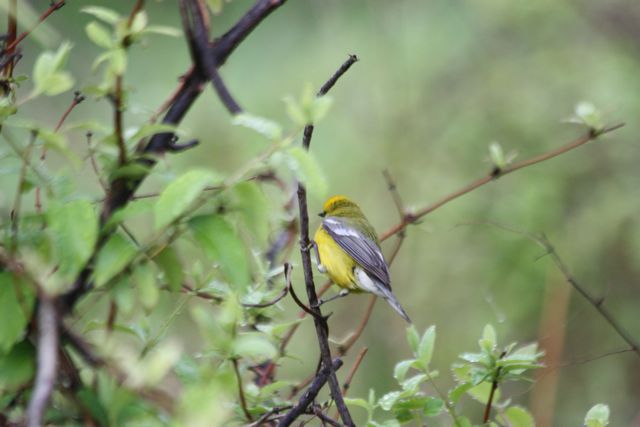
Meanwhile, the blue-winged warblers are making our old decrepit orchard a wonderful place to be. Part of the courting razzmatazz of the blue-winged warbler is spectacular chases, looping in and out of low prickly vegetation.

Most of the looks you get are like this:


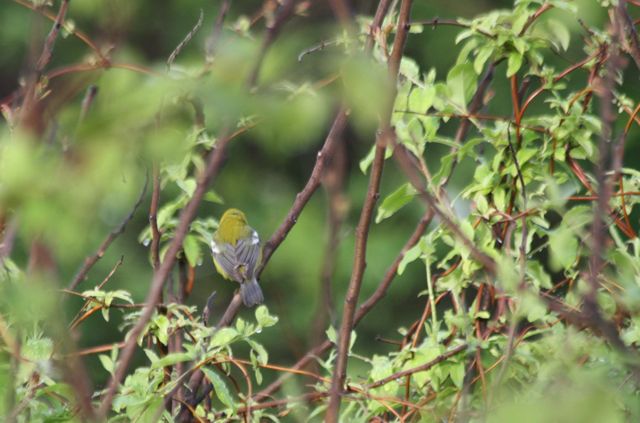
and then they're off again. But sometimes you get a clear look at the warbler's disappearing tail.


or its back as it pauses to catch its breath.


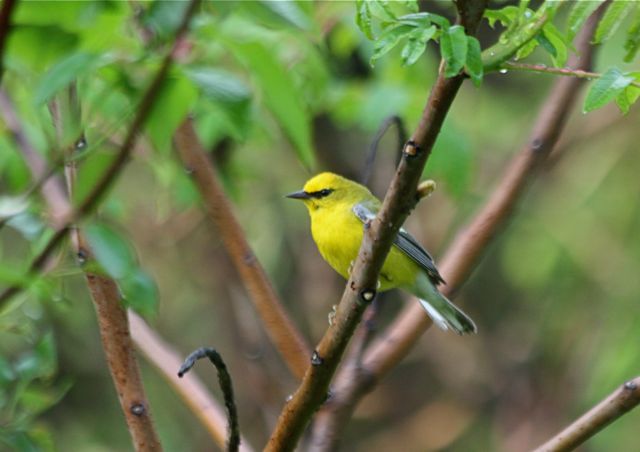
And then sometimes, if you stand around in the briar patch for an hour or so, waiting and taking dozens of pictures, one pauses long enough for you to fumble the manual focus onto it before it wings away again. Autofocus is not an option, with so much bramble in the way. The camera will pick an extraneous twig and focus on that instead of the bird. Maybe I'm weird, but I absolutely love trying to get my lens on a warbler and manually focus him into a decent image. Maybe because it's almost impossible. I love a challenge.

This isn't publishable, but it's good enough for me, and a heck of a nice way to spend a morning before the bus comes.

[Back to Top]