Background Switcher (Hidden)

Showing posts with label brown thrasher. Show all posts

Late Summer Riches

Tuesday, August 10, 2021

9 comments


Psst. Anybody know what this bird might be? It's a great quiz, a real booger. Puzzle on that one for awhile, make your guesses, write 'em down. It was spotted in my orchard, having been raised in a nest nearby. Its parents scolded me for weeks, and kept scolding even after it (and its siblings, I'm going to presume) were flying and hopping around and scolding me themselves, like this little chap is doing. I'll tell you at the bottom of the post, so as not to spoil the game.

This one's a lot easier to ID. See the rose flush coming in on the breast? What a little beauty--a newly fledged male rose-breasted grosbeak, so young his bill is still blackish--just like a young cardinal's. I'm not sure where he came from, because I didn't hear rosebreasts singing anywhere nearby this spring--not even down Dean's Fork, where I've had as many as five singing males in past years. Once they're flying, juveniles can disperse for many miles.

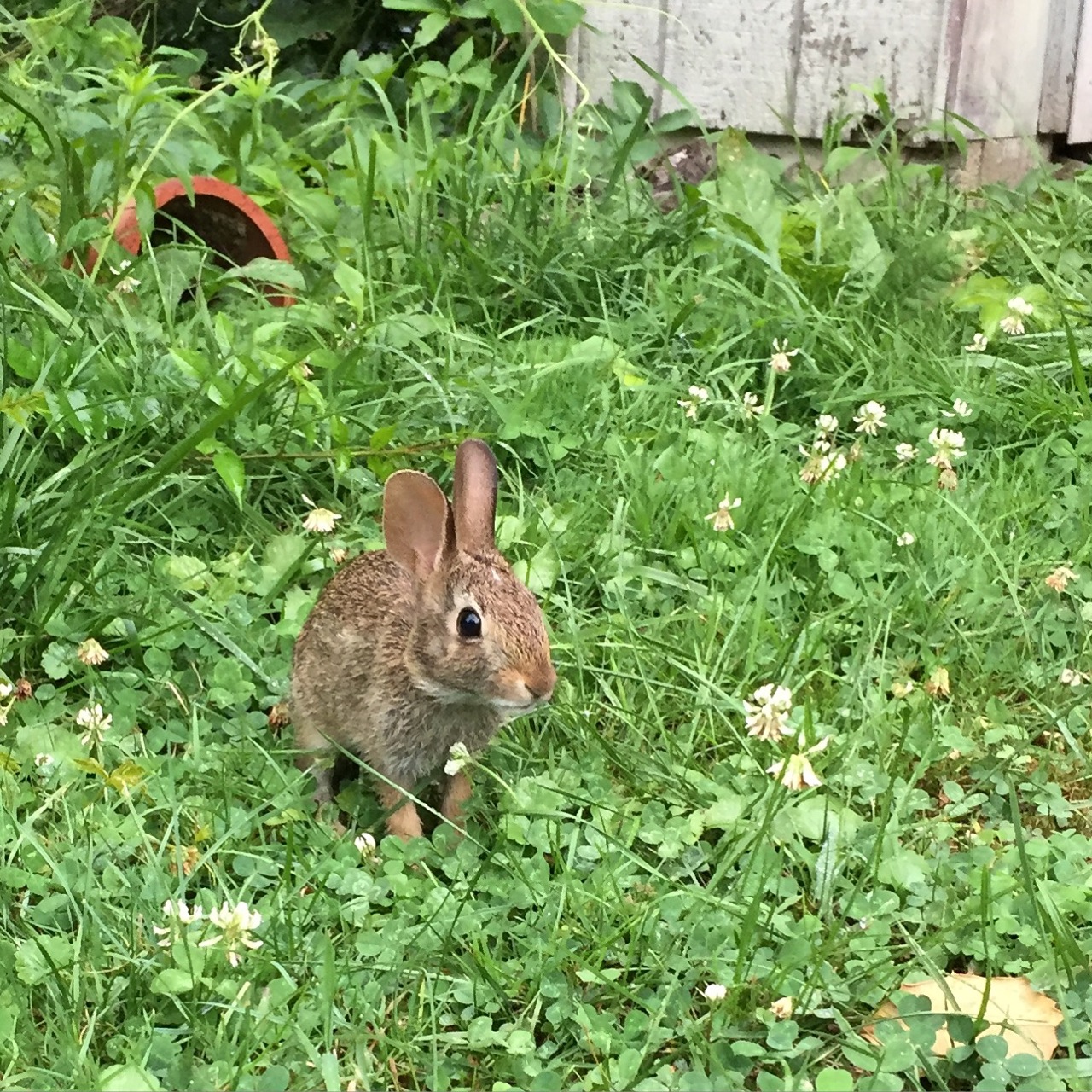
Younguns are everywhere. Here's a stripling rabbit, bug eyed and slender, perfect of fur and form.

 
And a stripling youth, watering the thirsty golden raspberries: rhubarb at his feet, tuberoses and mint in the foreground. Oh, how the Heritage Bed has grown! Every year I chop a fresh border out of the lawn, growing it out into the mown space. Much more fun to make food and flowers than grass.

We carved us up a whole lot of wisteria this summer. Wisteria has its place on the porches of Victorian homes, if you're willing to cut it back ferociously, and stop those shoots from coming up everywhere. It has no place here, but it's taken over a hill. We battled some of it back this summer. I shudder to think what this place will look like if the next inhabitants aren't feisty scrappers like we are.

I'm so enjoying the last week or two of his residence at home. It's been quite a ride. We've gotten to know each other so much better, and that has been a blessing. 

 
 But we were talking about birds, weren't we? Here's a newly fledged indigo bunting, calling for its parents in a sumac in the meadow. Spit! Spit! Spit! You should click on this one to see its grumpy face.

 
A young rubythroat, sticking out her rice-noodle tongue.
 
 
A young blue-winged warbler, contemplating my new bird fountain. Oh, what a thrill it was to see one of the two pairs of blue-wings that bred in the meadow flip out and flutter before me the day their babies fledged! And I loved to hear the males trading songs and insults all through the spring and early summer. Riches!! Gold coins!


There's such a parade of birds by the window, even though I'm not feeding them much at all any more. Water is the attractant, water and native plants and bright flowers everywhere, and all the insects they attract.  This old male cardinal has a bum right wing, likely from a poorly healed broken coracoid, but he's making it through his second summer with us pretty well. Nice to be able to take a cool dip on a hot day.
 
 
I've  greatly enjoyed watching two fledgling robins foraging on cutworms that they pull out of the clover and crabgrass in the lawn.  
 
 
Such an ornate and extravagant plumage. I wish they kept that spotty breast, like Europe's mistle thrush does. 
 
 
Not a single earthworm to be seen in this drought, but they make do nicely on cutworms, crickets and grasshoppers. I'm astounded how many they pull out of the "lawn." You won't see that happening on a Chemlawn! Nor will there be many moths at your porch light.
 
 
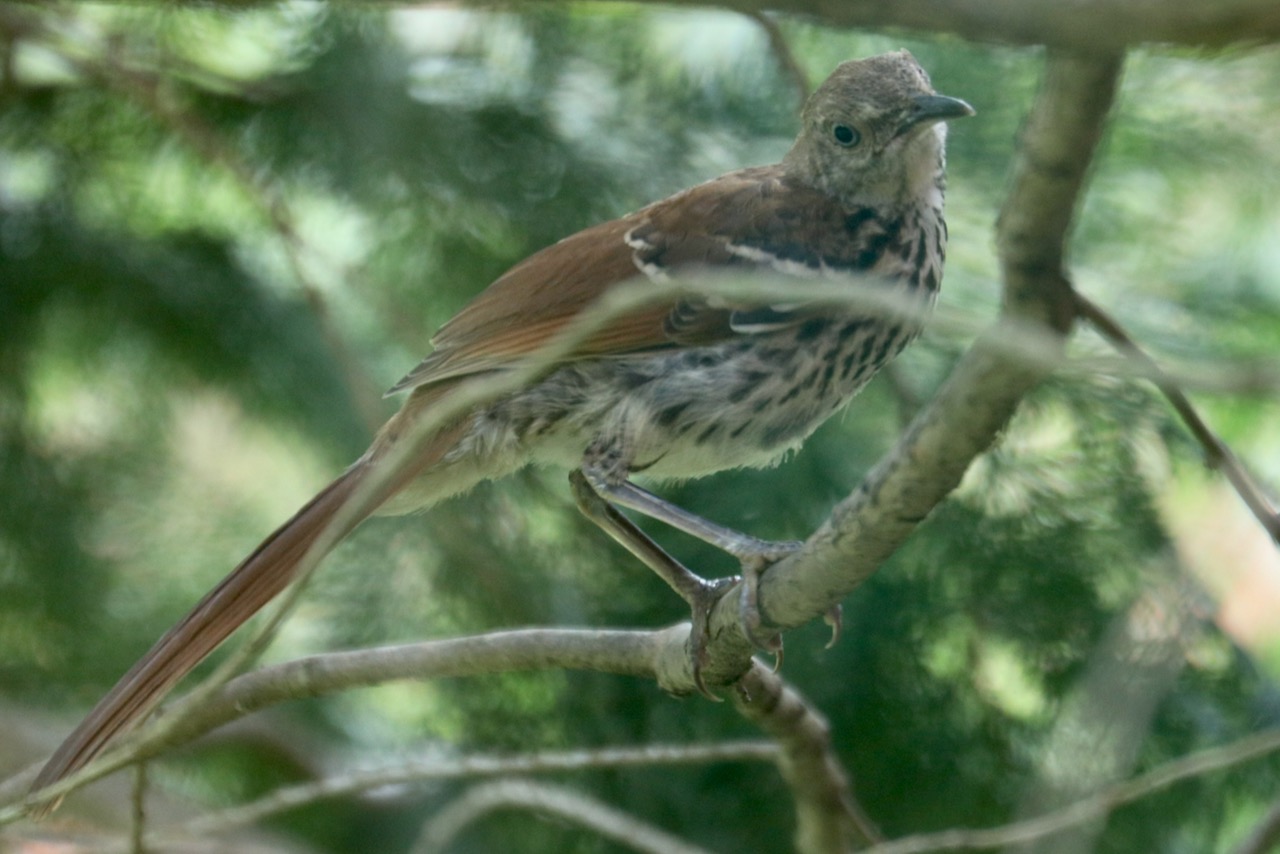
Another cutworm fan: a baby brown thrasher. No, they don't look their absolute best yet, but I love the young ones so. I love watching them learn to be birds.
 
 
 A messy, molty blue jay at the bath, one of a pair of hardworking parents who raised a couple nice babies on the place this summer. I didn't know either of them from before. So it goes. You get everybody nicely identified and wait breathlessly, and then all the ones you know leave, and new ones come in that you can't tell from anyone else. At least that's what happens in southeast Ohio. I miss Frost, who stayed two winters and  bred here once, but he's gone. I miss them all. It's been a lean summer for jays. One small but significant reason to look forward to November! That's when the jays come back to me.

 
A brood of Carolina wrens has been popping all about my new bird fountain. (I have yet to tell you about that, but I will). They love to investigate the rocks I leave lying about, crawling under and around them. If there's a little hole or cave, a Carolina wren is going to go in it.

Here's a baby American redstart preparing to bathe. Oh, they love water!

And they love my golden Chamaecyparis trees, that set off the red siding so nicely. 
 
 
All right. Are you ready with your possible ID's of the mystery baby in the first photo? That all-over olive creature with no identifying marks whatsoever? Because here it is (lower right) with its beautiful daddy. 
 
 
It's a lousy photo, but come on. Getting two Kentucky warblers in any shot is a lagniappe.
Having them breed in your old orchard somewhere in southeast Ohio is, too.


It's been a heck of a summer for breeding birds (and me) here. I've been here to document and confirm breeding of Kentucky, hooded, black and white, prairie, blue-winged, American redstart, and common yellowthroat, among the warblers. Pine warblers, Louisiana waterthrushes, ovenbirds and worm-eating warblers nested, but I never was able to see fledglings. Doesn't mean they didn't fledge! There were others, of course, but those are just the ones I could confirm. Other species confirmed breeding this summer were indigo bunting, blue-gray gnatcatcher, eastern wood-pewee, eastern phoebe, orchard oriole (only the second nest in 29 years!), chipping sparrow,  northern cardinal, Carolina chickadee, eastern bluebird (duh!), blue jay, tufted titmouse, eastern towhee, yellow-billed cuckoo, Carolina wren, American robin, downy and hairy woodpeckers, red-bellied woodpeckers, broad-winged hawks, red-tailed hawks, barred owl, and eastern screech-owl. That's a whole lotta creeping around in the woods, and I feel blessed to have been here to do it. From the way it's looking, I'll be here to document lots of other things, too, for the foreseeable future. A bit sad not to be traveling--I miss my family! but fine with the confinement, because there's always so much to learn, see, and marvel at.
 

Happy Birthday to Me!

Monday, July 25, 2016

26 comments
 I usually get a post up on Sundays, but I was working on a new talk and I had to get it done. 
It's only supposed to be 20 minutes, and it'll be delivered at the Saturday banquet for the Sedona Hummingbird Festival (Squee!!). I've figured out that I work something like two hours for each minute of the talk. The amount of time and brainpower I expend on these things is ridiculous. If it comes out right, it sounds extemporaneous. Well, it isn't. Snort.

So I was tied to the desk all day, except for an insanely cool evening walk down Dean's Fork, the subject of its own post. Sunday happened to be my birthday, so I decided if I had to sit all day, I would count the blessings that came my way. Each one would be a present.

My first gift was a handful of protoplasm. A couple of days ago, I looked down at a tire rut at a construction site and saw a puddle of tadpole goo where the day before there'd been rainwater. Because it's late July, the only thing they could be is Cope's gray treefrogs.  I touched them and sure enough a few wriggled in a SAVE ME!! kind of way. Oh no. More than a mile from home, and it's going to be a blistering hot day, and there is no natural water I can reach in shorts for at least another mile, unless...


I glanced around the site and saw a gallon of drinking water on a folding table, with a stack of plastic cups. Eureka!

I scooped up the taddies and a good bit of silt and plopped them in a cup, pouring life-giving water over them. Imagine how good that feels to a tadpole on its dying day. Jogged that mile home carrying the cup of taddies, laughing to myself about how that must've looked to the neighbors. Poured it in a plastic jar and added beaucoup rainwater. I gave them a couple of days to rehydrate before releasing them, and they needed it. When they started acting like tadpoles instead of crumpled bent fetuses, I knew they were ready to go.


This was my first birthday gift.


For future reference, they love koi sticks. Nomnomnom.

On this morning, I took the jar down to our fishpond, fed the comets to repletion, then installed the jar on a shelf in the pond.  One by one, the taddies who had survived their ordeal came up for air, saw the great expanse of water and delicious algae, and swam off into the deep. 


This one swam curlicues, dove, wriggled through the algae; its joy on being in proper habitat that wouldn't dry up was palpable. Honestly, I don't know how tadpoles do it, always watching the water levels, praying for rain, facing the imminent prospect of death by baking. Ugh.


There being no puddles left anywhere in the sweltering July heat, our water garden was my best choice. I had to hope the fish would leave them be. Comets aren't very predatory where small swimmers are concerned. As I was monitoring their exodus from the jar, I saw a tiny comet, the first spawn of my four fish, swim by. If he can make it, they can, too. 

Second present: BUN.


 There's a litter of three young cottontails in the yard who, having grown up in the sanctum sanctorum of Indigo Hill, have no frame of reference for humans as dangerous animals. They barely recognize Chet as a threat, which (let's be frank) he barely is. So these foolish little animals perk their ears attentively but go on chewing clover when I speak to them, kneel down and take iPhone photos of them from barely five feet away. Dumb bunnies. But of course, I adore them. So, Bun. They're all three named Bun.

I have a little family of brown thrashers in the yard! I don't know if any of them are Cletus, Melba or Harper; I think not, because the adults aren't tame at all. But oh, being able to look out and see thrashers doing thrasher things, dust bathing, sunning, hunting bugs or, in the case of one of the parents, grabbing a sunflower seed and pounding the shell off--it's just the best. This is a juvenile. Gift 3.


Seeing the laborious way a thrasher, which doesn't hold seeds in its toes for shelling, has to pound the hull off a seed, I spread sunflower hearts in all their favorite spots. Watching them gobble them down: Gift 4.

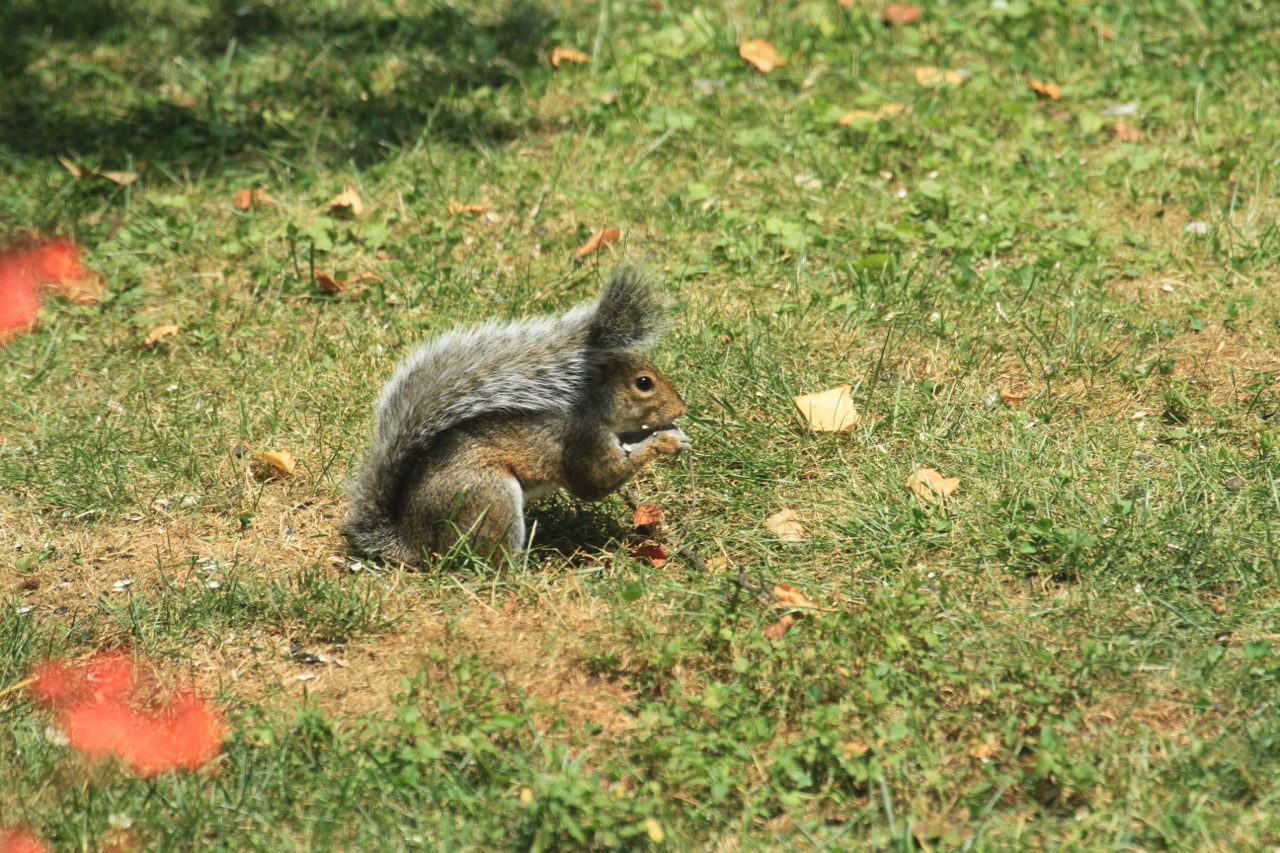
Present # 5: Someone dribbled squirrel! He appreciates the sunflower hearts very much. He ooches around on his belly picking them up one by one. I have to say I love my squirrels. They annoy the hell out of me, but they're such fun to watch! So they're paying their way, at least partly.


The sunflower hearts brought in MamaCoon and her three kits! Gift #6: July 24 was first day she's brought them out at noontime.


It's amazing how long those raccoon babies are dependent. The smarter the animal; the more complex and comprehensive its diet, the longer the juvenile dependency period.


It takes a long time to learn to be a raccoon.

Gift 7: the yard robin resents crowding by a ruffian house sparrow, tells him to back off! Just having a robin in the Spa, ahhh. But this combo was too much.


#8: speaking of Back Off, a mourning dove warns a squirrel it's too close.  I am big! I will beat you with my wing! Interestingly, a dove would NEVER let a chipmunk get that close. Chipmunks are far more dangerous than squirrels. They're nastya-s little animals. Chipmunks remind me of the killer rabbit in Monty Python and the Holy Grail. 


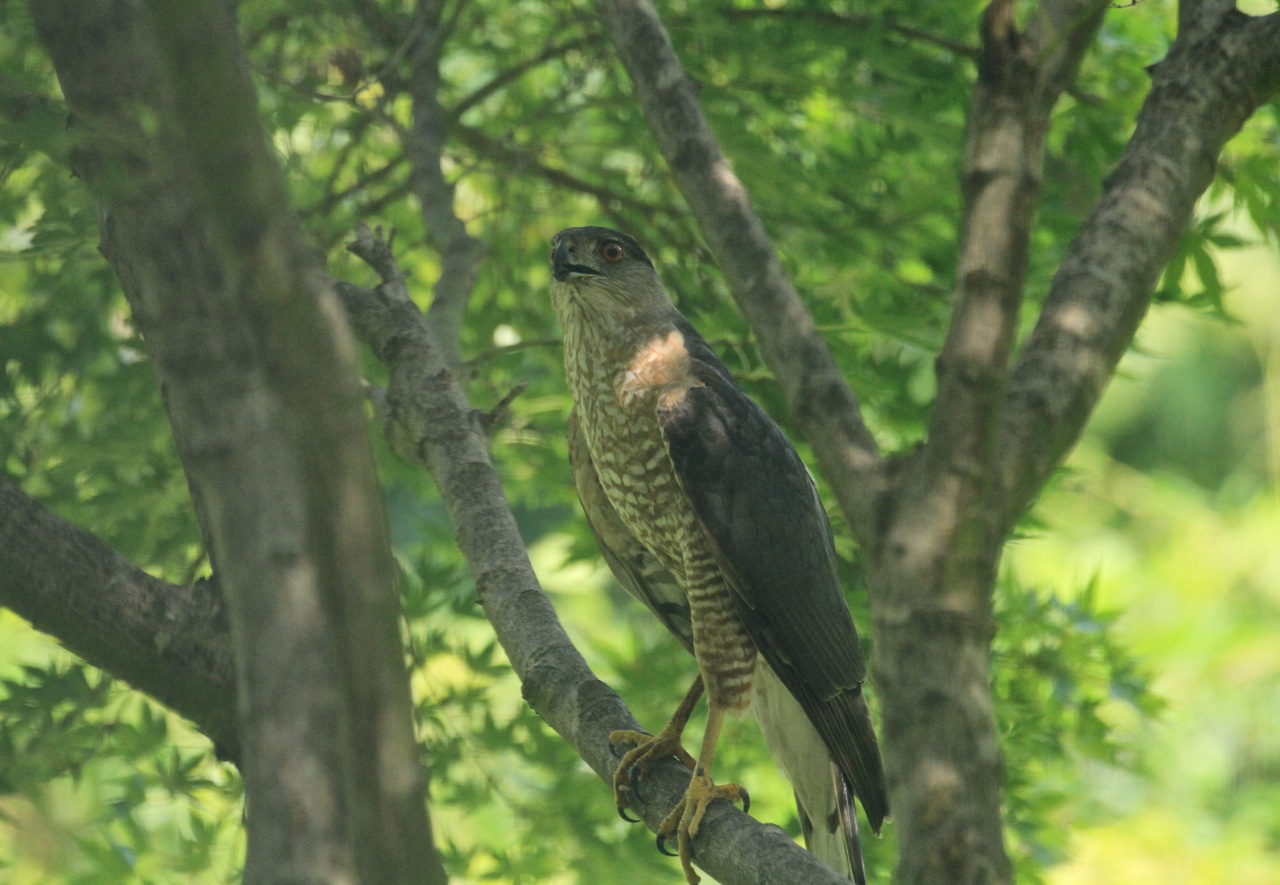
 Adult male Cooper's hawk makes two passes through the feeder zone. I manage to capture its bill, leg and foot, enough to identify it, as it fetches up in the Japanese maple. Not a great photo, but still gift #9.


This just in!! July 25: I saw the Coop take a pass at some doves just now and scuttled with camera downstairs to shoot it from the bedroom. This is through two panes of glass, at a terrible angle, but OH MY. Talk about a gift, hurled from the Other Side. Thanks DOD!!


On the first shot, I captured the whole hawk. When it turned toward me, I lost my head and focused on its face. Ah well. Too excited to shoot well.
Please note that this hawk is perched in a retired, or as I love to say, recovering bonsai. DOD, you place your gifts so well. He adored my bonsai. 


You beautiful thing!! Please help yourself to mourning doves, and  take a house sparrow as a chaser, willya? You're also most welcome to squirrels, but please not the one who sccoches around on his belleh.


#10: Seeing a gray squirrel use its tail as a hat and parasol.


At this point it's 98 in the shade,  easily 102 in the sun, and I'm so thankful to be inside mostly (not) working on my talk. 


 # 11: a rubythroat investigates the coneflower, seeming to find a sip of nectar in the disc. Not something I see every day, but these midsummer juveniles try everything.


There has to be nectar in this big fat bud. Just has to. I'll wait for it to open. This photo: Gift 12.


I have a variety of wire supports for my tall cardinalflower and Fuchsias, and the hummingbirds adore them. Hummies appreciate thin perches. They can watch for Cooper's hawks from them. It must be nice to be too small and fast to bother with. But you still have to stay vigilant. 


This photo: Gift 13.

Meanwhile, fall migrants (yes, I said it; fall begins in July for warblers!) are sifting through the yard. A young yellow-throated warbler on its leisurely path southward. Or westward, or eastward...they do a bit of wandering.  This has to be one of my favorite warblers, Gift #14. Get the picture? Everything out there is a gift. I had intended to put all my birthday gifts in one blogpost, but it's evolved into at least three. And that is a gift in itself.


Happy birthday to me! Now you can see why it takes me so dang long to put together a talk. Or a blogpost. A giant set of Venetian blinds for the studio window would probably go a long way toward increasing efficiency, but ignoring the show going on just outside those windows in late July? Unthinkable! All but a couple of these photos were taken through my studio window, through the crop netting screens that cover them. Gift #14: having such a big, comfortable blind for a house!


Blessed, that's all!

A Thrasher Goes Home

Tuesday, June 7, 2016

5 comments

My car-hit brown thrasher didn't even try to fly for a week. She started by jump-fluttering from perch to perch, the way a baby bird begins to fly.


 I fed her. I let her be. Finally she began to fly low toward the other end of the tent when I'd enter the garage. Oh, yes. Good. Everything works. It hurts to fly, but you can fly.

By May 28, she could helicopter straight up from the floor of the cage to its top, a distance of 5'. And she did it without hesitation, like a normal wild bird would when a human enters its space. This is what I'd been waiting for. She'd been healing for 11 days.


So much of wildlife rehabilitation relies on gut instinct. You have to open yourself to the animal, feel what it's feeling, empathize completely, sense what they need. When they're ready to go, they tell you. I wanted this bird to be bouncing off the tent walls before I let her go, so I waited 12 days. It still amazes me that she could go from a little stunned immobile wreck back to a thrasher, big as life, in only 12 days. What a gift.


I opened up the garage at dawn and closed it at dusk, so she could take in the fresh air and sounds and scents of outside. She spent a lot of time listening to the thrasher who sings in our yard. I was sorely tempted to release her here, where she wouldn't get hit by a car.


But I knew from past experience that wild things want to be where they want to be. The last bird I took in, a tufted titmouse whose airsacs had been punctured by a cat, was ready to go in a  little over a week. I was loath to release it where it had been injured (a residence about 5 miles away, with feeders and free-roaming cats, ugh!) so I let it go here. When I let it out, it flew and leapt to the top of a birch, got its bearings, and flew in a direct line straight back toward Lower Salem, and that yard full of feeders and free-roaming "barn" cats. All I'd done is make getting home harder for it. Duh. 


It was hard to take this exquisite creature back where she'd been hit, but I knew that was the right thing to do. 


If I didn't take her there, she'd have to fly there.


Farewell, sweet thrasher, who never got a name, because I always knew you were going home.

In this video, you can see that I'm worried about her, hating the traffic; hoping she'll stay on the green side of the highway, yet knowing that bringing her home is the right thing to do. The thing about rehab is most of the time you can never really know if you're doing right by the animal. You just have to hope you are.


Thrasher + Car = Bad

Sunday, June 5, 2016

10 comments
I'm trying to stay under the radar where wildlife rehab is concerned. When simply answering the phone constitutes taking on someone else's fresh, completely unexpected problem, one that is likely to eat most of my day, what you get is someone who cringes every time it rings. And all the other callers are Democrats, hesitating in silence for about 30 seconds, and then wanting money for this and that. I'm thinking of yanking the thing out of the wall. The number of calls I get on my cell (none) is about right for me.

I've gotten myself off the public lists of Ohio wildlife rehabilitators. I had to. I'd get nothing else done. But as my friend Christy said, "Rehab follows you, wherever you go." 

Word.

This brown thrasher came to me via a Facebook message on May 17. Guessing at its sex, I called it a female. She'd been hit by a car and found stunned and gasping in the middle of a busy intersection that roars through some beautiful thrasher habitat. 


When I picked her up at my good Samaritan's home, she could hardly move. The slightest exertion resulted in an open bill and loud gasping, with a clicking noise called crepitation. When you hear crepitation, you can assume the bird's airways are compromised. The clicking can be caused by fluids or rupturing of its air sacs, which need to be intact to give it the buoyancy to fly. Crepitation not a good thing to have or to hear. 

I examined her thoroughly, finding no visible broken bones. Wings and legs worked, but she was totally grounded. The prescription, in an ideal world, would be an X-ray to see where it hurts. Washington County, Ohio is not an ideal world, and local veterinarians quite understandably won't admit wildlife. If they did, word would get out and that's all they'd wind up doing. So I go a lot on gut instinct. 


And if I can determine that nothing visible is broken, I don't see the point of sending a bird to the excellent but oversubscribed Ohio Wildlife Center in Columbus. R & R I can provide, and my gut told me this bird just needed a couple of weeks of food, rest and healing. She was underweight to start with. Well, at least compared with the superfat baby brown thrashers Cletus, Melba and Harper the kids and I raised last summer. So I kept her in a pet carrier for a couple of days, feeding her and leaving her alone. She barely moved, even when I changed her dishes and papers. Hurting bad, she was.


After a couple of days, she started rattling around in the carrier, and it was time to move her to more spacious quarters. I pulled out the flight tent and put it up in our garage. One whole side of zippers has given out and I have to secure them now with clothespins. It's an incredibly flimsy piece of overseas-made crap, far too delicate to be erected out in the yard, where the slightest gust would roll it over, but it works just well enough to contain most birds. Must be why they call it the Zephyr. 


The thrasher seemed thrilled and overwhelmed at the new digs. She spent the whole first afternoon trying to get out the front of it.


Then she settled down a bit and started using her perches. I offered her unmedicated chick starter, live mealworms, sunflower chips, and fresh berries. Oddly, at first she ate a lot of chick starter, in preference to mealworms. My baby thrashers liked it too. It's nice to have a nutritious pelleted food I can offer wild birds, and even nicer when they accept it.

I could literally see her gaining weight, though I wasn't about to capture her or lay a finger on her until it was time for release.


I'll leave her, and you, here to heal awhile. The Rest of the Story is coming up.


[Back to Top]