Background Switcher (Hidden)

Showing posts with label American Birding Association. Show all posts

What's That Bird? Using Science to Decide

Friday, July 31, 2020

21 comments

Facebook groups. To me, they're like folk festivals: best when they're small. And then they get too big, really fast, and you suddenly realize you can no longer abide them. At least that's how it has always worked for me. There's this sort of tipping point where the people who have no idea what they're talking about (but are loud) outnumber the ones who do (who are quiet) and that's when I vamoose.

I think being in isolation for too long has made me peek in on Facebook groups lately. The ones having to do with natural history ID can frustrate me terribly, because you'll no sooner get somebody's critter identified than you'll be drowned out by ten people, all guessing away but sure they're right, some of them openly and none too politely shouting you down.  That's no milk snake! That's a TIMBER RATTLER!! And I'd wind up wondering why I'd bothered to help.  Who needs to put themselves in a situation like that?

But a funny thing has been happening. There are good people out there with cameras, taking interesting shots, and it's fun again for me, now that I know how to sidestep and laugh off the inevitable keyboard rage that happens in large Facebook groups. So when I stumbled on two photographs submitted by Kimberly Nancarrow to "What's This Bird?" (the American Birding Association's FABULOUS  bird ID page),  I sat up and took notice. Over 48,000 members strong, this page is a potent way to introduce people to the joys of bird identification.

Kimberly had photographed a mystery bird sitting on the back of a whitetail doe, and that got my attention. I love seeing birds and mammals interacting.


The pair was photographed in the middle of a soybean field in Altmont, Michigan, on July 27.

Though the photos were taken at a great distance, I knew immediately what the bird was. 
There was quite a bit of disagreement among the others commenting, and what was interesting to me
was thinking about how I had known what it was right off the bat. Why wasn't it so obvious to the others?

I started thinking about how I'd arrived at my ID. I decided to deconstruct my thought process and see if I could elucidate things. Because even though I knew it instantly, there had to be a series of clues I'd picked up on, and I wanted to know what they were.

 I didn't want to do that analysis on the Facebook page, because I was afraid my effort would go to waste. So I decided to do it here. 

There seemed to be two camps: Team Starling and Team Eastern Phoebe. I was firmly on Team Starling, and here's why.

The first has to do with phenology, my field experience, and situational awareness. It's late summer, the time of year when  starlings perch on large mammals. This I knew, from my photo salon in September 2019 with a little herd of Angus crosses and their starling attendants. 


You see, in late summer the face flies and deer flies build up to plague proportions, and the starlings are happy to get rid of some for the cattle. I wrote the behavior up for my True Nature column in Bird Watcher's Digest Jan/Feb 2020 issue. I called the piece "American Oxpeckers."


So that was the first tool in my belt that perhaps the Team Phoebe folks didn't possess: knowing that starlings sit and forage for flies on large animals. 

I realized from the start that the mystery bird was showing far too much leg, and too robust a set of legs, to be a phoebe. You just don't see, or perceive, flycatcher legs at a distance. I can immediately see a good pair of legs on this bird.  To my eye, it could only be a starling. 


I also perceived that it was much too large to be an eastern phoebe. But I needed to be able to prove that was true. There had to be a way. I wasn't sure how, but I dove in anyway.  First, I traced Kimberly's photo and measured the bird, then the doe's ear. They were almost exactly the same length!


Now I needed to know how big a doe's ear might be in real life. That way, I could extrapolate, and say how big the mystery bird was. How to do that?

I happen to have a number of deer skulls in my studio that I've picked up over the years. I grabbed the biggest doe skull, since the doe in Kimberly's photo looked like a full grown one to me. This is not a skinny yearling.

I traced the skull's outline, then fleshed it out a bit. 


Before adding the ear, I measured the length of my deer's head, then measured the head of the deer in Kimberly's photo.

The deer in the photo had a 41 mm. skull with a 30 mm. ear. My skull measured 305 mm long, so I set up a simple proportion to figure out how long its ear would be.

skull length in photo  41  = 305    skull length in my drawing
ear length in photo      30       x      ear length in my drawing


I multiplied 30 x 305, then divided by 41 to get X, the ear length in my drawing. X turned out to be 8.75"

So I added an 8.75" long ear to my sketch, done from the actual skull. Now I knew how long a real doe's ear is!


Now it was time to hit the books and see how long a phoebe is, relative to a starling. David Sibley says an eastern phoebe is 7" long. I noted with satisfaction how short and delicate its legs were in Sibley's painting.


Now for the starling. Oh, look! A starling is 8.5" long! Well, my my my. That's about the same length as a doe's ear! 


Boom. Between its robust, visible legs, its potbellied profile, and its size relative to the doe's ear, this bird can only be a European starling. 


The last cool thing I noticed was the fact that Kimberly's mystery bird was dark overall, with some pale areas around the face. That works for a juvenile starling in late July. Look at these September starlings--juveniles, with just a bit of pale juvenal plumage around the head. 


Meanwhile, back in the group discussion, there were people on Team Starling flatly stating that phoebes don't sit on animals. Well, I have been studying phoebes for years, and have even raised two from babies, and I've never seen them sit on animals.  But I would never flatly state that they never do it. How would anyone know that? It's so important to be kind. It's even more important to avoid asserting something you don't know to be a fact from direct experience or solid research.

Moderator Tim Kalbach (Team Starling, but stirring the pot) contributed this photo by Chuck Holliday, taken July 22, 2019 and found on Flickr:


It's an eastern phoebe sitting on a whitetail, catching deerflies. Cool!!

I love it!! Humans can always be wrong. Birds and animals, not so much. Animals have no egos to get in the way of their truth.


 Look how much bigger the bird below appears relative to the deer, than the phoebe above. Look, too, at how you can see the thighs and legs on the starling below, but not on the phoebe, above. You can barely perceive the phoebe's legs at all, because they're so fine and short. The phoebe's belly practically contacts the deer's rump. And the contrast between dark upperparts and pale underparts is obvious on the phoebe, but totally lacking on the starling. So there's that...


I've had lots of fun proving the veracity of my ID, even if it was only for myself. Perhaps this torrent of fact-based information has won over some Team Phoebe folks, but I don't really mind either way. I like to base my ID's on facts, not opinion. I love to dive inside and see the deductive reasoning contained in a split-second judgement of bird identification. Walking through the facts here seemed like a tiny strike for the scientific process. I look forward to the day that science and fact-based reasoning re-ascend the pedestal.


I'm going to try to make sure I enjoy belonging to social media groups going forward--dip in and out, grab a fly here and there, help when I can, learn something new whenever possible, and fly off when I can't. I wish the same for you.

Thanks to the American Birding Association, page moderater Tim Kalbach, and especially to photographer/birder Kimberly Nancarrow for permitting the use of her photos. Bird on! and keep your eyes open and your camera ready.


ABA Bird of the Year, Part Five--Finis!

Tuesday, April 3, 2012

6 comments

See why I was so excited to paint the male evening grosbeaks?

Here are their ghosts...


By now you’ve gathered that most of the work of doing a bird painting, at least for me, is putting the bird in a believable setting. For me, painting the birds themselves is dessert, because it’s effortless and fun. Well, I shouldn’t say it’s effortless, because male evening grosbeaks are tricky to paint. I’m really excited to move on to the males, knowing what impact their colors will have on the whole piece.


The key to painting male evening grosbeaks is laying down a bright yellow underpainting and letting it dry completely. When I then stroke burnt umber over top of the dry underpainting, the yellow shines through. The final effect should conjure a good golden-brown honey mustard, with touches of pure hotdog-ready French’s on the coronet, rump and flanks. Mixing the two colors would give mud, which I don’t want; I want an overlay of burnt umber and sepia with glimmers of yellow shining through, because that’s what I see in the plumage of the study skins I’m working from.


Here, in the upper left corner, is the male I thought would work for the “iconic bird of the year,” but the general consensus at ABA HQ was that the pose was a bit odd. In the end, the pose was deemed too outré for use on a sticker or patch, so I drew another male (also from the same batch of life sketches) in a more typical and easily interpreted pose for this application.
That’s OK. I’m used to having my better ideas not work out in the end. Like having a flock on the cover…
 

I'm always saving something back for dessert. In this case it's the pink apple blossoms.


The painting's almost done, with pink apple blossoms painted in. I’ve done a bit of glazing of Chinese white on the birds to give their plumage a sheen, and shadowed the whites in their wings as well. They’re eating apple blossoms, something grosbeaks like to do in spring.


Here's a more saturated photo of the piece. Juicing up the blacks usually helps any painting.


I hope you’ve enjoyed this walk through the process of creating Birding’s new cover and its Bird of the
Year.


Stay tuned for information on purchasing this painting! No fooling! Proceeds go to evening grosbeak conservation.


ABA Bird of the Year, Part Four

Thursday, March 29, 2012

3 comments

 
We're still working on the Birding cover for ABA's Bird of the Year issue. Evening grosbeaks! This one, female. 

I lay in the basic washes on the female bird first. I’ve been waiting for this moment, to see how her colors bounce off the colors in the road.


She looks flat here  because I haven’t modeled her shape or shaded the underside. I just want to get her colors laid in first.


With a little shading, she looks much rounder. I’ll work on her more, but for now I decide to work on the landscape a bit more, now that I have her to tie it into the painting.  I darken those stripey violet shadows coming across the road and the grass. They’ll give the sense of dappled sunlight, which I think is already coming across pretty well. The darker the shadows, the brighter the apparent light source. And violet shadows evoke reflected skylight and mix wonderfully with greens, which is more than you can say for a lot of colors. Cobalt Violet and Cobalt Blue are my two main shadow colors.


What I can say at the end of the third day of working on this is that all the planning and masking were worth it. The painting part is sheer joy.  I love the way the female works with the dirt road in the landscape. Best part is yet to come: Painting the boys!!

ABA Bird of the Year: Part Three

Tuesday, March 27, 2012

13 comments
We're continuing to work on the cover for Birding Magazine, of the American Birding Association's Bird of the Year, the evening grosbeak.


You’ll notice the light regime changes in my progress photos. Normally I trot outside to shoot them, but sometimes I reach a key passage in a painting when it’s dark outside. So for some photos, I had to use incandescent light rather than the clean north light that usually floods my studio. This is a work-in-progress, and progress isn’t always as well-lit as we’d like.


The apple tree leaning over the road is a bit of a stretch, I know. I wanted to give the viewer the experience of pretending they are birding and seeing such a wonderful sight, so it was important to me to have a road in the painting, a place for the viewer to stand. A road stretching away gives the viewer a distance to walk into, so I stretched the truth a bit. Let’s just say it’s an apple tree that’s leaning so far over the fence it’s probably about to fall into the road and not worry about it, OK? It’s an imaginary apple tree, anyway. It won’t even break the fence when it falls.


This photo was taken by daylight—what a difference in color temperature!  I like the way the sky turned out, especially near the lower left horizon. It feels springy to me. I’ve rubbed away the Incredible White masking compound with my finger and  peeled off the masking film to reveal clean paper. I’ve had lots of fun with this painting until now, and it’ll only get better.

What fun I had laying in the brilliant spring greens of the landscape! I went ahead and painted right over the fenceposts because they would be so much darker than the grass. I could paint them over it without a problem. My secret plan for the road was to tie its color into the colors in the plumage of the female grosbeak. She being nearest to the ground, I think it’ll work well.


I start by painting the branches, and then I paint the birds’ feet and flower petioles all in one go, since they’re almost the same color. I like the way the foreground is starting to work with the background. The little buildings ground the whole composition, as do the fenceposts; they define the plane of the road and give the eye somewhere to go. I’m SO excited to paint the flowers and birds, and especially to lay in the sharp blacks of the wings, and the brilliant yellows in the birds’ plumage.


I paint those glow-in-the-dark green bills next, and for efficiency’s sake, I do them all at once. Once I’ve mixed the color, why recreate it for each bird?


ABA Bird of the Year, Painting Part Two

Sunday, March 25, 2012

2 comments

Here’s what I use for masking out areas I don’t yet want to paint. Frisket Film is a transparent plastic film with low-tack adhesive on back that sticks to the watercolor paper. The artist cuts it in the desired shape with a small X-acto knife, then places it over the area to be masked. Masking the birds was a bit of an adventure. I cut one big piece of masking film by Frisket, and applied it to the paper. Frisket doesn’t much like to stick to the irregular surface of cold press watercolor paper, and that’s a big problem, because it’ll let paint creep under and ruin your nice white space for the birds and flowers. So I engineered the leaves and buds so they intersected the birds fairly smoothly and made one nice big area, and cut the shape a little smaller than needed. Then I ran around the outside of the big, irregular shape with liquid masking compound (I use Incredible White Mask) which has the consistency of thick whipping cream, but dries to a clear, rubber-cement like finish. This effectively seals the edges of the Frisket film and prevents the wash from creeping under it.


The masking compound, after it dries, can be rolled off with the finger or an eraser when you’re ready to remove it. In this case, it did a lovely job of sealing the edges. My results vary widely, and sometimes paint creeps under my mask no matter what I do. This time, I lucked out and got to skip the step where I peel off the masking film and spend a half-hour scrubbing out all the places where the wash seeped under it.

Time to paint the sky!

ABA President Jeff Gordon had requested a spring scene, something other than the typical snow scene most people are used to seeing. I wanted an active sky, a spring sky, a sky that could change and get overcast in a few minutes, so I used lively brushwork on paper that had been dampened by a fine mist from my trusty spray bottle.  I didn’t worry about getting it all perfectly even. The sky outside the day I painted this was similar, so I just looked at the random cloud shapes and didn’t worry about where they were as I painted; I just laid them in as it felt right. I did a little scrubbing and lifting of the blue wash to better define the clouds, but I really didn’t want them to compete with the birds, so I kept them pretty filmy. Once a wash like this dries you can’t go back into it and work on it much, so when it was done it was done.


 One thing I remember about EVGR is that they always seemed to stay so late in the spring that you started to hope they were going to breed. I remember seeing them in flowering trees in W. MA and even hearing them singing! So I decided to put them in a full-on early May scene, with the trees all leafing out and the grass already getting high along the fencerow. It could be anywhere where EVGR breed—Vermont or Maine, but it’s a scene from not far from where I live in SE Ohio, on Tick Ridge. Painting as I was in late January, I can’t tell you how wonderful it was to waller around in springtime for the time it took to paint this. I could feel the tall grass and the warm breeze and smell the unfolding leaves, that green smell when the sun hits everything.


ABA's Bird of the Year, as Rendered by Zick.

Thursday, March 22, 2012

7 comments


It’s an honor to be asked to paint The American Birding Association’s Bird of the Year. It’s a special thrill when the B.O.Y. turns out to be a bird I adore, a bird that’s part of my personal history, dating back to my childhood in Virginia, an unprecendented and never again repeated invasion of the birds in the mid 1970’s, and the first and most fabulous feeder my father ever built for me.

The Bird of the Year is chosen carefully. Most of all, it’s spotlighted for conservation reasons. Evening grosbeaks are declining overall, and we’re not really sure why. Research is needed. Many yearn to see this bird, but fewer and fewer do. In southeast Ohio, it’s been almost twenty years since an evening grosbeak has so much as lit at our feeding station. If any species deserves the limelight right now, the evening grosbeak does. See ABA’s special page devoted to the program, which we hope will result in greater attention to its decline and research as to its causes and, we hope, eventual arrest.

Part of the push is the sticker/badge you see above, and part is a cover for Birding that features the chosen species. I was asked to do both.

My first, and most grandiose idea for this magazine cover was a flock of evening grosbeaks in flight. Color, motion, forward movement for the ABA…it was all so appealing. I was soon to bump up against the hard reality that a flock of birds doesn’t work very well on a vertical magazine cover. To make a flock, it takes more than three or four birds; it takes a village of birds. After a couple of days of drawing, I just couldn’t get around the reality that each bird would have to be less than an inch long to get a decent number of them all on the page. I am too old to paint inch-long birds. Just getting all their eyes in the right place would be an enormous challenge at that scale, not to mention all those tiny flight feathers.

The magazine cover’s vertical format means that in order to get more than one or two on the page, you have to stack the birds one atop the other. I considered asking editor Ted Floyd to print just this one issue of Birding sideways, so I’d have more space to play with. Shouldn’t be that big a deal to reformat the whole magazine and staple the short side, right? The proposal died aborning. I kept struggling with the vertical flock.

I worked on that for two and a half days and threw in the towel. Then I tried just a few birds. But still they were small, small, small, and I didn’t want to paint small. I wanted big fat juicy birds that you could caress with your eyes. Birds with structure, birds with volume. Grosbeaks are neat chunks of mustard and butter, hearty well-built streamlined units. I decided to perch them and heaved a sigh of relief as I put my flying grosbeak drawings in a drawer for later.
I went into my old sketchbooks from the last time we had evening grosbeaks at the feeders in the early 1990’s. I was so glad to find some lively sketches, which brought the living birds right back for me.


I knew I wanted a nice male to be the “totem” Bird of the Year, just for color and graphic appeal. And I decided to be a little bold with the pose—looking head on at you over his shoulder, which would show the nice white wing patches, the bright yellow rump and coronet, and the massive bill. I hoped it would work. I didn’t want it to be boring, and the best way I know to avoid boring is to go right to the living bird.


Here’s the final drawing, transferred to tracing paper, then to be transferred onto watercolor paper. I do this by taping the drawing made on tracing paper to the back of the watercolor paper and putting the whole affair on a light box. You can also tape it to a window—the poor artist’s lightbox. It’ll give you the same effect, which is a strongly backlit setup so you can see to trace, but it’s a bit harder to draw vertically!


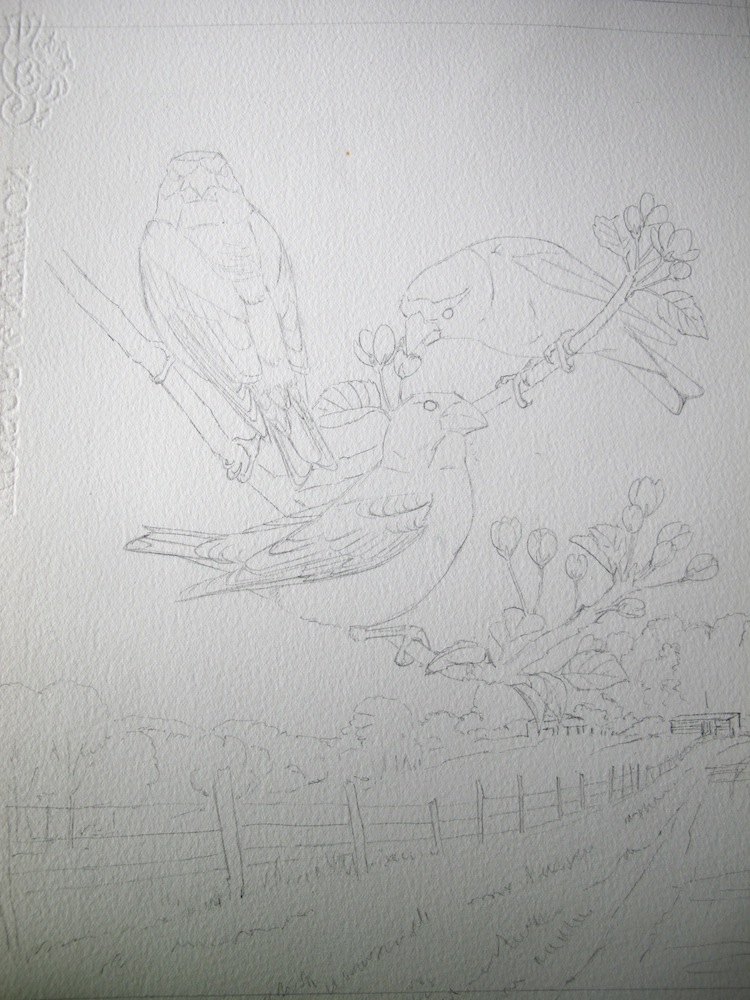
I’ve now traced the drawing onto the watercolor paper. You can see the watermark on the Winsor-Newton paper in the upper left corner. Everything’s on the paper now; all that remains is to take a deep breath and start masking the birds so I can paint a sky behind them.

[Back to Top]