Background Switcher (Hidden)

Showing posts with label Eastern phoebe. Show all posts

Easter Release!

Sunday, April 4, 2021

4 comments

 Three weeks is a long time in a human life. Imagine taking antibiotics for three weeks. After ten days, I'm ready to jump out of my skin. Now imagine being a very small bird, weighing less than half an ounce. You could mail two American goldfinches with one letter stamp. Well, as of this writing you could...

Some of these birds have been in this cage since March 4. Over the next four days I caught so darn many, snagging them off the tube feeders, that I just put that batch together in the largest cage I had (17 "x 20" x 25." The last one was caught March 8, so I had to hold the entire batch of six until that one was finished with its 21 day course of Tylan. 


Two large cages are sequestered in a quiet back bedroom that once belonged to Liam. When he came home this weekend I had to put him in a different room. He didn't complain--he was just glad to be home in a comfy bed, hanging with his mom and pet curdog, instead of his "cot" at college. And oh was it nice to see him for a few days! 


 This cage faces out onto the east hill, so the birds can see where they will fly soon. I keep the three sides facing into the room covered with a sheet. When the sun comes in I can spy on them. Keep your eye on the little female who starts the video popping up and down like popcorn on the left side of the cage. She then moves to pulling at a thread hanging from the cage cover. Oh, do these birds want OUT. 

And out they shall go. I wanted so badly to document it! I lay awake for several nights in the wee hours, trying to figure out how to execute both the release and a slow-motion video of it. I made a stiff cardboard false top for the cage and thought about pulling it off the cage with a string while manning the camera. Dumb, dumb, dumb, and I might inadvertantly injure a bird in doing it. Julie. You idiot. Just call Shila and ask her to make the dang video! I finally succeeded in fighting back Pioneer Woman long enough to make the call, and my faithful and talented photographer friend drove out to make this video. This is typical behavior for me, but it's exacerbated by long isolation.  I exhaust every possibility before I finally admit I need someone to help me. Shila is almost always that someone! I am so blessed to call her my friend.


Sharp observers will note that one goldfinch (probably the one who pulled threads and hopped up and down like a kindergartner) failed to leave. Never worry. She got out in the next wave.

Extra sharp observers will also note that I have gotten a MUCH needed haircut since this release video was made. If you thought you were reading a lifestyle and beauty blog, my presence in this video should serve to alert you that you're in the wrong place. In subsequent slo-mo release videos, I am going to endeavor to try not to look so much like I'm giving birth to a barnyard animal.

It feels SO GOOD to let these birds go. If this months-long ordeal has taught me anything, it's that I have less than zero desire to cage any bird, for one minute longer than I have to, in order to help it. 

And as I'm writing that sentence, an Eastern Phoebe lands on a low wall right in my sight. She flutters to the patio and looks hard at two twigs lying there. She's thinking about nesting! Two nights ago, a phoebe who might have been her spooked off the roost around 9:30 pm when I turned on the porch light to take Curtis out for his last wee. It blundered around the front stoop, bonking into the lit windows and hopping on the ground, until I caught it and brought it inside to spend a safe night in a Critter Keeper. Not going to let that precious bird fall prey to the screech-owl who leaves big white puddles on my front porch! 

The phoebe was not amused to be Gentle Cobra'ed and brought into the bright light of my kitchen. Please pardon my impudent digit; you can see more of the bird with that middle finger out of the way, and there's nothing I can do about it. Gotta love that rapidly snapping bill. I never knew phoebes did that. The two I hand-raised never had occasion to be that afraid or defensive. 

Cages have their place, and this spring they're all over my living space,  but my favorite thing to do with them is open the top and let that bird fly. Off it goes, into the sunrise!


 Remember Mr. Netinyahoo, the evil little goldfinch who evaded capture for days, then flew up to the clerestory windows in the living room? Here he is, feeling EVER so much better, on April 4. Still ornery though!

I can attest that he is fat as butter! Oh how I love to see them come back to life, and get sleek and fat again.

I caught him this morning to put him in the last cage, which will be released April 17. As of Easter Sunday, I am down to five birds in two cages, and after caring for 18, that feels like quite a load off my shoulders. 

I had better clear some bird care space, because the bluebirds are not wasting any time! Without any supplemental food at all, this little gal has five warm eggs as of the morning of April 3. Holy cow. In a hurry, she is! And that little phoebe I kept overnight? Already setting on eggs in a mud nest under the back deck. 


My, how Spring marches on. We have to just try to keep up, lurching along in her wake. 

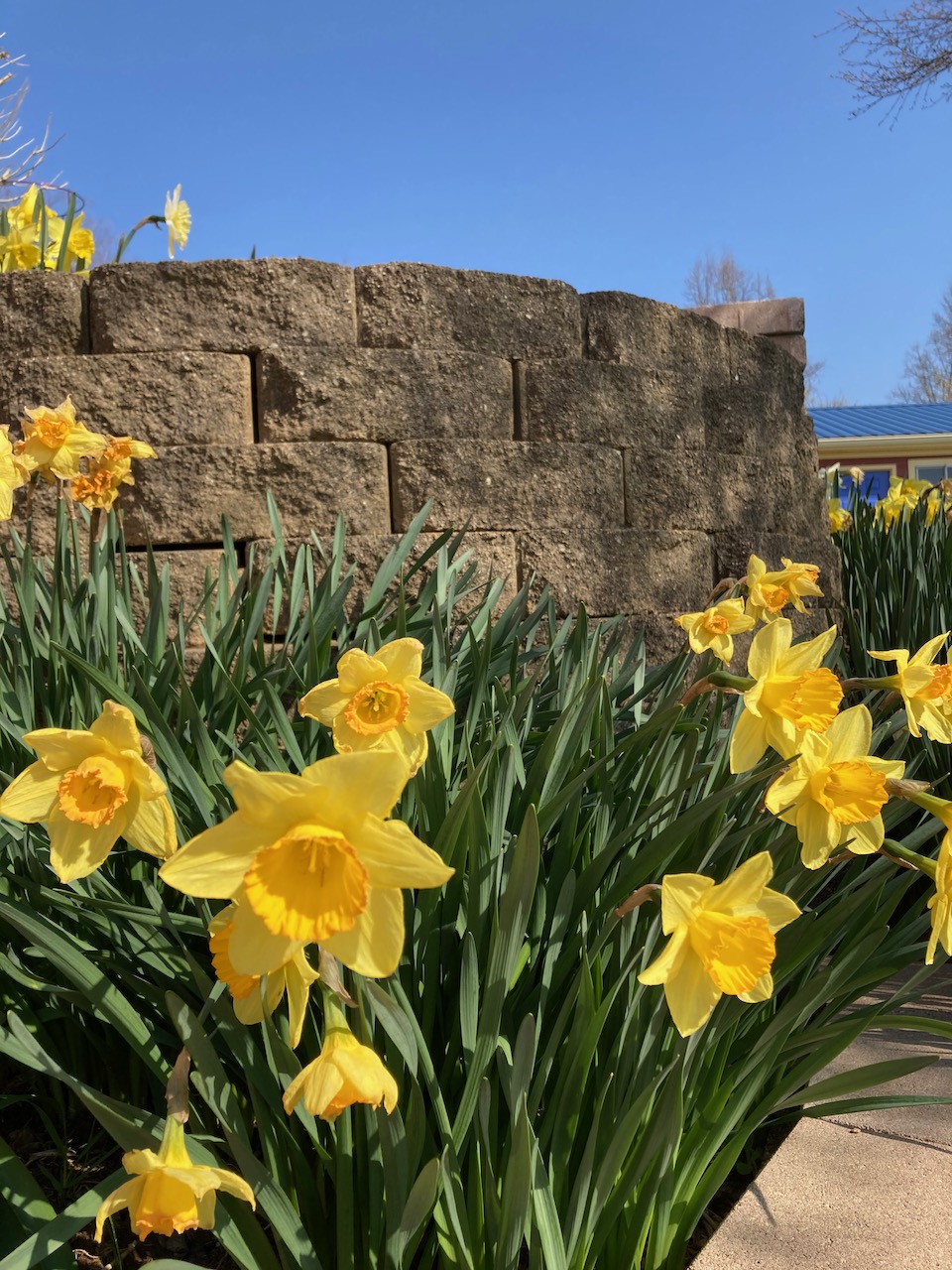
We had two nights in the lower 20's, April 2 and 3. I figured my daffodils, roses, lilacs, bluebells, daylilies were all toast. Still I covered and fussed. And all but the poor kiwi vine came through with flying colors--literally!


As is usual with Nature, the joke was on me. 


Happy Easter from my little family to yours. 


Looking Back on Fall

Friday, November 13, 2020

6 comments

Man, it was such a beautiful fall. In the midst of all the mishegas going on in this country, we here in Ohio had that, at least, and it was a lot. I look at these photos and can't believe the meadow ever looked like this. 
But it did, it did, and I was out there every morning I could be, photographing it and reveling in the million little cigarette lighters the goldenrods held up, saying Thank You Fall, We Loved It! Play One More!


I had an absolute blast with monarchs, watching them chomp six potted Asclepias, bringing them in so I could be there for their special moments. And there are so many special moments with monarchs. I have reams of them on video, and I must get to them. So when winter finally arrives, I will have a busy studio, humming with industry. I don't intend to twiddle my thumbs.


I wanted to show you a few of the birds who came across my little bit of Appalachian ridgetop this fall. There were so many bay-breasted warblers! You can tell them by their lead-colored legs and sweet open faces. Blackpolls have orangey feet and a more severe look about the eye.  

\
Same baybreast, preparing to go. 


Here's a blackpoll for comparison. If you click on the photo, you can see its orangey (not cool lead gray) feet. See the facial expression? Sort of calculating. Not as innocent as the baybreast, whose eyes are framed in pale crescents.


And there was a late flush of blue-headed vireos, and I don't think a BHVI is ever more beautiful than in fresh fall plumage. Look at that snowy white throat and breast! The shading of olive at the sides of its chest are just delicious. And those shining white spectacles. Hard to miss this bird, and it's quite vocal in fall as well, voicing a squeaky, chirrupy, slow, Cheree! Cheerio? Squee? 


They love willows, even our beat up old weeping willow. This one sidled down a willow whip almost to the ground.


Blackburnian warblers have the mostest eye stripes! This is a superciliary (over the eye) line. Look how long and pronounced it is--and orangey. Also note the pronounced back striping. The central pair down the middle of its back will be whitish on a Blackburnian.


It's pretty easy to identify the diminutive black-throated green warbler. Males keep a good bit of their coloration in fall. The stark black throat is overlain by white scaling, which is just fresh feather fringes. Those will wear off by spring.  The big golden head sides are a good tipoff for ths species.


The sycamores are almost done dropping their tremendous leaves now. Each one falls with a kind of slishy thud, which is pretty freaky to listen to in the dark. The sycamores, of course, don't care whether they drop them in daylight or dark. I like thinking of the leaves falling all night long. Some of these leaves are a good 10" across, making our sycamore a frustrating tree to bird in, until you see one calmly perched atop a leaf. Don't try that with a maple or a birch!


One of the most common fall migrants here is the Tennessee warbler, notable for its plainness. There are almost always traces of wingbars. Tennesses have short, sharp bills and a short-tailed cobby shape. They make constant lisping notes as they forage together, and when they take off they invariably drop a sweet shower of tsit notes as they go. Over the years and the annual waves of fall migrants, these little cues tell me what I have--I don't even need to see them to know they're around. 


White undertail coverts help separate the Tennessee from the similar looking orange-crowned warbler. Tennessees are whiter below than orange-crowned, and only rarely have any streaking on the breast. This is a Tennessee, taking off from a bath in the Bird Spa.


Finally, the waves of warblers and vireos were replaced by the hardier migrants. We had gobs of eastern Phoebes this fall, as well as a tolerable number of eastern wood-peewees. Listen for the phoebe's soft Chip! note and watch for its bobbing tail. Pewees are more elegant, keep their clothes cleaner, sit up straighter--phoebes who have been to charm school. 


Above: sludgy lil phoebe; below, natty lil peewee.


I love to see the field sparrows coming through. I know the juncos can't be far behind. 


Yellow-bellied sapsuckers had a good showing. Most of them are immatures, which makes for some very nondescript woodpeckers. But note the big longitudinal white wing panel. This is surprisingly easy to pick up at a distance, and when coupled with their swoopy flight style, usually ending as they stick a vertical landing on a tree trunk, you can amaze your friends with your long reach woodpecker ID's. I hope I get a peanut/suet freeloader again this winter. I love sapsuckers. They pound my birches to pieces, but that's OK with me!


So I passed an agreeable and lovely fall, walking the paths and watching the birds. Watching the meadow change every day was a thrill--waiting for them to throw the main power switch that would light up all the goldenrod at once. 


And the Maximilian sunflower glowed.


What's That Bird? Using Science to Decide

Friday, July 31, 2020

21 comments

Facebook groups. To me, they're like folk festivals: best when they're small. And then they get too big, really fast, and you suddenly realize you can no longer abide them. At least that's how it has always worked for me. There's this sort of tipping point where the people who have no idea what they're talking about (but are loud) outnumber the ones who do (who are quiet) and that's when I vamoose.

I think being in isolation for too long has made me peek in on Facebook groups lately. The ones having to do with natural history ID can frustrate me terribly, because you'll no sooner get somebody's critter identified than you'll be drowned out by ten people, all guessing away but sure they're right, some of them openly and none too politely shouting you down.  That's no milk snake! That's a TIMBER RATTLER!! And I'd wind up wondering why I'd bothered to help.  Who needs to put themselves in a situation like that?

But a funny thing has been happening. There are good people out there with cameras, taking interesting shots, and it's fun again for me, now that I know how to sidestep and laugh off the inevitable keyboard rage that happens in large Facebook groups. So when I stumbled on two photographs submitted by Kimberly Nancarrow to "What's This Bird?" (the American Birding Association's FABULOUS  bird ID page),  I sat up and took notice. Over 48,000 members strong, this page is a potent way to introduce people to the joys of bird identification.

Kimberly had photographed a mystery bird sitting on the back of a whitetail doe, and that got my attention. I love seeing birds and mammals interacting.


The pair was photographed in the middle of a soybean field in Altmont, Michigan, on July 27.

Though the photos were taken at a great distance, I knew immediately what the bird was. 
There was quite a bit of disagreement among the others commenting, and what was interesting to me
was thinking about how I had known what it was right off the bat. Why wasn't it so obvious to the others?

I started thinking about how I'd arrived at my ID. I decided to deconstruct my thought process and see if I could elucidate things. Because even though I knew it instantly, there had to be a series of clues I'd picked up on, and I wanted to know what they were.

 I didn't want to do that analysis on the Facebook page, because I was afraid my effort would go to waste. So I decided to do it here. 

There seemed to be two camps: Team Starling and Team Eastern Phoebe. I was firmly on Team Starling, and here's why.

The first has to do with phenology, my field experience, and situational awareness. It's late summer, the time of year when  starlings perch on large mammals. This I knew, from my photo salon in September 2019 with a little herd of Angus crosses and their starling attendants. 


You see, in late summer the face flies and deer flies build up to plague proportions, and the starlings are happy to get rid of some for the cattle. I wrote the behavior up for my True Nature column in Bird Watcher's Digest Jan/Feb 2020 issue. I called the piece "American Oxpeckers."


So that was the first tool in my belt that perhaps the Team Phoebe folks didn't possess: knowing that starlings sit and forage for flies on large animals. 

I realized from the start that the mystery bird was showing far too much leg, and too robust a set of legs, to be a phoebe. You just don't see, or perceive, flycatcher legs at a distance. I can immediately see a good pair of legs on this bird.  To my eye, it could only be a starling. 


I also perceived that it was much too large to be an eastern phoebe. But I needed to be able to prove that was true. There had to be a way. I wasn't sure how, but I dove in anyway.  First, I traced Kimberly's photo and measured the bird, then the doe's ear. They were almost exactly the same length!


Now I needed to know how big a doe's ear might be in real life. That way, I could extrapolate, and say how big the mystery bird was. How to do that?

I happen to have a number of deer skulls in my studio that I've picked up over the years. I grabbed the biggest doe skull, since the doe in Kimberly's photo looked like a full grown one to me. This is not a skinny yearling.

I traced the skull's outline, then fleshed it out a bit. 


Before adding the ear, I measured the length of my deer's head, then measured the head of the deer in Kimberly's photo.

The deer in the photo had a 41 mm. skull with a 30 mm. ear. My skull measured 305 mm long, so I set up a simple proportion to figure out how long its ear would be.

skull length in photo  41  = 305    skull length in my drawing
ear length in photo      30       x      ear length in my drawing


I multiplied 30 x 305, then divided by 41 to get X, the ear length in my drawing. X turned out to be 8.75"

So I added an 8.75" long ear to my sketch, done from the actual skull. Now I knew how long a real doe's ear is!


Now it was time to hit the books and see how long a phoebe is, relative to a starling. David Sibley says an eastern phoebe is 7" long. I noted with satisfaction how short and delicate its legs were in Sibley's painting.


Now for the starling. Oh, look! A starling is 8.5" long! Well, my my my. That's about the same length as a doe's ear! 


Boom. Between its robust, visible legs, its potbellied profile, and its size relative to the doe's ear, this bird can only be a European starling. 


The last cool thing I noticed was the fact that Kimberly's mystery bird was dark overall, with some pale areas around the face. That works for a juvenile starling in late July. Look at these September starlings--juveniles, with just a bit of pale juvenal plumage around the head. 


Meanwhile, back in the group discussion, there were people on Team Starling flatly stating that phoebes don't sit on animals. Well, I have been studying phoebes for years, and have even raised two from babies, and I've never seen them sit on animals.  But I would never flatly state that they never do it. How would anyone know that? It's so important to be kind. It's even more important to avoid asserting something you don't know to be a fact from direct experience or solid research.

Moderator Tim Kalbach (Team Starling, but stirring the pot) contributed this photo by Chuck Holliday, taken July 22, 2019 and found on Flickr:


It's an eastern phoebe sitting on a whitetail, catching deerflies. Cool!!

I love it!! Humans can always be wrong. Birds and animals, not so much. Animals have no egos to get in the way of their truth.


 Look how much bigger the bird below appears relative to the deer, than the phoebe above. Look, too, at how you can see the thighs and legs on the starling below, but not on the phoebe, above. You can barely perceive the phoebe's legs at all, because they're so fine and short. The phoebe's belly practically contacts the deer's rump. And the contrast between dark upperparts and pale underparts is obvious on the phoebe, but totally lacking on the starling. So there's that...


I've had lots of fun proving the veracity of my ID, even if it was only for myself. Perhaps this torrent of fact-based information has won over some Team Phoebe folks, but I don't really mind either way. I like to base my ID's on facts, not opinion. I love to dive inside and see the deductive reasoning contained in a split-second judgement of bird identification. Walking through the facts here seemed like a tiny strike for the scientific process. I look forward to the day that science and fact-based reasoning re-ascend the pedestal.


I'm going to try to make sure I enjoy belonging to social media groups going forward--dip in and out, grab a fly here and there, help when I can, learn something new whenever possible, and fly off when I can't. I wish the same for you.

Thanks to the American Birding Association, page moderater Tim Kalbach, and especially to photographer/birder Kimberly Nancarrow for permitting the use of her photos. Bird on! and keep your eyes open and your camera ready.


Baby Season

Friday, June 22, 2018

2 comments
Carolina chickadees, thinking I'm Mom. 


 Can it really be more than two weeks since I've posted? That's June for you, when both kids are home for the whole summer (I'm still dazed at this) and I'm conscious of treasuring every minute in their presence, because what else is there to do that is as important as that? Well, I had a big drive to Chicago in there, too, and a bunch of talks to give, but now I finally, finally get to stay home for a little while. Well, there's a wedding coming up on the East coast...but I still have a week here!!

There's also been the little side job of getting Liam ready for college, going through all the forms and financial aid and work study job applications and promissory notes and rooming assignments and buying extra long twin bedding and field trips and orientation...gaaaack it's like a part-time job. I don't remember anything like this with Phoebe. At all. Maybe because she just handled it herself. Or in part because Bowdoin didn't have an orientation, at least not one we could attend. Anyway. It's hectic as all get out. And he leaves for good on AUGUST 11. HOW IS THAT POSSIBLE OR HUMANE?? So if you don't hear much from me in the next couple of months, it's because I'm too busy loving him up. And if you don't hear much after that, well, assume the worst. Ha ha. Ugh. Not looking forward to rattling around in this too-big house by myself. Good thing Phoebe will be home another couple of weeks after that. Lord. From feast to famine, it'll be. I have a good project, at least, and I'll be deep deep into it then.

I've finally broken through the barrier and switched gears from finishing the writing to doing the illustrations for Saving Jemima. I think, no, I know it gets harder to do that with every book. I grind my gears for weeks, putting off the inevitable. I love to write. I could write hanging upside down by one toe from a forklift, if I could get the pen to work. But I have a really hard time getting started with painting.  Every time I sit down in front of a blank sheet, I'm afraid I've lost it. Which, of course, I haven't, but try telling my psyche that when I'm frozen up and looking for anything to do but paint.

 I literally got to the point where I couldn't write any more. The story was finished. I had cobbled a fairly satisfying ending out of a story that didn't have a satisfying end. She was here for eight months, and then she wasn't. Rats. OK then, let's recap. What did we learn here? That's the solution I came up with. And I learned a lot from that experience, from that bird. The ending works, I think.

 So I selected a ton of photos for each of 20 chapters, and decided what I should illustrate,  mostly things that can't be photographed. Every morning when I open my laptop it's like "Get Smart," where The Chief tells Maxwell Smart: "Your mission, if you choose to accept it, is..." except that I don't have a phone in my shoe (it's in my pocket!) and I certainly don't have an Agent 99 to help. All I have is me and my watercolors. And that's fine. I love getting the assignment each day. I've got this.

One thing that really helped was teaching a two-day sketching and painting workshop at the Morton Arboretum in Chicago. 

I'd love to post some illustrations but that would ruin the surprises for the book. I'm painting on scraps of very old Fabriano cold press watercolor paper, which I'm sure is a lot better than new Fabriano paper, and loving it so much. Soon I'll run out of that and have to rummage around in the flat file for more scraps. It's not a very big book, so I can paint these things fairly small. It'll be OK.

I have some photos from the last couple of weeks that I like, so I'll share them here, in this disjointed halooo from the Land of Book and Kids and Flowers and Rabbits and Chipmunks.

An extremely rare photograph of a Carolina chickadee sheltering its nestlings. Even got a little catchlight in its eye, practically impossible to do with chickadees. They're skittish, and inclined to come out of the nest box hole like an arrow aimed right at your eye. Staying put is not something they are good at. I had my iPhone camera on and ready when I took the box down to peek inside.

On my run a couple weeks ago, the same one where I saved the snapping turtle, there was a little thank-you present waiting in a little shed not far from the Three Graces--an active phoebe nest on a light fixture, and the light coming through the machine shed siding.  Oh, I like this picture. I could tell by the way the phoebe mom was acting that she had new babies in there. I got my photo and got gone. Looks like years of phoebes in that mud and moss tower.


The chicory was just coming out, and you know how I love chicory. 


One of my continuing frustrations is being unable to shoot The Three Graces in the morning. They're backlit and it just doesn't work. But here they are in full summer dress, in the morning.


Daisies do a lot better backlit. 

A moment when the sun came out for maybe six minutes and I ran around like Daffy Duck taking shots. 

I appreciate cattle. This heifer is absolutely lovely. She's got that deep deep mahogany red coloration I like.


Never mind the dirty bum and the poop bindhi on her forehead. She's still a looker, and she made me laugh too.


The Shadow Barn, from another angle. I'm worried about it. Pieces of siding keep falling off. Dang it.  But there's an orchard oriole nest in that beautiful oak, just like there was the last two years running.


Here's a little video of my first fawn of June with its mama.  You might need to full-screen it to see the fawn, which is barely more than a wake ripple behind the big doe.


And some of the sweetest music I know--begging eastern bluebirds. Yes, I'm speaking bluebird to them. One of my parlor tricks, learned of necessity as a rehabilitator. It's so much easier to whisper to them, and ask them to open up, than to force-feed them. Everybody's happier, and everybody eats.


 And in the perfect metaphor for how time and birds fly in June, here is the same brood recently, at Day 14. This photo taken with my "magic eye," held up to the box hole. I wrote the book, and the change in these birds in two weeks never ceases to amaze me. Time and bluebirds wait for no one.


My Garden Fantasy

Tuesday, June 23, 2009

11 comments
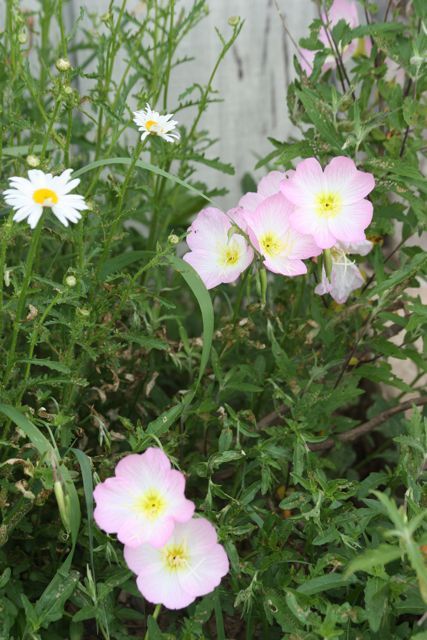
Native Missouri primrose, Oenothera spectabilis, in bloom by our garage. Keeping good company with a European field daisy.

A wee garden tour for you.

Every year there is a garden tour in Marietta, Ohio, the town nearest us. Well, it's still about 20 miles away. And the Marietta garden tour is one of my favorite events of the year, because the kids and I get to walk through other people's backyards and see what they think is pretty. It's kind of like watching "Cops," where you get to go inside those houses that you might only drive by with a little shudder. Well, it's actually nothing like watching "Cops," but I think you know what I mean. You get to poke around, to snoop, to see what other people do and think and plant.

I have always wanted to be on the Marietta garden tour, to open my gardens to viewing. But since hundreds and hundreds of people visit the gardens, they would have to have a set of chartered buses or the world's most bodacious carpool to get them the twenty miles out here from town. So it's never going to happen, but I always go on the tour and wish. I could give a good garden tour.

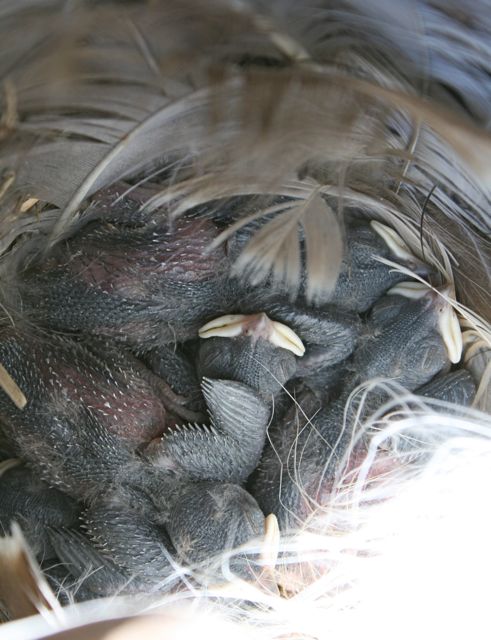
I could show everyone such a good time. I'd open my tree swallow box and voila! there would be sweetly smiling rubber swallow babies cuddled down amidst the feathers.


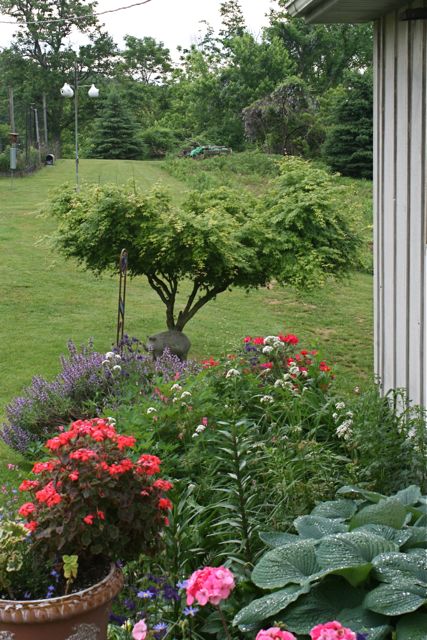
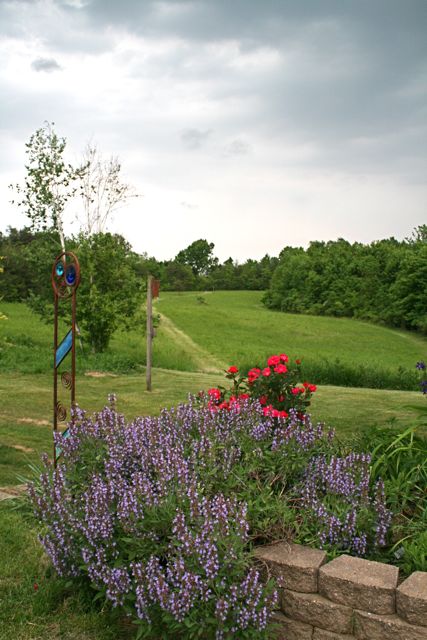
We'd take in the view of the north shade bed along the front of the house


and admire the aptly-named Salvia superba, the culinary sage plant I grew from a seed many years ago. Put a few of those leaves in butter and throw some portobella ravioli in that butter and you have something, ma'am. And I use the leaves year-round, fresh from the plant.


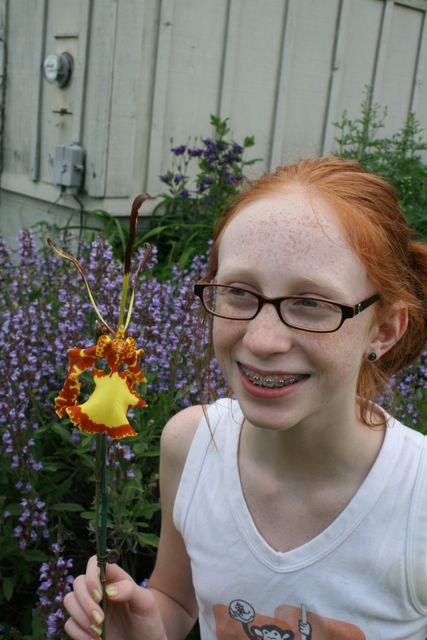
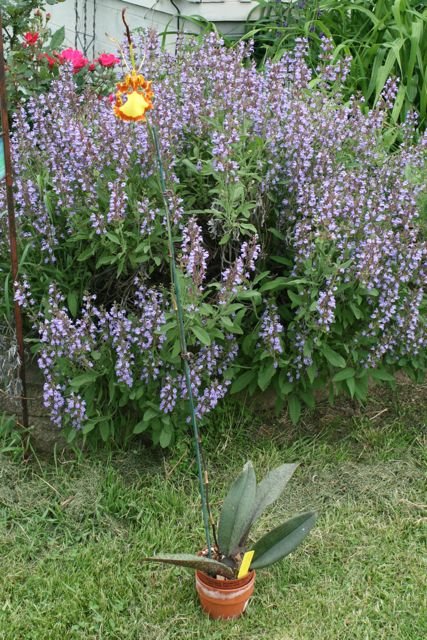
I'd have my assistant, Phoebe, go in the house and fetch the blooming Psychopsis mendenhall "Hildos."


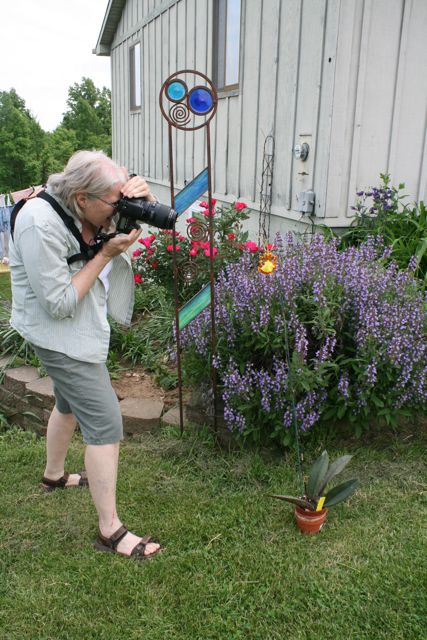
We'd set it up in front of the blooming sage plant, just for color overkill.


Everyone would gasp and want to photograph this chest-high wonder.


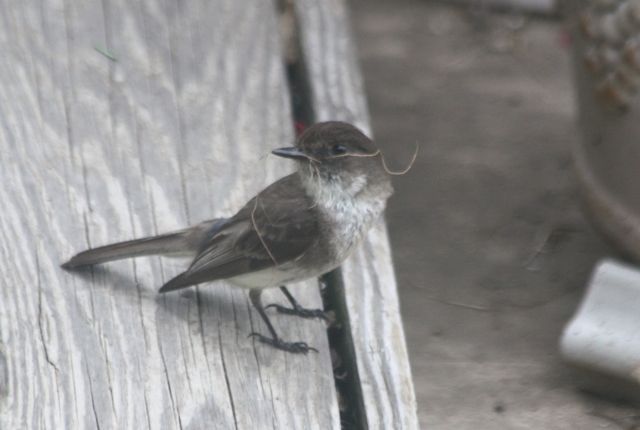
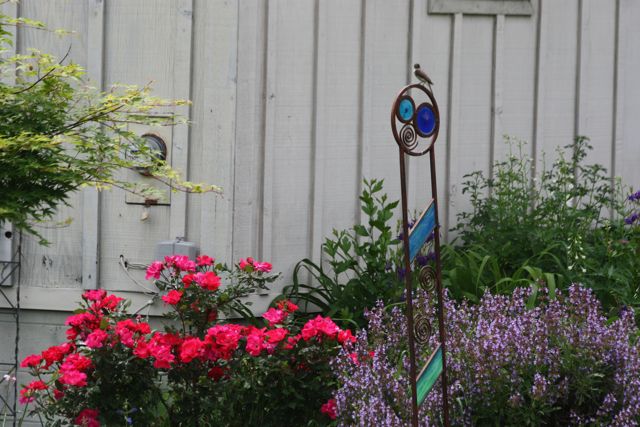
The eastern phoebe would tear some fibers from the cocoa mat planters, and pause on her way to the nest on our special shelf, put up just for her.

Then she'd fetch up on the Garden Forge ornament, while the Knockout rose bloomed and bloomed. Gasp!


And that's just the front bed. Mmmm. Such a sweet dream. I guess I'll have to share it with you all instead. Come to think of it, that's way better than having to weed my fingers to the nubs and clean the house and try to get the dirt out from under my nails in time for the first busload to roll up. Virtual garden tour!
[Back to Top]