Showing posts with label evening grosbeak. Show all posts
Meanwhile, at Home...
Readers will no doubt wonder what was happening with Chet Baker while we were away. Well, Chet was taken in by Michelle, who works at Bird Watcher's Digest, and her husband Ryan. Michelle is a consumer of Chet Baker's Facebook posts and already had some idea what she was in for by taking him home. She actually offered!
This is the first photo Michelle texted to me, of Chet checking out his new digs. Something in his eyes made me cry. Going for a week without my doggeh does that anyway. But I knew he was going to do fine.
Chet posted:
I knew it was coming.
Mether took me to Daddeh's office and left me with Miss Michelle who loves me.
I love her, too. Mether told me I would stay with Miss Michelle. I jumped up on
her lap and stayed there when Mether turned around and left. Miss Michelle just
sent this picture to Mether. I know it will make her cry but I am fine and
enjoying my little vacation. I will go into the Bird Watcher's Digest office
every weekday with Miss Michelle and see lots of friends and even my Aunt Pokey
Springer there. I will be fine.
And he was fine. He adopted Ryan as his very own and made Ryan tickle him all the time. The first night, he slept in his own bed, and after that he crawled under the kivers with his hosts.
There is something in his eyes that tells me he knows everything. He knows his picture is being taken; he probably knows it's going to be sent to me, and he sends me a message with his eyes. "I am a little sad, but I am happy, too. I miss you but I like it here. Just do what you have to do and come get me as soon as you get back."
Cryptic coloration in a resting Boston terrier.
Michelle wants to know why Chet always sleeps butt to head. I wish I knew the answer. But he does. She said he ate all his dinner after the first night of fasting. She said he loved his walks and loved to tear up junk mail and cardboard. She said he wouldn't poop in their neat yard but asked to be taken down the street to the woods. These are all things I already knew, but it was sweet to hear.
She also said he emanates a lot. Mmm-hmmm. See sleeping arrangement, above. Phew.
Despite this, Michelle reported that, although she and Ryan are dying to get a dog, they are now worried that any dog they get won't measure up to Chet Baker. "He's just so good." Words to make Mether's heart glow. I assured her that no matter what kind of dog they end up with, they will love it unreservedly. But did acknowledge that he is a very, very good dog.
While we were enjoying Texas sunshine, a mourning cloak tried to hibernate on the windowsill amongst my orchids. I don't know how it got there, but when I found it it played dead.
This butterfly overwinters as an adult, wedging itself into bark crevices. I was fascinated by its fur coat. You see that in moths, but not many butterflies. Butterfly fur. Now you've seen it.
It takes two million of them to make a decent coat, though. Tedious.
Bird Watcher's Digest's Managing Editor Kyle Carlson, an avid birder who's working on a stupendous Washington County year list, came out a couple of times to fill our feeders. On November 14, I walked into the studio and saw this:
which purely stopped my heart. Five evening grosbeaks decorated the mulberry by the feeder.
They ate for about five minutes, whirled off to the north and that's all she wrote. Sigh. I would so love to host them for more than a moment. It's an irruption year for winter finches, and I can only hope that the snows of January bring them back. Even with sunflower seed going for $26.99 for 40 lb. Ouch. I attribute this rare sighting to Kyle's provisioning. I only wish he'd seen them. He needs that bird for his list!
Another rarity in the mulberry: a brown creeper! The only North American representative of the Old World Certhiidae, this gorgeous little fairy hitches in a spiral twist up the trunk of a tree, flies down to the base of the next tree, and does it all over again. It's got a strong, spiny rachis on the two central tail feathers, and delicate translucent toenails like grappling hooks. A slender decurved bill works like a forceps to extract dormant insects and larvae from bark crevices. I found myself wondering what it might do with a mourning cloak...
I would eat it. And then it wouldn't have to play dead.
|
Widget for blogger by Way2Blogging | Via Spice Up Your Blog Gadgets
|
Grosbeaks: A Remembrance
Sunday, August 12, 2012
12 commentsThat winter was snowy for Richmond, Virginia. Big blankets of heavy wet snow made a mess of the streets and the southern drivers, not to mention their cars. I loved nothing more than awakening on a school day to see that special snow light peeping under the shade, the white, pure light that sets a child's heart singing with the hope of sledding instead of homework.
On one such morning, I tore downstairs to find my mother and father craning their necks out the kitchen window at a flock of strange birds in our sweet gum tree. They were mustard yellow, black and white, though some were gray, with pied wings. A ringing cleer! call punched the stillness and snow quiet. Several sat on the simple table feeder that my father had welded from a pipe and a steel plate. They had already cleaned up the sunflower seed there and seemed to be looking for more. "Giant goldfinches!" I yelled as I ran for my well-worn National Geographic Song and Garden Birds of North America.
They were evening grosbeaks, of course, and there were sixty of them, a flock such as I've never had since at any feeder. They showed up around Christmas and stayed into spring. We began buying striped sunflower seed in fifty-pound bags. This was a pretty extravagant purchase in 1967. I got up early every morning to put seed out for the flock, which my father referred to as "Julie's chickens." We loved to watch them squabble over the food, and we loved the way they looked, hanging in the trees like big ornaments. At about the same time, my father, who always spent his free time in his basement workshop, became secretive and wouldn't let me watch him work as he always had. I suspected he was making something for me.
On Christmas morning, I awoke to the familiar sound of grosbeaks fighting and feeding, but it was unusually loud. On the dining room windowsill was a feeder, the grandest one ever made, with a long dowel perch and a Plexiglas top to keep the seed dry, with drainage holes and a new coat of gray paint. It was three feet long, and the grosbeaks crammed into it by the dozen to wade in sunflower seeds. It was my Christmas present, and I can't remember one before or since that has thrilled me as much--not a bicycle or a guitar, a book or a trip.
My father was to make many more feeders, always from found materials--hubcaps and plastic pipes, odds and ends from the warehouse of the pipeline company where he worked. The most elegant piece he produced was a birdbath constructed of a steel pipe welded to an old harrowing disc. Its edges are gently scalloped from wear, and the iron is pitted from decades of immersion. It is the perfect depth for a goldfinch to wade into, the perfect width for a whole family of bluebirds to share. Dad painted it a creamy white to look like a destroying angel mushroom, and it does. He showed me how to scrub it out with a lump of sod, soil still attached, scouring away the brown algae. "Dirt cleans pretty well," he used to say. Your mother wouldn't agree, but it does." (He pronounced it "mither.")
The windowsill feeder finally rotted apart in 1991, and my father died in 1994. When we cleaned out the big house, I got a checkerboard he'd made, a table he'd constructed from an iron sewing machine stand and a plank of fine cherry, an ancient Scots rocker he'd refinished, and the destroying angel mushroom birdbath. It stands in my front yard, surrounded by rhubarb and flowers, and I still clean it with a lump of sod.
I have a picture of my dad sitting with me on the living room carpet, looking through a great sheaf of Audubon prints he'd gotten for me. He's in an old short-sleeved shirt, the front smeared with grease and oil, varnish and paint from his projects. I'm in heavy black Buddy holly glasses and short hair, a good look for a hardened tomboy. It's the only picture I have of just us two together, but it speaks volumes about our relationship. Youngest of the five children, I latched onto my dad the hardest, followed him around the yard as he gardened, learning his craft seed by seed, weed by weed. I feigned an interest in antique gasoline engines because he would take me out with him, looking for them on long drives through the Virginia countryside. Where there were iron wheels peeking from the weeds, there were bound to be birds, and I wore his old German binoculars' pebbled finish smooth watching them. We became good at evaluating tumbledown sheds for both their machinery and their barn swallow potential.
My sweet nieces Courtney and Christy got to know their granddad.
I am writing this (October 1996) with my three-month old daughter lounging on a pillow on my lap, her legs hanging off one side as she nurses. She will never know her grandfather, never feel him squeeze her foot, hear him say, "This baby likes to have her foot squeezed," something he claimed about every baby. He had a soft spot for little girls, as he had for me. I realize only now, on becoming a parent, that all the things a child becomes are outgrowths of who her parents are and what they do. I am grateful for all the things he was--farmer, gardener, bird watcher, handyman, teacher, inventor, teller of stories.
This post is in honor of my DOD, obviously. And to mark the American Birding Association's celebration of its Bird of the Year. Art by JZ.
|
Widget for blogger by Way2Blogging | Via Spice Up Your Blog Gadgets
|
Labels:
ABA Bird of the Year,
evening grosbeak,
my dad
ABA Bird of the Year, Part Five--Finis!
Tuesday, April 3, 2012
6 commentsSee why I was so excited to paint the male evening grosbeaks?
Here are their ghosts...
By now you’ve gathered that most of the work of doing a bird painting, at least for me, is putting the bird in a believable setting. For me, painting the birds themselves is dessert, because it’s effortless and fun. Well, I shouldn’t say it’s effortless, because male evening grosbeaks are tricky to paint. I’m really excited to move on to the males, knowing what impact their colors will have on the whole piece.
The key to painting male evening grosbeaks is laying down a bright yellow underpainting and letting it dry completely. When I then stroke burnt umber over top of the dry underpainting, the yellow shines through. The final effect should conjure a good golden-brown honey mustard, with touches of pure hotdog-ready French’s on the coronet, rump and flanks. Mixing the two colors would give mud, which I don’t want; I want an overlay of burnt umber and sepia with glimmers of yellow shining through, because that’s what I see in the plumage of the study skins I’m working from.
Here, in the upper left corner, is the male I thought would work for the “iconic bird of the year,” but the general consensus at ABA HQ was that the pose was a bit odd. In the end, the pose was deemed too outré for use on a sticker or patch, so I drew another male (also from the same batch of life sketches) in a more typical and easily interpreted pose for this application.
That’s OK. I’m used to having my better ideas not work out in the end. Like having a flock on the cover…
I'm always saving something back for dessert. In this case it's the pink apple blossoms.
The painting's almost done, with pink apple blossoms painted in. I’ve done a bit of glazing of Chinese white on the birds to give their plumage a sheen, and shadowed the whites in their wings as well. They’re eating apple blossoms, something grosbeaks like to do in spring.
Stay tuned for information on purchasing this painting! No fooling! Proceeds go to evening grosbeak conservation.
|
Widget for blogger by Way2Blogging | Via Spice Up Your Blog Gadgets
|
ABA Bird of the Year, Part Four
Thursday, March 29, 2012
3 commentsWe're still working on the Birding cover for ABA's Bird of the Year issue. Evening grosbeaks! This one, female.
I lay in the basic washes on the female bird first. I’ve been waiting for this moment, to see how her colors bounce off the colors in the road.
She looks flat here because I haven’t modeled her shape or shaded the underside. I just want to get her colors laid in first.
With a little shading, she looks much rounder. I’ll work on her more, but for now I decide to work on the landscape a bit more, now that I have her to tie it into the painting. I darken those stripey violet shadows coming across the road and the grass. They’ll give the sense of dappled sunlight, which I think is already coming across pretty well. The darker the shadows, the brighter the apparent light source. And violet shadows evoke reflected skylight and mix wonderfully with greens, which is more than you can say for a lot of colors. Cobalt Violet and Cobalt Blue are my two main shadow colors.
What I can say at the end of the third day of working on this is that all the planning and masking were worth it. The painting part is sheer joy. I love the way the female works with the dirt road in the landscape. Best part is yet to come: Painting the boys!!
|
Widget for blogger by Way2Blogging | Via Spice Up Your Blog Gadgets
|
ABA Bird of the Year: Part Three
Tuesday, March 27, 2012
13 comments
We're continuing to work on the cover for Birding Magazine, of the American Birding Association's Bird of the Year, the evening grosbeak.
You’ll notice the light regime changes in my progress photos. Normally I trot outside to shoot them, but sometimes I reach a key passage in a painting when it’s dark outside. So for some photos, I had to use incandescent light rather than the clean north light that usually floods my studio. This is a work-in-progress, and progress isn’t always as well-lit as we’d like.
The apple tree leaning over the road is a bit of a stretch, I know. I wanted to give the viewer the experience of pretending they are birding and seeing such a wonderful sight, so it was important to me to have a road in the painting, a place for the viewer to stand. A road stretching away gives the viewer a distance to walk into, so I stretched the truth a bit. Let’s just say it’s an apple tree that’s leaning so far over the fence it’s probably about to fall into the road and not worry about it, OK? It’s an imaginary apple tree, anyway. It won’t even break the fence when it falls.
This photo was taken by daylight—what a difference in color temperature! I like the way the sky turned out, especially near the lower left horizon. It feels springy to me. I’ve rubbed away the Incredible White masking compound with my finger and peeled off the masking film to reveal clean paper. I’ve had lots of fun with this painting until now, and it’ll only get better.
What fun I had laying in the brilliant spring greens of the landscape! I went ahead and painted right over the fenceposts because they would be so much darker than the grass. I could paint them over it without a problem. My secret plan for the road was to tie its color into the colors in the plumage of the female grosbeak. She being nearest to the ground, I think it’ll work well.
I start by painting the branches, and then I paint the birds’ feet and flower petioles all in one go, since they’re almost the same color. I like the way the foreground is starting to work with the background. The little buildings ground the whole composition, as do the fenceposts; they define the plane of the road and give the eye somewhere to go. I’m SO excited to paint the flowers and birds, and especially to lay in the sharp blacks of the wings, and the brilliant yellows in the birds’ plumage.
I paint those glow-in-the-dark green bills next, and for efficiency’s sake, I do them all at once. Once I’ve mixed the color, why recreate it for each bird?
|
Widget for blogger by Way2Blogging | Via Spice Up Your Blog Gadgets
|
ABA Bird of the Year, Painting Part Two
Sunday, March 25, 2012
2 commentsHere’s what I use for masking out areas I don’t yet want to paint. Frisket Film is a transparent plastic film with low-tack adhesive on back that sticks to the watercolor paper. The artist cuts it in the desired shape with a small X-acto knife, then places it over the area to be masked. Masking the birds was a bit of an adventure. I cut one big piece of masking film by Frisket, and applied it to the paper. Frisket doesn’t much like to stick to the irregular surface of cold press watercolor paper, and that’s a big problem, because it’ll let paint creep under and ruin your nice white space for the birds and flowers. So I engineered the leaves and buds so they intersected the birds fairly smoothly and made one nice big area, and cut the shape a little smaller than needed. Then I ran around the outside of the big, irregular shape with liquid masking compound (I use Incredible White Mask) which has the consistency of thick whipping cream, but dries to a clear, rubber-cement like finish. This effectively seals the edges of the Frisket film and prevents the wash from creeping under it.
The masking compound, after it dries, can be rolled off with the finger or an eraser when you’re ready to remove it. In this case, it did a lovely job of sealing the edges. My results vary widely, and sometimes paint creeps under my mask no matter what I do. This time, I lucked out and got to skip the step where I peel off the masking film and spend a half-hour scrubbing out all the places where the wash seeped under it.
Time to paint the sky!
ABA President Jeff Gordon had requested a spring scene, something other than the typical snow scene most people are used to seeing. I wanted an active sky, a spring sky, a sky that could change and get overcast in a few minutes, so I used lively brushwork on paper that had been dampened by a fine mist from my trusty spray bottle. I didn’t worry about getting it all perfectly even. The sky outside the day I painted this was similar, so I just looked at the random cloud shapes and didn’t worry about where they were as I painted; I just laid them in as it felt right. I did a little scrubbing and lifting of the blue wash to better define the clouds, but I really didn’t want them to compete with the birds, so I kept them pretty filmy. Once a wash like this dries you can’t go back into it and work on it much, so when it was done it was done.
One thing I remember about EVGR is that they always seemed to stay so late in the spring that you started to hope they were going to breed. I remember seeing them in flowering trees in W. MA and even hearing them singing! So I decided to put them in a full-on early May scene, with the trees all leafing out and the grass already getting high along the fencerow. It could be anywhere where EVGR breed—Vermont or Maine, but it’s a scene from not far from where I live in SE Ohio, on Tick Ridge. Painting as I was in late January, I can’t tell you how wonderful it was to waller around in springtime for the time it took to paint this. I could feel the tall grass and the warm breeze and smell the unfolding leaves, that green smell when the sun hits everything.
|
Widget for blogger by Way2Blogging | Via Spice Up Your Blog Gadgets
|
ABA's Bird of the Year, as Rendered by Zick.
Thursday, March 22, 2012
7 commentsIt’s an honor to be asked to paint The American Birding Association’s Bird of the Year. It’s a special thrill when the B.O.Y. turns out to be a bird I adore, a bird that’s part of my personal history, dating back to my childhood in Virginia, an unprecendented and never again repeated invasion of the birds in the mid 1970’s, and the first and most fabulous feeder my father ever built for me.
The Bird of the Year is chosen carefully. Most of all, it’s spotlighted for conservation reasons. Evening grosbeaks are declining overall, and we’re not really sure why. Research is needed. Many yearn to see this bird, but fewer and fewer do. In southeast Ohio, it’s been almost twenty years since an evening grosbeak has so much as lit at our feeding station. If any species deserves the limelight right now, the evening grosbeak does. See ABA’s special page devoted to the program, which we hope will result in greater attention to its decline and research as to its causes and, we hope, eventual arrest.
Part of the push is the sticker/badge you see above, and part is a cover for Birding that features the chosen species. I was asked to do both.
My first, and most grandiose idea for this magazine cover was a flock of evening grosbeaks in flight. Color, motion, forward movement for the ABA…it was all so appealing. I was soon to bump up against the hard reality that a flock of birds doesn’t work very well on a vertical magazine cover. To make a flock, it takes more than three or four birds; it takes a village of birds. After a couple of days of drawing, I just couldn’t get around the reality that each bird would have to be less than an inch long to get a decent number of them all on the page. I am too old to paint inch-long birds. Just getting all their eyes in the right place would be an enormous challenge at that scale, not to mention all those tiny flight feathers.
The magazine cover’s vertical format means that in order to get more than one or two on the page, you have to stack the birds one atop the other. I considered asking editor Ted Floyd to print just this one issue of Birding sideways, so I’d have more space to play with. Shouldn’t be that big a deal to reformat the whole magazine and staple the short side, right? The proposal died aborning. I kept struggling with the vertical flock.
I worked on that for two and a half days and threw in the towel. Then I tried just a few birds. But still they were small, small, small, and I didn’t want to paint small. I wanted big fat juicy birds that you could caress with your eyes. Birds with structure, birds with volume. Grosbeaks are neat chunks of mustard and butter, hearty well-built streamlined units. I decided to perch them and heaved a sigh of relief as I put my flying grosbeak drawings in a drawer for later.
I went into my old sketchbooks from the last time we had evening grosbeaks at the feeders in the early 1990’s. I was so glad to find some lively sketches, which brought the living birds right back for me.
I knew I wanted a nice male to be the “totem” Bird of the Year, just for color and graphic appeal. And I decided to be a little bold with the pose—looking head on at you over his shoulder, which would show the nice white wing patches, the bright yellow rump and coronet, and the massive bill. I hoped it would work. I didn’t want it to be boring, and the best way I know to avoid boring is to go right to the living bird.
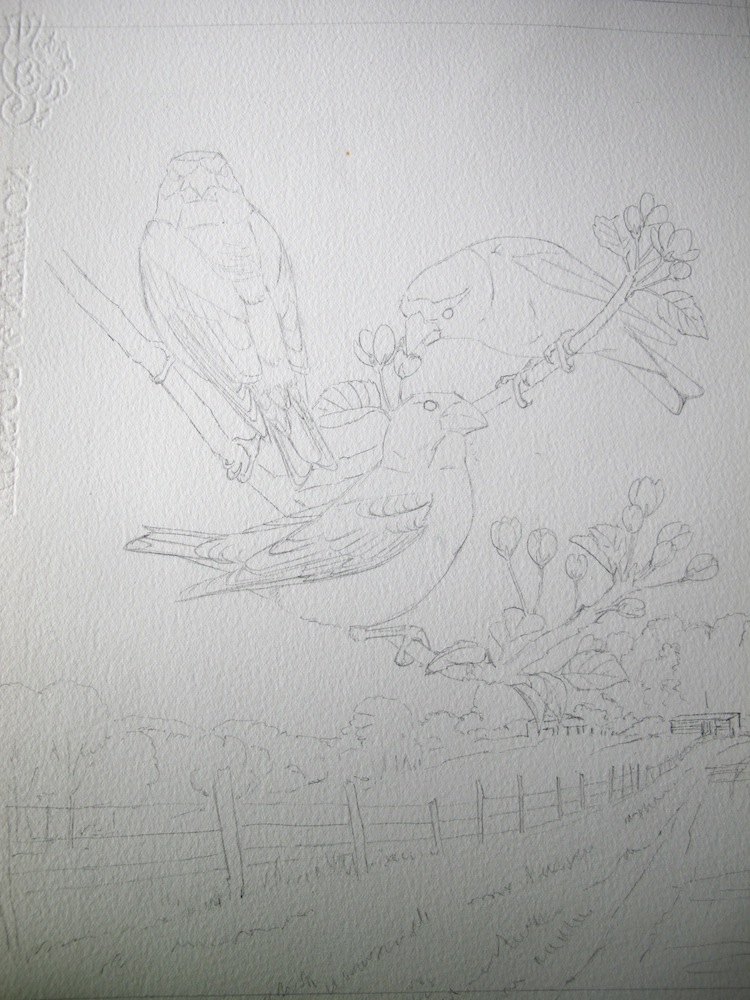
Here’s the final drawing, transferred to tracing paper, then to be transferred onto watercolor paper. I do this by taping the drawing made on tracing paper to the back of the watercolor paper and putting the whole affair on a light box. You can also tape it to a window—the poor artist’s lightbox. It’ll give you the same effect, which is a strongly backlit setup so you can see to trace, but it’s a bit harder to draw vertically!
I’ve now traced the drawing onto the watercolor paper. You can see the watermark on the Winsor-Newton paper in the upper left corner. Everything’s on the paper now; all that remains is to take a deep breath and start masking the birds so I can paint a sky behind them.
|
Widget for blogger by Way2Blogging | Via Spice Up Your Blog Gadgets
|


Sunday, December 9, 2012
4 comments