Background Switcher (Hidden)

Showing posts with label jabiru. Show all posts

Dog and Bird Spotting at Hacienda Solimar, Costa Rica

Thursday, March 10, 2016

4 comments

I am happy to report that, after 8 days away, my laptop has been returned by the excellent gentlemen of Elan Technologies, fitted with a new top case, keyboard, trackpad, and battery. No more will its swollen and aging battery impede progress on all fronts. Back in the blogging saddle! I took this time to write thank-you notes, 27 of them, to people who helped me with Baby Birds. It was like doing Christmas cards, and hand-writing a different letter to each recipient. Being that nice for five days was exhausting. :) I want to thank you all for the vote of confidence on old-fashioned prose posts, though; my photo-free post "Becalmed" has done better than most of my glitzier photo posts. Huh.

On Day 4 of our Costa Rica expedition, we made a lunchtime stop at Hacienda Solimar, a working cattle ranch of epic propotions in the Guanacaste region of the northwest Pacific coast. On this enormous ranch, beautiful Brahma cattle are bred and raised, mostly for breeding stock.
They are definitely a cut above the usual, even to my untrained eye.  I'm guessing the red X's on these cows indicate they've been bred.


On this day, the cowboys were separating calves from moms, and there was a lot of bellering going on, and dust rising in the air.


They use horses for much of the cattle cutting, but there were also some fancy four-wheelers in the garage. I spotted a very cute doggie resting in the shade. She had the nicest smile!


And then, feeling a little self-conscious, she yawned, and displayed perhaps the longest tongue I've ever seen on a dog.  


Just down the road, a classic yaller dog trotted home, curled tail held high over his back.  A good yaller dog is not too far from a dingo, if you ask me. Survival instincts keen and sharp; a coat that blends into dry grass, a yaller dog is a hunter, vigilant and crafty. Perhaps the ancestral dog.


  Much as I love cattle and dogs, I had to admit we were here for birds, and Hacienda Solimar did not disappoint. A pair of rufous-naped wrens drinks from a coconut shell. Oh sweet scene, there in the dappled light.


And just down the driveway, a Pacific screech-owl pretends to nap. It's a real good bet that an owl who looks like he's sleeping is glaring at you from behind those heavy lids. And wishing hard that you'd bug off.


Good as the land birding is, the marshes of Solimar are stupendous. We were gobsmacked by throngs of black-bellied whistling ducks. Struggling to comprehend why there were so many, I kept asking Mario and Solimar guide Demetrio if they were  massing for migration, enjoying  a post-breeding break or what? No, they replied; they're always here in numbers. Well, that just didn't make sense to me.


The more I thought about it, the more it bugged me. The black-bellied whistling duck is a cavity nester. It's a big duck, almost goose-sized. That's a whopping cavity! And every one of these ducks was born in a cavity.


Where do they find all those huge cavities for their nests?? And what are they all doing here? How can there be enough food in these sloughs for all those ducks? Sometimes nature just befuddles me. 

And wading around with the whistling ducks and an amazed great blue heron was an enormous jabiru, nearly five feet tall. 


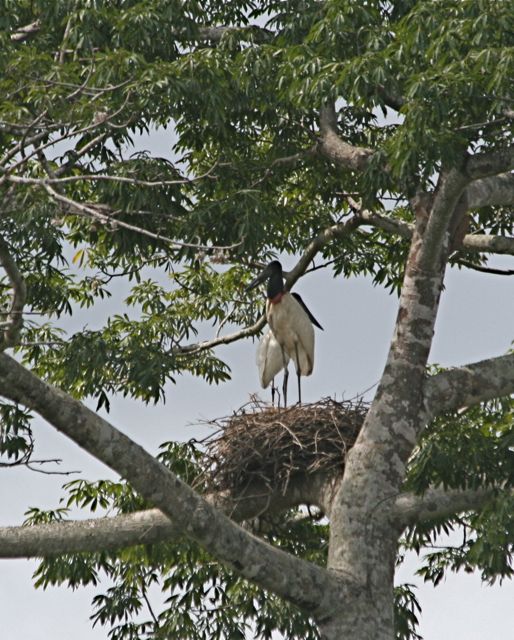
These endangered storks nest at Solimar, and we were privileged to see a nest, with three young, at a great distance, so as not to bother them. What a tree, what a nest, what amazing storks they are.


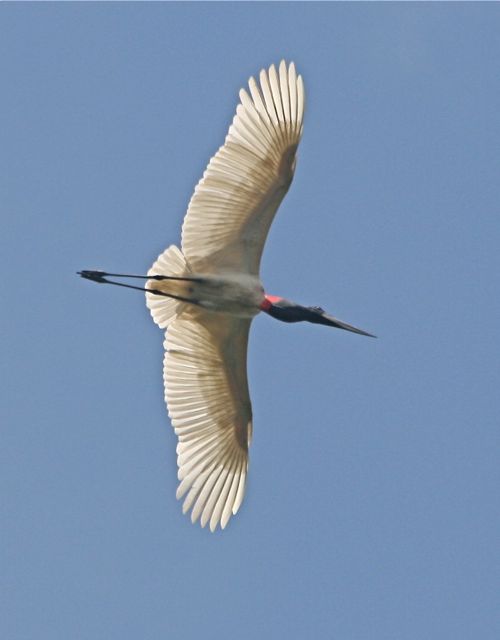
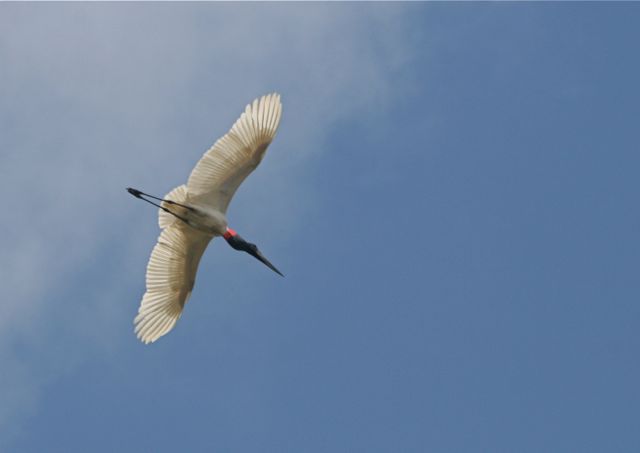
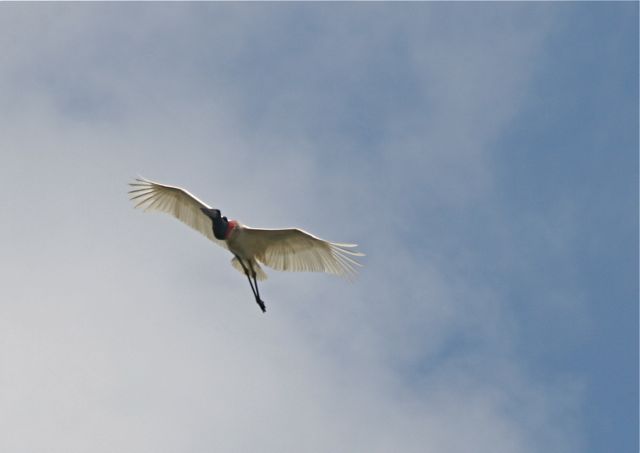
In flight, with those pure-white primaries beating, they're magnificent. I expected their wings to be trimmed in black.  Melanin strengthens feathers for the inevitable wear flight brings. That's why most white birds like terns, gulls, gannets, wood storks and snow geese have black-tipped primaries at least. Not the jabiru. Does it not make long-distance flights? How come no black? Always scratching my head. Especially in the Neotropics. 


This is a fun shot. If you click on it to embiggen it, you'll find that three of these things are not like the others. Three of these things are not the same. Can you name all the birds in the photo?
** Answer at the bottom of the post. **


I'm just going to say right now that for some reason my photos in this post, viewed at normal size, look like crap. And when you click on them and see the larger version, you see that they are largely not crap. This is something I've been noticing about Blogger lately. If you like a photo, by all means click on it and see it how it's supposed to look. For instance, you can vaguely tell that the large birds in the photo above are some kind of craney storkey thing. Click on the photo and boom! Wood storks!

We watched the flocks for signs of danger, for the high whistled calls of the ducks and sudden explosions and rises. For there were peregrines about!


And why not? Wherever there are huge flocks of shorebirds and waterfowl, the wandering peregrine will attend them.  These two sparred playfully, thrilling us to bits.


Look at that leg extension! Wow!!


It always gets me when birds fly upside down. It never gets old.


By now you're probably figuring out that birding in Costa Rica is just fun, fun, fun. Especially with the Science Chimp jumping around scratching her head and asking questions. Right, Mario? Heh.

**The flock consists of 19 wood storks, and from left a black vulture, a tiny high-soaring anhinga, and an osprey, heading the other way. 

Jabiru Nest!

Tuesday, March 24, 2009

12 comments

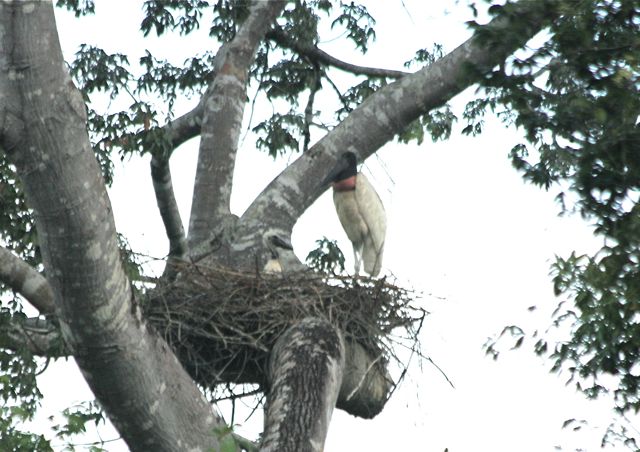
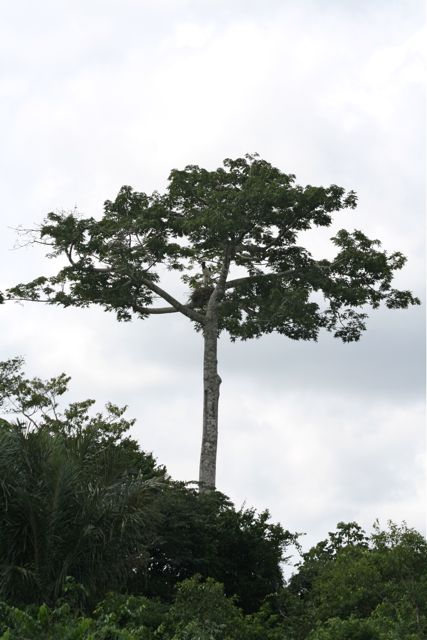
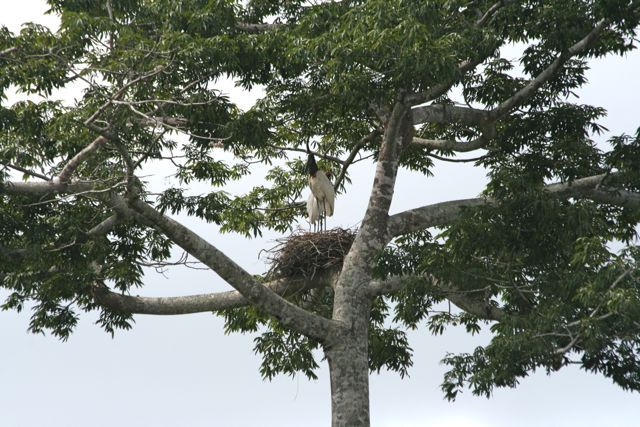
Once again, a ceiba tree was host to a forest king. This time, it was not a harpy, but a jabiru pair, nesting along the Rupununi River. It takes a heck of a tree to hold up a jabiru nest.This nest is probably bigger than the antique oak flat file that takes up the entire center of my studio. Those birds are five feet tall, as tall as people. It's hard to convey how huge the whole affair was, tree, birds, nest and all.

And how rare is the opportunity to look into a jabiru nest.
We were to see not one but two different jabiru homes. In the second, a little jabiru princeling.
Ceibas are good trees, are they not? What treasures these forest giants hold. No wonder they're sacred all across their range. From tribe to indigenous tribe, everyone respects the ceiba.

I feel pretty certain that I'll never have a better look or photographic opportunity with jabirus than I got in Guyana.
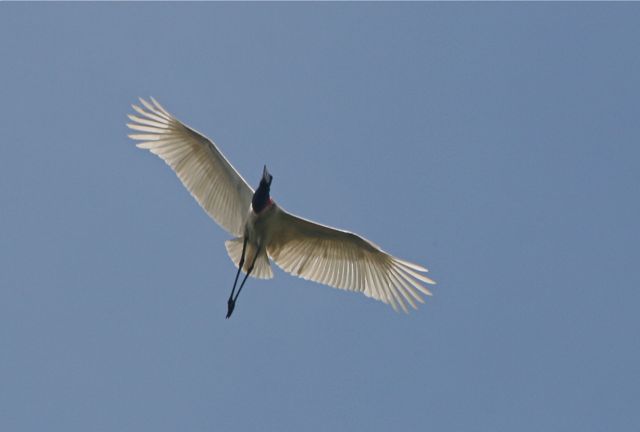
The jabiru soaring overhead reminded me of DaVinci's flying machine, a man hanging from the great jointed wings.

Meanwhile, back at the ranch, spring is on hold. It has to rain, it just has to. Dust curls up off the road and the spring peepers are silenced. There are no wood frogs, no mountain chorus frogs, no salamanders. Even the bluebirds, always eager to nest, are holding back. I can't remember a spring like this. When?

Jabiru

Monday, March 23, 2009

11 comments


Jabiru! Just the name sends a thrill through any aspiring Neotropical birdwatcher. Though they occasionally show up in Texas as vagrants, you really have to be in the tropics to see this magnificent stork.

The jabiru eats fish, crustaceans, mammals, reptiles, amphibians: whatever it can subdue with its enormous, slightly uptilted bill. That's probably most of the animals it encounters, because this thing is BIG. It is the tallest bird in the Americas, standing nearly five feet, tipping the scales at almost 17 pounds, looking me right in the eye. And I can tell you I would not want a jabiru to look me in the eye at close range. Herons and storks have a disconcerting way of aiming for the eyes of people who tick them off. So I will have no hair-raising tales of patting the jabiru.

I'd only ever had distant and pretty crummy looks at jabirus in Costa Rica. To come to a place where they were reasonably common and easy to see was a great thrill. Guyana thrilled me in so many ways.

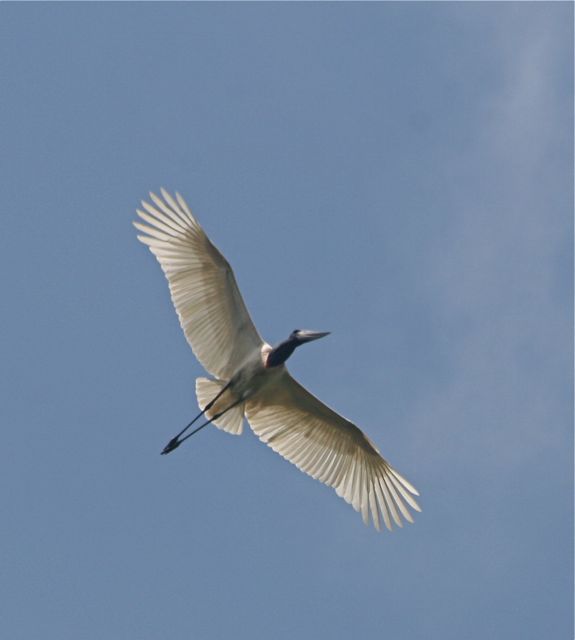
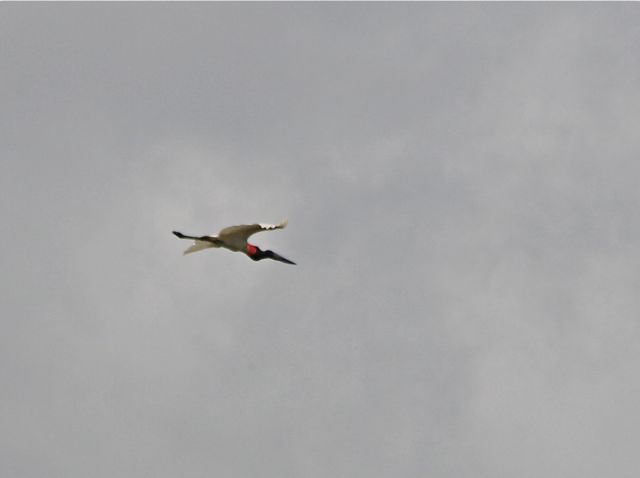
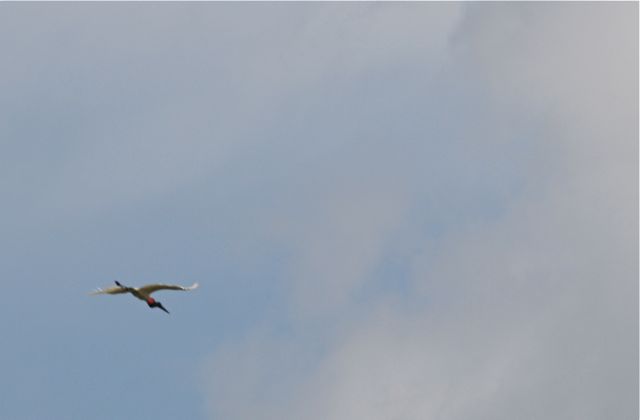
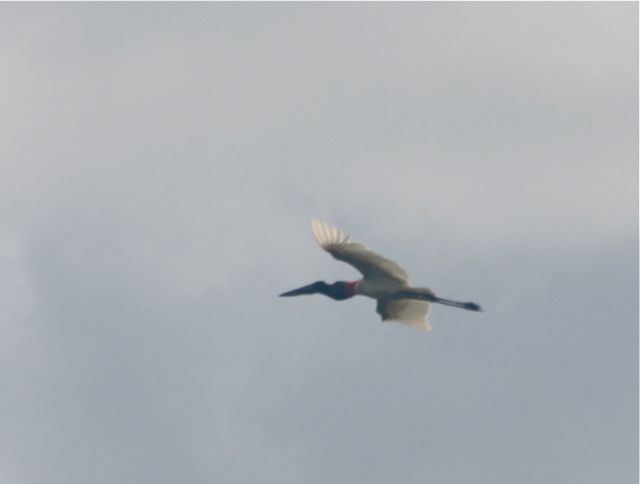
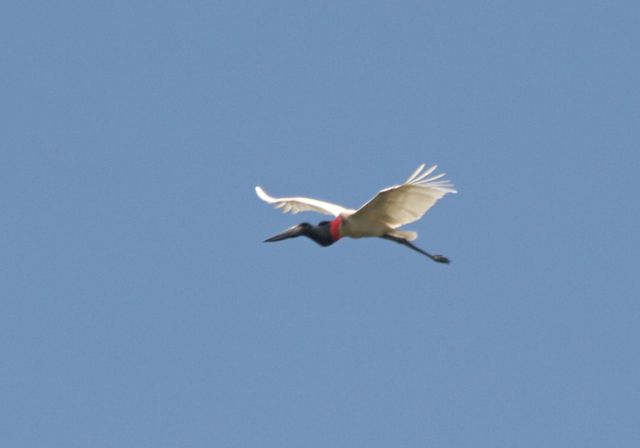
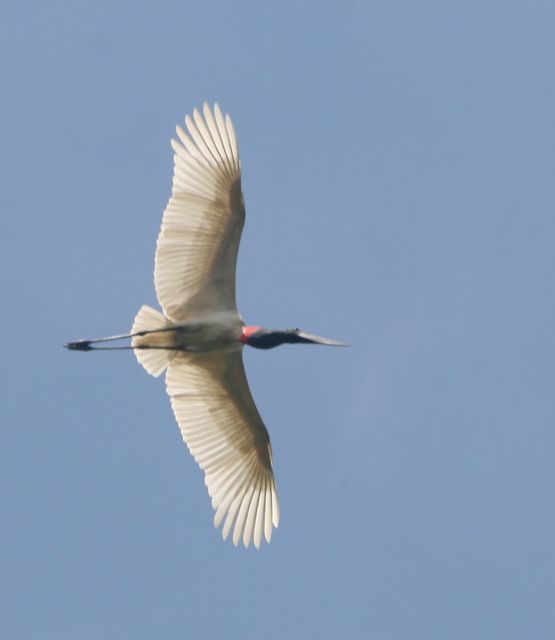
Flying jabirus are distinctive mainly by their absolute hugeosity. Not only that, but their plumage is completely white--no black primaries here. Their feathers must be enormously strong, both to hold their weight and to resist wear without the aid of melanin, the dark pigment that strengthens the wingtips of most white-winged birds.

In flight, jabirus appear very neck-heavy. Its name is a Tupi Indian word meaning "swollen neck." Yeah.Most of the birds that we saw were circling in pairs or even quads, and we witnessed a few really strange neck-throwing displays in flight, where the bird would toss its head over its back, flashing a big red patch at the base. I wish I had a picture of the bird with the head thrown up, but it happened really fast.The display looked aggressive in nature to me, but one never knows. It could just as easily have been a breeding display. I noticed that the base of the neck varied in color; most birds that have such skin coloring are able to deepen the hue by allowing blood to rush to the part. Think turkey heads, which can go from blue to blood-red to snow-white in a few seconds. Whether this is something that is under voluntary control I don't know; it's more likely related to how excited the bird happens to be.

Oh, gosh I love jabirus, and I had a hard time picking my favorite photos. When I am focused on a circling jabiru, I'm very happy that my camera, set on Auto, knows what to do to bring out the detail against a bright sky. Tomorrow, a jabiru nest!

[Back to Top]