Background Switcher (Hidden)

Showing posts with label birding in Guyana. Show all posts

What IS a "Fam Trip," anyway?

Tuesday, August 14, 2012

6 comments

Zick laying hands on a very large, very old female black caiman in Guyana.
Photo by Erica Geis


I've been working for weeks now, sorting, editing, cropping and weeding photos taken on my South African safari in February, 2012. It's been at the top of my to-do list since then. I knew, looking at my spring and summer travel schedule, that it would be gruesome, but I didn't think it would take me until August to have the time and mental space to sit down and do the work of processing a ten-day trip. As a visual learner, I'd be absolutely lost without my Canon 7D camera and the souvenir photos I take. When I finally sit down to write the article, I have my field notebook, a stack of field guides, my itinerary, and the photos right in front of me. Then comes the painstaking work of reconstructing the trip. It's amazing how much I forget when I'm staying in a different place every night and have no down time whatsoever to digest it all.

See, I get these press familiarization trips (also known as fam trips) over the transom every few years. My last one to South Africa was in 1994, so maybe I should revise that to "every few decades." At first blush, they look like all-expense paid vacations to places I could never afford to go. And they are, sort of, and they're great, they're terrific. But they're almost always on very short notice (Can you go to Africa in three weeks?) ; you usually have to convey yourself to either New York or Miami to depart, which involves air fares, parking and hotels, and usually  inoculations and necessary but costly gear upgrades, all on your own nickel. My "free" trip to Guyana cost me a bit over $1,000 in such expenses. I had a fabulous trip, and I thanked the Guyana Tourism Authority by writing an article for Bird Watcher's Digest and posting 64 substantial blogposts about everything from Marmite and crab-eating raccoons to colonial spiders in quilt-sized webs to catching and sexing giant caimans at night.  


Mike Weedon standing next to a communal spider web on Turtle Mountain, Guyana, with thousands of seething spiders inside. Eee! Eee! Eee!


I'd also add that fam trips are something else, but they're not a vacation. The whole point of a vacation is to let your brain go wherever it wants to while you do stuff that you like to do, or maybe nothing at all. On a fam trip, you're being rapidly scuttled from one place to the next so you see the most in the shortest possible time. Fam trips often involve all-day bus rides, short flights, and several transfers in a single day. I'm scrambling the whole time, jotting notes about birds and plants and insects and geography; getting weird place names spelled right; getting contact information on lodgings, making notes about the culture and the food, taking photos every few seconds. Firing on all cylinders from dawn to the moment I collapse into bed, to rise again in the dark and have another day.


A Guyanan crab-eating raccoon (Procyon cancrivorus) raiding the power bar stash in my suitcase. Ack!! Ack!! Eee! Eeee!

I am not complaining. I'm just 'splaining, for those who are tempted to think I am nothing but lucky for getting to go on fam trips. Well, I am very lucky. But I am not being asked to go on these things because I'm lucky or particularly cute or highly enthusiastic in a Science Chimpy way. Tourism departments ask me because I work like an organ grinder's monkey to deliver the payback they're looking for, which is articles in Bird Watcher's Digest and blogposts right here. The beauty of blogging about it all is that the information remains online indefinitely, and anyone searching "South Africa birding" can come across these posts. And that makes me very happy, because South Africa's wildlife reserves are like a great big gift to the planet, and I love to share gifts.

So with that as a preamble, I'll kick off a series on my February 2012 trip to South Africa. You're going to like it.

Speaking of "like," thank you, dear readers, for your magnificent response to my last post, "Me, You and BWD." Subscribing to Bird Watcher's Digest, either digitally or in print, is a resounding vote of support for a family-owned and published magazine that, after 34 years, continues to give you the best that it's got. A Zick magnum opus on South African birding is coming up in its pages, with the endless photo salon (I picked 715 that were worth looking at) and my usual loose and jittery commentary appearing here on the blog.

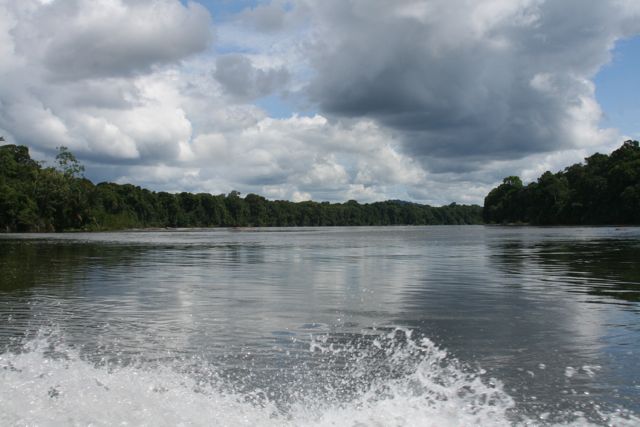
On the Issequibo River

Thursday, March 26, 2009

7 comments

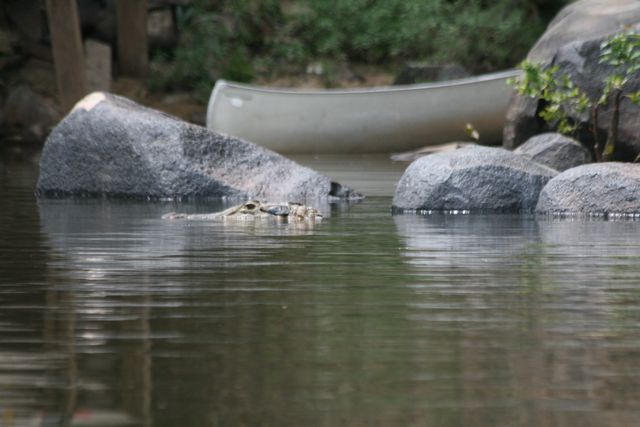
The Issequibo River flows right by Iwokrama Lodge. It is an absolutely gorgeous river, clear of water and abundant in life. This is Sankar, a huge black caiman who hangs out right by the dock. He gets fed. I don't know if you can strike a deal with an 11-foot caiman, like: we'll feed you if you won't eat us. Can you work something like that out with a giant reptile? Is it capable of knowing you shouldn't eat the people who bring you chicken scraps? Probably. Anyway, Sankar hung around like a dirty shirt, floating like a hopeful log just off the dock.

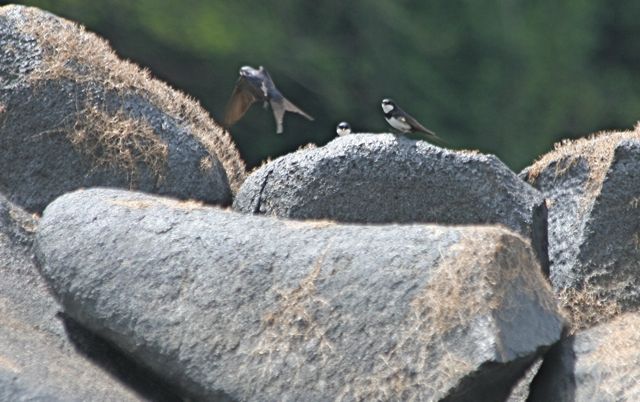
We took a few boat excursions in open whalers to see what there was to see. One of the most fascinating birds we found was the black-collared swallow, Atticora melanoleuca. This diminutive bird nests in crevices in river rocks, which would seem to put it at great risk in the face of fluctuating water levels. On the bright side, there's not much that's going to swim across a swift-flowing river and prey upon their eggs and young, especially far back in a narrow crevice. I should think it would cut down on the snake predation, especially. I like this picture because it shows the great big, deeply-forked tail--such a surprise on a bird that otherwise looks a lot like a bank swallow.
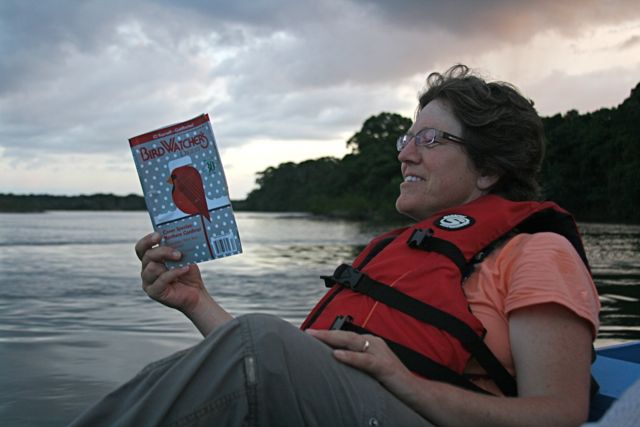
I decided to stage a shot of me reading Bird Watcher's Digest in the boat. This is a tradition with Bill and me, staging such shots, just to show that BWD goes around the world.Photo by Mike Weedon. See, Mike, I credit your photos.

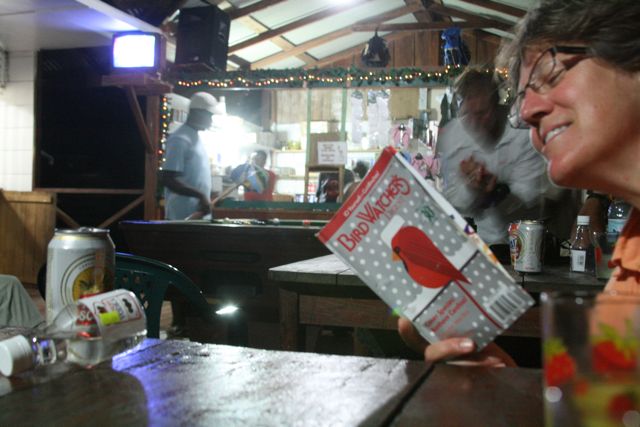
That was so much fun, we staged another of me reading BWD in a bar on the Issequibo River. One night we wound up in a very funky, cool little bar within shouting distance of the lodge. There, we got pretty snookered on rum and vodka mixed with Orange Crush, because they were out of fruit juice. This is something that I would not even consider drinking at home, but it actually tasted sort of not too horrible in this little bar, because it was so cute and friendly there. They had a videotape playing on the television. First Anne Murray gave a concert, and then Kenny Rogers gave one. Then Anne Murray, then Kenny. Then Anne, Kenny, Anne...The tape was probably about thirty years old, and they probably know every single song by heart, but that's what they had. This is what I look like on vodka and Orange Crush.Photo by Kevin Loughlin

I wish you could see Kenny on the screen but you can't.

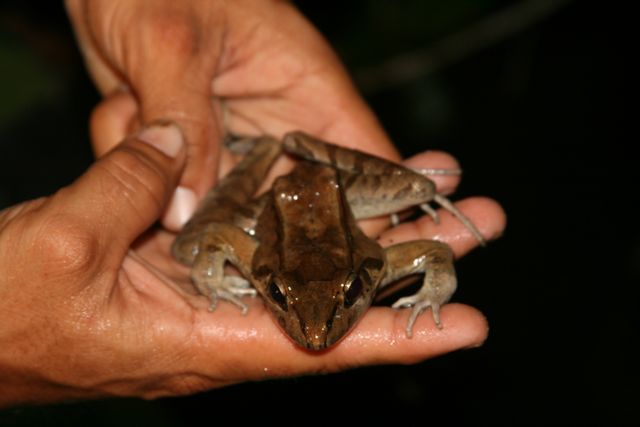
After that, we went out spotlighting wildlife, but we probably didn't see near as much as we could have because Weedon and I started talking about Cockney rhyming slang and other ridiculous things and we laughed too much. I took one picture of a large frog they call mountain chicken. Why you would call a frog "mountain chicken" I have no idea, because it lives in the river. Sadly, this is the only photo I took that night.

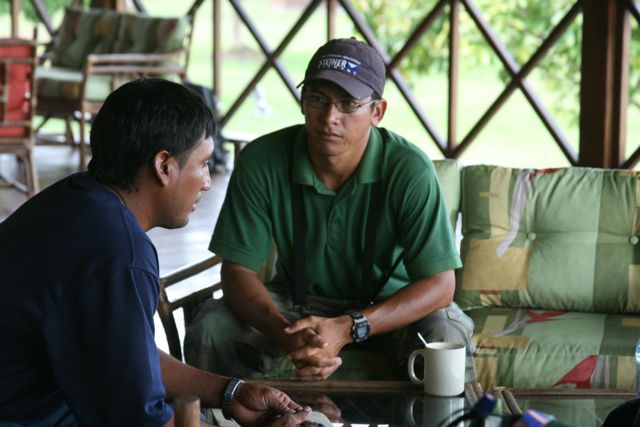
The next morning, our guides Ron and Asaph sat discussing something, probably what they ought to do about the loud, disruptive people in this press group. Asaph is recommending that they wad up a sock and then put a little duct tape on my mouth, and Ron just thinks they should cut me off on the vodka and Orange Crush.More adventures anon.

Iwokrama Lodge

Wednesday, March 25, 2009

13 comments

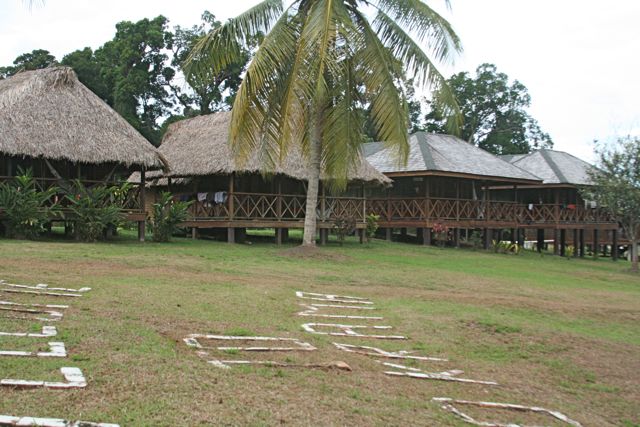
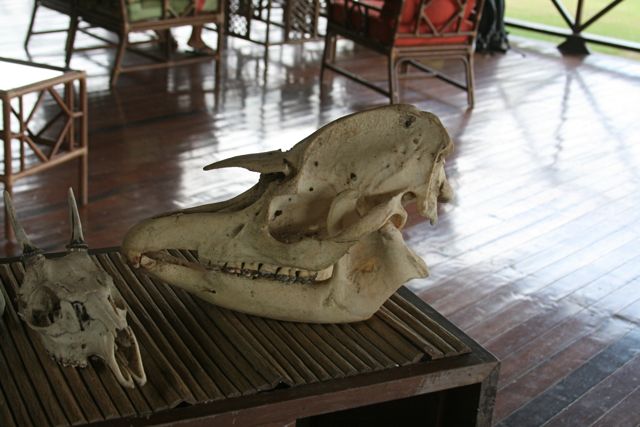
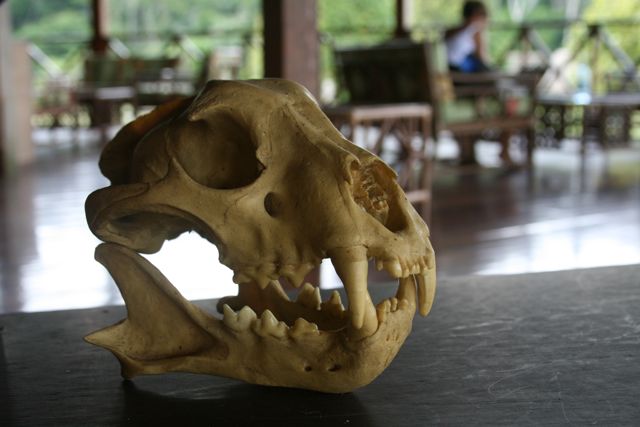
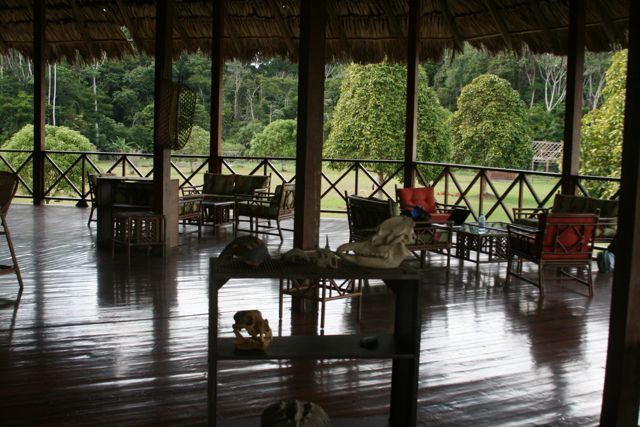
I guess I'd better set the stage here for some more adventures in Guyana. We'd reached our final destination: Iwokrama Lodge on the big, wild Issequibo River. What a cool place--completely oriented toward ecotourism and research, bird and animalcentric. You know you're in a good spot when there's a table full of skulls right in the dining room. lowland tapir (right) and brocket deer (Mazama sp.), left.Jaguar skull. Possessed of the most powerful crushing bite in the cat family, this is what sabretoothed tigers became, I wager. Jaguars are built like sumo wrestlers, built to bring down lowland tapirs.

Diagnostic Zick habitat.
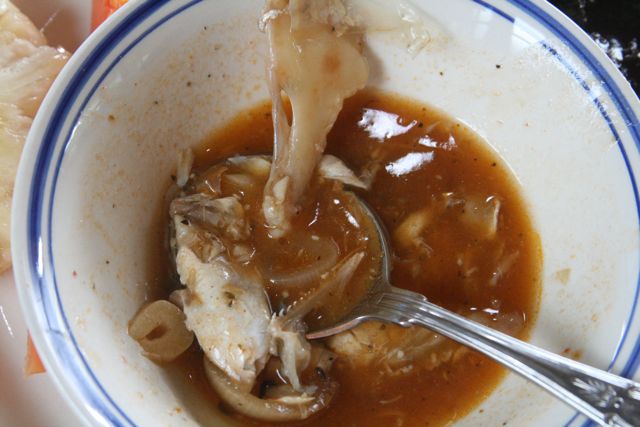
I burst out laughing when I sank a spoon into my dinner and found it toothed. Just fish, but still. That was one bony stew. What is proper etiquette when one finds oneself being chewed by one's soup? Spitting it across the room is out, that much I know.


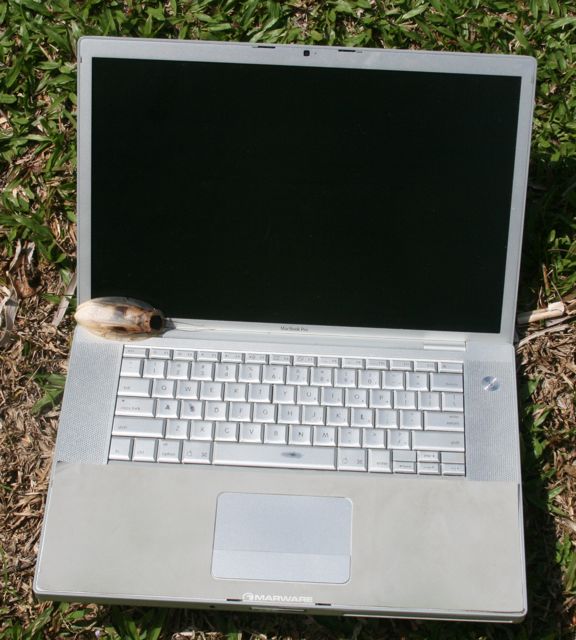
Another thing not for the faint-hearted: taking a beloved and highly essential laptop to a place with nearly 100 percent humidity and what felt like nearly 100 degrees all the time. You want to talk computer bugs? Yes, that's a roach, and I found it on our cabin porch, and it is just a whisker short of 3" long. Communal shudder. Easton Apple Store dudes, this is how it happened:
After its ordeal at Atta Canopy Tower camp, when it poured for a day and a night, my computer started spontaneously shutting down. And then, arggggh, it wouldn't start up, either. And there was Internet at Iwokrama, as there is nearly everywhere we went in the interior, and I wanted to talk to my husband and kids. I also wanted my data, and my next book manuscript, and 20K photos, and sundry things like that. I was wiggin'.

I went cabin to cabin interviewing all the sympathetic and helpful gearheads, who also happened to be Mac people (I told you there were great people on this trip!) and we reached the consensus that my laptop had drowned. I should try setting it out in the sun. It had worked for my portrait lens, which I drowned when I put it in a fanny pack with an unscrewed water bottle. Drowning appliances is one of my many fortes. I have drowned three, count 'em, three cordless telephone handsets. I watered one and washed two in the machine.

But back to the Mac. Now, setting something out in the Guyanan sun is tantamount to broiling it. So I decided to set it out for only a half hour and see if it would start then. After about five minutes, I peeked at it. Tiny red ants were POURING out of the keyboard, running in crazy zigzags across the white-hot titanium. And each one had a cookie crumb in its jaws. That had to be a good thing. People go to spas to stick their feet in fishtanks and let little fish eat the dead skin off their feet. I thought this might be something similar. The pharoah ant treatment for your laptop.

Lo and behold, after its time on the tanning bed, it started. I've never been so happy to hear the annoying DAAAHHH! it makes when I wake it up. (Why can't it peep or twitter instead?) But I had to set it out in the sun every time I wanted to boot it up. That couldn't be a good thing. I am happy to report that my Fed-ex guy came up the sidewalk today with a laptop-shaped box, and the people at Apple had done something to the logic board, fixed the fan, and fixed the disc drive, too, and we are cookin' now, and she's not shutting down no mo'. And I am real, real glad I bought AppleCare. Real glad. Even though it expires in September. By then, MacIntosh is betting I'll have to have the new AirBook with a green battery that lasts eight hours. Too bad I'll have even less than no money by then.

Too bad I couldn't bring my REAL, 3" long computer bug back home.

ZICK ALERT: I will speak and sign books tomorrow, 6:30-8 pm. at Miami Middletown Downtown, 4 North Main St. Middletown, OH, as part of Miami University Middletown’s public lecture series. Contact email: mumccc@muohio.edu; phone (513) 727-3248 (Dr. Eric Melbye). For more ZICK ALERTS, see my website's Meet Julie page.

Jabiru Nest!

Tuesday, March 24, 2009

12 comments

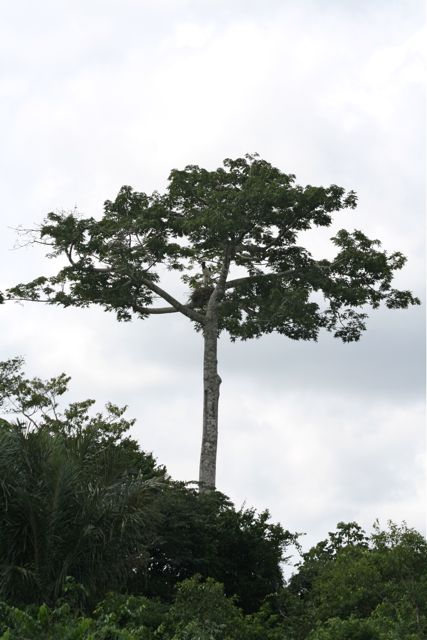
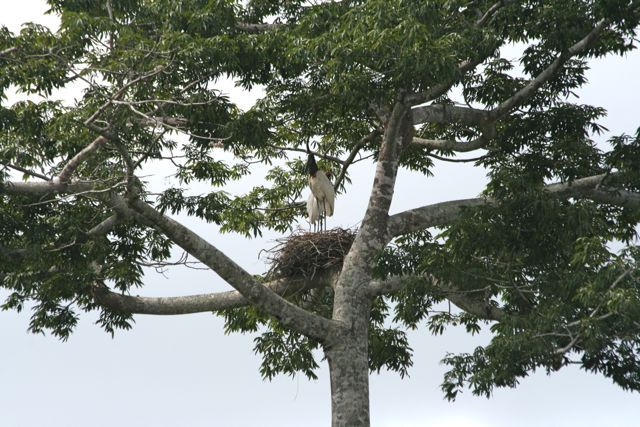
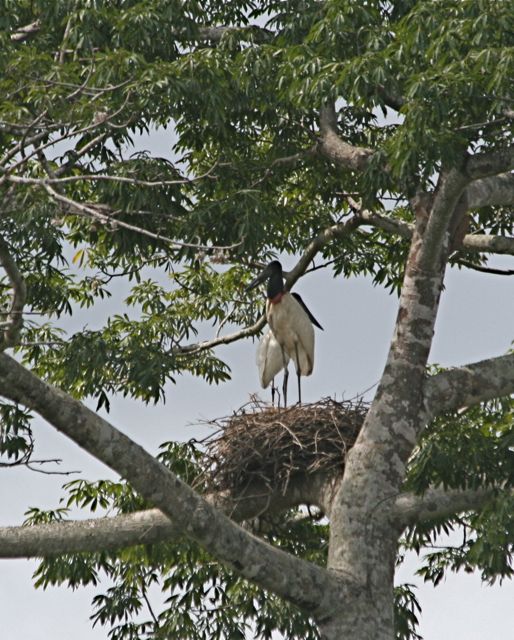
Once again, a ceiba tree was host to a forest king. This time, it was not a harpy, but a jabiru pair, nesting along the Rupununi River. It takes a heck of a tree to hold up a jabiru nest.This nest is probably bigger than the antique oak flat file that takes up the entire center of my studio. Those birds are five feet tall, as tall as people. It's hard to convey how huge the whole affair was, tree, birds, nest and all.

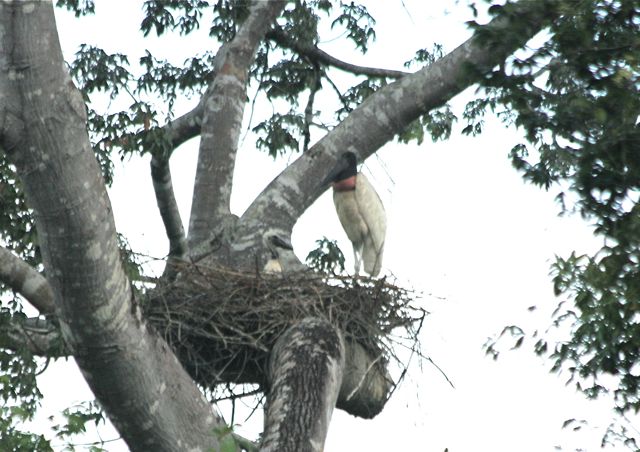
And how rare is the opportunity to look into a jabiru nest.
We were to see not one but two different jabiru homes. In the second, a little jabiru princeling.
Ceibas are good trees, are they not? What treasures these forest giants hold. No wonder they're sacred all across their range. From tribe to indigenous tribe, everyone respects the ceiba.

I feel pretty certain that I'll never have a better look or photographic opportunity with jabirus than I got in Guyana.
The jabiru soaring overhead reminded me of DaVinci's flying machine, a man hanging from the great jointed wings.

Meanwhile, back at the ranch, spring is on hold. It has to rain, it just has to. Dust curls up off the road and the spring peepers are silenced. There are no wood frogs, no mountain chorus frogs, no salamanders. Even the bluebirds, always eager to nest, are holding back. I can't remember a spring like this. When?

Jabiru

Monday, March 23, 2009

11 comments


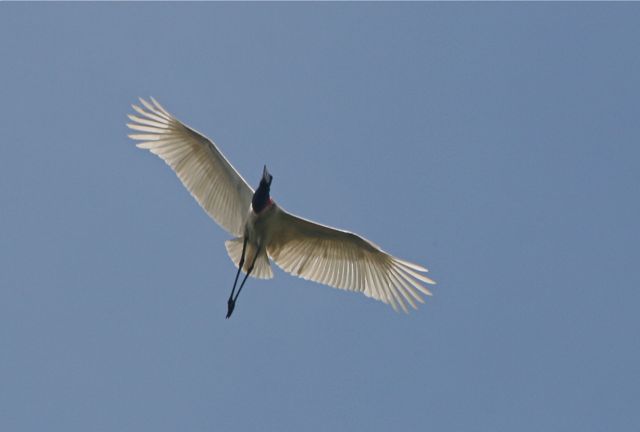
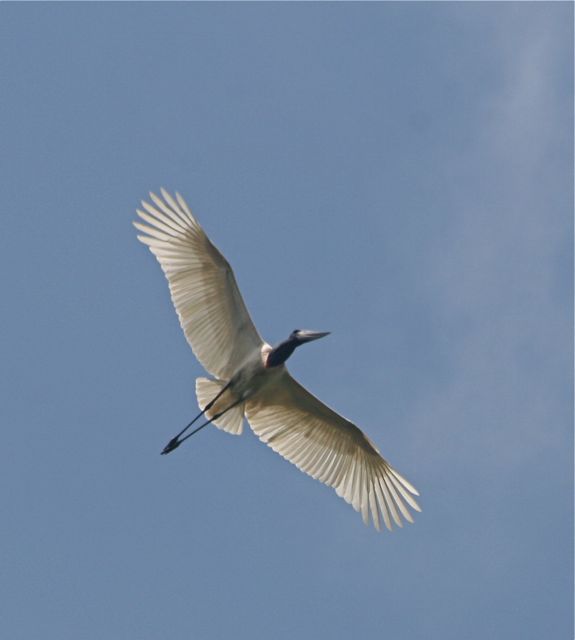
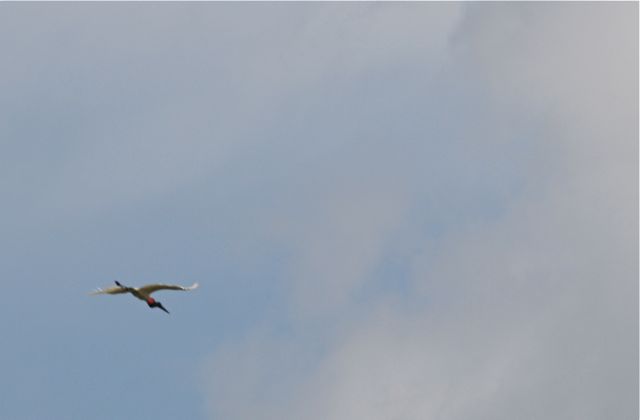
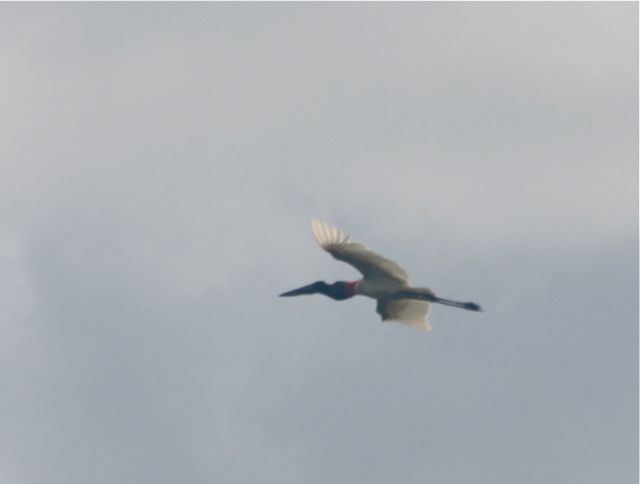
Jabiru! Just the name sends a thrill through any aspiring Neotropical birdwatcher. Though they occasionally show up in Texas as vagrants, you really have to be in the tropics to see this magnificent stork.

The jabiru eats fish, crustaceans, mammals, reptiles, amphibians: whatever it can subdue with its enormous, slightly uptilted bill. That's probably most of the animals it encounters, because this thing is BIG. It is the tallest bird in the Americas, standing nearly five feet, tipping the scales at almost 17 pounds, looking me right in the eye. And I can tell you I would not want a jabiru to look me in the eye at close range. Herons and storks have a disconcerting way of aiming for the eyes of people who tick them off. So I will have no hair-raising tales of patting the jabiru.

I'd only ever had distant and pretty crummy looks at jabirus in Costa Rica. To come to a place where they were reasonably common and easy to see was a great thrill. Guyana thrilled me in so many ways.

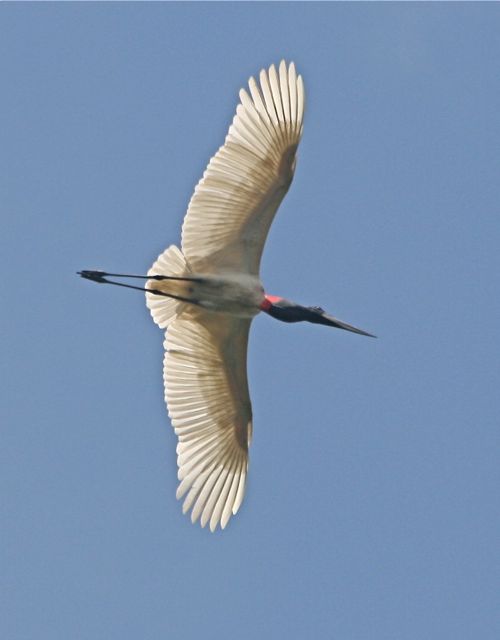
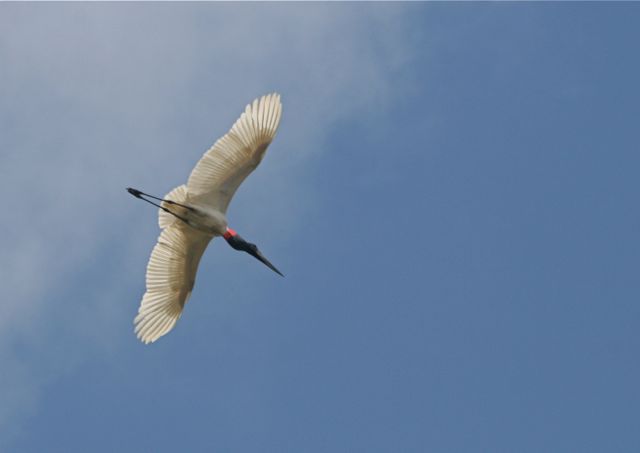
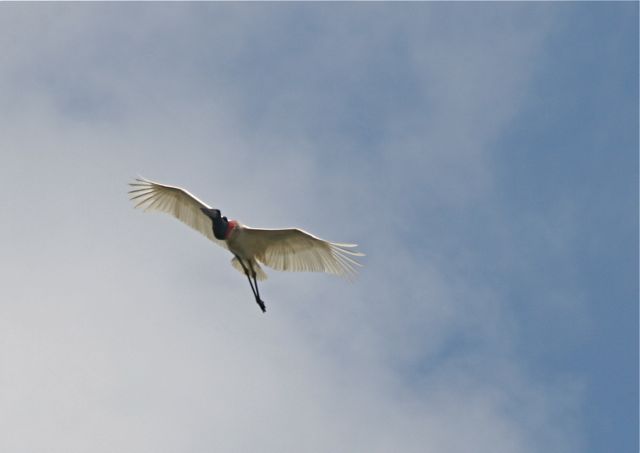
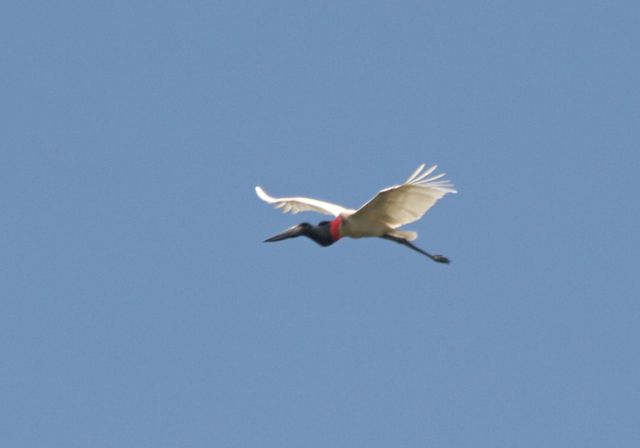
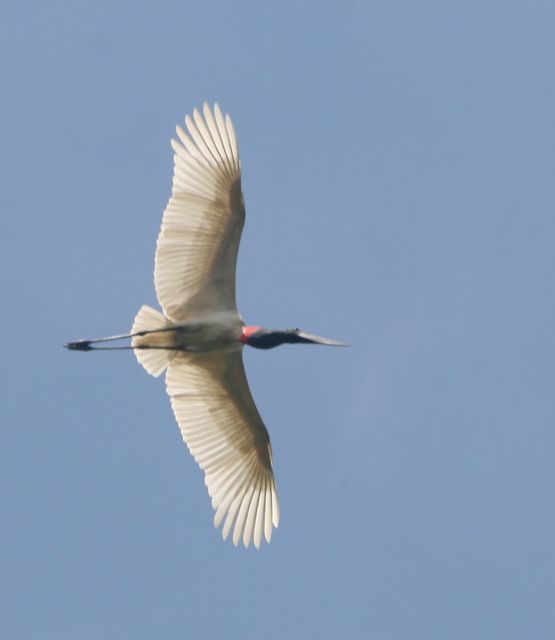
Flying jabirus are distinctive mainly by their absolute hugeosity. Not only that, but their plumage is completely white--no black primaries here. Their feathers must be enormously strong, both to hold their weight and to resist wear without the aid of melanin, the dark pigment that strengthens the wingtips of most white-winged birds.

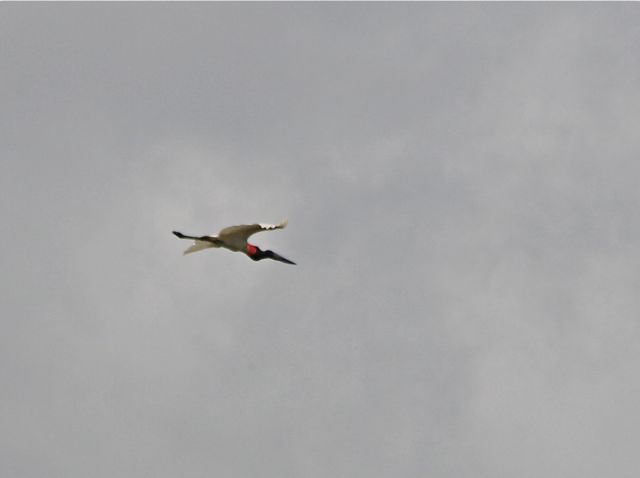
In flight, jabirus appear very neck-heavy. Its name is a Tupi Indian word meaning "swollen neck." Yeah.Most of the birds that we saw were circling in pairs or even quads, and we witnessed a few really strange neck-throwing displays in flight, where the bird would toss its head over its back, flashing a big red patch at the base. I wish I had a picture of the bird with the head thrown up, but it happened really fast.The display looked aggressive in nature to me, but one never knows. It could just as easily have been a breeding display. I noticed that the base of the neck varied in color; most birds that have such skin coloring are able to deepen the hue by allowing blood to rush to the part. Think turkey heads, which can go from blue to blood-red to snow-white in a few seconds. Whether this is something that is under voluntary control I don't know; it's more likely related to how excited the bird happens to be.

Oh, gosh I love jabirus, and I had a hard time picking my favorite photos. When I am focused on a circling jabiru, I'm very happy that my camera, set on Auto, knows what to do to bring out the detail against a bright sky. Tomorrow, a jabiru nest!

Fear of Heights

Sunday, March 15, 2009

27 comments

Let's talk about fear. A little fear is good. A little fear keeps us on our toes, keeps us functioning above resting state. A lot of fear can be paralyzing.

We all have our monkeys. Mine are deep ocean water, tornadoes and heights. I mean, those are the major, environmental ones. Then there are clowns. But we won't talk about clowns here.

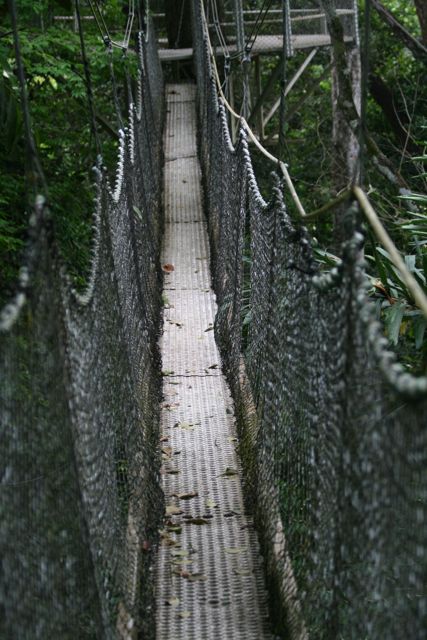
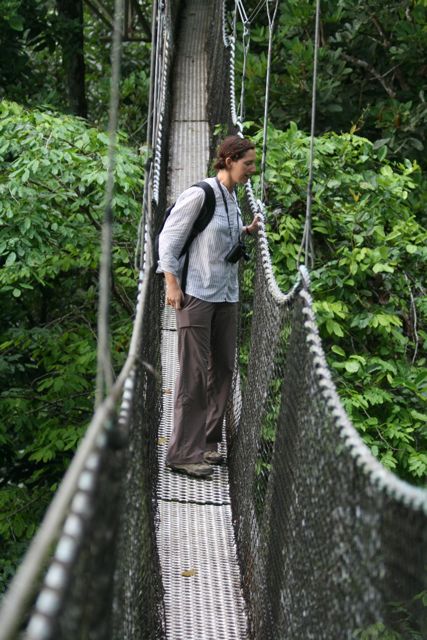
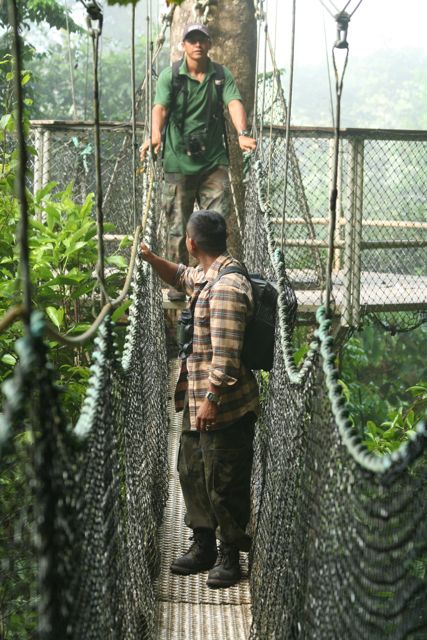
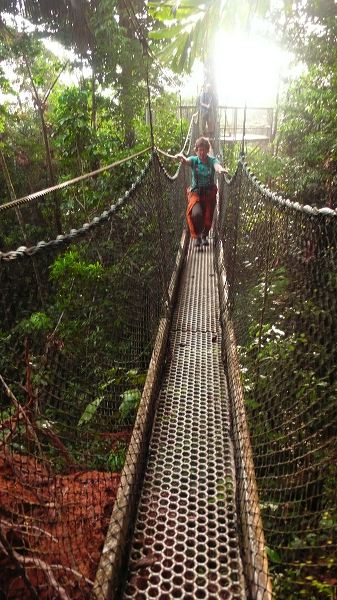
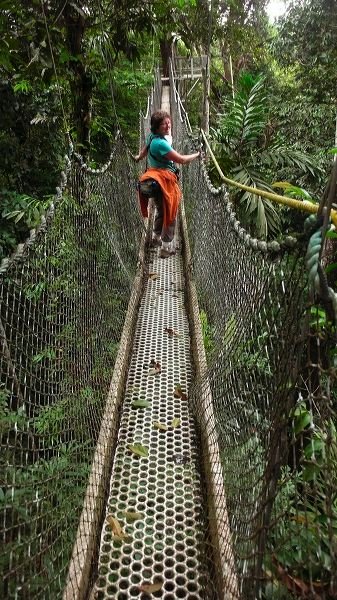
Pretty much every foreign trip has a moment that feels like Outward Bound for Zick. Maybe it's bargaining a vendor down in a crowded marketplace where nobody speaks English. Maybe it's getting everything I've bought back into my stanky suitcase for the ride home. Maybe it's just trying to make it through a day afield with dysentery. Or maybe it's having to cross narrow, swinging, slippery wet canopy walkways in an evening thunderstorm. Yeah, that's it. Crossing narrow, swinging, slippery wet canopy walkways in an evening thunderstorm.

At Atta Canopy Tower Camp, there is a system of walkways strung through the tops of forest giants, I don't know how many feet above the forest floor. It's way higher than our 42' tall birding tower, high enough to ensure that if you fell you'd be a spot of grease on the forest floor. I'd heard a lot about canopy tower walkways, but had never been on one. I'd never actually wanted to be on one. My time had come. Everybody else was going, so I did, too.

Erica tripped over them like a cat.
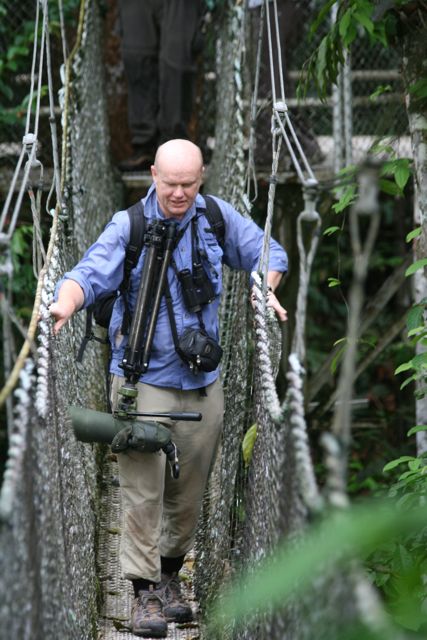
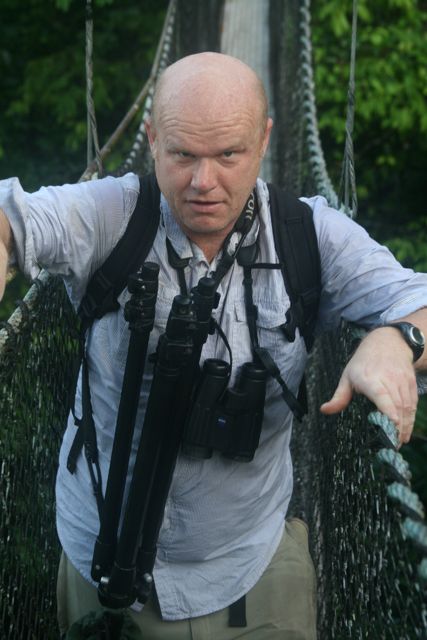
Mike was completely laden with optics and (eek!) tripod, but he gamely pressed on. He didn't enjoy it much more than I did, and I know I wouldn't have attempted it with that much luggage.
This is Weedon's I'mnothavingfunrightnow face. Nobody caught mine, thank goodness. Mike, I'm sorry. But I have so many good pictures of you I am shamelessly exploiting you without your consent. Hope that's OK.
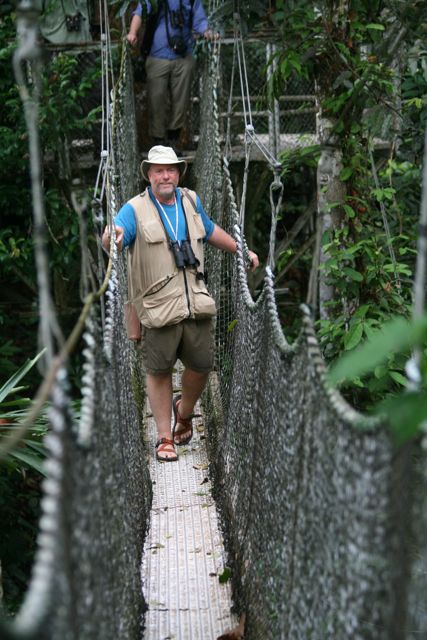
Crossing canopy walkways is all in a day's work for Kevin Loughlin. Here he comes, relaxed as rain, and also toting much photographic gear in those giant vest pockets. He's a wonderful cheerleader for the timid. (and taking trips to Guyana with Wildside Nature Tours).
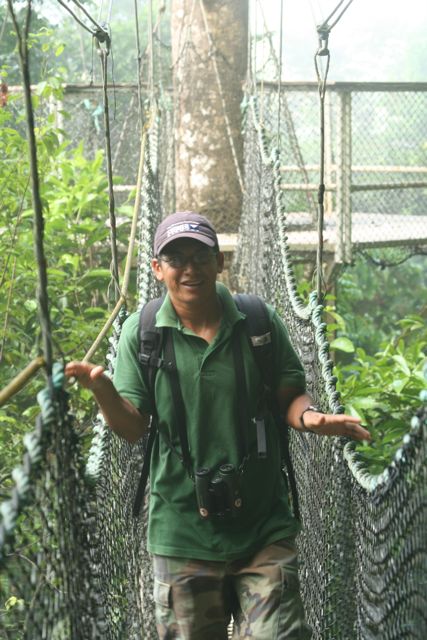
Ron Allicock was unfazed, but then he's a guide. This is what he does.
The guide in the foreground was a major designer and construction engineer of the walkway. He told me about shooting lines up into the trees, hoisting other lines, climbing with spikes and other gear, driving anchors into the trunks, all of it dangling perilously above the unforgiving earth. He walked those swinging paths with the nonchalance of a jaguar. He is made of much stronger stuff than I.

I figured out that the only way to get through it was as fast as I could, just taking one step forward at a time, then stringing those steps together into a journey. photo by Kevin Loughlin

The only way forward is straight ahead. But sometimes it is very difficult.

All told we made two forays to the canopy walkways. I wish I could say we saw loads of amazing birds from there--I understand that often one does--but it rained nearly the whole time we were there and things were comparatively quiet.
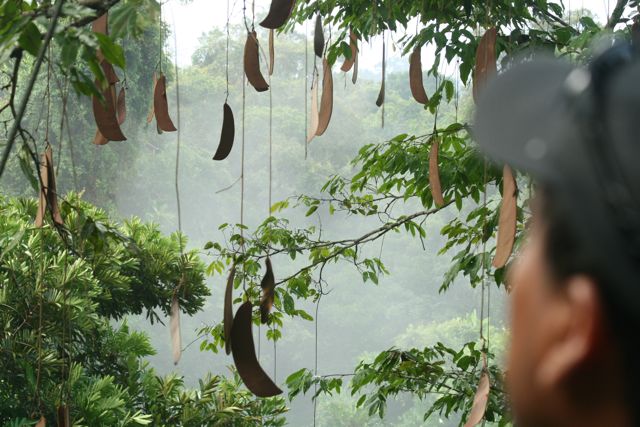
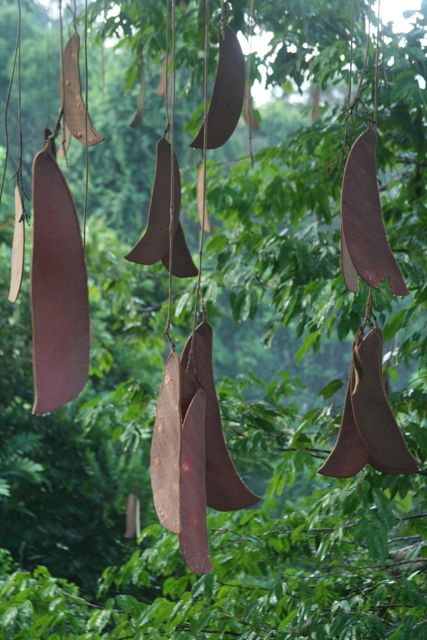
There were some very impressive pods, dangling like an interrupted phone call, which we'd never have seen from below.
Ron told me they suddenly pop open when they're ready to shed their seeds, and the seeds go flying in all directions. Ow! Bananas gone wild.
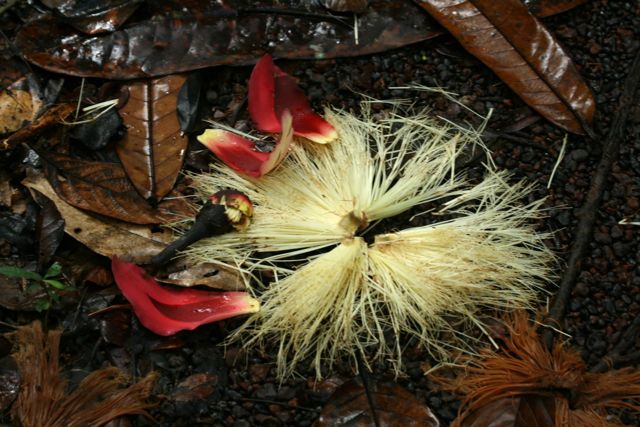
Far below, there were bits of giant exotic tree flowers, I knew not what sort.
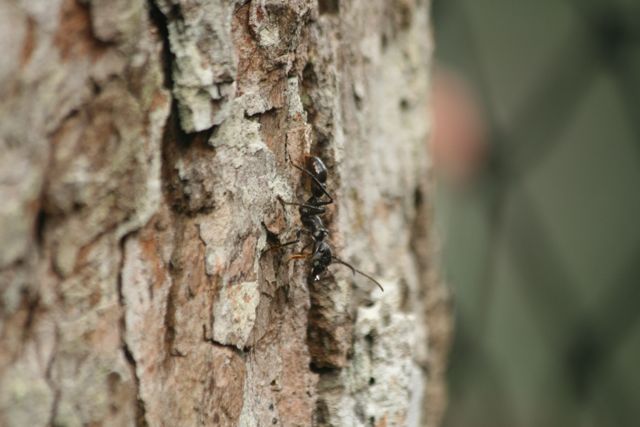
There were bullet ants on the tree trunk. The bullet ant's sting is so painful that Makushi Indians use a bullet ant bite as part of a male initiation ceremony.
For painful initiation, crossing five swinging walkways, each one longer than the last, over dizzying dark leafy heights is plenty enough for the Science Chimp. I made it, twice over.
Photo by Kevin Loughlin

Posting from the Apple Store in Columbus, where my friendly geniuses have concluded that I have a major chip issue in my Mac PowerBook. It started in a downpour in Guyana and it hasn't gotten any better. She's been spontaneously shutting down and that, my friends, is a drag on the creative spirit. So I bid her adieu for five to seven days of under-warranty massage, and somehow cope with the old G-5 desktop that smells like burning wires and whines like a lonely hyena. Many thanks to Jaime and Kevin for handholding, cord-replacing (durn macaw!) and general good vibes. It's good to have Geniuses who read yer blog, especially as I descend into LAS (laptop separation anxiety).

If all goes well I will transport the semi-conscious, jetlagged carcass of Bill of the Birds from the airport safely home to Whipple this afternoon. Those of you who travel by air know how much is encoded in the phrase "if all goes well." Let's just say I left the kids with their grandparents. Could be a rough ride.

Seeing the Harpy Eagle

Thursday, March 12, 2009

19 comments
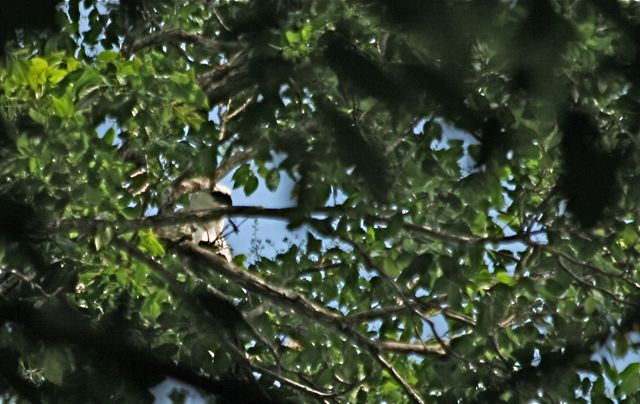
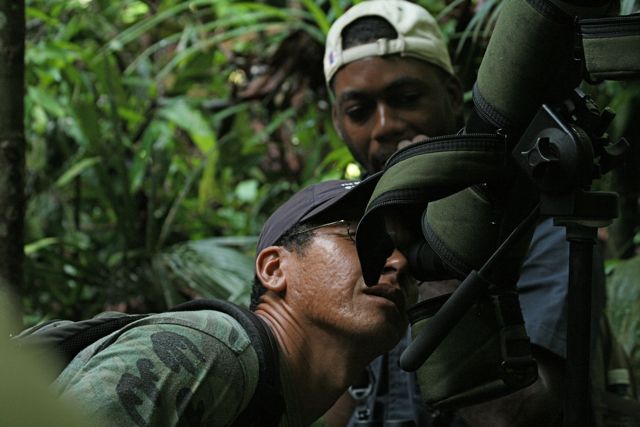
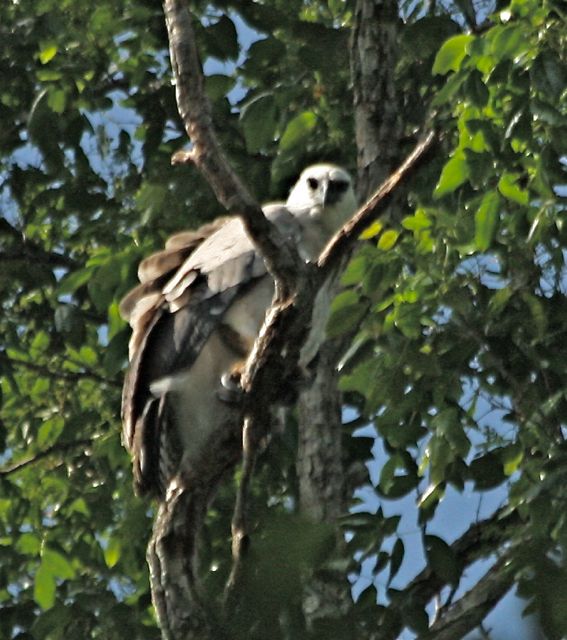
It took quite a bit of maneuvering for our skilled guides, Ron Allicock and Luke Johnson, to spot the fledgling harpy eagle perched on a branch of the ceiba, then get us into a position where we could see it, too. But it was there, it was there, and our hearts overfilled with joy at the prospect of seeing even a bit of it.

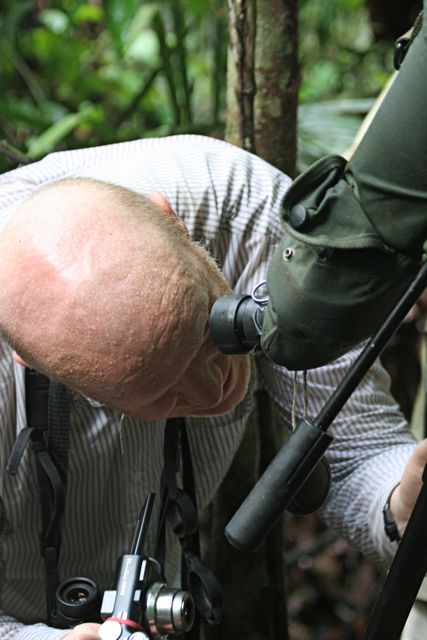
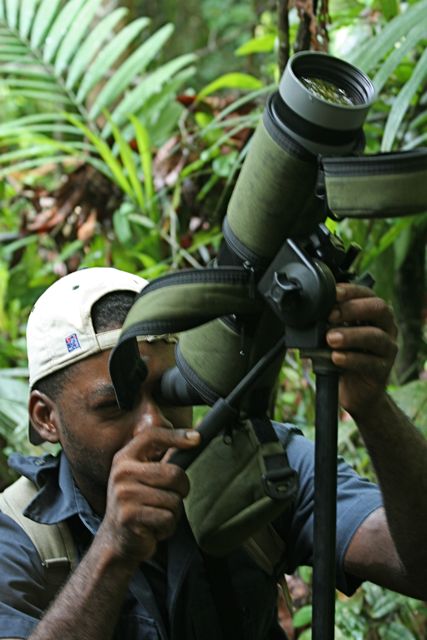
We practically bent double to get the scopes on the bird, more than a hundred feet overhead in the very top of the emergent ceiba tree.Mike Weedon gets an eyeful. Unnh!

For the next forty minutes, we admired this from our contorted positions:
just the face of a young harpy. It was enough. It was wonderful. Every now and then the breeze would blow its feathers and raise its double crest and we'd sigh in admiration. We were looking at a harpy eagle, the most important bit of a harpy eagle, and a baby harpy at that.

Here's Ron Allicock, who found it for us in the first place. Obviously, the nest was a stakeout; it was a known nest, discovered when logging crews came to fell some trees in a selective cut. (The ceiba will not be cut, and the harpies are doing fine). But it takes some serious doing to see the eaglet even when you find the nest, because at the time we visited, it was trying its wings and "branching" all over the enormous tree, sometimes in view and mostly not, obscured by the canopy below the emergent tree. In fact, the second group of our tour who visited the nest the next morning missed seeing the eaglet. Let's have a moment of silence for those hopeful birders. No gloating here.


But Luke wanted more for us, so he and another expert guide set quietly off through the jungle to try to find a better vantage point.


And find it they did.
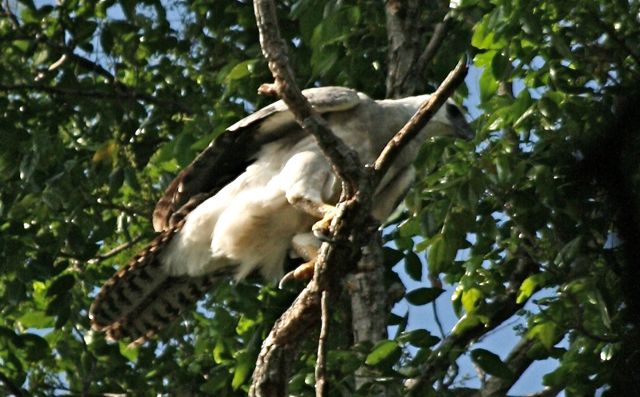
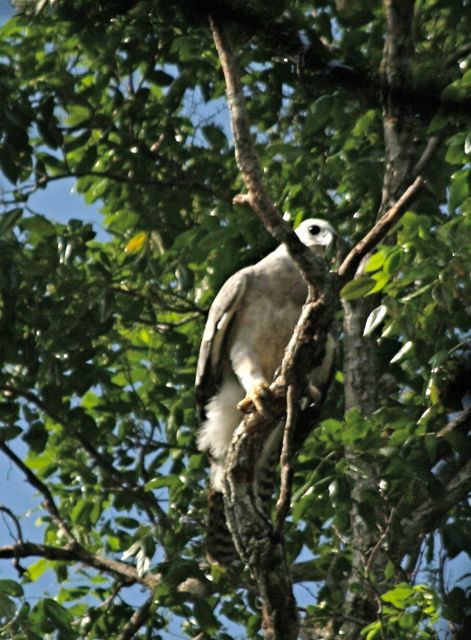
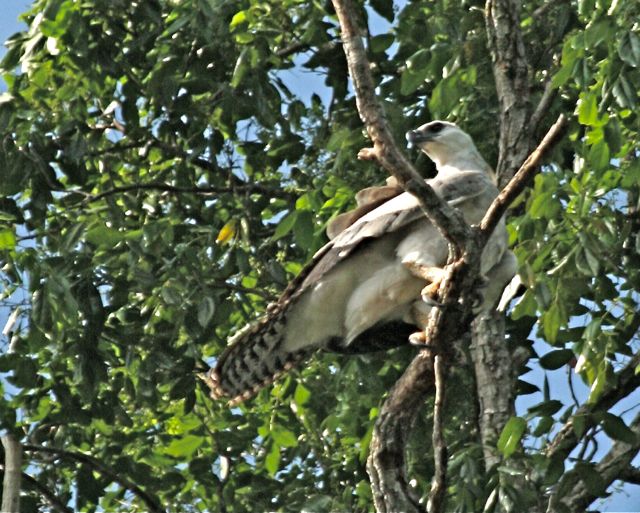
O.M.G. Now we had not just the head, but the whole enchilada, fluffy harpy eaglet bloomers, massive talons and all. Whooooooo.

The eaglet noticed.

But it preened and seemed fairly unconcerned about these primates far below which were after all too large to practice upon.


Harpy eaglets apparently come one to a nest. Though two eggs are laid, the second is abandoned as soon as the first hatches, and all the parents' focus goes to raising the sole princeling or princess. A harpy eaglet stays in the vicinity of the nest and in the care of its parents for a year or more, waiting for the occasional sloth/monkey to be airflighted in, and growing stronger until it's ready to try its six-foot wings and catch its own prey. With a reproductive rate like that, it's no wonder this apex predator is so rare.

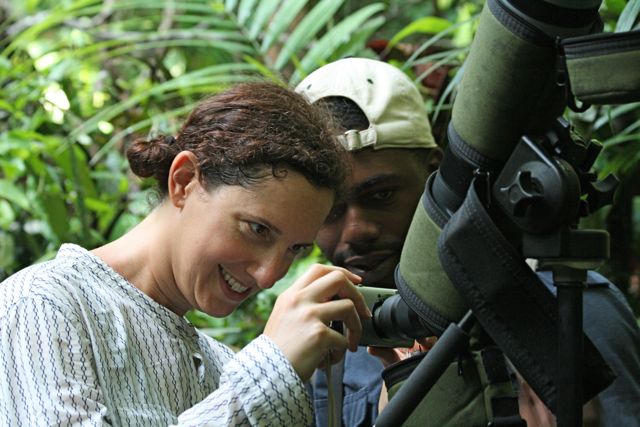
Luke watches Erica get her camera lined up to digiscope the eaglet.
And the eaglet looks right back.

We quietly withdrew, grateful for this audience with a mythic bird.

Keep growing and thriving, prince or princess, whichever you be. Thank you, Surama Eco-Lodge, thank you Ron Allicock and Luke Johnson, US AID and the Guyana Sustainable Tourism Initiative, for taking us to the nest of the great forest harpy. I am grateful to be able to share the experience with so many people, and hopeful that one harpy eagle is ultimately worth more to the people of the area than many, many fallen logs.

Go see. Give Guyana, its giant otters, its potoos and giant anteaters and harpy eagles some of your travel budget if you can. It will not disappoint.

Back here on earth, I will be speaking and showing my paintings at the Riverside Artists' Cooperative Gallery, 188 Front Street, Marietta, Ohio 45750 at 6 pm on Friday, March 13. For more information please call (740) 376-0797. And don't forget to blurt "BLOG" when you introduce yourself!
[Back to Top]