Background Switcher (Hidden)

Showing posts with label wood stork. Show all posts

Dog and Bird Spotting at Hacienda Solimar, Costa Rica

Thursday, March 10, 2016

4 comments

I am happy to report that, after 8 days away, my laptop has been returned by the excellent gentlemen of Elan Technologies, fitted with a new top case, keyboard, trackpad, and battery. No more will its swollen and aging battery impede progress on all fronts. Back in the blogging saddle! I took this time to write thank-you notes, 27 of them, to people who helped me with Baby Birds. It was like doing Christmas cards, and hand-writing a different letter to each recipient. Being that nice for five days was exhausting. :) I want to thank you all for the vote of confidence on old-fashioned prose posts, though; my photo-free post "Becalmed" has done better than most of my glitzier photo posts. Huh.

On Day 4 of our Costa Rica expedition, we made a lunchtime stop at Hacienda Solimar, a working cattle ranch of epic propotions in the Guanacaste region of the northwest Pacific coast. On this enormous ranch, beautiful Brahma cattle are bred and raised, mostly for breeding stock.
They are definitely a cut above the usual, even to my untrained eye.  I'm guessing the red X's on these cows indicate they've been bred.


On this day, the cowboys were separating calves from moms, and there was a lot of bellering going on, and dust rising in the air.


They use horses for much of the cattle cutting, but there were also some fancy four-wheelers in the garage. I spotted a very cute doggie resting in the shade. She had the nicest smile!


And then, feeling a little self-conscious, she yawned, and displayed perhaps the longest tongue I've ever seen on a dog.  


Just down the road, a classic yaller dog trotted home, curled tail held high over his back.  A good yaller dog is not too far from a dingo, if you ask me. Survival instincts keen and sharp; a coat that blends into dry grass, a yaller dog is a hunter, vigilant and crafty. Perhaps the ancestral dog.


  Much as I love cattle and dogs, I had to admit we were here for birds, and Hacienda Solimar did not disappoint. A pair of rufous-naped wrens drinks from a coconut shell. Oh sweet scene, there in the dappled light.


And just down the driveway, a Pacific screech-owl pretends to nap. It's a real good bet that an owl who looks like he's sleeping is glaring at you from behind those heavy lids. And wishing hard that you'd bug off.


Good as the land birding is, the marshes of Solimar are stupendous. We were gobsmacked by throngs of black-bellied whistling ducks. Struggling to comprehend why there were so many, I kept asking Mario and Solimar guide Demetrio if they were  massing for migration, enjoying  a post-breeding break or what? No, they replied; they're always here in numbers. Well, that just didn't make sense to me.


The more I thought about it, the more it bugged me. The black-bellied whistling duck is a cavity nester. It's a big duck, almost goose-sized. That's a whopping cavity! And every one of these ducks was born in a cavity.


Where do they find all those huge cavities for their nests?? And what are they all doing here? How can there be enough food in these sloughs for all those ducks? Sometimes nature just befuddles me. 

And wading around with the whistling ducks and an amazed great blue heron was an enormous jabiru, nearly five feet tall. 


These endangered storks nest at Solimar, and we were privileged to see a nest, with three young, at a great distance, so as not to bother them. What a tree, what a nest, what amazing storks they are.


In flight, with those pure-white primaries beating, they're magnificent. I expected their wings to be trimmed in black.  Melanin strengthens feathers for the inevitable wear flight brings. That's why most white birds like terns, gulls, gannets, wood storks and snow geese have black-tipped primaries at least. Not the jabiru. Does it not make long-distance flights? How come no black? Always scratching my head. Especially in the Neotropics. 


This is a fun shot. If you click on it to embiggen it, you'll find that three of these things are not like the others. Three of these things are not the same. Can you name all the birds in the photo?
** Answer at the bottom of the post. **


I'm just going to say right now that for some reason my photos in this post, viewed at normal size, look like crap. And when you click on them and see the larger version, you see that they are largely not crap. This is something I've been noticing about Blogger lately. If you like a photo, by all means click on it and see it how it's supposed to look. For instance, you can vaguely tell that the large birds in the photo above are some kind of craney storkey thing. Click on the photo and boom! Wood storks!

We watched the flocks for signs of danger, for the high whistled calls of the ducks and sudden explosions and rises. For there were peregrines about!


And why not? Wherever there are huge flocks of shorebirds and waterfowl, the wandering peregrine will attend them.  These two sparred playfully, thrilling us to bits.


Look at that leg extension! Wow!!


It always gets me when birds fly upside down. It never gets old.


By now you're probably figuring out that birding in Costa Rica is just fun, fun, fun. Especially with the Science Chimp jumping around scratching her head and asking questions. Right, Mario? Heh.


**The flock consists of 19 wood storks, and from left a black vulture, a tiny high-soaring anhinga, and an osprey, heading the other way. 

Pink Flamingos, Happy Boy

Thursday, February 5, 2015

10 comments

The first thing Liam and I did upon arriving at Merritt Island NWR near Titusville, FL, was to stop right on the road for a bald eagle who was hangin' out on a power pole. I have been there a bunch of times and I'd never seen that. Now, maybe I'm supposed to be blase about an enormous sea eagle 30' over my head. But I'm not. A truck honked at us and swerved, gunning its engine, and it was then I realized it was probably stupid of me to stop on the main road. But still. I was overwhelmed. And as it turned out, we never saw another eagle perched so close. I was glad we'd taken the time to ogle it. Liam took this photo! (I kept handing him my camera, as all the best wildlife was out the passenger side of the car. Wink, wink.)


Great big and itty bitty Florida cooters near the Merritt Island Visitor Center. I want to name a dog Cooter.


Another Liam shot of a majestic high-headed gator. Ahh. Such a grand reptile.

I love packing my long lens around. I can take candid shots of my primate companions. Liam saw some oranges hanging high overhead and wanted one sooo badly.


He scrounged a palm frond petiole and took to leaping and poking.


I so wanted him to score an orange to eat, but they were on there pretty good, wouldn't come down for him. I call my kids The Toucans. It is very difficult to keep them in fruit. I buy apples and kiwis and clementines by the bushel.

We climbed back in the car and drove slowly around Black Point Wildlife Drive. The light was hard and harsh, but we had fun fun fun.


I always forget that roseate spoonbills have head skin the color of used chewing gum. Freaky greenish-blue. That's a winter American avocet exiting, stage left.


We were in Florida for a week and saw oodles of spoonbills, but I never once got used to seeing a large flaming pink bird. I'm glad of that. May I never get used to spoonbills. 


I had a good (silent, inner) chuckle when a woman I was standing near on a viewing platform asked me if I'd seen the flamingo go over. 
"I saw a roseate spoonbill go over just a bit ago, but no flamingo."

"This was a flamingo."

I chewed that over for awhile and decided the fate of the world didn't ride on whether she'd seen a flamingo or not. Flamingos may sometimes be found very sparingly in the Florida Keys. A day's drive south of Titusville.


I replied simply, "Cool!" and ambled off. About twenty minutes later I was peering intently into a shrub at a common yellowthroat. The same woman came up behind me. "What are you looking at?" she asked.

"Common yellowthroat, male, right at the water's edge."

"Really? Now who'd ever think to stop and look at something like that?" she exclaimed.

That took me by surprise. Huh?? I actually laughed out loud. What a bizarre thing to say!

I turned around and smiled at her, meeting her eyes.

"That pink bird you saw fly over? Roseate spoonbill. Flamingos are found only in the Keys, and they're super rare."

"Oh! OK."

Never can pass up a teaching moment, and she'd given me permission to correct her (kindly) by asking me what I was looking at, and making a comment that told me she didn't yet know a hawk from a handsaw. Seemed like the right thing to do, to tell her she'd seen a spoonbill, so she wouldn't go around calling them flamingos to everybody she ran into. Kind of like wiping a daub of ketchup off somebody's lapel.

Or shoulder...I never tire of trying to get a peek or a picture of a spoonbill's saffron tail. Not to mention the used-bubblegum head.


Binocular vision in a young tricolored heron. I like his tighty whities.


Really, what a lovely bird, all painted with rufous. Saw so many of them and never tired of the "Lady of the Lake," either. Pure elegance on the wing or on foot. I do miss the name "Lousiana heron."


When I was a teen, I was pretty sure I'd never get to see a wood stork in my lifetime. They were almost extinct then. I felt the same about brown pelicans and bald eagles. Imagine. I'm that old. But I'm not that old. They've recovered that quickly! There is so much to celebrate in conservation today. Forget the gloom. There are bald eagles on the power poles, and wood storks walking around on lawns and roadside ditches. And that, to me, is a miracle.

 Liam liked this wood stork. He narrated its preening. I love birding with Liam.


A raft of northern pintails, hauled out. They have the right idea. Breed in the prairie potholes, winter along the Florida coast. I could dig that seasonal regime, if I had somebody to fly with.


Another Liam Thompson shot, of shovelers! Watch out world, he's got a telephoto!


He's not bad with an iPhone camera, either. Selfie by the pool... taken for his sister who was freezing her patootie off in a Maine snowstorm at that moment. He said it was so bright he couldn't see the palm tree until he got back in the room. Classic shot!


Yes, it's always worth yanking the kid out of school for a week in January. Never more emphatically so than this January. He told me today (Feb. 2) that he's finally caught up with schoolwork and back in the groove. And that the Florida vacation was worth every minute of grief since he got back.
Atta boy! Way to live.

Bird Beauties of Viera

Sunday, February 13, 2011

9 comments
If you can't get a good photo of a great blue heron in Florida, there is something wrong with you. But you can get wonderful photos of all kinds of much scarcer and shyer birds at Viera Wetlands, and the photographers all know it.


A glossy ibis preens its coppery plumage.


You beautiful thing. For this birdwatcher, for decades, glossy ibis have been just dark shapes through a spotting scope, and now here you stand right before me, preening unconcernedly.


A drake hooded merganser hides in the rushes, yellow eye like a panic button.


He gathers his mate and out they glide, and I am too close to get them both in (I'm digiscoping with Bill of the Bird's Leica rig, and loving every second of it). For more on the equipment I rather inexpertly used for my closeups, go to Jeff Bouton's Leica Birding Blog.


White ibis are confiding and nice, and pretty much everywhere around Space Coast.


 But the limpkin is a specialty of Viera Wetlands, and this is where wonderful photographers like my friend Marie Read come to immortalize them. Just look at her gallery of a spectacular limpkin fight at Viera!

They were in a much more pacific state of mind when we visited, but the air still rang with their staccato calls. Limpkins, more closely related to cranes than to their lookalike ibis, specialize in eating apple snails, and the empty shells strewn on the shore attested to their efficiency. I love their Latin name: Aramus guaruna. The origin of Aramus is unknown, according to Ernest Choate's Dictionary of American Bird Names, but the Guaruna are a tribe inhabiting the Orinoco region of Venezuela. There are not many bird names in Choate's gem of a book whose origins are unknown, and I like the air of tropical and systematic mystery surrounding this strange and noisy bird. According to Whatbird.com, it's called "Limpkin" for its jerky, awkward flight, but the Internet is full of tautologies. Jury's out on that. I can attest that the limpkin's haunting, hollow, cackling call has much of the resonance of the sandhill crane's purr, and that's good enough for me. Here's "Inspirational Sheila's" brief video of a limpkin calling. I have to confess I hadn't really thought about the limpkin's crane affiliations, but the voice truly gives it away. Listen to this bird's putts and then the full-out cry.


It was good to see and hear this dusky little brother of the crane.


News flash! A palm warbler actually on a palm!!  a sabal, to be exact. I like this photo a lot. You can even see its shadow.


A shoveler nearly in full breeding plumage. Most of them were looking tatty.  


A lady of the lake (tricolored heron) fishes the clear waters. Hard to believe they were in a shower or toilet at one point...


Sun has its myriad attractions, but the colors of tricolored herons really show nicely in overcast, as on this rainy first visit to Viera.


The once endangered wood stork, another success story for conservation. I really though I'd never be lucky enough to see one, so critically endangered were they when I was growing up. It seems Ol' Ironhead is everywhere now. How lovely to have a true stork in North America. Nyah nyah, Old World. We got one too


and ours has pink feet!

Spectacular birdie he is. I almost drove off the road on my first visit to Fort Meyers in the early 90's, when I saw a bunch of wood storks in a roadside ditch. While I was growing up, wood storks were quietly making a comeback in Florida, spreading through the Southeast. I hadn't known. And now they are a reasonably common sight.


So many things to celebrate! It is what it is, and much of it is good.


Painting a Stork

Tuesday, December 23, 2008

18 comments
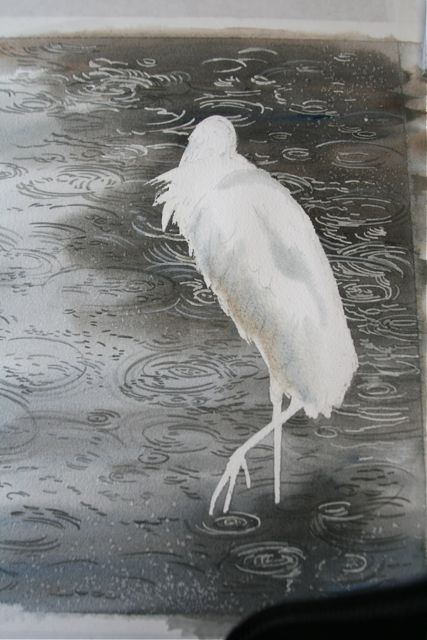
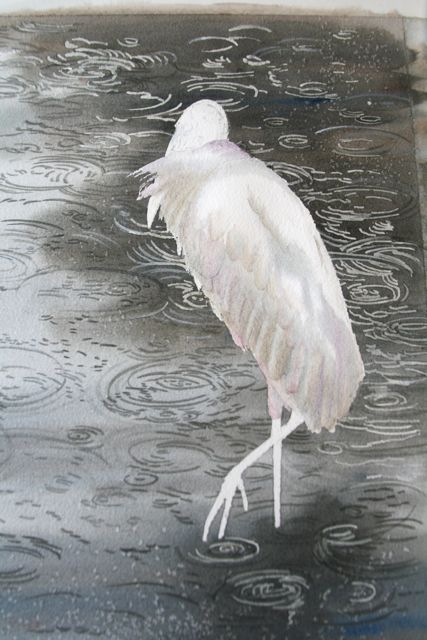
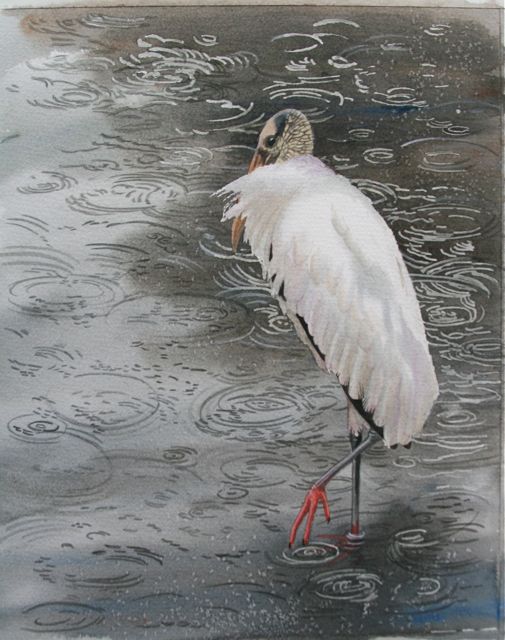
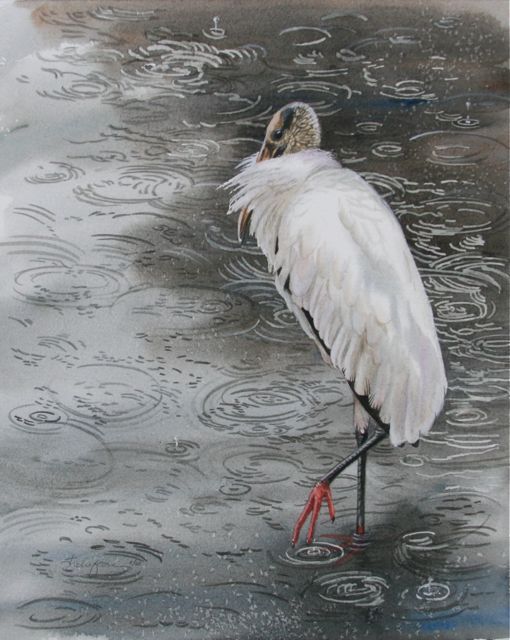
Oh goody! I get to paint the bird now! While the stork's body was wet down with clear water, I fed some of the same colors found in the water--burnt umber and cobalt blue--into that clear wash. I wanted the colors to diffuse so there would be no hard edges on the white plumage. You might be thinking at this point that the bird looks kind of dirty. Me, too. Most wood storks I've seen look dirty to start with, but that's beside the point.  Oddly enough,  you have to overpaint white birds a bit to make them look white, if that makes any sense. Or at least to make them look rounded and not flat.  White is a color that picks up color from everything around it. You can do all kinds of dirty work in the shadows of white, as long as you keep the highlights bright white. If you keep the highlights clean, the whole thing will read as white, (almost) no matter what you do in the shadows.

White is a negative space, and other colors rush in to fill it. They reflect on white; they fill it up. White is such fun to paint.

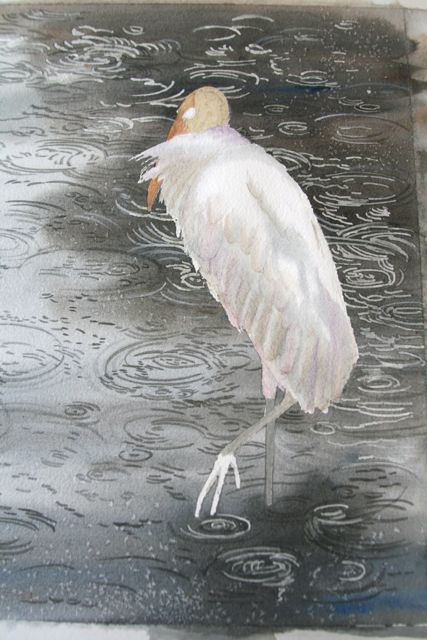
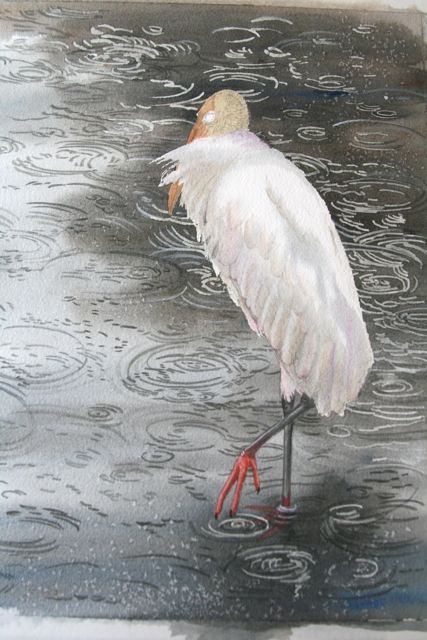
I started painting in head, bill and legs.And the darker those bits got, the cleaner the bird looked. Put dirty white against black and it suddenly looks bright and clean. And now you see why I wanted the bird to raise its foot. I couldn't resist that shrimp-pink appendage, so unexpected in such a somberly colored bird.Let's work on that head, and trick in the black edge of the flight feathers along the underside of the stork. Ahh. Now the white looks white again. Isn't that cool beyond cool?

Some of those ripples in the background are still a bit aggressive, a bit too bright, and I think they're fighting with the bird.

So I calm them down with some more gray-blue washes, and paint over an annoying squiggly one under the bird's back leg with dark gray. Time to sign it.
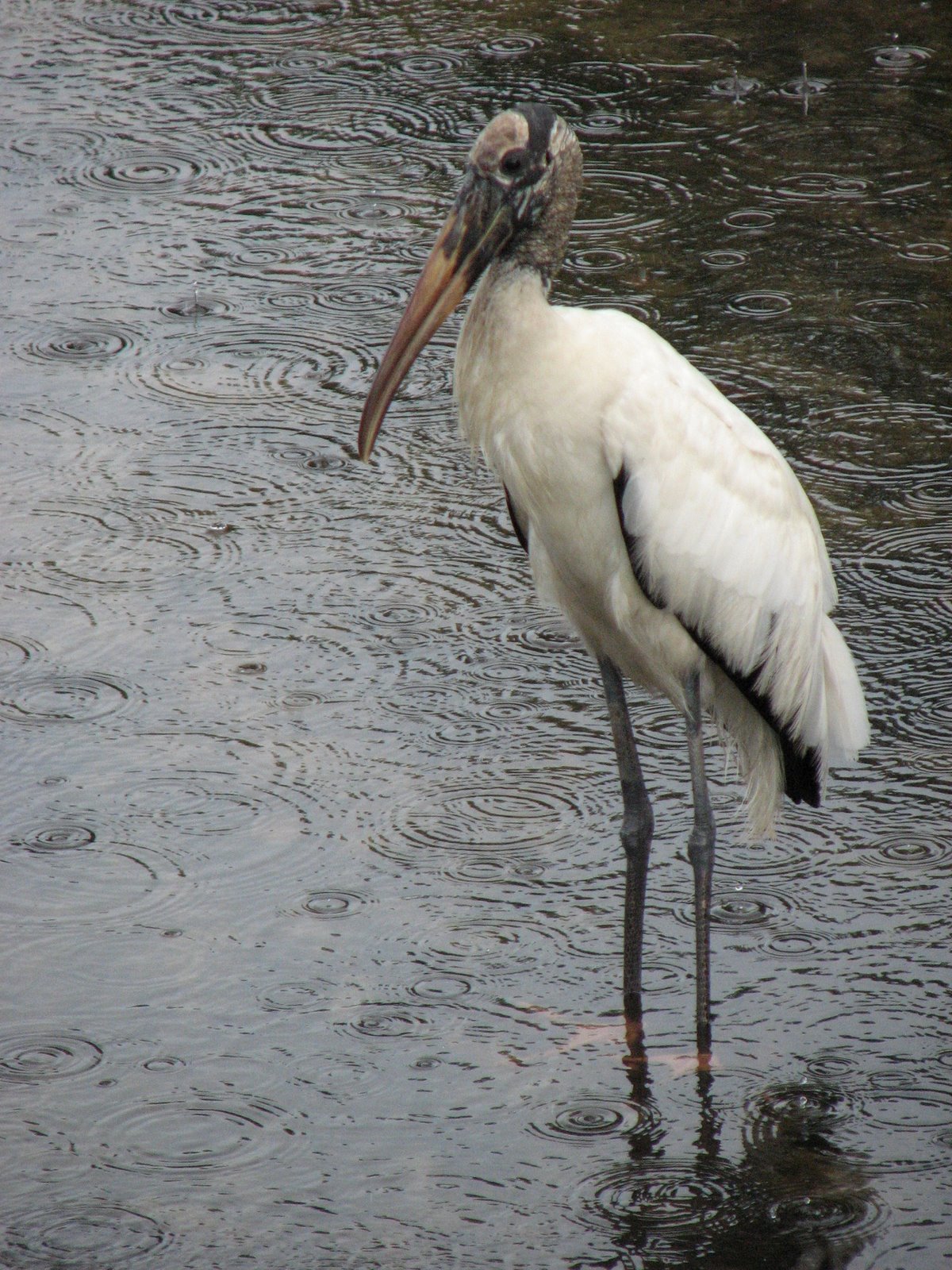
Let's have another look at that reference photo. You might be interested in my thought process on the stork. Although it's a lovely photo, I thought it lacked a bit in mood, due to the fact that the stork is on alert and facing the viewer. He looks a little tense, and facing front, he blocks the viewer from entering his world. He looks like he's challenging you, and deciding whether to fly off. As I thought about it, facing the stork more into the scene would help the viewer enter, and make the bird less confrontational. I also wanted to put the stork in a quieter, more reflective mood, so I pulled his head in and fluffed his feathers out. I very nearly closed his eyes but in the end I didn't want to remove that point of contact with the viewer.
The result is considerably simplified from the photo; fewer little rings and droplets, the stork in a more peaceful and contemplative attitude. It's not raining quite as hard in my painting as in the photo, is it? 

I like what watercolor does with water. The diffusing wet-on-wet wash gives it a painterly magic that a photo (or a slavish rendering of a photo) can't achieve. I could see the shrimp-pink foot underwater and couldn't resist raising it for a peek. I haven't necessarily improved on the photo, but I've made a painting of it with the filter of my brain. I took the commission in August, but I wasn't really ready to paint it until November, because thoughts like how to enhance the mood of the scene, how to draw the viewer in, and how to render the raindrops don't come quickly to me.

I think it's done. I don't want to overwork it. All told, I've spent one day's work on the drawing and preparation (transferring and masking); one day on the water and a day on the bird. And oh, three months on the thinking part. I do the hard stuff first and save the most fun stuff for last. It's kind of a reward system.

Net result: Money to put toward groceries and gas, happy clients, and a temporarily unblocked creative spirit. I didn't lose it; it was always there, but it seems I have to prove that to myself again and again.

Oh--the recipient loved it. Here's an excerpt from the sweetheart of a guy who commissioned it:

"I’d been teasing that her big gift was going to blow her mind, so after exchanging all the other gifts I had her close her eyes while I went upstairs to retrieve the BIG present that had been hidden unbeknownst to her in her closet the whole time. Played the eyes-closed game, had her open them, and…

"One of the things about gift-giving is that you know what the gift is and the recipient does not –as such, seeing someone look at something the first time, you can see the thought process play out in real time:


1. What is...
2. What the…
3. Oh my, this is just…
4. Oh wow…
5. WOW…
6. Hey, wait, this looks like…
7. HOLY &*(&^!
8. Wait a…HOLY &*&*^@!


And that’s pretty much how it went, and I got to watch it, and it was perfect."


Giving gifts is so much better than receiving, isn't it?

Love ya, mean it,

JZ
[Back to Top]