Background Switcher (Hidden)

Showing posts with label cattle. Show all posts

A Boy and His Calf

Friday, October 5, 2018

17 comments


This one lucky shot has had me watching the skies at dawn, sent me back on a four-mile jog again and again, trying to replicate it. I have so far failed. One of the funny things about this photo is that while I was composing it, the Great Pyrenees who guards this farm spotted me, and began to bark. I get barked at a lot, since you very rarely see a person out walking or running on these roads, and as a result I am an object of much discourse among the dogs. Being barked at makes me nervous, so I began counting her thunderous borfs. One hundred forty-seven, until I was out of earshot. 

This visit was in the afternoon, and the light was completely different. I took another shot, and saw Rusty and his son Riley out and about. Luckily, Stella hadn't spotted me.


As I rounded the curve I grinned to see the UPS truck pull up. I began humming, "Wells Fargo Wagon" from The Music Man. The driver backed into the driveway, hopped out and instead of delivering a box, he popped the hood of the truck and asked Rusty to take a look at it. It was such a homey scene. Rusty's mighty handy with engines.


The driver had pulled away by the time I got there, and Rusty told me they'd gone to high school together. We got to talking. His boy Riley shyly asked me if I'd like to meet his fair calf, Tucker. "I would LOVE to meet Tucker! I thought you'd never ask!" I answered. Rusty and Missy laughed and off Riley and I went to the barn. First though, I asked if I might meet Stella, the Great Pyrenees I'd admired from afar. I thought maybe if she knew my voice I could calm her jets going forward.

 
She wasn't so sure about me. I looked a little sketchy in her opinion. GP's are superb guard dogs, always on alert and very barky.


She took a big whiff of my scent and checked me out thoroughly with startlingly beautiful bright nut-brown eyes.


I must've checked out all right, because her trepidation turned to unbridled joy. Wow! What an unexpected boost, to have a gigantic guard dog make a snap decision that you're not just OK, but fabulous!!

 
You haven't been smiled at until you've been smiled at by Stella.
 What a doll! What a good girl! I wanted to roll around on the ground with her, but there was a calf to meet.


 Riley slipped a rope halter over Tucker's head and led him up to the gate. It was best I stay behind it.


He put his little manatee snoot through the wire to check me out.


It was clear this little steer had been very well treated.
No fear there.

I began asking Riley questions about what it takes to prepare a calf for the county fair competition, and was so captivated by his pride in the little beef that I knew I had to make a video.


We were in the barn so long that Rusty came out to see what might be going on. Just talking cattle, that's all, happy as clams.

Riley and I talked about the elephant in the barn: the fact that, this coming Saturday, he would show Tucker at the Barlow Fair, and that would surely result in his sale.  In the video, Riley says he hopes someone will buy him so they can show him next year. But he knows deep down that's unlikely.

I like to get the whole story, and that takes time: that's why I cook these blogposts for so long. I would have been at the Barlow Fair with bells on, watching and shooting as Riley showed this beautiful onyx block of a calf, but Parents' Weekend at WVU beckoned, and I had to go see my boy. I came back refreshed and happy from spending a couple of days with sweet Liam, and I wondered how Riley and Tucker had fared in Barlow.

There were a few ways to find out, but I lucked into the best. I trotted back out the ridge the next time we had a sunrise, and lo and behold if I didn't find Riley's grampa Dale out sweeping his driveway. I'd never really had a conversation with him; just waved at him and his lovely wife as the kids and I would ride by on our bikes, grinning like fools and deliriously happy that we'd finally made it up Campbell Run's grueling hill to the ridgetop where Riley's grandparents live, just a half-mile from the beautiful farm.


We talked about many, many things. Cattle and weather and life on the ridge; responsibility and crime and fidelity and marriage and changing times. It was really cool. My favorite thing Dale said was when he talked about Riley and his big sister McKenzie. "They're my lights, my bright spots. They really are."

I felt so lucky to hear that, so lucky to have heard Riley talk about raising his calf.  Lucky to be able to share it with you.

 This is my Fitbit's hi-tech witnessing of the run I did that day. There's a green spike, which means a lot of footsteps, and then some red and yellow lines.  Green: Fitbit approves. Red and yellow: Caution. You're not getting enough steps in! Well, pooh. Those red and yellow lines are me taking photos of mushrooms in people's yards. Ha ha!!

 Now:  See that hour and twenty-minute hole in the middle of all the green activity? That's me, finding out how Riley did at the Barlow Fair. Ha ha ha!! I like the way I fidget a bit at the start  (tiny red lines); settle in for the long yak (flatlining); and then fidget a lot (more red lines) before I take off for home. Dale kept apologizing for "taking a bite out of my day." Perish the thought!


 I loved every minute of our chat, which became a conversation, which became another treasured connection. Long story short: Tucker brought the third-highest price of any calf sold: $2100. Now, that has to be amortized for the feed and equipment that is purchased for readying such a calf for show. And that's darned expensive. But still. I wouldn't have known what a check for $2100 looks like at Riley's age.  That's a powerful lesson in work, preparation and reward right there.

Dale said that Tucker acted up quite a bit on the way out of the ring, and it was clear to me that the calf was right at the point where he was getting too big and strong and opinionated for Riley to handle. A fractious 600-pound Angus calf tossing his head around is a battering ram with a big bony sledgehammer at one end. I pushed away thoughts about why Tucker might have acted up, and thought of Riley, saying goodbye to a calf he'd cared for every day for the last six months.

If 4H teaches a child anything, it's that he* must let go.  He must push away thoughts. He must put all that love and care into an animal and then, when the time comes, walk away. It's a relationship he enters willingly, knowing all along that it's going to end. Knowing that this calf who loves treats and eats shirts and likes to have his soft brisket rubbed is destined, in a few too-short months, for the human food chain. He's not a dog, not a horse. He's a steer. And steers don't get to hang around. A few lucky bulls do (witness Buck the Bull), but it takes only one bull to service a herd. So all the males get cut and sold for beef. A lucky few of those get the deluxe treatment, the relationship with a human that enriches both their lives. In cattle terms, Tucker was a lucky steer, if a steer can be lucky.

*of course girls participate in 4H; I just don't want to clutter up the wording with (s)he. 

The rest of the herd (in part). Lone bull to upper left. Big cow getting up. I felt bad about that. I try not to make them get up.

I never talk with a 4H-er without picturing myself in their boots. I chuckle just thinking about it. I, who as a kid wept torrents and held funerals for every fishie that went belly-up in my 5-gallon aquarium.  I, who, grown up but no better at letting go, stared fixedly out the window for seven months while I recorded every move a hand-raised blue jay made. Who still watches for her, every day.  If there is anything I am horrible at, it's letting go when I should.

And yet as I look back on 2017, the lesson the Universe kept hurling at me was: Let Go or Be Dragged. From my beautiful kids, who were bound to leave and make their own way no matter how good the food, loving the mama, or soft the bed; to my sweet Chet Baker, who had to leave too soon; to Jemima, who went when she got the call; to my husband, who finally made the long-awaited move away just over a year ago. 2017 was all about letting them go. All of them. And I have come out of it, and I'm looking back on it all now, and I never thought I'd be able to say that. And not only am I still alive, but I'm actually feeling happy again. I knew that I would be, eventually, but it's still such a nice surprise to be level. I get out of bed in the pitch-dark morning thinking, "Well, what am I going to paint today? Where will I run? Will there be a sunrise?"


And the answer is: Sometimes. Get dressed and be ready for it. Get out and savor it when it happens.


After the enduring connection with my family and friends, it's the savoring, the land and the sky, the flowers and the birds and the insects and animals and clouds that keep me going. 


That, and the light.

The lights.


Riley's going to raise a heifer next year. That way, when he falls in love with her, he gets to keep her, watch her raise her own calves.


For more on cattle:

Buck the Bull

My NPR commentary on Buck's greatest moment

A Quiet Dawn

Friday, September 28, 2018

3 comments


It's been so wicked cloudy in the last few weeks that, when there is a sunrise, I go for it. I want to see that light spread across the sky and land, across the houses and barns and the backs of black cattle. I want to see it light up the ponds, make sky-holes of them. I keep checking the sky as 7 AM approaches. If there are breaks in the clouds, I know I may have a show to enjoy.

I remember going to Sanibel Island and Siesta Key in Florida and being completely charmed by the fact that sunrise and sunset are community events. People deliberately take time out of their day to go witness what, for them and for me, are miraculous, if daily, events. They lug lawnchairs to the beach and sit and watch.

Rarely content to sit, I like moving around under a beginning sky. The turn of the seasons, and the prospect of a long, mostly dreary cloud-socked MOV** winter,  pushes me to savor what I'm given. Don't get me wrong: clouds are among my favorite things. But I like to see light play on them, so a few breaks in the cover are what I'm after.

**Mid-Ohio-Valley
 Very funny story...Facebook discussion revealed many are wondering what an MOV winter is. Harma pointed out that the Google is no help; tells you it stands for MOV (metal oxide varistor, a type of movie file). The other thing Urban Dictionary will tell you MOV is an abbreviation for mother***** aaaaaaaaaccck! These winters get me down but not that much! Anyway, sorry to be obtuse. Or even obliquely profane, which I try not to be, at least here in my shiny blog living room. I briefly considered defining the acronym as I wrote this post, then thought, ahh, people can Google that if they don't know what MOV means...well...back to our originally scheduled programming.

Some sunrises are a slow bleed of color into a pure blue sky. Those are fine, too. Rare, and fine.

I hurried to see the sun peek over the hills. These heifers are always curious about me, as young things are.


The sun lights the side of a barn, and teases a pond out of a dark hollow. The pond gazes up at the sky. That's all it can see.


A Rose of Sharon bush has thrown its seeds and become a wild hedge of them, in particolors of pink, red and white. I just finished shearing my beautiful Satin series "Bluebird" before the 1.2 million seed pods it has set are able to dry out, burst open, and shake their progeny all over my flower beds. The things you don't think about when you're smitten with a Rose of Sharon at the nursery! I've learned through hard experience to do this. If I don't, I get to pull 1.2 million woody seedlings the next fall.


Phoebe came back from a run asking about these flowers she'd seen back in August. She's the reason I headed out the ridge in this unaccustomed direction. I don't know why I get so set in my ways, and only run the paths I'm accustomed to. But I'm glad I followed her lead, this time and so many others. 

 
 A new mother comes to the fence to tell me her calf is off-limits. She lowers her head and tosses it in an unmistakable threat. It's awfully late for a wee calf. He'd better eat up, put some weight and hair on before the winds turn biting cold.


Another look at this lovely scene, the one that got me hooked. This time, there's no drama in the sky, just the slow bleed of color that I love as well. A few starlings on the wire, singing their wandering song of fall.

Further on, I hear something like a lion roaring, and I realize it's an Angus bull, calling to his herd. 
Some young heifers have been moved across the road, to fresh pastures, and probably to be out of his...sphere of influence, and he doesn't like it one bit. Turn your sound up, and see if his low moans  transport you to the veldt.


I turn for home with the sun high in the September sky.
 By the time I'm done watching the cattle and headed back, the barn with the star on it looks like this:


I chug along, headed to the drawing table to get to work.

In the field along my road, I see a sign of the times. All its leaves have fallen, and the milkweed is letting go.


A Song for No One

Wednesday, June 27, 2018

7 comments
 I've been running daily, and it feels so right. It helps to have Phoebe in the house; she's my inspiration and personal fitness advocate. We don't run together, because we'd be running together a half mile apart, ha! But we do bike together, and there is not much that's more fun than zooming down these hills and toiling up them with my kids. Proud to be a beast, schooled by the endless Appalachian foothills.

I usually run on my road, but I need a change of scenery now and then. Because I make lists of all the birds I hear and see on each run, it's fun to change it up and see what's singing elsewhere. I can get 50 species on my two-mile stretch of road in a single run in mid-June. The number I can hear drops steadily throughout June and July, not because there are fewer birds, but because they're too busy making more of them to sing. Boy, do I know the feeling. Busy launching my fledglings and painting pictures. It kind of rules out spending a lot of time behind the keyboard.

So I took a different road, and I found some beautiful things. If I didn't already love chicory for its inimitable blue, it's even more ravishing when punctuated by goldfinches.


 You can't crop off the guardrail or the road. They're part of the story, and beautiful too, for the way they curl through the composition.


A decrepit fenceline only adds to the charm.


It was on this road that I heard a song that stopped me in my tracks. It was coming from deep in the woods, that sloped steeply away from the road.
It was a hermit thrush.
Hermit thrushes are usually denizens of cool boreal forest. In Ohio, they seek out pockets of hemlock, with the refrigerated microclimates that go along with deep rock chasms.  The closest hermit thrushes nest in the Hocking Hills, a two-hour drive west of here.

Hermit thrushes aren't supposed to be here. My county, Washington, is the big one, five up from the bottom, on the right, the one with the notch in it. Where hermits are concerned, it's blank, for Not Reported. And as you can see, there are precious few hermit thrush breeding records statewide. That's because there's precious little hemlock habitat in Ohio, and what we have is suffering badly from the hemlock wooly adelgid, a nasty gummy white sap-sucking insect from Asia. I watched in horror as it wiped out Connecticut's hemlocks in the late 1980's, and now it's happening here. I can think of only two places in Washington Co. that have any hemlock, and I'm afraid to go look at them, afraid of what I'll find.


I borrowed this map from the Second Atlas of Breeding Birds in Ohio, the one with the Zick cover. I still get a big grin on my face every time I pull this book out for reference.  It came out in April 2016, the same spring that Baby Birds did. I was so durn proud to paint the cover for my beloved state's atlas, I can't even tell you. I sure hope they ask me to paint the Third Atlas of Breeding Birds cover, whenever that comes out! I hope I can still see to paint then!


Here's what it says inside. Author Paul Rodewald goes on to prognosticate that the hermit thrush may decline even more in Ohio, with the death of our hemlocks. The state has designated hermit thrush as a Species of Special Interest. 


No kidding. I was taking a special interest in this songster, hearing him on June 23, 2018, when he "should" have been far, far to the north or west, in our special pocket of HETH habitat in the Hocking Hills. 


And yet he was here. And he was lighting up the forest with his song. I'd never heard a hermit sing in Ohio in June. I made some recordings, which increased in quality over the next few days. I'll subject you only to the good ones. I could listen to them all day.


It is instantly addicting to spend a sunrise in this forest with that bird sending out silver spirals of notes, to no one. Or to someone. I have been there three times now, and I want to go there every morning.

I've never been in a woodland precisely like this one. The reason it is unique is, I'm afraid, anthropogenic. Which is to say the hand of man is heavy on this land.

There is no understory vegetation in this forest. And this is the chewed-upon pelvis bone of the reason why. 


People in this part of Ohio will fence and run cattle in the damnedest places. Well, they do it out West, too, put cattle in our national forests, our "multi-use" land. I won't pontificate on the propriety of that, but it isn't right ecologically to put cattle in a forest, either for the cattle or the forest. Cattle are descended from African ancestors. They belong on savannah; they belong on grasslands. Cattle eat grass. But, when forced by necessity, they will also eat anything that might try to come up in the understory of a forest. Which does not include grass.


So what you get when you've had cattle on a piece of land for decades, maybe hundreds of years, is topography like this. Deeply cut and eroded and trampled. And you can see for hundreds of yards. Now, that makes it pleasant to walk through, to be sure, but it is practically devoid of birds and wildflowers. I found some striped wintergreen, but most everything else trying to grow there was nonnative. Like the cattle.


Tromp and graze and cut it for enough decades, and the land becomes deeply eroded, with rivulets, most of them seasonal, running between artificial pillowed ridges. This landform was made by overgrazing. By people, and the cattle they put here. It happened when the forest was cut, grew back, was cut, grew back...and they never gave it a rest from grazing.


The Virginia pines, I'm thinking, dominate here because the cattle wouldn't eat them. Yes, it's a wholly artificial situation, atypical of the mixed deciduous forest in our area. There are a few beeches and red maples, but most of the cover is pine.

And pine, it seems, is close enough to hemlock for this hermit thrush. The missing understory, oddly, mimics that of hemlock forests. (Hemlocks poison plants that try to grow beneath them, and the ones that don't die get shaded out). This forest is cool and very dark, and there's lots of water. It must have felt like home to this wintering hermit thrush, enough so that he decided to stay.

 The forest is practically devoid of birds. Except This Bird. 

I kept visiting, hoping to see him singing. It was funny, being a pretty good lifelong birder, to keep coming home empty-handed. But he was singing high in the canopy first thing in the morning, and I just couldn't pick him up. 

So I lay down and made videos, imagining which treetop he might be in, while the silvery streamers of his song floated down and landed gently around me. I let hearing him be enough for me, and it was more than enough. 

 On June 26, I lay there so long--over an hour--that I zeroed in on the exact pine where I thought he might be. And then I got up and circled around, staring hard at the pine top, hoping. 

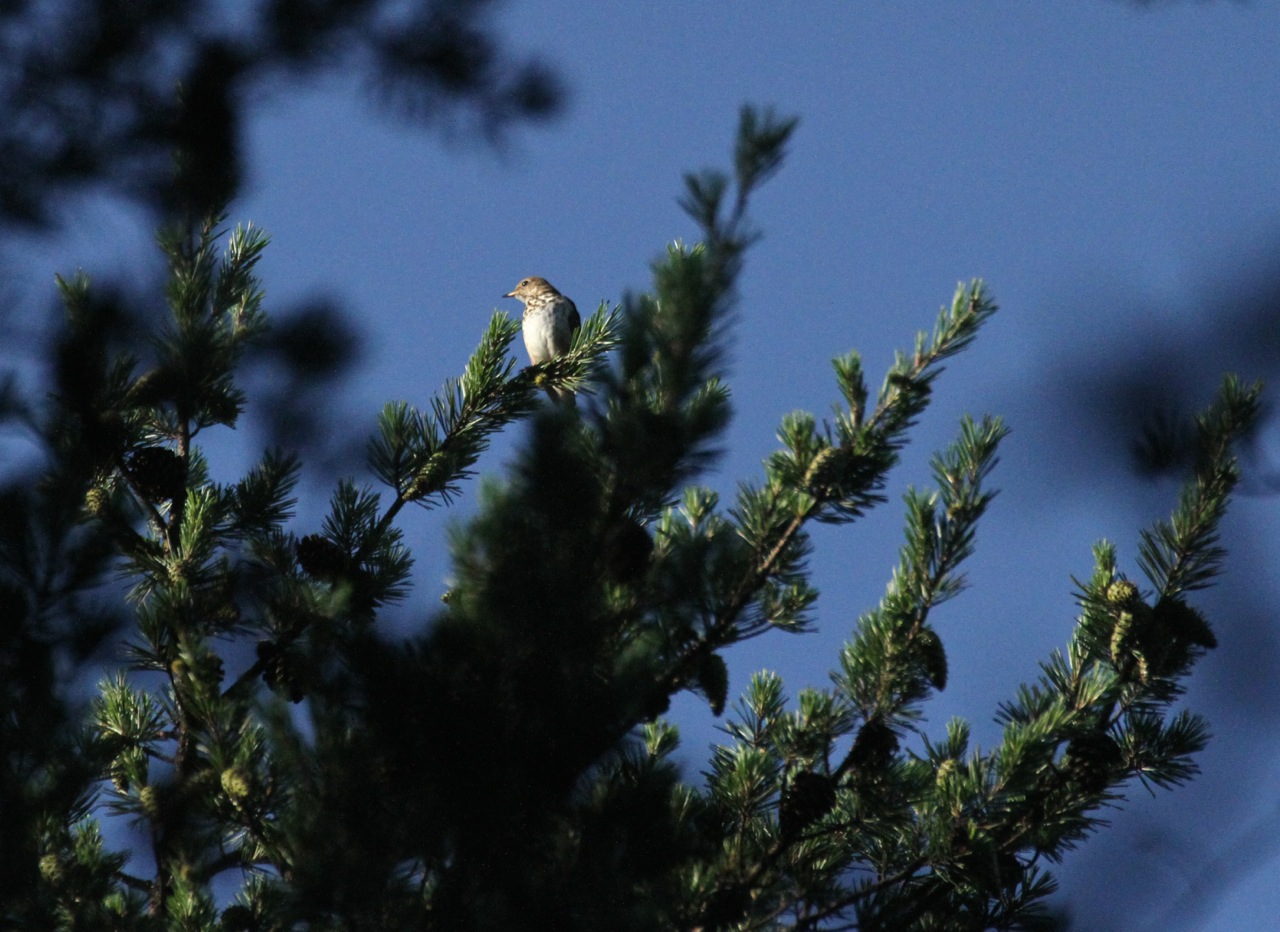
And I saw him. He was lit by the warm morning sun, a little white angel topping my best Christmas tree ever.


And he saw me. Hrrnh? A human?


But he didn't stop singing. He noted me and took me in and paused a few moments and then went right on with his homily.


And for that I was grateful. To see that song come out of his little yellow maw, well, it was a sweet reward for days of patient waiting. But it got better. I was positioning myself for a better shot, using a dead limb as a stabilizer, and he suddenly disappeared. After singing for at least an hour in one spot, he was gone. 

I saw something falling down through the canopy like a big brown leaf. It was him. He came down to have a closer look at me. 


It was so, so dark down where I was, but he paused just long enough for me to get a blurry shot that showed his rusty tail--the best mark for a hermit. 


He kept singing. And I saw another big brown leaf come up from the forest floor and land near him. It looked to me like another hermit thrush.

I left then, so as not to disturb them any further. I climbed out of the ravine, exalted by my brush with this finest of singers, thrilled that I hadn't frightened him; that instead of flying away, he'd chosen to come down to have a look at me. 


The light came through the windshield of an old junked truck, and I thought about all the crap humans leave behind on the land. Not just our junk, but our misuse and abuse of the land. We turn a bunch of animals that weigh a ton apiece loose in a forest and expect them to thrive. We never even give a thought to what our huge animals destroy; to the trails and ruts they carve in the land. We throw old cars and cans and bottles full of God knows what there, because it's a place to put junk where we won't have to look at it.


And the earth thanks us in a song like this, in a hymn for undeserving ears.


I work to deserve a song like this. I figure if I share it with you, and it brings you peace and wonder, the hermit thrush will like that. There's no way he could sing a song so beautiful without caring who hears it.


Talking to the Neighbors

Saturday, February 4, 2017

11 comments
As I continue to recover from surgery and shingles, feeling around to find my strength and wellness again, I'm slowly upping my hours and miles back to something that feels normal. I try to surpass 10,000 steps per day. It feels so good to cover some ground again. I'm not sure when running is going to feel right again. Hoping it will. Ankles hurt all the time. Not sure what that's about.

For now, I'm in hiking boots, slogging through mud and over tussocks.

If the morning is fair, which it all too rarely is, I hurry out to catch the sunrise. 

I can never capture it to my satisfaction, but trying is fun. There's the corner oak that marks the east 40 on our property. 

If I capture the land, the clouds suffer. 


If I capture the clouds, the land suffers. Still, digital phone cameras are worlds better than my little film Pentax and Canon AE-1 used to be. Dawn's always a challenge. 


On my way out to the sunrise I stop to see Ellen, or what's left of her. She's still lying in the field where the coy-wolves dragged her, the same one where she fell. Just a ribcage, a spine, a leg and a hoof. 
She'll be gone with the first hay cut, just some hard bits of bone in a hayroll somewhere.


This is why I need Buffy, Flag and Pinky. I need them like I need breakfast and hot tea.

I need these wide landscapes and softly smiling skies.


And oh, I need the sun, the shadows. It's been behind gray blankets for far too long. My friend Scott called them "dryer lint skies." Just about as inspiring as dryer lint, too.

But on a sunny morning, well, anything's possible. My brain works a lot better.


The base of an oak reminds me of a mountain slope with trees creeping up to timberline. You look at a distant mountain in the West, and you can't believe how tiny the huge trees look, straggling up its flanks. You try to imagine walking out there. That's what this oak bole brought to mind.


The bark of another oak, a fresh amazement. How can the code for this corky structure be contained in the DNA of cells? How does it form so characteristically by species, into perfect runnels and ridges?


Set back from the new fenceline is a row of old posts, relics. Someone strung them with barbed wire while they were living trees, and the wire cut faces in them as they struggled to grow around it. I saw a moai god, come to Ohio. Rapalachian cow scratcher. 


I'm delighted to see the neighbors coming up out of the woods.


I haven't met them here this time of day.


The lone Holstein heifer takes herself a good scratch on the log god. Looks like he's saying Ooh Ooh Ooh.


I can see much of it is worn smooth from such daily attention. This is why I can't put bluebird boxes up in cow pastures. They'd get scratched and leaned and pushed right down.


This little Hereford bull calf is so adorable in his heavy fur coat. 

And I'm charmed by the markings on this one. Look at her bib, the spot between neck and breast; the particolored ears. Cattle are dead easy to tell apart at first glance. Whitetails, not so much. 


You can look at her stance and see something's going on here. She arches her back and cuts a luxuriant fart, doing her part to add to the world's methane.


In the woods, another little sprite pauses to look back at me. 


A smart person won't fall in love with beef cattle. Happy to be dumb then, blundering my way through others' hayfields, hanging on their fencelines, talking to the neighbors.


[Back to Top]