I'm an artist and writer who lives in the Appalachian foothills of Ohio. With this blog, I hope to show what happens when you make room in your life, every day, for the things that bring you joy. Strange...most of them are free.
Thurs. Feb. 27, 2020, 7 PM: "Saving Jemima: Life and Love with a Hard-luck Jay" at
Mt. St. Joseph University Theater, 5701 Delhi Rd., Cincinnati, OH 45233. Doors open 6:30 pm.
For info call Colleen McSwiggin (513) 244-4864
Mar. 11-15, 2020: Bird Friendly Backyard workshop and Saving Jemima talk at Joint Conference, N. Am.
Bluebird Society/Bluebirds Across Nebraska, Holiday Inn Convention Center, Kearney, NE. Right in the middle of
sandhill crane migration! Call (308) 237-5971 for reservations.
Mon. Mar. 23, 2020, 6 PM: "Saving Jemima: Life and Love with a Hard-luck Jay" at Morgan Co. Master Gardeners Event, Twin City Opera House, 15 W. Main St., McConnelsville, OH. Free and open to the public. Call (740) 962-4854 for information.
Sun. Mar. 29, 2020, 3 PM: "Saving Jemima: Life and Love with a Hard-luck Jay" at
Sunday With Friends,, Washington Co. Public Library, 205 Oak Hill St. NE, Abingdon, VA 24210. For more information, call (276) 676-6390
Apr. 30-May 2, 2020: Julie Zickefoose at New River Birding Festival, Opossum Creek Retreat, Fayetteville, WV. Friday night keynote: Saving Jemima. Curtis Loew, miracle curdoggie, presiding.
May 7, 2020, 7 pm: "Saving Jemima: Life and Love with a Hard-luck Jay" at Campus Martius Museum, Washington and Third Streets, Marietta, OH. Booksigning after. If you missed the Esbenshade lecture/ People's Bank talk in November 2019, this is your event!
Weds. May 13 2020, 5:30 PM: "Saving Jemima: Life and Love with a Hard-luck Jay" at Roger Tory Peterson Estuary Center's event at Essex Meadows, 30 Bokum Rd., Essex, CT 06426
This event is open to the public.
Thurs. May 14 2020, 6 PM: "Saving Jemima: Life and Love with a Hard-luck Jay" at New Haven Bird Club's Annual Banquet, Amarante's Restaurant, 62 Cove St., New Haven, CT 06512. This event is open to the public!
Sat. May 16, 2020: "Saving Jemima: Life and Love with a Hard-luck Jay" for Bergen Co. Audubon Society at
Meadowlands Environment Center, 2 DeKorte Park Plz, Lyndhurst, NJ 07071
Time to be announced. Call (201) 460-1700 for more info.
Sun. May 17, 2020, 2 PM: "Saving Jemima: Life and Love with a Hard-luck Jay" at White Memorial Conservation Center, 80 Whitehall Rd., Litchfield, CT 06759. Call (860) 567-0857 for information.
Tues. May 19, 2020, 7 PM: Good Reads on Earth Author Series, by PRI's Living On Earth with Julie Zickefoose and Saving Jemima at Mass Audubon's Drumlin Farm Wildlife Sanctuary, 208 South Great Rd., Lincoln MA 01773. Includes audience participation, and will be taped for airing on public radio! Get the book first, read up and call (781) 259-2200 for information.
Thurs. May 21, 2020 6 pm: Julie Zickefoose, "Saving Jemima: Life and Love with a Hard-luck Jay" at
Bigelow Chapel, Mount Auburn Cemetery, 580 Mt. Auburn St. Cambridge MA 02138. Call (617) 547-7105 for more info.
I took a celebratory walk down the entire road, a total of 3 miles down and 3 miles back up, on June 21. I was celebrating the Summer Solstice, and it was going to be a scorcher, so I started well before sunrise in the cool of the night. I wanted to be in the arms of Dean's Fork when the sun came up on the longest day of the year. It had been so hard to come by, this feeling of peace. The boot was always hanging over my head, ready to drop. The thought that the next time I visited, the beavers might have been shot and their dam ripped out again made going on my favorite hike a proposition fraught with anxiety. I never took a whole breath until, peeking through the shrubs and trees, I saw water where it should be.
And now...now I could believe it would all still be there when I came to see it.
The reflections on the water, the sun coming through fresh leaves, the songs of thrushes and catbirds all around. The sweet warm breath of June, wafting across awakening meadows. The insect choir.
The first Rosa carolina smiling from the moist ditches, their scent pure attar of rose, the scent that sends me through the weeds and down to my knees to inhale it.
My boon companion by my side, or more properly pulling me along. Constantly reminding him not to pull, occasionally having to put the lead on the clip on his chest (It's the Walk Right front connect harness, and it's great). He hasn't learned not to pull because I praise him when he pulls me up the hills. The same thing that helps on hills annoys me on a straightaway. Any dog would be confused.
He's on a lead because there are just too many temptations for a ramblin' man on Dean's Fork.
The chitter of chipmunks, the sudden thumps and windy cries of deer...all would take him down their trails.
The apports kept coming on this auspicious day. My third barred owl feather of the spring, not far from where I found the belly feather on our last trip. This is probably a primary covert--a very stout long shaft on a short strong feather. This feather is rooted in the fused finger bones of the owl. That one pale spot on the vane says barred owl, as does the cool umber-brown color. You can't feel it, but the whole thing is very soft and downy. That's how I knew it was an owl feather--that and the large size. Stoutness of shaft tells you a lot. It tells you how big the bird was, and where on the bird the feather came from.
I had already figured out through concerted Chimping and staring at it that this was a barred owl primary covert, but it was fun to get confirmation from this photo from the Rouge River Bird Observatory blog.
See the feathers the bander's thumb is on? Those are the primary coverts. Thanks, Rouge River Bird Observatory! And thanks to whomever tossed that feather down in my path. Dean's Fork is rich in spirit. It's always leaving messages for me to find. And today, I was ringing like a struck bell, open to the joy, because I finally felt I'd been able to accomplish something here.
I walked on farther and found a clump of fur in the road. Now that was interesting.
I feel I have a few choices here: fox, coyote or bobcat. The hair is wavy, but not crimped, which makes me lean away from canid and toward bobcat. There are no obvious guard hairs, which also makes me lean felid. The gentle tawny color sure works for bobcat too. I rubbed it between my fingers and was reminded of the one and only time I'd ever touched a bobcat--the kitten I took in for a brief time. Its fur had a dense, wooly hand--without the filmy silkiness of domestic cat fur-- that surprised me.
I found this clump of hair in a stretch where, in favorable conditions, I almost always find bobcat tracks. I've tucked it in my little deerskin pouch with its bit of wool from Miracle, the white bison in Jamestown, ND. It has power I can feel, the kind of power I need.
My Solstice beaverdam celebratory shirt: I BELIEVE. Empowered. Badass bunny hugger.
As it always does when I turn around on a sunny morning, Dean's knocked me flat. Oh what will I do when that black barn falls down? Photograph its ruins, I suppose. I hope it stands forever, or at least outlives me. Slate roof, swaybacked but still solid. Big brown bats within: poopin' up a pile.
The yarrow is out today, and the yellow sweet clover.
But the sweetest surprise of this solstice day was running into Brad and Becky and their three youngun's, who flew and drove great distances to be with their dad on Father's Day. Brad and Becky are well-known naturalists in Marietta. And here they were, come to see the beaver pond on Dean's Fork. This was a first for me. I've never run into another naturalist here unless it was pre-arranged, usually by me.
I was so amazed I asked if I could take their photo. And it made a pretty nice family Father's Day portrait!
I had to ask how this wonderful family knew to come here. Well, they'd found out about it via my blog! That made me so happy. Dean's Fork needs love from people who care, who won't toss beer cans, dump their gutted deer carcasses (yeah, I see what you do), poach, or rip up the road "muddin'." Ugh. To that end, I talk to everyone I see here, if they'll talk to me. That's how you build community, how you let them know you're watching.
When I got home, I saw the first chicory opening by my mailbox.
I can't find a time of day when I want to sit down and write a blogpost. I'd rather be loping along, grabbing images of late July. I've fallen into my delicious stay-at-home routine which keeps me healthy, happy and wise, if not materially wealthy. I wake up with the first cardinal at 5 and am out on the road by 6:30, enjoying the sunrise and the opening chicory and the long beamed raking light and shadows. I'm proud to say I have an addictive personality--but only for beauty and exercise and being outside.
I get a huge dose of all this every morning, and it sets me up for a day of painting blue jays for Saving Jemima. If that isn't a good life, I don't know what is. I'd love to share my new paintings, but Houghton Mifflin Harcourt frowns on that. October 2019...watch for it!
I thought last year was beautiful. This year, though...
Sweet peas and chicory, a rare Three Graces view in the back, plus bonus bumblebee!
Across the road, the very first tall ironweed bursts into bloom on July 18! Very early. It's announcing the festival that'll be going on in August, whetting my appetite for great swatches of royal purple, for the round heads of Joe-pye weed and dancing swallowtails of three species.
Had to get those Graces in the shot. Not a great angle for the tree dancers, but with ironweed, a rising sun, and The Three Graces, how can you lose?
I've been having the kids drop me off a few miles down our county road on their way to work in the morning. We get a wee bit of car time, a bit more time to yak and be together, and I get to be out where it's most beautiful way earlier than I could get there if I ran from the house. It's fabulous. And all the ground I cover is new, because I'm only running one direction. Yes, I run the same road most every day, but it changes overnight.
Chicory and rust-red dock seeds and hayrolls and a barn. Winning!
Yep, that's me, crouching by the side of the road, in case you were wondering as you sped by. I should probably wear a shirt with my Instagram address in big block letters. I amuse myself by thinking what they must be thinking as they smile and wave every morning. Oh, there she is. Doesn't get all that much running done, does she? Usually hunkered down peering at the flars.
On this morning's outing, I discovered that these glorious roadsides had just been mowed down. Goodbye, evening primrose and chicory...
until mid August. See you then. That's what perennial roots are for.
I ran down our dirt road yesterday, singing our Rain Crows song, "Dirt Road." I'll sing it TONIGHT, July 20, 2018, at The Blennerhassett Hotel with the full band! That's in Parkersburg, WV, and we're playing 7-10 pm, old people's hours. If you're within striking distance, come see us. We'll be in the delightful rose garden if it's not raining, and in the gorgeous leather lounge if it is. Win win. From left: Wendy Clark, keyboard/vocals; Craig Gibbs, bass/guitar; JZ, vocals, woodwinds, percussion; Mike Austin, drums; Bill Thompson III, guitar/vocals.
Wasn't that smooth, to talk about our dirt road, then segue into an ad, then go back out on the road again?
Real good chicory skies on a side path.
I found a couple things on our dirt road that got me all excited.
First was a perfect, still shiny-wet pile of bobcat poop. Adult bobcat poop. Big stuff, maybe 3/4" in diameter, but broken into the short, square Tootsie Roll segments that say CAT. I was happy about that! That's the kind of cat I like to have spooking around my house.
Second was a little smashed bottle. I knew it would be good, because it looked like something you'd get at the Impulse Buy counter at a gas station, so I picked it up.
Nobody there to hear me crowing, first over bobcat poo, then over
SEXIEST FANTASIES tempt me sweetly
Alas, no bouquet remained, as it had been squashed many times over, but I was delighted to learn that one could enter a new world of sensual fantasies with a little alcohol, denatured water, fragrance and propylene glycol. Humans are such suggestible creatures. I'll spray this on and he'll go wild!
Thanks, I'll take the bobcat poop.
( I realized at this moment, with a small sigh, that I lead a very dull life by ordinary human standards. I find it incredibly exciting, but I get excited by things most people don't even notice.)
When I got home, Phoebe had Blackberry Cloud Cake, a Martha Stewart recipe, waiting for me. Sugared wild blackberries and pistachios top an impossibly light concoction of meringue and blackberry whipped cream. She had whomped it up late the night before, rolled it, refrigerated it, and had it waiting for me when I got back from my run. It's the food of angels. The tart blackberries and crunchy salted pistachios make it.
We had to do something with all those wild blackberries that have sprung up around our totally neglected oil derrick on the back 40. The company that leases the well is happy to take our oil, but is definitely not keeping up its part of the bargain to maintain the well. The welljack is busted and covered in brambles, and we're heating and cooking only on the natural pressure of the gas as it comes out of the ground, unaided by the jammed welljack. It's been out of commission for more than a year!! Makes me very nervous. Will the pressure hold all winter, keep my greenhouse warm?
The only good thing about this deplorable situation is blackberries.
It is SO GOOD to have my girl and boy home this summer, together.
Things people don't even notice:
The 3/4", impossibly blue blossoms of dayflower.
The Lamborghini of beetles, the dogbane beetle. With my cellphone reflected in his chrome. Click on this one.
An oddly bent petal,
which turns out to be the silken shelter of the wee looper who's been eating
all the true flowers out of the black-eyed Susan's eye, and leaving lots of
frass, too.
And under the silk shelter of the flower in the back?
A yellow crab spider who has doubtless eaten the wee looper that went with this flower. Gonna have to click on this one to see the spider. Noticing...it's the thing to do.
So. I've found myself far more interested in loping around, playing with my kids, cooking, gardening, looking at bugs, checking bluebird boxes, taking photos, and painting for my book than blogging frequently this summer. Not apologizing, because everything is free here. However. I have a situation that has smoked me out, that I'm hoping someone out there enjoying this post might remedy.
I'm taking a group of ten travelers to southern Ecuador for a birding/natural history/photography/ridiculously fun and indulgent trip, October 24-Nov. 2, 2018. And I had it all sewn up, had a beautiful group assembled, and life intervened, as it often does, and three people had to drop out at essentially the last minute. So I have three spaces open on a Holbrook Travel-sponsored private Zicktrip that's coming up fast. Guiding will be me, the fabulous Mario Cordoba, and Ecuadorean guide Manny Lopez. That's three guides for ten people, and that's deluxe. Here are a few critters we saw in 2017.
Booted racket-tail.
Lubber grasshopper nymph.
Donna, Mario, and our local guide scoping the canopy.
Violet-tailed sylph. Lord, lord, lord.
Moustached antpitta.
Plate-billed mountain toucan in the rain.
Ecuador is SO MUCH FUN. Southern Ecuador will be new territory for me and Mario! Traveling with a small group of 13 total, 3 of them guides, is wonderful. If you have the means and the time, and would like to join us, click this link! And if it fills right up, I keep a waiting list, so leave your email with Holbook. Thank you for reading, for noticing, and for indulging me on this rare two-ad post. I hope there's enough bobcat poo and floral lore to balance the shameless self-promotion.
I've been running daily, and it feels so right. It helps to have Phoebe in the house; she's my inspiration and personal fitness advocate. We don't run together, because we'd be running together a half mile apart, ha! But we do bike together, and there is not much that's more fun than zooming down these hills and toiling up them with my kids. Proud to be a beast, schooled by the endless Appalachian foothills.
I usually run on my road, but I need a change of scenery now and then. Because I make lists of all the birds I hear and see on each run, it's fun to change it up and see what's singing elsewhere. I can get 50 species on my two-mile stretch of road in a single run in mid-June. The number I can hear drops steadily throughout June and July, not because there are fewer birds, but because they're too busy making more of them to sing. Boy, do I know the feeling. Busy launching my fledglings and painting pictures. It kind of rules out spending a lot of time behind the keyboard.
So I took a different road, and I found some beautiful things. If I didn't already love chicory for its inimitable blue, it's even more ravishing when punctuated by goldfinches.
You can't crop off the guardrail or the road. They're part of the story, and beautiful too, for the way they curl through the composition.
A decrepit fenceline only adds to the charm.
It was on this road that I heard a song that stopped me in my tracks. It was coming from deep in the woods, that sloped steeply away from the road.
It was a hermit thrush.
Hermit thrushes are usually denizens of cool boreal forest. In Ohio, they seek out pockets of hemlock, with the refrigerated microclimates that go along with deep rock chasms. The closest hermit thrushes nest in the Hocking Hills, a two-hour drive west of here.
Hermit thrushes aren't supposed to be here. My county, Washington, is the big one, five up from the bottom, on the right, the one with the notch in it. Where hermits are concerned, it's blank, for Not Reported. And as you can see, there are precious few hermit thrush breeding records statewide. That's because there's precious little hemlock habitat in Ohio, and what we have is suffering badly from the hemlock wooly adelgid, a nasty gummy white sap-sucking insect from Asia. I watched in horror as it wiped out Connecticut's hemlocks in the late 1980's, and now it's happening here. I can think of only two places in Washington Co. that have any hemlock, and I'm afraid to go look at them, afraid of what I'll find.
I borrowed this map from the Second Atlas of Breeding Birds in Ohio, the one with the Zick cover. I still get a big grin on my face every time I pull this book out for reference. It came out in April 2016, the same spring that Baby Birds did. I was so durn proud to paint the cover for my beloved state's atlas, I can't even tell you. I sure hope they ask me to paint the Third Atlas of Breeding Birds cover, whenever that comes out! I hope I can still see to paint then!
Here's what it says inside. Author Paul Rodewald goes on to prognosticate that the hermit thrush may decline even more in Ohio, with the death of our hemlocks. The state has designated hermit thrush as a Species of Special Interest.
No kidding. I was taking a special interest in this songster, hearing him on June 23, 2018, when he "should" have been far, far to the north or west, in our special pocket of HETH habitat in the Hocking Hills.
And yet he was here. And he was lighting up the forest with his song. I'd never heard a hermit sing in Ohio in June. I made some recordings, which increased in quality over the next few days. I'll subject you only to the good ones. I could listen to them all day.
It is instantly addicting to spend a sunrise in this forest with that bird sending out silver spirals of notes, to no one. Or to someone. I have been there three times now, and I want to go there every morning.
I've never been in a woodland precisely like this one. The reason it is unique is, I'm afraid, anthropogenic. Which is to say the hand of man is heavy on this land.
There is no understory vegetation in this forest. And this is the chewed-upon pelvis bone of the reason why.
People in this part of Ohio will fence and run cattle in the damnedest places. Well, they do it out West, too, put cattle in our national forests, our "multi-use" land. I won't pontificate on the propriety of that, but it isn't right ecologically to put cattle in a forest, either for the cattle or the forest. Cattle are descended from African ancestors. They belong on savannah; they belong on grasslands. Cattle eat grass. But, when forced by necessity, they will also eat anything that might try to come up in the understory of a forest. Which does not include grass.
So what you get when you've had cattle on a piece of land for decades, maybe hundreds of years, is topography like this. Deeply cut and eroded and trampled. And you can see for hundreds of yards. Now, that makes it pleasant to walk through, to be sure, but it is practically devoid of birds and wildflowers. I found some striped wintergreen, but most everything else trying to grow there was nonnative. Like the cattle.
Tromp and graze and cut it for enough decades, and the land becomes deeply eroded, with rivulets, most of them seasonal, running between artificial pillowed ridges. This landform was made by overgrazing. By people, and the cattle they put here. It happened when the forest was cut, grew back, was cut, grew back...and they never gave it a rest from grazing.
The Virginia pines, I'm thinking, dominate here because the cattle wouldn't eat them. Yes, it's a wholly artificial situation, atypical of the mixed deciduous forest in our area. There are a few beeches and red maples, but most of the cover is pine.
And pine, it seems, is close enough to hemlock for this hermit thrush. The missing understory, oddly, mimics that of hemlock forests. (Hemlocks poison plants that try to grow beneath them, and the ones that don't die get shaded out). This forest is cool and very dark, and there's lots of water. It must have felt like home to this wintering hermit thrush, enough so that he decided to stay.
The forest is practically devoid of birds. Except This Bird.
I kept visiting, hoping to see him singing. It was funny, being a pretty good lifelong birder, to keep coming home empty-handed. But he was singing high in the canopy first thing in the morning, and I just couldn't pick him up.
So I lay down and made videos, imagining which treetop he might be in, while the silvery streamers of his song floated down and landed gently around me. I let hearing him be enough for me, and it was more than enough.
On June 26, I lay there so long--over an hour--that I zeroed in on the exact pine where I thought he might be. And then I got up and circled around, staring hard at the pine top, hoping.
And I saw him. He was lit by the warm morning sun, a little white angel topping my best Christmas tree ever.
And he saw me. Hrrnh? A human?
But he didn't stop singing. He noted me and took me in and paused a few moments and then went right on with his homily.
And for that I was grateful. To see that song come out of his little yellow maw, well, it was a sweet reward for days of patient waiting. But it got better. I was positioning myself for a better shot, using a dead limb as a stabilizer, and he suddenly disappeared. After singing for at least an hour in one spot, he was gone.
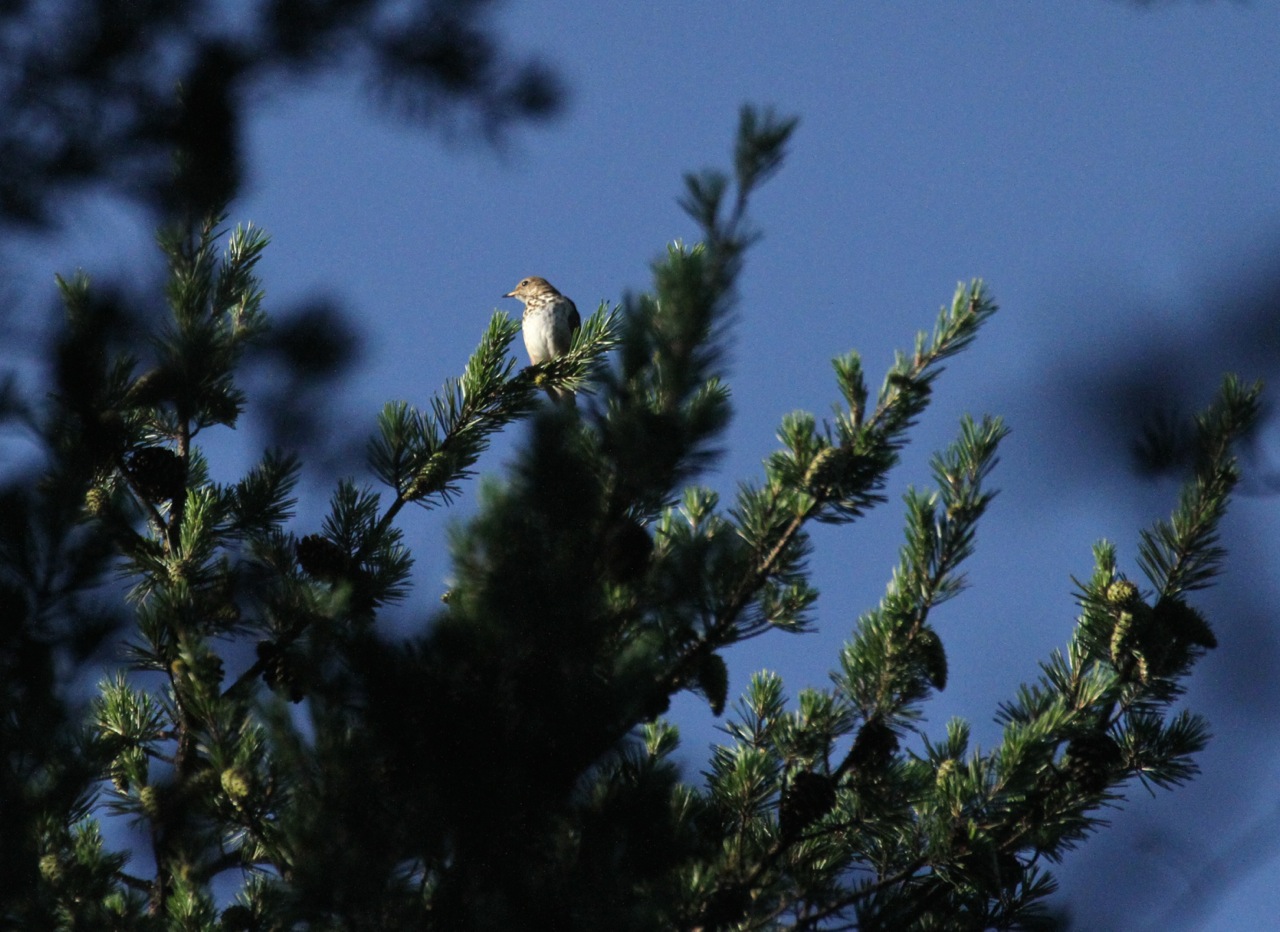
I saw something falling down through the canopy like a big brown leaf. It was him. He came down to have a closer look at me.
It was so, so dark down where I was, but he paused just long enough for me to get a blurry shot that showed his rusty tail--the best mark for a hermit.
He kept singing. And I saw another big brown leaf come up from the forest floor and land near him. It looked to me like another hermit thrush.
I left then, so as not to disturb them any further. I climbed out of the ravine, exalted by my brush with this finest of singers, thrilled that I hadn't frightened him; that instead of flying away, he'd chosen to come down to have a look at me.
The light came through the windshield of an old junked truck, and I thought about all the crap humans leave behind on the land. Not just our junk, but our misuse and abuse of the land. We turn a bunch of animals that weigh a ton apiece loose in a forest and expect them to thrive. We never even give a thought to what our huge animals destroy; to the trails and ruts they carve in the land. We throw old cars and cans and bottles full of God knows what there, because it's a place to put junk where we won't have to look at it.
And the earth thanks us in a song like this, in a hymn for undeserving ears.
I work to deserve a song like this. I figure if I share it with you, and it brings you peace and wonder, the hermit thrush will like that. There's no way he could sing a song so beautiful without caring who hears it.
Saturday, June 27, 2020
4 comments