Background Switcher (Hidden)

Showing posts with label birdsong. Show all posts

Moon as Ovum and Other Surprises

Friday, November 19, 2021

3 comments


I was a little bleary this morning. There was, after all, some kind of once in 500-years total lunar eclipse, the slowest ever bla bla bla...I don't pay much attention to the various  distinguishing human markers slapped on every celestial event, but I was excited about seeing the moon in an altered state. There was a mackerel sky in force upon my retiring, and I had high hopes it would break up by the time the eclipse got going. 


My brain, naturally, woke me at 1:30 AM, 2:33 AM. and 3:47 AM. Each time I got up to look. Finally, at 3:47, the clouds had cleared and I had to run to the west side of the house to find the moon. It was worth it.


I couldn't shake the impression that it was not a moon; it was an ovum. It looked watery, diaphanous. It looked like it would jiggle like an egg yolk if you poked it. There it was floating in the vast womb of the sky, waiting for something to come swimming along and make something of it. It was unfinished, protoplasmic. I was riveted. Penumbra. That's what the disc is called, right? Even that sounds like a reproductive term.
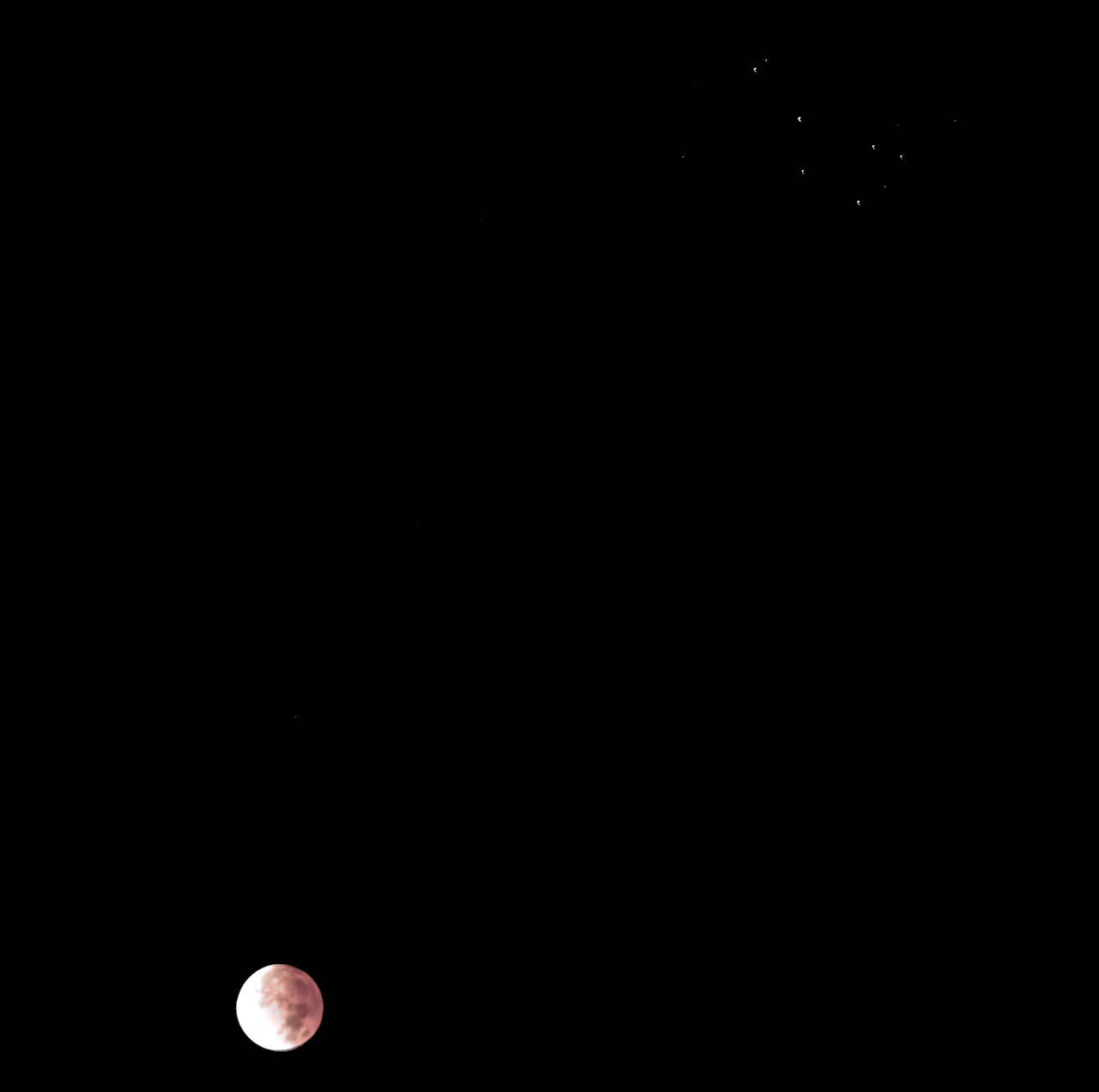

It was very difficult to photograph, especially without a tripod. I should have digiscoped it, but fussing with a scope, tripod and phone adaptor at 4:05 am was just not something I could handle. I couldn't even deal with finding socks for my freezing feet. So I sat down on the ground, leaned against a cold concrete retaining wall, steadied myself, and shot some lousy photos. I kind of like this one, that includes the Pleiades, or Seven Sisters, in the upper right corner. Orion was bold and bright, but he was caught up in the twigs of a birch and I had no hope of capturing him. I have a sort of crush on Orion. At least he makes me smile each time I run into him.

I went back upstairs and it was getting light when I finally drifted back to sleep. I opened my eyes again at 6:55 AM. Four wakeups feels like a lot, even for me. Still, getting to enjoy the celestial events (that always happen at miserable hours) is one of the very few benefits of chronic insomnia. 

Who could be droopy and sorry, though, when this is waiting for them in the living room upon arising? 

We call this Wide Stance. He assumes it when he is asserting himself. Such a guy. I'm very proud of Curtis because a quick check-in at the vet's today showed that he has dropped more than four pounds! He's a lithe 43.4 lb. and I am delighted about that. It's all about the crispy fall weather. Running weather. And run he does. I can't believe my companion is 7 now. Where do the years go? Well, we started the clock at Year 4. That's most of it. How I wish I could have loved him from Day One. But his life experience has made him the dog he is. He is the Most Wonderful Dog.


I walked out the meadow with him. First, there had to be zooms, and hiding. He doesn't hide himself very well; I think he thinks I'm blind.  He hides the way an adult hides from a baby. He lets me find him.


We went out the orchard next, and I got an idea. After a slowly spectacular near-total lunar eclipse, well, there might just be another surprise out there. Yes! The first frostflowers of winter 2021! The red blackberry leaf says it all. It's still fall, and they're already out.


I was so intrigued. There was a freshness, a pristinity to them I hadn't seen before. I think these are the earliest frostflowers I've ever found. Please click on each photo, because the detail is so beautiful, and these photos are so small.


One American dittany plant, its stems splayed, a flower on each one!


Being so fresh, and the first, these were tight, beautifully formed, close curling flowers. This one looks like a cone shell.


I almost threw this photo away before I saw the only in-focus part: a frost flower just forming in the rightmost dark stem! Wow! Do click on the photo to see what I mean. The stem is split, and the flower is just starting to protrude.


This one reminded me of Casper the Ghost's friend. Elmore? I can't remember his name. I love the way they're rising up into the frigid morning light. OooooOOoooOooo


There's something so delicious about seeing fresh frostflowers with green grass blades.


For those new to my blog, you can get the whole story on frostflowers and why they form at this post:

Please note that in this post, I had the plant incorrectly identified as pennyroyal when it is in fact American dittany. I was in the right family (mint), but it took awhile to ID the plant from the withered remains I found. I'm also bemused that last year's post is from November 22...pretty much right on target. See, that's the great thing about getting older. You forget when stuff happened, so everything is fresh and new all the time! Here I was thinking these were my first November frostflowers. Well, they're earlier by maybe two days...


This is a much better post about frostflower origins:


It's devilishly difficult to photograph American dittany (Cunila origanoides) complete with frosty skirts because the stems are hair-thin and just vanish in the clutter. But those small paired green leaves belong to the frostflower plant!


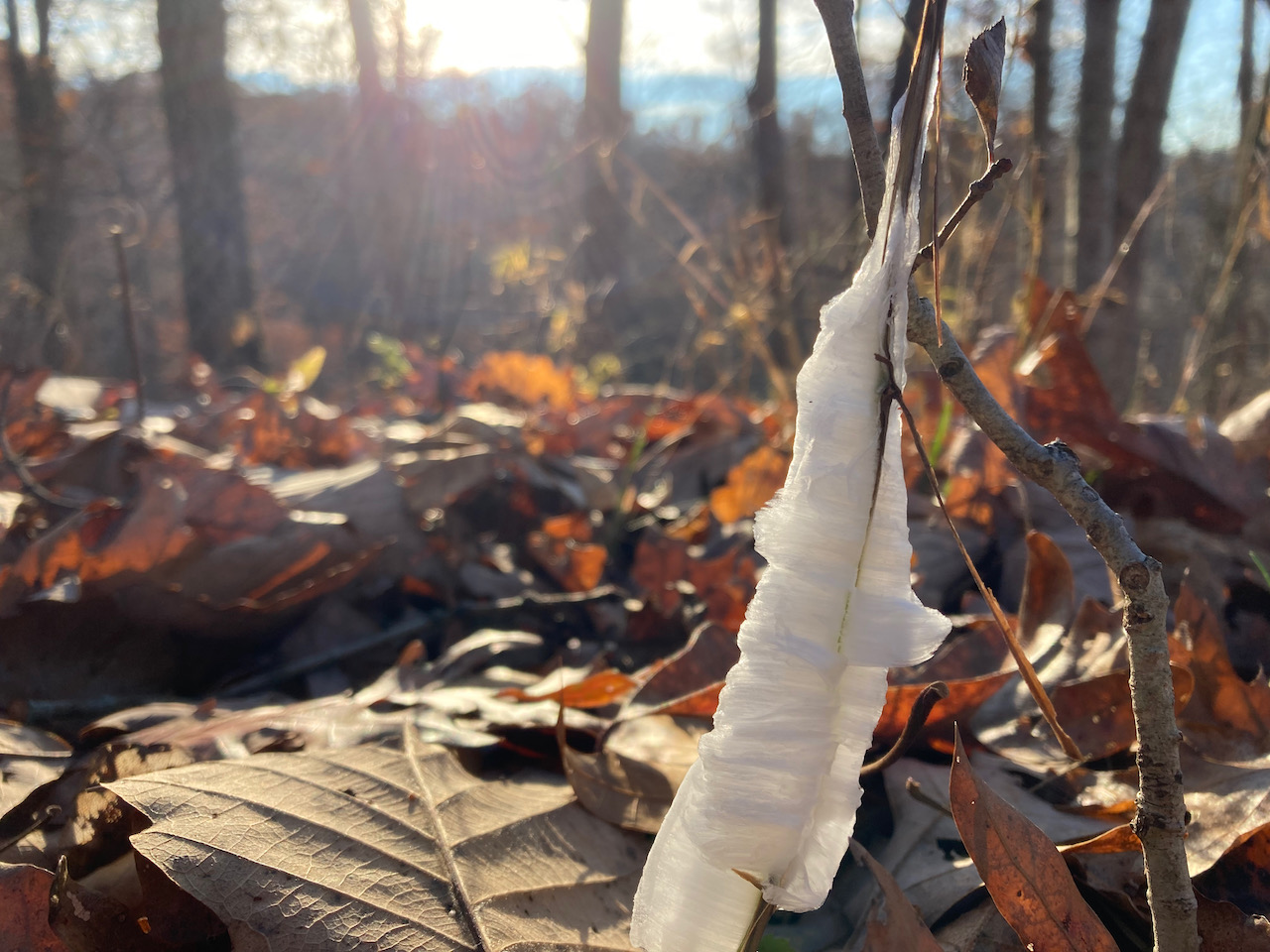
It's wonderful to get down and close with them, especially when there are still green leaves about.


Yes, it was a frostflower morning, and a fine one. Everything old is new again. I am continually amused by the wonders laid out for me to find. For that I am continually thankful. 


I made my way back up the orchard from the gasline cut where the dittany dances. I had long since misplaced Curtis; he was giving occasional bays from deep in Orchid Valley, safely in the middle of my land, and that was fine. 

I walked very slowly as the orchard was seething with birds. Gleaming cedar waxwings in the tulip tops, preening and cuddling. I love a bird that will sit touching shoulders with its friends. 

The winter wren that chimps at me every time I walk past Bill and Elsa's graves. 

And hermit thrushes. Man, do we have the hermits this year. I have a way of talking to them that, if I'm very patient and lucky, often results in their singing a few phrases. They're pretty territorial in winter, I guess, because my pitiful imitations of their songs and a much better imitation of their tchup! call bring them right in. Today, after much waiting, I was rewarded with November songs. Ahhhh how that conjures the boreal forest for me, even as I stare into a miserable tangle of Japanese honeysuckle in Appalachia. I do adore these little elves of the thicket. I'm so grateful they stay the winter here. All hail sumac and honeysuckle fruit; withered grapes and the odd snail or slug. 


I've been wanting to blog for a very long time, but just couldn't pull the trigger. I'm too busy. Crazy to imagine someone living in the middle of the woods being too busy to blog, but there you go. New ventures, new directions, good things. I miss writing to you. I especially wrote this one for Jeanne. 


I'll leave you with a Towertop Sunset. Sound up for a bonus white-throated sparrow, rambling adorably. Dootin-doo-doo, feelin' groovy! in a sparrowy kind of way. 

                  

A Song for No One

Wednesday, June 27, 2018

7 comments
 I've been running daily, and it feels so right. It helps to have Phoebe in the house; she's my inspiration and personal fitness advocate. We don't run together, because we'd be running together a half mile apart, ha! But we do bike together, and there is not much that's more fun than zooming down these hills and toiling up them with my kids. Proud to be a beast, schooled by the endless Appalachian foothills.

I usually run on my road, but I need a change of scenery now and then. Because I make lists of all the birds I hear and see on each run, it's fun to change it up and see what's singing elsewhere. I can get 50 species on my two-mile stretch of road in a single run in mid-June. The number I can hear drops steadily throughout June and July, not because there are fewer birds, but because they're too busy making more of them to sing. Boy, do I know the feeling. Busy launching my fledglings and painting pictures. It kind of rules out spending a lot of time behind the keyboard.

So I took a different road, and I found some beautiful things. If I didn't already love chicory for its inimitable blue, it's even more ravishing when punctuated by goldfinches.


 You can't crop off the guardrail or the road. They're part of the story, and beautiful too, for the way they curl through the composition.


A decrepit fenceline only adds to the charm.


It was on this road that I heard a song that stopped me in my tracks. It was coming from deep in the woods, that sloped steeply away from the road.
It was a hermit thrush.
Hermit thrushes are usually denizens of cool boreal forest. In Ohio, they seek out pockets of hemlock, with the refrigerated microclimates that go along with deep rock chasms.  The closest hermit thrushes nest in the Hocking Hills, a two-hour drive west of here.

Hermit thrushes aren't supposed to be here. My county, Washington, is the big one, five up from the bottom, on the right, the one with the notch in it. Where hermits are concerned, it's blank, for Not Reported. And as you can see, there are precious few hermit thrush breeding records statewide. That's because there's precious little hemlock habitat in Ohio, and what we have is suffering badly from the hemlock wooly adelgid, a nasty gummy white sap-sucking insect from Asia. I watched in horror as it wiped out Connecticut's hemlocks in the late 1980's, and now it's happening here. I can think of only two places in Washington Co. that have any hemlock, and I'm afraid to go look at them, afraid of what I'll find.


I borrowed this map from the Second Atlas of Breeding Birds in Ohio, the one with the Zick cover. I still get a big grin on my face every time I pull this book out for reference.  It came out in April 2016, the same spring that Baby Birds did. I was so durn proud to paint the cover for my beloved state's atlas, I can't even tell you. I sure hope they ask me to paint the Third Atlas of Breeding Birds cover, whenever that comes out! I hope I can still see to paint then!


Here's what it says inside. Author Paul Rodewald goes on to prognosticate that the hermit thrush may decline even more in Ohio, with the death of our hemlocks. The state has designated hermit thrush as a Species of Special Interest. 


No kidding. I was taking a special interest in this songster, hearing him on June 23, 2018, when he "should" have been far, far to the north or west, in our special pocket of HETH habitat in the Hocking Hills. 


And yet he was here. And he was lighting up the forest with his song. I'd never heard a hermit sing in Ohio in June. I made some recordings, which increased in quality over the next few days. I'll subject you only to the good ones. I could listen to them all day.


It is instantly addicting to spend a sunrise in this forest with that bird sending out silver spirals of notes, to no one. Or to someone. I have been there three times now, and I want to go there every morning.

I've never been in a woodland precisely like this one. The reason it is unique is, I'm afraid, anthropogenic. Which is to say the hand of man is heavy on this land.

There is no understory vegetation in this forest. And this is the chewed-upon pelvis bone of the reason why. 


People in this part of Ohio will fence and run cattle in the damnedest places. Well, they do it out West, too, put cattle in our national forests, our "multi-use" land. I won't pontificate on the propriety of that, but it isn't right ecologically to put cattle in a forest, either for the cattle or the forest. Cattle are descended from African ancestors. They belong on savannah; they belong on grasslands. Cattle eat grass. But, when forced by necessity, they will also eat anything that might try to come up in the understory of a forest. Which does not include grass.


So what you get when you've had cattle on a piece of land for decades, maybe hundreds of years, is topography like this. Deeply cut and eroded and trampled. And you can see for hundreds of yards. Now, that makes it pleasant to walk through, to be sure, but it is practically devoid of birds and wildflowers. I found some striped wintergreen, but most everything else trying to grow there was nonnative. Like the cattle.


Tromp and graze and cut it for enough decades, and the land becomes deeply eroded, with rivulets, most of them seasonal, running between artificial pillowed ridges. This landform was made by overgrazing. By people, and the cattle they put here. It happened when the forest was cut, grew back, was cut, grew back...and they never gave it a rest from grazing.


The Virginia pines, I'm thinking, dominate here because the cattle wouldn't eat them. Yes, it's a wholly artificial situation, atypical of the mixed deciduous forest in our area. There are a few beeches and red maples, but most of the cover is pine.

And pine, it seems, is close enough to hemlock for this hermit thrush. The missing understory, oddly, mimics that of hemlock forests. (Hemlocks poison plants that try to grow beneath them, and the ones that don't die get shaded out). This forest is cool and very dark, and there's lots of water. It must have felt like home to this wintering hermit thrush, enough so that he decided to stay.

 The forest is practically devoid of birds. Except This Bird. 

I kept visiting, hoping to see him singing. It was funny, being a pretty good lifelong birder, to keep coming home empty-handed. But he was singing high in the canopy first thing in the morning, and I just couldn't pick him up. 

So I lay down and made videos, imagining which treetop he might be in, while the silvery streamers of his song floated down and landed gently around me. I let hearing him be enough for me, and it was more than enough. 

 On June 26, I lay there so long--over an hour--that I zeroed in on the exact pine where I thought he might be. And then I got up and circled around, staring hard at the pine top, hoping. 

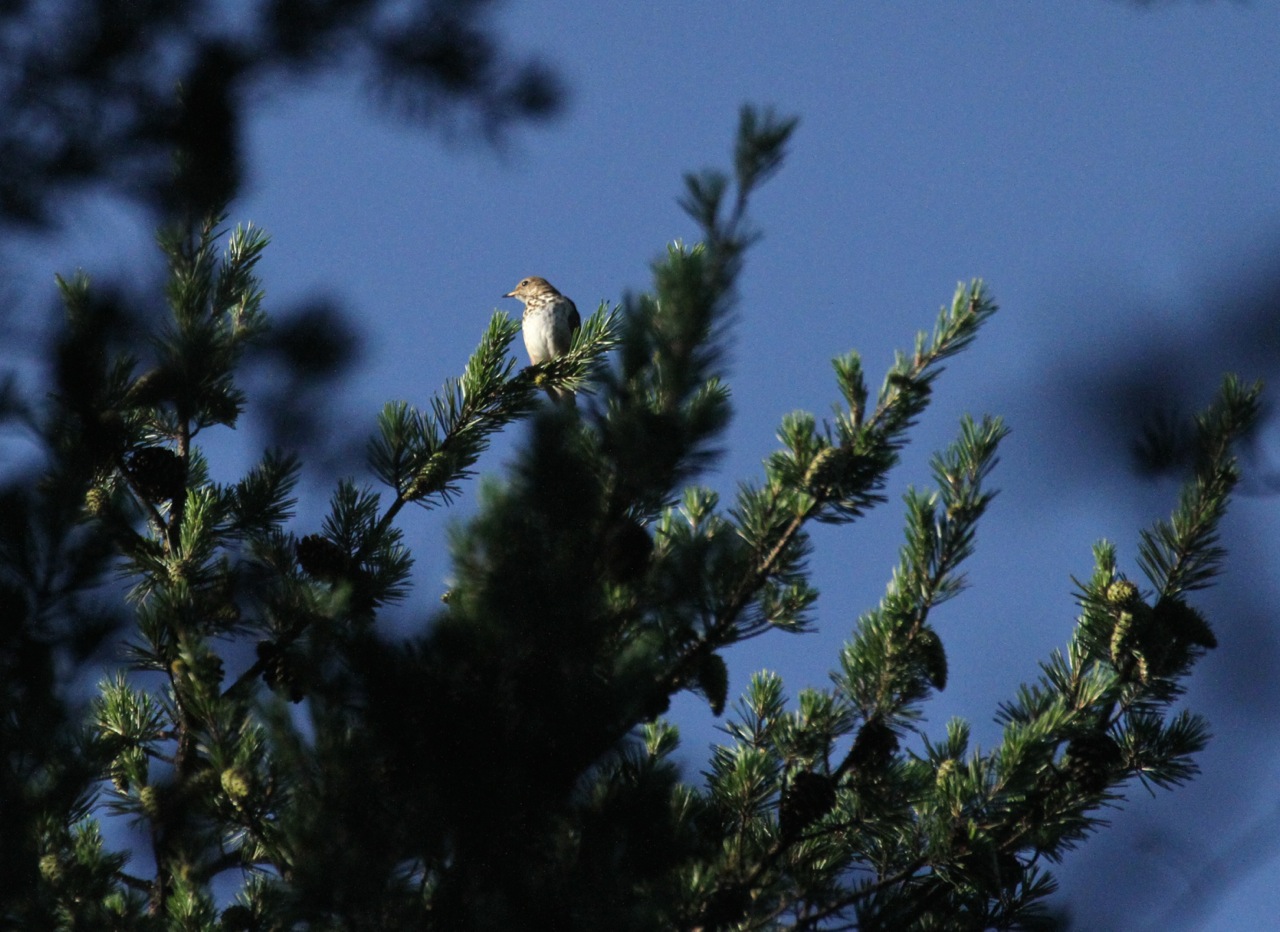
And I saw him. He was lit by the warm morning sun, a little white angel topping my best Christmas tree ever.


And he saw me. Hrrnh? A human?


But he didn't stop singing. He noted me and took me in and paused a few moments and then went right on with his homily.


And for that I was grateful. To see that song come out of his little yellow maw, well, it was a sweet reward for days of patient waiting. But it got better. I was positioning myself for a better shot, using a dead limb as a stabilizer, and he suddenly disappeared. After singing for at least an hour in one spot, he was gone. 

I saw something falling down through the canopy like a big brown leaf. It was him. He came down to have a closer look at me. 


It was so, so dark down where I was, but he paused just long enough for me to get a blurry shot that showed his rusty tail--the best mark for a hermit. 


He kept singing. And I saw another big brown leaf come up from the forest floor and land near him. It looked to me like another hermit thrush.

I left then, so as not to disturb them any further. I climbed out of the ravine, exalted by my brush with this finest of singers, thrilled that I hadn't frightened him; that instead of flying away, he'd chosen to come down to have a look at me. 


The light came through the windshield of an old junked truck, and I thought about all the crap humans leave behind on the land. Not just our junk, but our misuse and abuse of the land. We turn a bunch of animals that weigh a ton apiece loose in a forest and expect them to thrive. We never even give a thought to what our huge animals destroy; to the trails and ruts they carve in the land. We throw old cars and cans and bottles full of God knows what there, because it's a place to put junk where we won't have to look at it.


And the earth thanks us in a song like this, in a hymn for undeserving ears.


I work to deserve a song like this. I figure if I share it with you, and it brings you peace and wonder, the hermit thrush will like that. There's no way he could sing a song so beautiful without caring who hears it.


A Song Sparrow Named AlphaBits

Thursday, March 29, 2018

3 comments
 Longtime readers of this blog will remember Luke, the leucistic song sparrow first photographed in this Appalachian Ohio yard on October 7, 2012. He was spectacular, and beloved, as all my special woodland friends are.

He'd show up for the Big Sit in mid-October, thrill our friends, hang around for a little while, then disappear until around Easter, when he'd set up territory in the side and back yard. Oh how I loved that little sparrow.

I'd photograph him through the bedroom window, singing in the crape myrtle by the fishpond. This is Easter, 2013. 


With his snow-white cap, throat, primaries and tail feathers, and his pale pink bill and legs, he was a showstopper. Leucistic birds are sometimes called "partial albinos." They have a patchy expression of albinism. Sometimes they're dilute and pale overall, but more often they have scattered white patches like Luke did.

 I felt so blessed to call him my friend and neighbor. How lucky can you get, to have a bird like this singing in your yard for three years?


This is my last photo of him, taken January 7, 2015. Luke didn't reappear in the spring of 2016. I was, of course, bereft. Again. I find myself bereft all too often. This is the lot of women who fall for wild things. However, if I have faith and wait, some other marvelous creature comes along to fill my critter-loving heart back up. Or, more properly, I fixate on another victim. ;)
 

What a cutie Luke was. I think he knew how special he was. Toward the end of his stay on Indigo Hill, I could call, Luuuuke!! and he'd pop up in the prairie meadow, as if he knew I needed to see him.

Last summer I noticed that one of my resident song sparrow's songs was very distinctive. Now, a song sparrow has a whole collection of songs that he mixes and matches throughout his day. They are all similar in pattern but not in pitch or notes. This song type was a doozy!

I loved hearing this bird all throughout the spring and summer of 2017. He left in the fall and I heard him no more. I was trying very hard to sleep in earlier this month when my subconscious took note that Alpha Bits had returned and was singing his distinctive little song outside my bedroom window--at 5:45 AM! I awoke and sat straight up with a big smile on my face. AlphaBits!! You're back!

Here's how he sounds. This video was taken at dawn, March 24, 2018. You can't see him, but you can sure hear him!


This bird sings the first six notes of The Alphabet Song. A B C D E F ... It's so melodic, it's uncanny. No wonder we call them song sparrows!

I have a bunch of audio recordings of AlphaBits from 2017 and already from this spring. It took a little while longer to get a halfway decent photo of Alpha Bits. I never managed to in 2017--he's very shy and he doesn't tend to sit high up and exposed while singing. But I got lucky later that same morning that I made the beautiful dawn video. These shots were taken through my bedroom window screen on March 24, 2018. So they're lousy. I've since taken the screen out and washed the windows. I've been trying to catch him ever since. He's singing, but not where I can photograph him. Soon enough, my pretty. I'll get you, and your little song, too!


He's not Luke, but he's beautiful all the same.


I love more than anything connecting with the special birds and animals who share my habitat. I love knowing that I have the same song sparrow as was here the year before. I am constantly looking and listening for the distinguishing features of each creature I meet.


Sometimes, the distinguishing feature is only in the song.


But that is enough. All of this is more than enough.


ZICK ALERT: TODAY, Thursday, March 29: I'll be telling the story of the WV snowy owl who dominated my blog just before last Christmas. I've distilled more than 1500 words and 160 photos into a gripping narrative. There's a lot of who'd'a thunk it stuff about snowy owls, too, courtesy Project SNOWstorm and a special guest photographer. 7 pm, Campus Martius Museum, 2nd and Washington Streets, Marietta, Ohio, March 28, 2018. I rarely get to speak locally so I'm very excited to see who shows up! Thank you!!

When May Comes...

Sunday, May 28, 2017

5 comments


 I awoke on a May morning to birdsong, as I always do this time of year. April is tough. My brain has to transition from no song to a sudden chorus coming in the window. And early May is worse, but better too; worse in the sense that my brain starts processing and sifting all those songs and winds up yammering to me so that I wake up thinking about what I'm hearing in my "sleep." Better in that the birds are back! and singing! and I will have to slowly learn to sleep through the robins and cardinals and wake up for the prairie warblers and yellowthroats. So this morning was kind of fun, because the song sparrow who now sings under my bedroom window has one song type that I find quite sweet.


 Listen to this video. He'll sing twice, once at 09-12 seconds, and again at 24 seconds.

 Do you hear the familiar climbing scale we all learned when we were three? He's singing the Alphabet Song! A B C D E F GGGGGG...he never goes on to H I J K LMNOP. But oh, the musicality in that voice! He's hitting the notes perfectly, perfectly. And my brain grabs onto that and runs with it, even before I'm awake. The brain is a wonderful organ. It can be extremely annoying, when I need sleep so badly and rarely seem to get it, but there it is.

 Right after I made this recording (dominated by the pond fountain, burbling away, and my iPhone's obsessive focus on the window screen) he switched to another song type, not nearly so anthropomorphic. And don't animals charm us most when they remind us of ourselves? Sigh. It's true. For those curious, a field sparrow's sweet accelerating trill opens the video, then a blue-winged warbler sings bee-buzz, followed by the song sparrow. Then comes the field sparrow, overlain with the brown-headed cowbird's piercing Twee dee dee! and the song sparrow finishes the 30-second clip with his Alphabet Song again. It's so rich. It's late May. Abbondanza!

Blackberry spring. 

 Missouri primrose says YEAHHH!


And THIS is what happens when you put cow manure and water on a peony that's been struggling for years. It says YES THAT IS WHAT I HAVE NEEDED. THANK YOU VERY MUCH!


 A blue jay shows up at the feeder with a soiled front. I know what that means. She's nest-building, using wet rootlets to weave her amazing solid platform, and it's dirtied her breast as she shimmies around to form the cup.

As if to corroborate this bit of situational awareness, her beautiful mate swoops in with a gular load of sunflower hearts for his hardworking wife's breakfast. So nice to have someone to cook for you when you're oversubscribed. 

 Everybody's oversubscribed. The bluebird babies grow fat and fill my nest boxes.


Oh what can happen in only a week!!


I must check this cardinal nest again. I saw the female pop off of it as I walked down the orchard path and found these three exquisite orbs full of protein and hope.


On my next peek six days later (May 16), here's what I found. And I've stayed away since. 


The temptation is great to look often. But predators are watching, sniffing, wanting, so I don't. 

I don't blog often in April, May and June. It's not for lack of material. It's for lack of time, for my cheese being spread too thin over the immense cracker of obligation. I've got everything I can do to keep up with this yard, the gardens, my family, friends and a too-hectic speaking and traveling schedule. And the moment I get a breather, and get to stay home for a few weeks in a row, in come the baby birds to be fed every half-hour. It is both my joy and my ball and chain, and balancing it all and keeping the joy is the big trick.

On days when I haven't slept much and it seems that everything and everybody needs a piece of me, and life goes roaring on all around me, I remind myself that I'm just one good sleep away from being on top of it again. And that's the truth. 

I get a good sleep, then spend a whole day, sunup to dark, gardening and doing heavy yardwork, and the sleep and the work fix the broken parts, glom them back together.


The Pig of Good Fortune smiles on the inkblot someone dribbled on the emerald grass.


The Encyclia from Guatemala laughs out loud, filling the studio with clove and honey.Twelve years it's been growing and blooming, and I treasure it more every year. 


This doughty plant, brought home as a withered bulblet in my bra, reminds me that everything good is worth waiting for. And as DOD pointed out, I'm already waiting.


Grandma Cora (proper name, Madame Chereau), blooms as she's bloomed for more than a century. Planted in the Adirondacks exactly 100 years ago by my friend Caroline's Grandma Cora, who was then young and just married, this treasure has been passed from hand to hand and state to state. It's blooming in Caroline's South Dakota garden, in my sister's garden in Connecticut, and soon to go to Massachusetts, too. We will have to count up the states where Cora blooms.

First with a few blossoms, and many furled buds


And then, when the May sun shines at last, with a full fanfare of cobalt violet, and the heady aroma of fake grape Kool-Aid! And there are orange shirts on the line, and I just have to lie down in the sweet smelling grass for a minute and breathe, unable to believe that I get to live here


in all this useless beauty I've planted with my own square and calloused hands. The nails are broken and there's dirt under what's left, but I wouldn't have it any other way.


Thank you for all your expressions of love and support after that last difficult post.  I occasionally must gather myself and tell the full truth of what's going on, or I can't go forward. It takes me months to work up the words and the courage to do it, but I owe you that, and it's the best way I've found to put one foot in front of the other and keep going on. Chet Baker is doing fine. He's still good for a 5-mile walk, and his coat is coming in shiny and new. I can't tell you how much it means to me to run my hands over a mostly smooth coat,  to see the little hairs standing on end as they grow in, and to blow a raspberry on that round belly, too.


He puts up with a baby bluejay who likes to jump suddenly up on his back. He tucks his rump and scoots out from under her, which deters her not one bit. You must click on this to see the look on his face. Ut oh. Here she comes again.


Chet Baker, yep, he still comes along. And I treasure every moment that he does.


May 26, 2017

Happy birthday to Hodge (yesterday), The Light of Cambridge, Star of Middlesex County, and to Ida (today) who is in every flower and bird and shining through the sweet souls of my children, too.


[Back to Top]