I'm an artist and writer who lives in the Appalachian foothills of Ohio. With this blog, I hope to show what happens when you make room in your life, every day, for the things that bring you joy. Strange...most of them are free.
Thurs. Feb. 27, 2020, 7 PM: "Saving Jemima: Life and Love with a Hard-luck Jay" at
Mt. St. Joseph University Theater, 5701 Delhi Rd., Cincinnati, OH 45233. Doors open 6:30 pm.
For info call Colleen McSwiggin (513) 244-4864
Mar. 11-15, 2020: Bird Friendly Backyard workshop and Saving Jemima talk at Joint Conference, N. Am.
Bluebird Society/Bluebirds Across Nebraska, Holiday Inn Convention Center, Kearney, NE. Right in the middle of
sandhill crane migration! Call (308) 237-5971 for reservations.
Mon. Mar. 23, 2020, 6 PM: "Saving Jemima: Life and Love with a Hard-luck Jay" at Morgan Co. Master Gardeners Event, Twin City Opera House, 15 W. Main St., McConnelsville, OH. Free and open to the public. Call (740) 962-4854 for information.
Sun. Mar. 29, 2020, 3 PM: "Saving Jemima: Life and Love with a Hard-luck Jay" at
Sunday With Friends,, Washington Co. Public Library, 205 Oak Hill St. NE, Abingdon, VA 24210. For more information, call (276) 676-6390
Apr. 30-May 2, 2020: Julie Zickefoose at New River Birding Festival, Opossum Creek Retreat, Fayetteville, WV. Friday night keynote: Saving Jemima. Curtis Loew, miracle curdoggie, presiding.
May 7, 2020, 7 pm: "Saving Jemima: Life and Love with a Hard-luck Jay" at Campus Martius Museum, Washington and Third Streets, Marietta, OH. Booksigning after. If you missed the Esbenshade lecture/ People's Bank talk in November 2019, this is your event!
Weds. May 13 2020, 5:30 PM: "Saving Jemima: Life and Love with a Hard-luck Jay" at Roger Tory Peterson Estuary Center's event at Essex Meadows, 30 Bokum Rd., Essex, CT 06426
This event is open to the public.
Thurs. May 14 2020, 6 PM: "Saving Jemima: Life and Love with a Hard-luck Jay" at New Haven Bird Club's Annual Banquet, Amarante's Restaurant, 62 Cove St., New Haven, CT 06512. This event is open to the public!
Sat. May 16, 2020: "Saving Jemima: Life and Love with a Hard-luck Jay" for Bergen Co. Audubon Society at
Meadowlands Environment Center, 2 DeKorte Park Plz, Lyndhurst, NJ 07071
Time to be announced. Call (201) 460-1700 for more info.
Sun. May 17, 2020, 2 PM: "Saving Jemima: Life and Love with a Hard-luck Jay" at White Memorial Conservation Center, 80 Whitehall Rd., Litchfield, CT 06759. Call (860) 567-0857 for information.
Tues. May 19, 2020, 7 PM: Good Reads on Earth Author Series, by PRI's Living On Earth with Julie Zickefoose and Saving Jemima at Mass Audubon's Drumlin Farm Wildlife Sanctuary, 208 South Great Rd., Lincoln MA 01773. Includes audience participation, and will be taped for airing on public radio! Get the book first, read up and call (781) 259-2200 for information.
Thurs. May 21, 2020 6 pm: Julie Zickefoose, "Saving Jemima: Life and Love with a Hard-luck Jay" at
Bigelow Chapel, Mount Auburn Cemetery, 580 Mt. Auburn St. Cambridge MA 02138. Call (617) 547-7105 for more info.
Showing posts with label American kestrel. Show all posts
Showing posts with label American kestrel. Show all posts
Around January 22, 2025, a beautiful little falcon appeared, hanging around Jess' garage in Devola, Ohio. The bird couldn't fly much at all, but it managed to get atop a lawnchair, where it would perch, looking out at the wide fields stretching to the Muskingum River. At one point, Jess found it hiding in her garage. This went on for a few days. Jess knew something was wrong, so she asked her bird-loving friend Shelley what to do, and Shelley led her to me.
I went over, armed with leather gloves, a butterfly net, and a cat carrier, and swiftly had the female American kestrel in hand. A quick check revealed no broken bones, but she was flightless, so I looked closer and found some matted feathers and abrasions on the underside of her right wing. It turned out they were rakes in the flesh of the biceps and triceps, which would certainly impede flight. I put a snap-trapped mouse in the carrier with her and headed northwest, for Coshocton, where Airmid Place, a new home rehab center, is located. It was almost a two-hour drive. She was well worth it. A quick dropoff and turnaround and I was headed home again, a day spent for a good bird. She had eaten half the mouse by the time we got to Coshocton. That was a great sign! I could only imagine how hungry she was, after several days of immobility in the intense cold.
I was delighted to learn from Shane Pyle, proprietor, that her prognosis was excellent. He put her on antibiotics and pain medications and wrapped the injured wing.
The weeks ticked by and the kestrel's wing healed, was unwrapped, and she was transferred to a flight aviary to build her strength back. Finally I got a text from Shane that she'd be ready to go on Saturday, March 8. This time he met me halfway, for which I was grateful.
This little lady came in at 97 gm, and was going home at 118 gm. Shane said that he has to keep kestrels under about 130 gm or they'll be too fat to fly. I thought about my bats, Stella and Mirabel, who got too fat to fly, and what it took to get the weight off them and get them flying right. I never got a bat too fat again.
He loves kestrels and said it was an honor to keep her while she healed. I felt the same about being her driver! Driving Miss Weezie. (I named her in honor of my friend Matt Mullenix's mother, a fiery and brilliant Louisiana lady-in-the-truest-sense who passed away in late February). Like a beautiful little bird, she is. And Matt is a world-renowned expert on falconry with the American kestrel. So.
I drove along the Muskingum, through the floodplain farm fields, past the old, old homes.
We got to Jess' home just before 11AM (not bad for leaving the house at 9!) She had assembled a nice little gaggle of excited kids who were waiting to see the release of the famous falcon.
Way back when I was a young rehabber a crowd like this crowding around a wild bird would have rattled me. Now I say, "Give the kids a look!" A small price for the kestrel to pay to get back her soundness and her life, and you never know whose life direction it might change.
Please pardon my release technique. I should have taken the carrier apart, in retrospect, and let her launch out of the top. Instead I had to clumsily dump her out. She didn't want to leave the safety of the dark carrier and kept scuttling way to the back when I tried to get her out. Who can blame her?
Real-time video by Jessica Black.
And now for the slow-motion video by Shila Wilson!
She circled three times and fetched up in a distant treeline, the lone tree on the right. Her flight was strong and beautiful. Weezie perched up there for about 15 minutes, surveying the fields she knows so well. Then, when we weren't watching, she vanished into the clear blue.
Here are some stills from Shila's video. Oh, is she lovely!
See ya! Thanks for the mice and the rides!
Deepest gratitude to Shane for healing, feeding and exercising this little jewel since late January, that she may arrow through the Devola skies again! If you'd like to contribute, here's Airmid Place's website. Be sure to say it's for the kestrel!
Today I'd like to give you a little glimpse of what it's like to paint a watercolor to order, for a private commission. I was asked by a longtime follower of my writing and art to paint a kestrel who visits his Indiana backyard. I have never painted a full-sized kestrel, so I was eager to take this on. My path was clearly laid out; Mr. F. wanted the bird perched on his deck railing, looking into the window, as it does when it visits. I was a little doubtful that I could make an interesting painting of someone’s lawn and deck railing, but when I asked for photos, I could see that the beautiful forest border in my client’s Indiana backyard would allow me to play up a fall feeling and sail through.
I struggled with the composition for awhile, doing a throwaway study of it as a vertical piece. Yes, it's on horrible copy paper that wrinkles badly. This is on purpose. I don't want to spend any more time than I have to slapping it together. It's purely for composition and color thinking purposes.
I realized that the bird needed more space, and the yard needed more features to be recognizable. It took quite awhile for me to come to the idea of making it a larger horizontal composition, but when that finally occurred to me, things came together quickly. (The whole thing took about a week to lay out and paint, so "quickly" is a relative term). Unfortunately, I did not take progress photos of the painting. The washes were so large and so wet that I just kept plowing away. The original is 12 x 16, which is big as my paintings go.
I I painted the treeline first, keeping it very loose, laying down an underpainting of New Gamboge yellow to tie it all together. I used the same underpainting on the lawn grass, fully aware that It was not the bright almost kelly green that appears in the photo. Let’s just say that in my painting there have already been a few hard frosts. I abhor painting bright green grass, always shifting it to lime or yellow if I can get away with it. For me, lawn grass green looks nice in nature, but in my watercolors, it's a beauty killer. On the other hand, I always enjoy painting weathered wood, so I knew the railing would be a piece of cake to paint, even though it’s a pretty tough compositional element, unequivocally dividing the composition.
The reference photo was taken from eye level on a tall man. I thought it would help to drop the point of view, so you’re viewing the bird and railing more at eye level. That would in turn drop the treeline, and reduce the amount of lawn I’d have to deal with.
In progress, on my desk. I haven't finished the bird, but it's getting there.
The dwarf apple trees in the reference photo, which I intended to include so as to make the backyard recognizable, lacked a little in aesthetic impact, one having lost its leaves. I aged them by about 30 years , twisted their trunks, and clothed them in leaves, giving them probably more fall color than they would really have. Call it artistic license, to tart up some apple trees. I masked them with liquid masking compound and didn't remove it until I was all done with the forest and lawn. That turned out to be a good choice because I went over the lawn several times with large brushes and washes, trying to tame the green into something that would look nice with a kestrel's brilliant colors, and painting around those branches would have been a nightmare.
So it goes with my paintings…I make sure everything else is done before I get to start on the bird. But I have to keep backtracking. Once the deck railing went in, it mandated a lot more detail in the forest and the lawn, so there was a lot to do there. I knew that would happen. It's tough to have a super-detailed subject in the foreground and just haze out the background, unless you want it to look like someone’s photo.
I knew that the sky could make or break the painting. I didn’t want a super bright blue, and I wanted lots of clouds, to give it light and air. I wanted a feeling that the weather could change at any moment, the way it does in October. And like magic, when the clouds went in, the whole thing lightened up and you could see sunshine. I absolutely love painting clouds. I sketch them in pencil very loosely on the paper. Then, the trick is to get the paper as wet as you can. Then paint in the gray underbellies of the clouds, darker than you want them, because watercolor fades as it dries. Then, while everything is still sopping wet, get your brush loaded with blue and with the tip just tickle in the areas of blue sky, letting the blue spread and bleed into the white you’ve left around the cloud shadows. Voila. Try to avoid hard edges, but when you’re painting a big sky area, they happen while you’re busy somewhere else. That’s what makes it watercolor. Such a blast to paint cumulus clouds. You just have to wet that paper and let them happen. This medium was made for skies and clouds.
My best reference for skies turns out to be the photos I take many times yearly of the Three Graces. I found just the sky I wanted in this mid-October photo.
My client had a firm idea of what he wanted in the bird. He’d found a photo of a kestrel online with just the pose and attitude he wanted. While I liked the angle, and the bird was adorable, I wasn’t crazy about its overall condition. It looked rough to me, like it wasn’t getting the right diet. The jesses and the military uniform suggest it’s a mascot, not perhaps in the care of an active falconer who lets it hunt for fresh live food. So I went about improving its disheveled plumage texture and color and improving its soft part coloration, and redrew its wings and tail to make them more understandable to the viewer. (in this photo, the bird's tail is depressed straight down for balance, and the wingtips are a bit disordered). Mostly, I wanted my bird to look smooth and in perfect feather (wild), which the reference bird is clearly not. Here is a comparison photo to show you what I’m talking about.
Compare this longterm captive kestrel with this clearly wild bird, below. Look at the feather coloration and texture of the wild one. There's an intensity of color of the plumage and soft parts that comes from a wild live diet and lots of exercise. There's a smoothness there, a perfect interlocking of barbules, no roughness. This bird is in perfect condition, as it needs to be to survive in the wild.
Photo by Kenny Diaz, Adobe Stock (used purely for illustrative purposes here)
The most important thing, after satisfying the client's wishes, was to capture kestrel magic.
I was after something more resembling the condition of the bird in the second photo, though my efforts are pitiful compared to Nature's. The few times I've been close to a wild kestrel--most recently when I was involved with a rescue last winter--I have been astounded by their beauty and intensity. Of course, being so small, that beauty has an elfin quality, as in: "I can't believe this bird is so beautiful, so perfect and small and colorful!" Their dark eyes spark and glow; their perfect little feet and ceres match in deep egg-yolk yellow, and the combination of brilliant rust, slate blue, peach, and cream, set off by inky black, in their plumage is amongst the most ornate and pleasing of any bird I know. Anyway, I tried, and I can see a million ways that it falls well short of the real thing, but it'll do, I guess.
All in all, it was a fun painting to do, a challenge to pull off; to walk that line between what the client asks me to do and what I might have chosen to do. This was more proscribed than the usual private commission, because it was important to the client that his backyard be recognizable. More than that, though, he also knew what he wanted for the bird and even supplied the reference photo. That doesn't happen very often. So my job as an artist who has accepted a specific commission was not to paint whatever I wished. My job was to set aside my own ideas about what would constitute an interesting kestrel painting, and work to make the best composition I could with what I was given. It’s a little like those TV chef challenges where you open up a refrigerator with four ingredients in it and are asked to make a dish of them. I feel that I cooked up something tasty. My client is thrilled with it because it’s faithful to his setting and has just the bird he wanted, and I had fun in my experimental watercolor kitchen. Win/win!
I think that, as a career illustrator, I am probably happier painting the occasional commission than many artists might be. I'm quite used to being asked to deliver a specific scene, behavior, event...it's a challenge I willingly accept. In some ways it's easier, more cut and dried, than dreaming up the most boffo "ideal" painting of a given species. That said, it's also great to have free rein, and artists given free rein tend to be happy artists. My choice is to be happy about whatever I'm doing, because painting watercolors in the comfort of my studio beats any number of alternatives I could name.
I'll leave you with a case of the warm fuzzies: what it was like to be painting one of my favorite birds for a wonderful client, on a snowy December afternoon.
A month went by, as months do when Christmas is coming and you're traveling with your kids in Spain (I'm not done with Spain! I just had to tell you about this bird!). A few days after admission on December 12, the kestrel had X-rays and a thorough exam at the Ohio Wildlife Center hospital near Columbus. Coracoids were fine. However there was a left carpal issue--the hand part of his wing was hurt.
He received light oral inflammatory treatment, laser therapy to promote natural healing, and physical therapy. He was kept in the hospital for a few more days, then taken out to the pre-release facility with its big flight cages to test his wings. I got this precious information from my friend Connie Ray, a volunteer rehabilitator for Ohio Wildlife Center. I so appreciate a little glimpse into their workings, especially when one of my special birds is recuperating in their care.
I was hoping perhaps to pick the kestrel up when we got back from Spain on Dec. 30, but he wasn't quite ready. He was flying, though, and the veterinarian was hopeful. So was I. I just couldn't imagine this jewel anywhere but in the sky, hovering over the vast fields of Barlow.
photo by Lee Hermandorfer
Finally, I got the email from Ohio Wildlife Center that I'd been hoping for. The kestrel was ready for release!
I can't tell you how grateful I am that I don't have to get in the car and drive 2 1/2 hours to go pick these creatures up, or take them to care in Columbus. All I do is text Lee, and we coordinate. She budgets the time to go by OWC and get the bird; we meet up. But this time Lee would be in on the release, and I was so happy about that. It was only right.
I also have to tell you how amazing it is to have been able to release two raptors this winter. The percentage of raptors that meet up with barbed wire fences and cars, and come out of it releasable, is so vanishingly small. And it is so heartbreaking to field one after another, send them up, only to hear they've been euthanized for their injuries, too severe to be healed. It's very hard on the heart, especially when it's a big sweet old barred owl with those liquid eyes, or a beautiful Cooper's hawk, wild and crazy but oh so broken. I just don't feel that I can or should pronounce on these birds; I feel like I have to give them the benefit of a full veterinary exam. And yet most of the time I know what the answer will be. That's what makes it so hard.
But I had a good feeling about the barbed-wire redtail, which was richly borne out, and I had a good feeling about this little kestrel. His eyes seemed to say, "I've got this. I need time, but I'll be coming back to you."
And he did.
Also attending the release: the Yost family, with their Miracle Dog, Frank, who was lost this winter for a couple of months, but who was found again, much to their joy.
Anastasia and her kids are the ones who caught the falcon when they realized he was hurt.
These kids...the sweetest.
They walked and scooted and strollered from home to attend the release!
The little falcon was scrabbling around in his carrier. He knew where he was. His head bobbed, his eyes bugged. He was home! Why wouldn't we let him out? Well, we eventually did. Being humans, we had to yak about it for awhile first. We don't make much sense to falcons.
It was an unnaturally warm, very blustery day, over 70 degrees, but it wasn't raining. The kestrel would just have to deal with the gusty wind, and the cold front roaring toward us. It was time for him to be free at last.
I was very nervous about capturing his release in slow motion, but I somehow managed to do it. He was out of there like greased lightning. A real-time video would have shown nothing but a blur. With this, we get to revel in his amazing colors one last time, and in motion!
please note--it's ohiowildlifecenter.org -- I got it wrong in the video. Doesn't he fly so beautifully, so swiftly, so assuredly? Great work, Ohio Wildlife Center!
If that wasn't cool enough, the kestrel made a tremendous circle around Barlow town center, sat for awhile in the big sycamore on the fairgrounds, then came back to us! He fetched up in a tree and commenced to holler.
He was looking all around, hollering killykillykillykilly as if he were calling for his mate.
See, now, that's such a parrot thing to do, to sit up on a high perch and yell like that.
I wish I could say that a female flew right up in response, but that didn't happen while we were watching. He'll have to go look for her.
It was SO cool to see him fly so easily, so well, and to see him return from his perch in the sycamore, where he was little more than a speck to the naked eye.
These aren't great shots, but he was so fast and the light was absolutely pitiful.
See that row of round white windows along the rear margin of his wing? Great field mark for American kestrel.
Barlow is full of fields and farms like these. That bird is in tall corn.
Michael McCutcheon is a dentist whose office overlooks the field where our bird was found injured. He said he's been watching a kestrel there for a long time. He's also Lee's dentist and a birdwatcher, so we were delighted that he and his family could attend the release. He'll keep an eye out for the bird going forward. Curtis attended, but he stayed in the car for the release, because Frank got there first. He was kind of mad at me so I brought him out and took him for a nice hike in a hemlock ravine immediately afterward.
Curtis enjoyed meeting everyone. He is becoming expert at the impromptu meet and greet events that seem to follow us wherever we go. People recognize him, and then figure out who I must be. Ha ha!!
I enjoyed seeing this little band of people, united in joy at the kestrel's release.
That's Lee holding the carrier. She has incredibly sharp and practiced birder eyes and is pointing out where the kestrel is at the moment.
Fare well, little death parrot. Thanks to everyone who made your recovery and release possible. Thanks to the kestrel who came zipping back to holler awhile, and let us know he was large, in charge and back home where he belonged!
Wildlife rehab isn't just for broken kestrels and orphaned opossums. It's for people, too.
I think that we all need the occasional lift of a newly freed bird's wings.
Please donate here, to keep the Ohio Wildlife Center going strong. They helped more than 5,000 animals and birds last year! and I'd be utterly lost without them.
Facebook...it's where so much happens. Everyone's got a cellphone, everyone has access to everyone else, and little waifs like this American kestrel can be the beneficiaries.
My friend Anastasia and her kids saw this little kestrel standing by the roadside in Barlow, Ohio.
When they stopped the car and got out, the kestrel ran and fluttered, but he (see the blue wings?) couldn't get altitude. Something was wrong, something was hurt.
They had the sense and courage to pursue the bird and capture him, and they took him home in a box. I say this about courage because it is pretty rare. Most people are afraid to touch birds, especially ones with a lot of pointy bits. We have been so inculcated since early childhood by the dictum never to touch a bird that I think a lot of Americans get phobic about it. Not the Yost family!
When Anastasia got him home, the kestrel managed to get out of the box and crouched on their kitchen table for another photo. At this point I had a bunch of messages from Anastasia. I set about arranging for the bird's transport to the Ohio Wildlife Center in Columbus, and also telling her how best to contain and feed the little guy.
Understandably, Anastasia was afraid of doing the wrong thing, so she and her husband and their kids all piled in the car and brought him to me that night of December 8, 2019. I was moved by their dedication to the best outcome for this bird. As soon as I laid eyes on him, I understood completely. I would have driven 45 minutes one way to save him, too.
While I waited for him to arrive, I prepared a pet carrier, got out my supplies, and snipped a bit of raw lean pork chop (half my dinner) into little strips. It was what I had, fresh that evening, with no warning whatsoever, and it would have to do until I could get some proper food.
First, to examine him, and see if I could figure out what was wrong. He took my breath away. He reminded me of a parrot--the intelligence in his eyes, the shape of his square head; the way he lay in my glove...and well he should. Falcons are taxonomically closer to parrots than they are to hawks! This news is a few years old, but if you don't travel in ornithological circles you may not have heard it. It all makes sense--the way they hold their prey in their feet and bring it up to their beaks to eat; their playful nature; even their brilliant coloration makes sense if you think of a kestrel as a kind of death parrot.
I couldn't find any broken bones, which made me suspect a coracoid fracture deep in his chest. He was holding his left wing a little out and low, which was consistent with that diagnosis. Cage rest wouldn't hurt him. I had contacted my Angel, Lee Hermandorfer, who told me her next trip to Columbus, where she works as a Respiratory Therapist at Childrens Hospital, would be in three days.
Well, OK. We'd take it. Until then, he was mine to pamper. I tucked him into the carrier, his perch well-padded, and gave him a dish of pork strips. I put him in a quiet, lit part of the newly cleaned basement. Checking back about 15 minutes later, he had decimated the pork and drunk some water.
His crop was looking nice and bulgy. I was so glad this little gentleman was warm, dry, and stuffed with food. I hoped he was comfortable. I was already in love.
What a mess he was! He spent much of his day trying to figure out how to get out of the carrier. I didn't want him trying to fly with a possible fracture, so he had to stay in it. He quickly splashed all the water out of his dish and pooped absolutely everywhere.
By the first afternoon, I had procured a bag of frozen snap trapped white-footed mice, generously offered by my friend Chad Goode. How considerate! I usually keep them in my freezer, but I'd fed them all to busted owls and hawks and was out. I drove into town to meet Chad and grab the goods. I've never been so happy to be gifted a bag of small dead animals.
As a little aside, Chad's mom Mary delivered both my kids. Best labor and delivery nurse anybody could ever cling to. And man, I clung to her. We bonded something fierce.
Kestrels won't thrive on plain raw meat. They need organ meat, fur or feathers for roughage, and bones for calcium. Whole foods are the way to go for little predators like this one. Thank you, Chad.
\ It occurs to me that, without Facebook, nobody would have known
a. I had a kestrel or b. I needed frozen mice.
And nobody would have known to contact me without it, either.
This social media sword cuts on many edges.
The kestrel heartily approved of the mice and swiftly tore them into bits.
I changed his towels, papers and water daily.
His onyx eyes radiated intelligence and an almost eerie calm composure. No frantic fluttering for this one! I was transfixed by his beauty, but I didn't want to stress him by staring at him, so I left him alone until it was time to feed, water or clean his carrier.
Finally, the day arrived when he'd get his lift to the Ohio Wildlife Center.
I opened his carrier, intending to transfer him to a roomy cardboard carrier for the trip (the same one the barbed wire redtail had arrived home in).
To my surprise, he flew right out the carrier door and landed on the bed. Once again, he was calm and peaceful, and clearly glad to be out of that small confined space.
He took my breath away, again. Somehow he'd managed to keep himself scrupulously clean. I suspect he bathed several times daily, as his water dish was perpetually emptied.
Oh, the glory of it, to have a male kestrel on one's bed. I wished I could let him stay for awhile, but it was time to meet Lee. Could he be any more sleek or beautiful? I prayed hard that he'd be releasable. It just wouldn't be right for him to have to be caged for the rest of his life.
December 11 was his last morning with me. Now, it was up to the veterinarians and experienced rehabilitators at Ohio Wildlife Center. I was headed for Spain soon, and I was glad he'd have far better housing and expert veterinary care while I was away. I'm so thankful for OWC!!
You will doubtless remember the red-winged blackbird, singing out his song in backlit water vapor, that so electrified me in this post.
Bryan Holliday made that image. Here, he's pictured with a storm-tossed wedge-rumped storm petrel in Mesa, Arizona. I do love a good animal selfie!
photo by Muriel Neddermeyer
I've had the pleasure of corresponding with and finally meeting Bryan when my friend Shila and I traveled to Sedona, Arizona, this past July. As I'd figured, he's a gem, and so is his wonderful girlfriend Kim. Though I'd hoped to do a little birding/hiking/hanging out with Bryan, he was all wrapped up in first-day-of-school preparations for his job as an elementary school science teacher, and I was all wrapped up in Sedona Hummingbird Festival stuff. So Shila, Kim, Bryan and I shared a meal in Phoenix and got to know each other a bit, which of course only made us wish we didn't live so very far away. I asked him if he'd send me another photo story for the blog, and here it is!
I love this image of an American kestrel, hanging out on a weathered fencepost. Several things about this image grab me. First, I never knew that the kestrel's little rufous beanie stood up above the heavenly slate-blue brow amd crown feathers. Too dang much. Second, the hearts running in perfect staggery lines down his flank. They couldn't be polka dots. They had to be perfect, fat little hearts. Third, the kestrel's look of peace and relaxation. No stress, no fear-sleeked feathers here. He's not about to flee; he's just looking back at Bryan, answering the clicks of the shutter with calm composure. This is a bird who's been approached slowly, with respect, who's been politely asked to stay for a little while and has been given the space to grant that request.
Please, click on the photo so you can see the detail I'm referring to. It's a beaut!!
Here's Bryan's story behind this remarkable photo.
After the red-winged blackbird photo titled “Morning Breath” was awarded First Prize in the Birds category of the National Wildlife Federation annual photo contest, I decided to submit it to a few others. In the spring of 2009, the image caught the attention of Scott Bourne and the Aperture Nature Photography Workshops. I was chosen as a finalist for the Emerging Photographer of the Year award and invited to Yellowstone National Park for a four day photo adventure, sponsored by Apple and their Aperture Nature Photography Workshops. Our group consisted of four professionals and us four chosen amateurs. We spent mornings and evenings shooting, with lunch and workshops during the afternoon to learn Aperture, which was Apple’s software to rival Adobe Photoshop and Lightroom.
We all had the greatest time traveling, photographing, and getting to know one another. We all had different photographic styles and interests, challenging each other to look at everything through fresh eyes. I was the only bird photographer of the amateurs, sharing this passion with Scott Bourne. Since I was in a new place with a big lens, I had birds on the mind more than anything. It was early April, so most of the birds were the residents. We mostly saw black-billed magpies, common ravens, and Canada geese. Then I began seeing American kestrels. They were doing their hovering along the roadsides, looking for prey, and perching on the fence posts bordering the ranch lands. I kept asking our drivers to stop so I could attempt to photograph one, but every time we did the bird flew away. If you’ve ever tried to photograph a kestrel, you know what I mean. They would look so beautiful sitting or hovering there, only to fly away as soon as we slowed down. After two and half days of this, I was frustrated. As was everyone else since they were sick of stopping! It became a running joke. I kept saying that I just needed to find the one bird that was willing to have his photo taken.
On the third evening, we all set out to photograph the sunset at some gorgeous spot in the mountains. But the heavy clouds made me think it would probably be a bust. Luckily, we drove in multiple cars, because there were more kestrels along the way! The others were done with this kestrel stuff and went on to the sunset spot. I was determined to find my bird. The clouds got even heavier gray. We kept trolling along, a bird here and a bird there. Then I spied a beautiful male kestrel on a cool wooden post, his colors rich in the overcast light. We slowed down and crept toward him along the gravel road. He stayed put. I rolled down the window and put my big lens on the door frame, ready for a chance. We crept even closer. The bird still stayed. I took a couple shots and he just sat there! After confirming my exposure, I said “We’re going for gold”. For the next few minutes the driver followed my explicit directions to move the car, an inch this way, a couple feet that way, turn left 15 degrees, forward a few more inches, until we were practically sideways in the ditch. I kept shooting, enjoying the chance to fine-tune the perspective of the bird and the background, which are both equally important for the success of the shot. Everyone in the car was so into it, they got out the recording equipment and began filming me photographing the bird. It then turned into an interview for Apple, asking me questions about what I was doing and how I was feeling about the situation, all while I was trying to shoot! And the bird stayed put!!
It was a crazy hectic few minutes, which came to an end when the other cars from our group came driving back and flushed the kestrel. They said the sunset shoot was no good and wondered how we did and why we never made it up there. We just smiled and laughed and showed them the back of my camera. Cheers and high fives all around!
ZICK HERE: This image delights me for many reasons. First, it was hard-won, the result of several days of trying. Second, although they were in Yellowstone National Park, stuffed with charismatic megafauna like grizzlies and elk, Bryan was holding to his modest bird-seeking goal, to the point of being the butt of everyone else's jokes. But as we saw with Morning Breath, holding to his goal is how he gets the best shots. And in holding to his goal, I believe, he's keeping a vision in his mind of what he's after. And here I'd submit that perhaps that vision in Bryan's mind was powerful enough to have been transmitted and received by the kestrel.
What if the kestrel got a picture from Bryan of himself sitting perfectly still and decided to do just that? Crazy, maybe, but who's to say that didn't happen here? Animals and birds don't think in words; they think in pictures. And I've had enough experiences of my own, with Chet Baker and other wild things, to tell me that they can send pictures to us, and receive them as well. I've found that mind-pictures send particularly well when my mind is clear of all other clutter; when I'm focused completely on my vision. I'm pretty sure, looking at his work, that Bryan focuses down to a laser point. At that point, if my experience is any judge, he's likely to be transmitting messages to his subjects, whether he means to or not. It's fashionable to call someone who sends and receives messages from animals a "whisperer." However it's done, it's clear to me that something metaphysical passes between those who understand animals, and the creatures they work with.
A little hint in his own words: "I kept saying that I just needed to find the one bird that was willing to have his photo taken." One he could get close enough to connect with, perhaps.
If you're intrigued by this notion, read Thinking in Pictures: My Life with Autism by Temple Grandin. And her pivotal book, Animals in Translation: Using the Mysteries of Autism to Decode Animal Behavior. Temple Grandin is well-known for giving us a picture of autism from the inside, from one whose mind works differently, and, where interpreting animal behavior is concerned, better than most people's.This is a book I should re-read every few years, to stay in better touch with the creatures I'm privileged to live with, and to better understand my fellow humans who have been grazed, touched, or subsumed by autism.
If you’re interested in purchasing this image, please contact Bryan Holliday for the details to make it happen. He can be reached at bryanhollidayatgmaildotcom. (I've scrambled it to foil the spambots; just substitute a period for the dot, and an @ for the and, and off you go!)
On our last morning in Texas, we went to Edinburg Wetlands and Anzalduas Park, which looks right across the Rio Grande to Mexico. There were so many beautiful things at Anzalduas. I was hoping hard for scissor-tailed flycatchers, but we found other things. A kestrel, leaving a wire.
A glorious adult white-tailed hawk. Yum!
That bird in my previous post, heavily marked on belly and underwing, was a subadult. This adult's immaculate and unlike anything else flying.
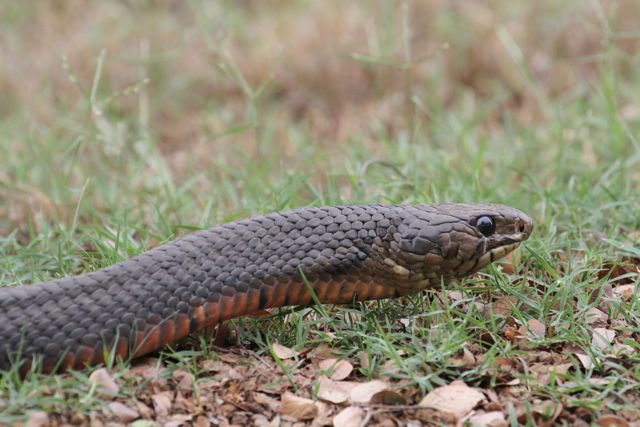
Bill spotted a fabulous serpent slithering away from us in the park: a Texas indigo snake!!
Liam and Phoebe wanted to get away from it!
It was about 4.5' long, quite thick, and not very fast.
But highly intelligent and suspicious of my motives. Which were merely to capture its fluid beauty. It refused to cross the pavement while I was following it, even though some riprap and shrubbery on the other side beckoned safety. It knew that it would be unable to travel fast on smooth asphalt, so it stayed in the grass and gravel where it could gain some purchase with its belly scutes. Smart serpent.
But the stars of the show at Anzalduas (at least when the scissortails aren't there) are the vermilion flycatchers. Oh, what a bird. This is a female, I believe.
Check out the back of that crown!!
O perfect and beautiful bird, like a phoebe that got into the makeup trunk.
We waited, and the perfect happened: a young male vermilion flycatcher landed on a painted post. Ahhh. What a lovely Anzalduas farewell.
And so goodbye to the Rio Grande Valley Birding Festival, and the wondrous birds of south Texas.














Saturday, March 8, 2025
0 comments