Background Switcher (Hidden)

Showing posts with label bird photography. Show all posts

Bokeh Bird

Tuesday, September 18, 2018

3 comments


This female ruby-throated hummingbird is sitting on one of the little shish kebab skewers that I provide for my clients. My clients being the gazillion birds who frequent my yard, who I'm trying constantly to please in creative ways. I've stuck the bamboo skewers, which are exactly the right gauge for tiny hummingbird feet, into the links of the chain holding up one of my hanging baskets. The skewers are almost never without a perching client, because they're close to the feeders and just right for fussy hummer feet.


I haven't known the term "bokeh" for too long. It sounds a bit like a Chet Baker word, doesn't it? It's Japanese, and it refers to the gorgeous thing that happens when the background of a shot goes all blurry and nice. What's behind this bird is my barn-red house siding with a blooming Achimenes "Pink Nighty" in a hanging basket. Wooo. That is some off-the charts nice bokeh. Especially the little dark patch framing the bird.


As soon as I saw her there on the skewer, with the flowers behind her, I knew I had a killer photo op. She was scratching away at her neck and head.


 You'd think a hummingbird's scratching foot would be lightning fast, but it isn't at all. She's got to bring that tiny leg up and over her big long wing, and that's really awkward. So she scratches very slowly.


Then she looks at her foot as if wondering how it got there, up over her wing, and how she's going to get it back where it belongs.


At length, she does, and she rests for a few moments.

Then it's time to scratch the other side of her face. You really must click on this one to embiggen it. Then you can see them all larger.


Because she is a hummingbird, there is always an argument in the offing. She cusses at an incoming bird


and sizes up her opponent. A second later, she shot straight up into the air in pursuit, and my precious moments with her were over.

I'm ridiculously attached to the few remaining hummingbirds in my gardens. I want them to stay forever. They won't, of course, but until they go, they'll get their portraits made. September is the month when the hummingbirds leave. Seems everyone leaves in September. But that also means everyone is passing through in September, and I get to photograph the parade!

Conversation with a Kestrel

Sunday, September 11, 2016

3 comments
You will doubtless remember the red-winged blackbird, singing out his song in backlit water vapor, that so electrified me in this post.

Bryan Holliday made that image.  Here, he's pictured with a storm-tossed wedge-rumped storm petrel in Mesa, Arizona. I do love a good animal selfie!

photo by Muriel Neddermeyer

I've had the pleasure of corresponding with and finally meeting Bryan when my friend Shila and I traveled to Sedona, Arizona, this past July. As I'd figured, he's a gem, and so is his wonderful girlfriend Kim. Though I'd hoped to do a little birding/hiking/hanging out with Bryan, he was all wrapped up in first-day-of-school preparations for his job as an elementary school science teacher, and I was all wrapped up in Sedona Hummingbird Festival stuff. So Shila, Kim, Bryan and I shared a meal in Phoenix and got to know each other a bit, which of course only made us wish we didn't live so very far away. I asked him if he'd send me another photo story for the blog, and here it is!

I love this image of an American kestrel, hanging out on a weathered fencepost. Several things about this image grab me. First, I never knew that the kestrel's little rufous beanie stood up above the heavenly slate-blue brow amd crown feathers. Too dang much. Second, the hearts running in perfect staggery lines down his flank.  They couldn't be polka dots. They had to be perfect, fat little hearts. Third, the kestrel's look of peace and relaxation. No stress, no fear-sleeked feathers here. He's not about to flee; he's just looking back at Bryan, answering the clicks of the shutter with calm composure. This is a bird who's been approached slowly, with respect, who's been politely asked to stay for a little while and has been given the space to grant that request.

Please, click on the photo so you can see the detail I'm referring to. It's a beaut!!

Here's Bryan's story behind this remarkable photo.

After the red-winged blackbird photo titled “Morning Breath” was awarded First Prize in the Birds category of the National Wildlife Federation annual photo contest, I decided to submit it to a few others.  In the spring of 2009, the image caught the attention of Scott Bourne and the Aperture Nature Photography Workshops.  I was chosen as a finalist for the Emerging Photographer of the Year award and invited to Yellowstone National Park for a four day photo adventure, sponsored by Apple and their Aperture Nature Photography Workshops.  Our group consisted of four professionals and us four chosen amateurs.  We spent mornings and evenings shooting, with lunch and workshops during the afternoon to learn Aperture, which was Apple’s software to rival Adobe Photoshop and Lightroom.  

We all had the greatest time traveling, photographing, and getting to know one another.  We all had different photographic styles and interests, challenging each other to look at everything through fresh eyes.  I was the only bird photographer of the amateurs, sharing this passion with Scott Bourne.  Since I was in a new place with a big lens, I had birds on the mind more than anything.  It was early April, so most of the birds were the residents.  We mostly saw black-billed magpies, common ravens, and Canada geese.  Then I began seeing American kestrels.  They were doing their hovering along the roadsides, looking for prey, and perching on the fence posts bordering the ranch lands.  I kept asking our drivers to stop so I could attempt to photograph one, but every time we did the bird flew away.  If you’ve ever tried to photograph a kestrel, you know what I mean.  They would look so beautiful sitting or hovering there, only to fly away as soon as we slowed down.  After two and half days of this, I was frustrated.  As was everyone else since they were sick of stopping!  It became a running joke.  I kept saying that I just needed to find the one bird that was willing to have his photo taken.  

On the third evening, we all set out to photograph the sunset at some gorgeous spot in the mountains.  But the heavy clouds made me think it would probably be a bust.  Luckily, we drove in multiple cars, because there were more kestrels along the way!  The others were done with this kestrel stuff and went on to the sunset spot.  I was determined to find my bird.  The clouds got even heavier gray.  We kept trolling along, a bird here and a bird there.  Then I spied a beautiful male kestrel on a cool wooden post, his colors rich in the overcast light.  We slowed down and crept toward him along the gravel road.  He stayed put.  I rolled down the window and put my big lens on the door frame, ready for a chance.  We crept even closer.  The bird still stayed.  I took a couple shots and he just sat there!  After confirming my exposure, I said “We’re going for gold”.  For the next few minutes the driver followed my explicit directions to move the car, an inch this way, a couple feet that way, turn left 15 degrees, forward a few more inches, until we were practically sideways in the ditch.  I kept shooting, enjoying the chance to fine-tune the perspective of the bird and the background, which are both equally important for the success of the shot.  Everyone in the car was so into it, they got out the recording equipment and began filming me photographing the bird.  It then turned into an interview for Apple, asking me questions about what I was doing and how I was feeling about the situation, all while I was trying to shoot!  And the bird stayed put!!  

It was a crazy hectic few minutes, which came to an end when the other cars from our group came driving back and flushed the kestrel.  They said the sunset shoot was no good and wondered how we did and why we never made it up there.  We just smiled and laughed and showed them the back of my camera.  Cheers and high fives all around!  

ZICK HERE:    This image delights me for many reasons. First, it was hard-won, the result of several days of trying. Second, although they were in Yellowstone National Park, stuffed with charismatic megafauna like grizzlies and elk, Bryan was holding to his modest bird-seeking goal, to the point of being the butt of everyone else's jokes. But as we saw with Morning Breath, holding to his goal is how he gets the best shots. And in holding to his goal, I believe, he's keeping a vision in his mind of what he's after. And here I'd submit that perhaps that vision in Bryan's mind was powerful enough to have been transmitted and received by the kestrel.

What if the kestrel got a picture from Bryan of himself sitting perfectly still and decided to do just that? Crazy, maybe, but who's to say that didn't happen here? Animals and birds don't think in words; they think in pictures. And I've had enough experiences of my own, with Chet Baker and other wild things, to tell me that they can send pictures to us, and receive them as well.  I've found that mind-pictures send particularly well when my mind is clear of all other clutter; when I'm focused completely on my vision. I'm pretty sure, looking at his work, that Bryan focuses down to a laser point. At that point, if my experience is any judge, he's likely to be transmitting messages to his subjects, whether he means to or not. It's fashionable to call someone who sends and receives messages from animals a "whisperer." However it's done, it's clear to me that something metaphysical passes between those who understand animals, and the creatures they work with.

A little hint in his own words: "I kept saying that I just needed to find the one bird that was willing to have his photo taken." One he could get close enough to connect with, perhaps.  

If you're intrigued by this notion, read Thinking in Pictures: My Life with Autism by Temple Grandin. And her pivotal book, Animals in Translation: Using the Mysteries of Autism to Decode Animal Behavior. Temple Grandin is well-known for giving us a picture of autism from the inside, from one whose mind works differently, and, where interpreting animal behavior is concerned, better than most people's. This is a book I should re-read every few years, to stay in better touch with the creatures I'm privileged to live with, and to better understand my fellow humans who have been grazed, touched, or subsumed by autism.

If you’re interested in purchasing this image, please contact Bryan Holliday for the details to make it happen.  He can be reached at bryanhollidayatgmaildotcom. (I've scrambled it to foil the spambots; just substitute a period for the dot, and an @ for the and, and off you go!)

More of Bryan’s work can be seen on his website at www.bryanholliday.com.


Morning Breath

Thursday, April 7, 2016

25 comments
Every once in awhile, you see an image that sticks with you, one you'll never forget. The sailor/nurse smooch on Armistice Day thanks Magpie! comes to mind. There are many others I won't invoke, for not all of them are nice. There is an image that has stuck with me for years, and it's one of my favorite photographs of all time. I never knew who created it, though. Lazy, I guess. I could have Googled and found out. Duh. Imagine my surprise when, in browsing through the photos of a new Facebook friend, I saw That Image. Bryan Holliday had made it. I don't say "taken," and you'll understand why when you read his story.

Every once in a blue moon, when I make a nice photo, I'll hear, "Wow. You must have a really good camera." Every photographer hears this. And most photographers do have a really good camera. My iPhone is a really good camera. So is my old Canon 7D. But it's the brain, the eye, and the mind behind the lens that makes a photo. It's the thought that counts.


Sit back and be humbled, as I was, by the story of how this off-the charts fabulous image was made by a middle school science teacher, who is also blazing his unique way as a visual artist, doing what he was made to do. My humblest thanks to Bryan Holliday for answering the call when I asked him to write it up, that I might share it here. If the image of this man skipping all the way home, lugging a large telephoto, delights you as much as it does me, give him some love in the comments section!

One early spring morning in southwest Michigan, I was teaching a group of students about pond ecology down at the local wetland.  The red-winged blackbirds had just returned and the males were singing and displaying to establish their territories before the females arrived.  It was a calm, chilly morning and we were down there early, just after sunrise.  One male bird flew in fairly close, flared out those gorgeous red epaulets, and sang.  And I saw his breath!  It never crossed my mind that it would be possible to see a bird’s breath, but there it was.  So cool!  He sang again a few more times, each time with his breath puffing in the cold air.  I just stood there, enjoying this rare sight while it lasted.

I decided this needed to be photographed.  So the next day I went down with my camera.  The birds were there, but it wasn’t cold enough.  No breath.  A couple days later, when it was colder, I tried again.  It was windy.  No breath.  I tried again, but this time it was cloudy.  No breath.  Thinking back to the first time, I realized there must be a particular set of conditions that are necessary for this phenomenon to occur.  So I tried more mornings, hoping for a repeat of the conditions.  No luck.  Soon it became too warm, and my attempts would have to wait until the next spring.  I tried again the second spring, with marginal results.  I was able to photograph some breath, but I wasn’t satisfied.  I wanted an image with impact.  Something extraordinary.  Soon the females arrived, nests were built, and babies raised.  So I had to wait again.  

The third spring finally arrived and I could hardly wait for the blackbirds to return.  I carefully watched the weather forecasts to try to predict if there would be breath in the morning.  One night the forecast looked promising, so I set the alarm for early.  The night was short and I was up, ready to go before dawn.  I carried the camera gear out the front door, paused to let out my own breath.  Couldn’t see it.  It wasn’t quite cold enough.  The thoughts of climbing back into my warm bed were very tempting, but knowing that there is never any regret from trying, I went down to the wetland.  As I got close, the air felt colder and heavier, but still no breath of my own.  I kept going.  Once I reached the edge of the wetland, I set up my camera and went in.  The sky was brightening and the birds were singing and calling all around.  I moved ahead to where a male had been singing in the days before, in hopes he would return to his spot for his display.  Almost time for sunrise.  In the last few moments before the sun, the dead-calm air cooled another degree or two, and I could see my breath!  All the conditions were right, I just needed a bird.  I positioned myself right where I needed to be, and he flew in!  For a few glorious minutes, this male red-winged blackbird perched in front of me and sang his heart out.  He flared those patches of red, splayed his tail feathers, and belted out his song.  The sun cracked the horizon and backlit his breath, which hung out in front of him for a split second, allowing me to capture this unbelievable sight.  All 3 notes of his konk-a-reeeeeeeee were there in the pattern of his breath.  He flew off, so I peeked at the back of my camera, and found THE SHOT.  I pulled the memory card out of the camera, stuck it in my pocket, and skipped all the way home.  You couldn’t wipe the smile off my face.  


Though I tried for 3 years to photograph this moment, I never once imagined the song of the blackbird could be captured.  I was going for a stream of breath and knew I had a great shot in front of me that morning.  But realizing the whole song was visible in his breath put the image on a whole different level for me.  I titled this image “Morning Breath” and it has been used in various ornithology lectures in conjunction with sonograms and audio recordings to help students study birdsong.  To this day it is widely considered to be the only photograph in existence that shows the song of a bird.

Zick: !!!!!!!!! A VISUAL SONOGRAM IN THE SPRING AIR!!!!!!!!!!!!!!

If you’re interested in purchasing this award-winning image, please contact Bryan Holliday for the details to make it happen.  He can be reached at bryanhollidayatgmaildotcom. 

Zick: Address deliberately scrambled to foil cruising spambots. Substitute @ for at and a . for dot and you're good to go.

You can see more of Bryan's work at www.bryanholliday.com


Pretty Ducks, Edible Flowers and Birds, Birds, Birds: Strandfontein

Friday, January 22, 2016

6 comments
I have so darn many photos from my South African safari that it's easy to miss some real goodies in trying to throw a lasso around the whole thing. Flamingos are real lens hogs.


With those Vargas girls in the foreground, it's hard to look at anything else, but there are so many other things to see at Strandfontein!

The marshy dikes were rich with bulbs, all in frenzied spring bloom.


We saw these enormous caterpillars in several places on the Cape. All I could do was enjoy them, without being able to put a name other than "Roscoe" on this creature.


Glorious thing. And don't miss the beetle halfway down the stem.  You'd swear it was a hummingbird-pollinated flower, but it's probably after sunbirds.


Her name is Ruth, but we were all calling her Rootie, as her family does, halfway through the trip. She has the same tendency to go plunging in after things that I do. So we were up to our necks in wild gladiolas. Fantastic!


Rootie set this shot up and I poached it. Sour figs, as purchased, and the ice plant flower that becomes a sour fig when it goes to seed! The plant, Carpobrotus edulis,  also known as sour fig, highway ice plant, Hottentot fig, or pigface, creeps prostrate across sandy dunes, and it's quite common. We saw  chacma baboons eating the flowers and developing fruits. I was concerned about the sour fig harvesting until I saw how many of the plants were on the dunes. Reading a bit, I learned that it's a horrid invasive in California and the Mediterranean, creating ice plant deserts on dunes. It's given to invading on disturbed sandy soil. I still think it's cool that somewhere back in time, somebody figured out you could dry the seedheads and get a delicious treat out of them. Wonder if anyone eats them in California? Perhaps we need to graze more.


Wild pelargoniums reminded me so very much of my wooly rose-scented friends of yore. They were aromatic, but nothing like the scented ones I grow. 


It's not hard to see why Strandfontein has such fabulous bird life. That's a bay right there, and the wetlands are the silver line inland, near the horizon.


 The fillymingos don't have far to fly to get to the rich lagoons.


Those vertebral bumps again! I love seeing skellingtons under all those feathers. 


 And the sudden spread of brilliant salmon wings,


which seem somewhat modest for the size of the bird, until you remember this bird is all neck and legs and featherlight hollow bones. Try this: cover up the neck and legs with your finger, and those wings are in perfect, gooselike proportion to the body size. Plenty.


Greater crested terns, Hartlaub's gulls, and Egyptian geese rest on a platform seemingly built just for preening and roosting.


Levaillant's cisticola sings monotonously from a shrubby lookout 


while his mate hauls cattail fluff to a hidden nest.


The little marsh warbler (yes, its name is little marsh warbler, and no, I'm not capitalizing it) who eluded us for minutes on end finally and inexplicably popped out for a portrait!


Everywhere, yellow-billed ducks (sort of the Cape equivalent to a mallard) sprang quacking from the reeds.


Like the mallard, a supremely beautiful bird to be so common. Lucky, we are.


And out in the lagoons, the pink showgirls preen. We bade farewell to Strandfontein and headed for the southernmost point on the African continent, to gaze out over the southern ocean and dip our toes in it, too. You have to do that when you're in South Africa!


I'm going again in September 2016, and I'd love to have you along. 
Click here for details.

A Gift, Hurled from the Other Side

Saturday, January 16, 2016

13 comments

I was sitting at the drawing table, trying to keep my spine straight as I finished the last of a tedious couple of months of edits and revisions to a how-to book I put together 15 years ago. One doesn't really "write" a how-to book. One puts it together.

 I entered the last edit on p. 230, pasted in the painstaking revision of a six-page Resources section, every entry and detail of which had been obsolete, and sent the dang thing off to the publisher. Don't get me wrong. It's a good book. How-to's just not my bag, never was. 

I took a deep breath and started a status update for Facebook, the little crutch/reward system I lean on when my work threatens to grind me to powder. 

"Just finished an incredibly tedious, months-eating rewrite, edit and update of Natural Gardening for Birds, a book I put together 15 years ago for Rodale Books. The thought that I might now...

And before I could continue with 

get to do something I want to is a heady one...

a great big dark shadow swooped through the feeder area just to my left. A roar of wings as doves and finches, sparrows and cardinals exploded in panic. I was off the drafting stool, lunging for my camera, and sock-foot skidding to the foyer window before you could say COOPER'S HAWK!!

My first photo was diagnostic, but not stellar. I was skidding to a halt, after all. So was she.


My second photo was The One. Jesus Mary and Joseph what a beautiful killer she is, clasping the branch with her crooked yellow hands, her eye ablaze, her outer tail feathers exclamation points!!!
Sure, there are branches crossing her, but I love this photo. She's landed in that birch like she was hurled there.

 She's just alighted and she's already planning to leave. Might as well go for it, might get lucky.


My third photo is her leaving in pursuit of juncos and white-throated sparrows.  She wound up diving right into a brushpile Bill created about a month ago, literally dove into the center of it trying to get a sparrow. Came out empty fisted, beat deep into the woods. Total elapsed time from seeing the blur of her incoming rocket to her departure: about four seconds. Raptors make my heart beat faster. Accipiters make it fibrillate.


It didn't take long for a big smile to creep across my face, as I looked at the photos and it hit me that my Dear Old Dad was mighty proud that I'd finally shoved that damn book across the finish line (again), 15 years after I did it the first time. 

And maybe he sent that beautiful Coop to say Huzzah! and Life Goes On! and Join the Party! and maybe just Hello, Julie. I'm here. You are accompanied.

He works with hawks. Hawks are his apports, the gifts he sends me from the other side.

I didn't know that word until my friend Charles taught it to me today, as we compared notes about synchronicity and messages from the departed. Far, far too many perfectly timed gifts arrive on his doorstep and mine to be chalked up to happy chance.

And the synch-up contintued when my friend Caroline from South Dakota (via New York) posted a link today to an interview with photographer Ken Van Sickle. Everything he said about photography resonated deeply with me.  Perhaps my favorite thing he said was 

"If you were there when the Hindenburg caught on fire, and you took a picture of it, that’s a great photograph. But you’re not a great photographer, because you can’t repeat that in everyday things.
"What a great photographer does is, they are consistently able to make something in a style that’s personal to themselves. My pictures don’t depend on extreme sharpness. They depend on the composition and on the subject and on the way I see it."

If you'd like to listen to his brief but spectacular interview, go here, to PBS News Hour's page.

I don't pretend that my Cooper's hawk shot is a great photograph. There's no composing a photo when you have your camera set on center auto focus, and the hawk is perched in front of you for perhaps two of the four seconds it takes you to get off your ass, grab an 8-pound rig, and skid down a hall and into a foyer. You center the thing on the bird, hold your breath and try not to punch the shutter button too hard. You punch it on the first shot, squeeze it on the second and third, and the hawk does the rest. Time's up.

However, I was there  and I did have my camera so in my view this qualifies as a Hindenberg moment. And that, and my Dad sending me a honkin' big adult female Coop as I was running my victory lap, is plenty enough for me.

More hawkish synchronicity in the next post. I'm not leaving South Africa behind. But every once in awhile the present bursts out of the woods, grabs me by the shirtfront, shakes me down and demands an audience.


Flamingos. Pinch Me Please.

Thursday, January 14, 2016

5 comments


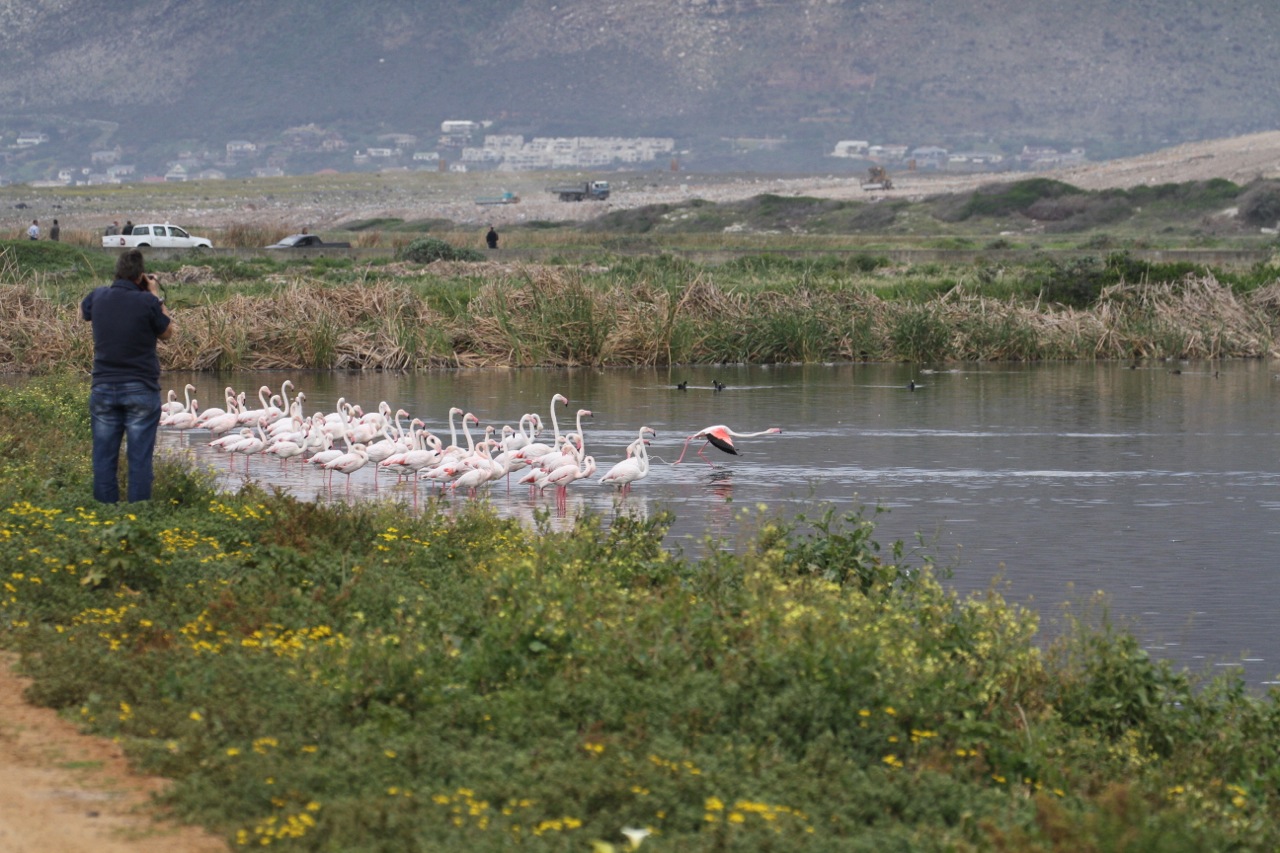
One never quite gets used to the sight of a flotilla of flamingos planing into a waste water lagoon.
But for the backdrop of towering mountains, and a glimpse of the nearby Atlantic Ocean, it's quite an ordinary place

with extraordinary birds feeding and prospering there.


I quickly realized that shooting flamingos at Strandfontein Wetlands was a matter of judicious framing.

When they are coming in against the mountain, they create a vision of singular beauty.


You can see the city of Strandfontein in the haze beneath the birds. They're all busy making wastewater for the flamingos.


Not every shot is so poetic. I had to shoot this guy, nonchalantly preening in flight as he dropped into a lagoon. The backdrop, not ideal...


But that's what's such fun about bird photography. You can frame and crop and tell any story you want.


We were able to get out and walk at the wetlands, but we made a point of staying in the van around the flamingo flocks. It's only polite.

I shot this from the vehicle. There's a kind of tunnel vision that overtakes an avid photographer in pursuit of that perfect shot. This person is trying to get as close as possible to a resting flock. You can see that, while some are preening, one head has shot up, and a wing is out. That's like a neon sign flashing, "Back off!!"


Which, of course, he doesn't. Perhaps because he wants some flight shots. It's pretty arrogant, we thought, to put sixty heretofore relaxed flamingos to flight just to score yourself some photos.


This isn't a zoo, and these regal birds haven't been put there just for your amusement. It's easy to forget that the flamingos are busy trying to lead their lives,  even when they seem to you to be doing nothing at all. When they radically change what they're doing because of something you're doing, you're doing it wrong, sir. Seeing that he was going to press the birds until he got what he was after, I thrust my Canon into Leon Marais' expert hands and he got this beautiful shot as the birds fled right past us.


And this one. Just look at the splashes! Thanks, Arrogant Photographer. I guess.

photo by Leon Marais. He was sitting on the right side of the van. But he is that much better than I am.

I much prefer shooting flamingos that are ignoring us. Or mostly ignoring us. In any flock, someone's always got his eye on you.


Artist Mary Richmond, whose wonderful blog, Cape Cod Art and Nature, has been going as long as this one (making us both blogosaurs), has a great Instagram feed. She found this greater flamingo mount in the Harvard Museum of Natural History. I thought you'd like to see what a flamingo does with the standard-issue 14 neck vertebrae all birds have. It uses them all, just stretches each one into a 2" tube. Look at the center bird. You can actually see the individual bones on the bottom curve of its neck. Looove it. You know what else I loved? Mary was on the South Africa trip! She'll be painting, writing and thinking about the million wonderful things she experienced for years to come.


Like the not so small miracle of flamingos at a wastewater treatment plant. 


Looking at this photo, I imagine that this bird is little more than the weight of its feathers, its bill and its long hollow bones. A supermodel among birds, living thin on her shrimp and spirulina protein shakes. 

Such a world we live in, that pink birds stiltwalk on water


fold into sines and graceful elipses


and steam off like a flotilla of sternwheelers on a September day


But this isn't the Ohio River, and it's not the Sternwheel Festival, and I am really seeing this, right over my head. Pinch me moments are what this trip is all about.


I'm going back to South Africa in September 2016. Wanna come along? Click here for details.

[Back to Top]