Background Switcher (Hidden)

Showing posts with label red-winged blackbird. Show all posts

My Bird Feeder Clients

Tuesday, April 13, 2021

7 comments

 As I write, the wind is roaring again, and the newly flowering maples are tossing their heads and arms like they're at a rave. Practically every minute, something changes out there. A fox sparrow arrives and beats up a house sparrow.  My beautiful red-winged blackbird comes in for peanuts, as he has for several springs running. 


It's not every redwing that will climb on a peanut feeder. He's special!


Yeah baby! Get you some peanuts! And then he flies off to his territory at the nearest pond, about a half mile away as the redwing flies. Fergus the Frog's pond, if you must know.


On March 30, my darling male chipping sparrow returned from wherever he spent the winter. He immediately checked out every single feeder (all new to him). 


and fearlessly worked his way under the protective dome over this hanging platform. 


I just love birds' intelligence and adaptibility. He checked for Zick Dough where it used to be before it was mobbed with house finches, and finding none, decided to take advantage of what was there. I can't wait to see if his funny little mate with the spiky eyebrows comes back again this spring. 


You see, I have deeply personal feelings about the birds who come to my feeders. I follow them from year to year. They're my friends, and that's nothing to minimize in a pandemic.  So when I see them under threat as a result of something I am doing, it bothers me deeply. 

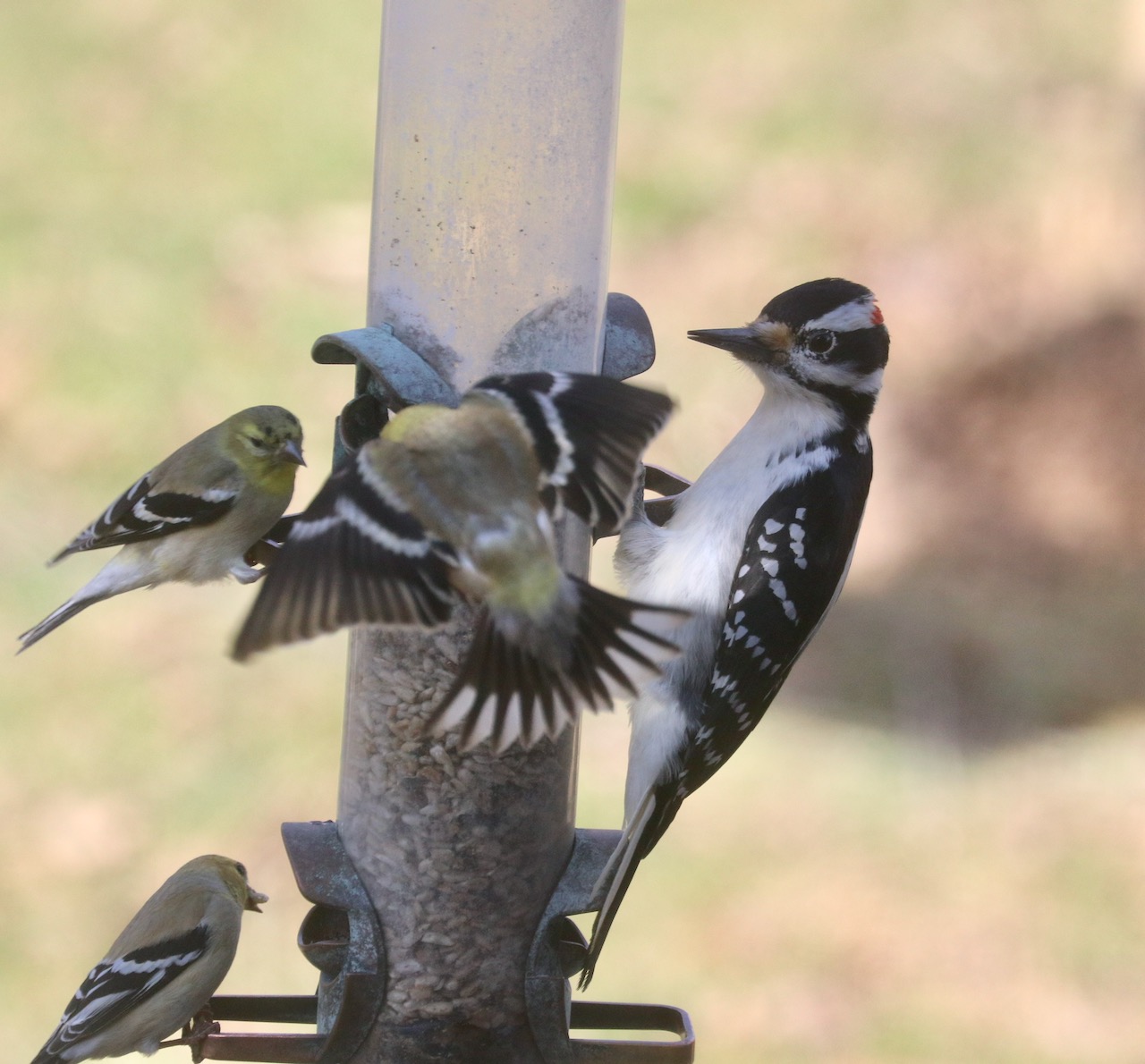
This old photo from March 8, of my beloved male hairy woodpecker mobbed by goldfinches at a tube feeder, is hard for me to look at now that I've made the connection between tube feeders and disease transmission. You can see the messed up eye on the lowest left goldfinch.


And his mate, with a sick goldfinch on the opposite port! You can see that scabby eye..the woodpecker perhaps saved from infection by her longer bill, which allows her to dip into the seed without contacting the port. However they have escaped it, I am so grateful. But this is what fuels my ferocious focus on taking the vectors out of the equation.


What fuels it is my love for all of them. 


This is a much safer way to feed. No ports to contact. Just bird and peanut and gone.


And what of the ones who brought this contagion? Why have I treated and (hope to) release now 18 American goldfinches, and no house finches? Well, this is something I've been thinking about a LOT. 
I see house finches with symptoms. And here's the thing: I can't even come close to catching them.

I'm trying to figure out what's going on. From what I have observed, house finches seem to be managing better with the disease than goldfinches. 
This is the first mass infection of goldfinches I've witnessed. I've never seen more than one or two American goldfinches with conjunctivitis, before this late winter/early spring of 2021. 

And suddenly they are overwhelmed. First one eye closes, and then the second. And when the second closes (which can take a couple of weeks), the bird is helpless, and it's then that I can capture it. IF it is a goldfinch.

But house finches seem to go on with the disease, seem to be able to continue to see well enough to get by. I suspect this is at least partly behavioral (as in, they have learned how to rub their eyes on perches to open them when they get stuck shut). But it may also be that house finches are building up some kind of partial resistance to the disease that the naive immune systems of American goldfinches as yet lack. They may be able to live with it, as goldfinches can't. I ache for their suffering. Their eyes look so sore, and the feathers around them are always matted and messy, as if they've been rubbing them, trying to get their eyes open. 

I'm not a scientist. My observations are all anecdotal. But I can't help but keep chewing on this problem. 

One thing that's not going to happen: these goldfinches I've worked so hard to get back to radiant health are not going to find tube feeders to share with house finches when they finally ply the sky again. They're going to have to go out and find the foods they're supposed to be eating. Or take the occasional treat from my hanging platform feeders. Watching like a hawk. So far, so good. Three birds twittering in the foyer cage, the last remaining. Two will be released tomorrow, April 14. That will leave one, #19. 

Captured April 7, Hey 19 was sitting on the platform feeder with two healthy goldfinches, his eyes completely shut. He was able to open them just enough to get there, but, once fed, he just ran out of steam. I crept up and nabbed him by hand. He'd spend almost two days in intensive care, with tiny dishes of food and medicated water, and droppers of medicated water given by hand, before he could see again.

He was completely blind until April 9, when both eyes opened blearily and he could make out his surroundings. These photos were taken that day, when he had graduated from his plastic Critter Keeper to the big cage. I always love to see their eyes open, see them see again. It keeps me going.


In this photo you can see I've lightly cut the tips of his right tail feathers, just enough to tell me who he is, in case I catch more that would be caged with him. Sincerely hoping he's the last of the last of the last. He'll be with me until April 28, and then maybe, just maybe, this epidemic will have run its course. 


So far, I've taken in 19 goldfinches. I lost one after a week to what I suspect was a secondary fungal infection that Tylan doesn't touch. Hey. 18 out of 19 ain't bad. I'll take it! I love these little chitterbugs.


Morning Breath

Thursday, April 7, 2016

25 comments
Every once in awhile, you see an image that sticks with you, one you'll never forget. The sailor/nurse smooch on Armistice Day thanks Magpie! comes to mind. There are many others I won't invoke, for not all of them are nice. There is an image that has stuck with me for years, and it's one of my favorite photographs of all time. I never knew who created it, though. Lazy, I guess. I could have Googled and found out. Duh. Imagine my surprise when, in browsing through the photos of a new Facebook friend, I saw That Image. Bryan Holliday had made it. I don't say "taken," and you'll understand why when you read his story.

Every once in a blue moon, when I make a nice photo, I'll hear, "Wow. You must have a really good camera." Every photographer hears this. And most photographers do have a really good camera. My iPhone is a really good camera. So is my old Canon 7D. But it's the brain, the eye, and the mind behind the lens that makes a photo. It's the thought that counts.


Sit back and be humbled, as I was, by the story of how this off-the charts fabulous image was made by a middle school science teacher, who is also blazing his unique way as a visual artist, doing what he was made to do. My humblest thanks to Bryan Holliday for answering the call when I asked him to write it up, that I might share it here. If the image of this man skipping all the way home, lugging a large telephoto, delights you as much as it does me, give him some love in the comments section!

One early spring morning in southwest Michigan, I was teaching a group of students about pond ecology down at the local wetland.  The red-winged blackbirds had just returned and the males were singing and displaying to establish their territories before the females arrived.  It was a calm, chilly morning and we were down there early, just after sunrise.  One male bird flew in fairly close, flared out those gorgeous red epaulets, and sang.  And I saw his breath!  It never crossed my mind that it would be possible to see a bird’s breath, but there it was.  So cool!  He sang again a few more times, each time with his breath puffing in the cold air.  I just stood there, enjoying this rare sight while it lasted.

I decided this needed to be photographed.  So the next day I went down with my camera.  The birds were there, but it wasn’t cold enough.  No breath.  A couple days later, when it was colder, I tried again.  It was windy.  No breath.  I tried again, but this time it was cloudy.  No breath.  Thinking back to the first time, I realized there must be a particular set of conditions that are necessary for this phenomenon to occur.  So I tried more mornings, hoping for a repeat of the conditions.  No luck.  Soon it became too warm, and my attempts would have to wait until the next spring.  I tried again the second spring, with marginal results.  I was able to photograph some breath, but I wasn’t satisfied.  I wanted an image with impact.  Something extraordinary.  Soon the females arrived, nests were built, and babies raised.  So I had to wait again.  

The third spring finally arrived and I could hardly wait for the blackbirds to return.  I carefully watched the weather forecasts to try to predict if there would be breath in the morning.  One night the forecast looked promising, so I set the alarm for early.  The night was short and I was up, ready to go before dawn.  I carried the camera gear out the front door, paused to let out my own breath.  Couldn’t see it.  It wasn’t quite cold enough.  The thoughts of climbing back into my warm bed were very tempting, but knowing that there is never any regret from trying, I went down to the wetland.  As I got close, the air felt colder and heavier, but still no breath of my own.  I kept going.  Once I reached the edge of the wetland, I set up my camera and went in.  The sky was brightening and the birds were singing and calling all around.  I moved ahead to where a male had been singing in the days before, in hopes he would return to his spot for his display.  Almost time for sunrise.  In the last few moments before the sun, the dead-calm air cooled another degree or two, and I could see my breath!  All the conditions were right, I just needed a bird.  I positioned myself right where I needed to be, and he flew in!  For a few glorious minutes, this male red-winged blackbird perched in front of me and sang his heart out.  He flared those patches of red, splayed his tail feathers, and belted out his song.  The sun cracked the horizon and backlit his breath, which hung out in front of him for a split second, allowing me to capture this unbelievable sight.  All 3 notes of his konk-a-reeeeeeeee were there in the pattern of his breath.  He flew off, so I peeked at the back of my camera, and found THE SHOT.  I pulled the memory card out of the camera, stuck it in my pocket, and skipped all the way home.  You couldn’t wipe the smile off my face.  


Though I tried for 3 years to photograph this moment, I never once imagined the song of the blackbird could be captured.  I was going for a stream of breath and knew I had a great shot in front of me that morning.  But realizing the whole song was visible in his breath put the image on a whole different level for me.  I titled this image “Morning Breath” and it has been used in various ornithology lectures in conjunction with sonograms and audio recordings to help students study birdsong.  To this day it is widely considered to be the only photograph in existence that shows the song of a bird.

Zick: !!!!!!!!! A VISUAL SONOGRAM IN THE SPRING AIR!!!!!!!!!!!!!!

If you’re interested in purchasing this award-winning image, please contact Bryan Holliday for the details to make it happen.  He can be reached at bryanhollidayatgmaildotcom. 

Zick: Address deliberately scrambled to foil cruising spambots. Substitute @ for at and a . for dot and you're good to go.

You can see more of Bryan's work at www.bryanholliday.com


[Back to Top]