Heads up: It's taken me more than a week to write this post. So it's a bit of a chronicle, rather than a summation. I took down the last tube feeder today, March 10. It sounds like such a simple thing to do.
But I lay awake night after night and even wept about it. Isn’t that a weird thing to have to confess?
For weeks, I have been caught in a whirlpool of guilt and obsession. Those two things always seem to be swirling in the waters of my misery. I had this thing going, and it was rolling along, dragging me down with it. Here’s what I've been doing. I would disinfect my tube feeder every day, and keep it filled with sunflower hearts, so I could continue to attract the sick goldfinches I would then catch and take inside to treat and heal.

And here’s the flaw with that: I kept thinking that at some point I would run out of sick birds, and then I’d be done catching them, and keeping them in hospital cages. I’d keep each one and treat it for three weeks, and I’d release them all, and that would be that. I’d be done with this horrid epidemic for this spring.

This poor little gal's whole head is swollen. No worries--she is back to normal proportions now. She can see fine, but has three weeks in sick bay to go.
But what happened in actual fact, while I was continuing to feed, is that more sick birds showed up every day. That is not what was supposed to happen, to my mind. It wasn’t what I wanted. I wanted this to stop. I thought I was doing something to help. As I look out at the lone peanut feeder that remains, there are eight sick goldfinches and at least five sick house finches hopping forlornly around on the ground underneath it, looking for crumbs. And it breaks my heart in two. How can it be that I have nine birds in the hospital, and 13 more outside who need help?
Well, I figured out the answer, but I had to smash and claw through multiple layers of rationalization and denial before I got there. Yesterday I sat down with my binoculars and watched the blinded finches feeding at that carefully disinfected tube feeder. Their swollen, goopy eyes rubbed against the feeder ports as they went in for each seed. I realized that I could take that feeder in and switch it out with a disinfected one three times a day, and I would still be infecting birds. All my precautions meant nothing. And my rationale, that I was “helping” the birds by continuing to feed them so I could take them into care simply fell apart, because I had a sick finch factory right in front of my nose. I was so blinded by my own zeal to care for them all that I failed to see the mechanism of transmission. I had lost sight of the big picture, if I'd ever seen it at all.
Because I am someone who needs to understand how everything is connected, I have explained in a previous post how the wild bird trade, a deliberate historic release of house finches in New York, and their resultant inbreeding depression have made Eastern house finches helpless against this scourge. But this current epidemic in my yard, I’m tracing back to plant genetics. I don't know if my theory holds true anywhere else, but it's a theory.
I’m sure this sounds weird, but stay with me. A few years ago, the sunflower feeder I’d used for decades, which is a big cylinder of hardware cloth with two metal pie plates on top and bottom, stopped feeding seed. Here's my favorite picture of my favorite feeder. So simple, yet so functional. The beauty of it is that birds don't contact anything but the seed. They pull it out of the mesh and they don't have to rub their eyes on any surface to get it.
Oh. And there's a scarlet tanager there, checking it out, because checking out what other birds do is how birds learn. I call this photo "A Few Red Birds."
This feeder served me for 20 years. But in the last few years, I could fill that thing up on a frigid snowy winter day and the birds would take it down maybe an inch. Before, I could fill the thing twice a day in such conditions, and barely keep up with the demand. What was going on?

Though I’ve not read this anywhere, it looks to me that black oil sunflower, which was once a slender, elliptical, small-diameter seed, is being bred to be bigger and plumper—wider around, more teardrop-shaped than elliptical. Shiny now, too. It's a lot prettier than the skinny dull gray black oil seed we started with, but the shiny fat seeds won’t fit through the mesh of my trusty, more hygeinic feeder. The seed goes in, but it just won’t come back out. Before, birds could cling to the outside of that feeder, grab a seed and work it easily out of the mesh without touching anything but the seed itself. It was a much cleaner way to feed the birds. Now, it's a Hotel California for sunflower seed. I suspect my mesh feeder is not the only one affected.
During the extreme cold snap this winter, I took that old trusty feeder in and retired it. It just wasn’t working any more, and with weeks on end of deep snow cover, I needed to deliver a LOT of seed to hungry birds. I turned back to the tube feeders that had been hanging unused in the garage for years. I missed my old large-capacity feeder, but what good is it if the birds can’t get the seed out of it? Throughout the February cold spell, my birds fed from tube feeders, for the first time in literally years. And toward the end of the snap, when the snow was still on the ground, I started finding sick goldfinches. Not sure what the incubation period for Mycoplasma might be, but I get the feeling it’s around two to three weeks. I picked up the first blind goldfinch on February 21. And then there came a cascade of them in the first week of March. I told myself that I must have gotten a new flock, and the sick birds had come in with them. But I no longer think that’s what happened.
I think that my tube feeders made them sick.

Weird to think that a quirk of plant breeding could cause me to switch to tube feeders, and worsen an epidemic that's already terrible. I'm pretty sure that's what happened here on Indigo Hill.
I implore you, if you’re still with me, don’t glance out at your feeders, see lots of birds sitting on them, and assume they're all fine. Take the time to get out your binoculars and really look at each eye on every bird. If you see squinty eyes, dull eyes, messed up feathers on the head, or swollen, closed, blind eyes, you have Mycoplasma in your flock. If a bird has one closed eye, within a week, both will close. And if you’re feeding birds with Mycoplasma, you’re just inviting healthy birds in to catch and spread it. You are creating a bacterial hotspot, and luring birds in to get infected.
March 10: There’s a male house finch circling the peanut feeder, flying like a yoyo with his body strangely upright, tail fanned. That’s because he can barely see. Eight goldfinches are shuffling around on the ground beneath. Four more house finches flutter in, and I feel sick. In the foyer, the incessant twitter of three goldfinches from the first batch. In a back bedroom, constant twittering from six more, the captive legacy of my good intentions. I've been “helping birds” by feeding them and treating them with three straight weeks of Tylan in their water, without being able to grasp that I am to blame for their being sick in the first place.
It’s that whirlpool again, that cycle of guilt and obsession. I made them sick. I need to fix them. I’ll keep feeding them so I can catch them and make them well again. If I can just catch the last two…three…eight…thirteen…In the time it took me to write this post, I went out and caught another one who had gone completely blind today (March 10). That makes ten, and this is crazy, and it makes me miserable. And I'm still trying to fix it.
Tube feeder. The round recessed seed port is the problem.
The definition of insanity is doing the same thing over and over again, while expecting a different result. Please don’t laud me for my “big heart” for taking care of sick birds. I'm the one who's done the harm, and doing some good is the least I can do to atone. Just go out and check your birds. If you find signs of disease, then do the right thing, hard as it is. Take those feeders down! And, if you care about your birds, retire the tube feeders for good. It's really hard to quit feeding. Believe me, I understand. I have been there again and again.

Mesh feeders like Ol' Trusty are better than tube feeders, but I'm certainly not saying they can't and won't spread Mycoplasma. Here's a blinded female house finch, poised to infect three other species by sitting on the feeder tray. House finches also like to sit in birdbaths when they feel ill. I would be happy never having seen a house finch in the East. I love them, and it's not their fault they have no genetic resistance. But I wish I didn't have them around.
Mesh feeders are better than tube/port feeders, but they aren't perfect. The same goes for the feeders shown below.
I love this hanging platform feeder, made of recycled plastic and stainless steel. Because it's open to the elements, I added a dome,which keeps the seed, if not completely dry, at least drier, and keeps droppings mostly out of the tray.

The peanut feeder is a mesh-style feeder, with no ports to collect bacteria from goopy eyes. Also equipped with a plexi dome to keep the peanuts dry.

And my crude cinder-block construction called Cyanocity works pretty darn well to keep seed dry and keep birds safer. While birds will defecate atop the cinder blocks, I've never found poop in the chambers of the blocks, because birds tend to cling and reach in with their heads only.
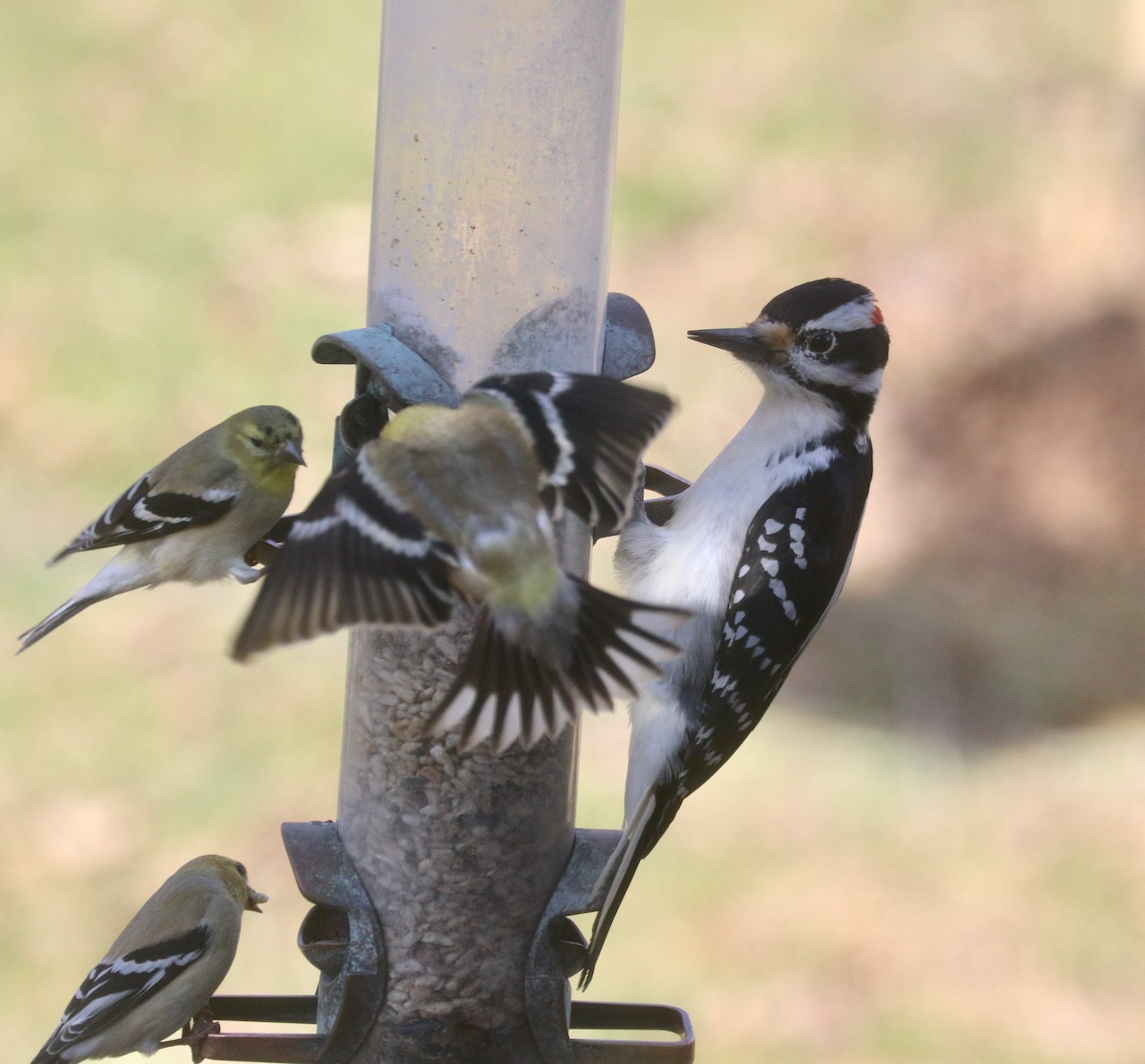
Again, this is virtually contactless feeding, which is what we're looking for in feeders. My beautiful hairy woodpecker male--I love him so much!
Meanwhile, the soundtrack in my house is still a constant twitter/ping/flutter. Seed hulls are scattered everywhere around the three cages, and it takes about an hour first thing every morning to service and clean them. I can't sit back and enjoy watching the birds; they're far too wild to suffer being looked at. I took this shot by creepin' my phone's lens under the cage cover. I keep only the side facing the window uncovered. For the brief moments I'm changing papers and replacing dishes, the birds flutter as if the most horrible monster in the world is trying to kill them. They hate my guts, and that's the way it is with wild things when they're caged.
I let the finch collected February 21 go on March 13, after three weeks of confinement. She flew like a bullet and that felt WONDERFUL. But the exhilaration of watching her roller-coaster flight high above budding maples was short-lived.
I caught and brought into treatment Finch #14 on March 14. Even if I stopped now, I'll still be caring for finches into mid-April. So far, there are four more out there that I've got my eye on. New infections seem to be slowing down. But I'm probably not the one to ask, or to prognosticate.
I'm still caught in the whirlpool, and I'm swimming as fast as I can.

















Friday, March 28, 2025
0 comments