Background Switcher (Hidden)

Snob Feeding with Zick Dough

Sunday, February 13, 2022

6 comments


Let's face it. Along with the fabulous birds we all want to see, the sapsuckers with their velvet berets, there's a lot of riffraff in the winter bird feeding world. 

One starling at the Zick Dough is unique and beautiful.


Eight starlings is expensive. Dirty, too. Then 30...ugh! Starlings can take a fine homemade food like Zick Dough and turn it into pounds of poop faster than any bird alive. 


We fill up our guts then we turn it into @#$# 
Then we get rid of it


If you go listen, and I hope you will, you will understand something of my musical roots, and my sense of humor. Best sung in a roomful of filthy hippies who gleefully shout the backup lines.

Anyway, I like to keep my homemade Zick Dough Improved away from starlings. The way to do this is to offer it in a place starlings (and house sparrows) fear to go. These imported birds know we hate them, and they won't generally enter a feeder that looks like a trap, or that brings them too close to people.

Back in Jemima Jay days, soon after her release in June 2017, I devised a little feeder she could use, that other birds hesitated to exploit.


It's under the crank-out window right by my studio drawing table. I stocked it with things like pecan halves and chicken breast and basmati rice, fresh corn, snap peas...the buffet was deluxe and she thrived on it.  It was our little secret! 


Of course, given such fabulous fare, it didn't take long for Jemima's  little feeder to catch on with the other birds. This was mostly fine with me, and it's had wonderful consequences of late.

I've simplified the offerings, keeping it to Zick Dough Improved. See bottom of post for recipe. 

The Snob Feeder was easy to make.  It's just a canning strainer with a handle, and a black alligator style clip from the hardware store. Why a strainer? Well, rain goes through it, so you don't make Zick Dough Soup every time it rains. That said, I feed small amounts frequently, and withhold the food if it's really pouring. 

 I've clipped the strainer to the shelf bracket that supports my big bird screen--a panel of black crop netting strung across a frame of PVC pipe, which prevents birds from killing themselves on my big studio window. 
For more on that, go here:

It's easy to access! I just crank out the studio window, put a handful of Zick Dough in the strainer, and go back to work. 
Now I'm going to show you who benefited from the inside knowledge of my little "Snob Feeder."

Here's the male white-breasted nuthatch who made an appearance in my last post about ice storms. If you click on the photo you can see he's missing a couple primary feathers on his right wing--pulled out by getting stuck in ice in his roost hole overnight. 
You can also see that the birds have made a hole in the screen that they duck in and out of. :)


 Here's my adorable little female red-breasted nuthatch. Squee!! They're so much smaller than the white-breasted nuthatch, and red-breasts are only here in SE Ohio in winter.


Needless to say, tufted titmice are my most enthusiastic customers, as are Carolina chickadees. They both jump for joy for Zick Dough!


Cardinals love Zick Dough too, but my window feeder pictures aren't so hot. So here's a nice old couple. Look at all the red on that female, speaking of  her advanced age and the higher testosterone levels that come with it. The higher the T, the stronger her color.


Now, white-throated sparrows aren't folks you'd normally think would clamber into a food strainer right next to a window, but...


after thinking about it and watching other birds enjoying this intriguing looking food, like this buff-striped bird is doing, I have several who have made the leap! Here's a pretty white- striped morph. Studies have shown that, while they may not be as attractive to our eye, buff-striped males make better dads. :)


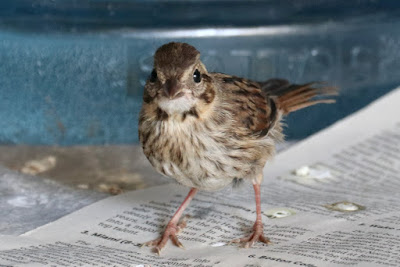
Speaking of sparrows, my sweet little song sparrow Ball, hand-raised last fall and still with me, loves Zick dough! He remembers it from when he was a babe.


If you click on the photo you will see the fault bar across his tail that is his nametag.


This fox sparrow will eat the Zick Dough I sprinkle on the ground below, but he's a little too shy to come in to the feeder. Having him this close is a thrill. Pardon the photo--the bird screen was iced up. 


Same for the eastern towhees. I have SEVEN this winter! Never have had more than a couple. I love these two huge sparrow species!


This lovely male downy woodpecker likes to come and go by the hole in the netting. He's welcome.


This might be his mate. I like the way she hangs down to get her treat.


Dark-eyed juncos are another ground feeder one wouldn't expect would climb into a homemade feeder, but here's one feasting.


Carolina wrens are regular. Like any insectivore, they need nourishing food to survive such hard winters as this one.


This beautiful American tree sparrow is thinking hard about coming in for Zick dough...


but settles for the dried mealworms I toss onto the snow several times a day. The birds were a bit slow to catch onto this new treat (just like me). But it's so nice to have something nourishing to offer the birds when it stays so cold for weeks at a time. 


Towhees, juncos and tree sparrows dig them! 


Pro-tip (I'm full of them today!)  The photo below was taken at Tractor Supply. Here's the choice. You can buy 17 oz. (just a hair over ONE POUND) of dried mealworms in the wild bird feeding section for $19.99. That's about $20/lb. I don't think the birds give a hoot about the "berry flavor" they add. That's just to get YOU to buy it for $20/lb.

OR you could walk to the chicken feeding section in back, and buy FIVE POUNDS of the same thing for $39.99. That's about $7/lb.

Your choice. They keep well. I tried to buy them first from my friend Tim Vocke at thenaturesway.com but he tells me that all dried mealworms are coming out of China these days. He's my first resort for live mealworms for my rehab birds. 


I hope this photo essay has shown you that you can cultivate personal relationships with birds using the snob feeding concept. Offer fabulous high quality, high protein food in small amounts, and make them work for it. Bring them in right up close to a window where you spend most of your time. They'll learn to recognize and trust you, watch your rhythms and anticipate your moves, and you'll get an intimate look into their lives. 

This is the fourth winter this beautiful female yellow-bellied sapsucker has spent with me.


I have had the great pleasure of getting to know her, teaching her how to eat strange things, and watching her slip into full adult plumage.


She brings me joy. Long may she run.

Here's that recipe.

 ZICK DOUGH IMPROVED: SMALL BATCH 

Melt in the microwave and stir together: 
1 cup peanut butter 
1 cup lard 

In a large mixing bowl, combine 
2 cups unmedicated chick starter 
2 cups quick oats 
1 cup yellow cornmeal 
 1 cup flour

Add melted lard/peanut butter mixture slowly to the combined dry ingredients and mix well.
Stir constantly.Stop adding the melted fats when the mix is crumbly and a little dry.
                                                    If you have extra PB/lard, just save it for the next batch.
                                                        You can adjust the texture with a little  extra flour.

NOTE: This is a COLD WEATHER OFFERING ONLY.  It's too rich to feed once the weather warms up. If you do feed in spring, keep it to cold snaps. It should be regarded as a treat in warmer weather, NOT a steady diet. 


Most frequently asked questions, to save time: 

I don't want to use lard. Can I substitute vegetable shortening?
You can, but the birds won't like it. I've done the side-by-side multi-species taste tests.

Isn't white flour bad for birds?
No.

I'm going to use organic almond flour and all-natural hand-ground peanut-butter.
Knock your$elf out! I u$e $tore brand wheat flour and PB becau$e I'm feeding a LOT of bird$$$$

Gift of the Ice Storm

Friday, February 4, 2022

14 comments


Winter Storm Landon's been an absolute brute. Here in southeast Ohio, it's dumped many inches of cold rain which, thank goodness, was rain and not snow. Thoroughly sick of moving through, dealing with, shoveling, and stumbling around in snow! The rain washed away almost all of the 16" of snow that had fallen over the last few weeks.  Thing is, it was still raining hard as February 3 turned to night, and the birds went to bed damp. Huddling in their roost cavities or in the cover of tree branches, those wet feathers froze to the substrate around them. 

So on wakeup, this white-breasted nuthatch was doubtless frozen to the inside of his cavity. His wet upper tail coverts and at least one wing feather were stuck. As he struggled to get free, they were pulled out. But the ice kept them glued to his tail all day long. 

What you see, then, is this weird plume-tailed variant of a white- breasted nuthatch. The odd shape of the feathers owes to the fact that upper tail coverts are quite long, running down the back and over the top of the tail. The black one is a wing feather, though. So he was pretty good and stuck--wing feathers are a lot harder to pull out than coverts or tail feathers-- but he got out.


Here's an unfortunate mourning dove who is wearing her tail on her wing. Rats. 


Long pointed tails are nice for maneuverability in flight (and dove flight is amongst the speediest around), but they're a liability in ice storms. 


Last but not least, my dear Bob the hand-raised song sparrow is back to looking like a ping-pong ball. Dang it!! 


Yes, he's still here with me, and I'm so glad of that. Released in September at 27 days of age, he's hanging in there, almost five months later!  I know he'll be well-fed through whatever the winter of 2022 throws at us. But dang. Ice storms--I hate them, and not because I usually lose power. I hate them because they're so tough on the wildlife I love. 

Losing a tail isn't quite as bad as it looks. A brush-loving species like a song sparrow can adapt. Even a mourning dove can fly just fine without a tail. It's harder, for sure, but they survive. And they should have a decent new tail within three weeks. Since the feathers were pulled out, the empty follicles are already gathering themselves to make more. 

I corresponded today with a kind woman from Athens Ohio who has five turkey vultures hanging around her backyard. Like us farther east, they are encased in ice after a rainy night that turned frigid. I explained that grounded turkey vultures are a thing in ice storms; that they cannot fly if their feathers are icy, and there are no thermals to give them lift. She and her husband thawed some chicken and offered it to the birds. Interesting twist: they have a 5' chain link fence around their yard, and the vultures are on the ground, inside the fence. Coincidence? I think not. If a white-tailed deer knows enough to jump into a fenced backyard to give birth (and they do!), I submit that a turkey vulture knows enough to know it's safer in a fenced yard than outside it. Something to think about, something to ponder. 

As I shot photos of my suffering songbirds, it occurred to me that there might be some cavity-roosters in my bluebird boxes in trouble. Could some have gone in to roost last night, wet, and not come back out? A little voice was tugging my sleeve. Go check. Go check. See if anyone is in need.

So I packed a nylon drawstring bag (for weak cold birds) and a screwdriver (to open the boxes), called Curtis Loew, and set out to the meadow to check some boxes. I heard a coyote bark several times nearby and stopped in my tracks. Curtis stopped, too, and let out one short, sharp bark. 
Hey. I know you're here. This is me, Curtis. 

I saw him before Curtis did. He was sitting out beyond the big pine, watching us. Wow. That is interesting. Coyotes are usually just shadows disappearing. Not this one.


I called Curtis to me, and he was only too happy to run back with me to the house. A romantic might think the coyote just wanted to play in the snow, but I wasn't about to offer my best boy for an experiment, or my heart for more breaking. I left my grateful and sensible Curtis inside and grabbed my big Canon rig. When I came out the back door, the coyote was still sitting out there, and that's how I got that first photo, from my deck. 

Do you see that sumac clump in the left foreground? That's how I got the rest of the photos. I snuck along the back of the house, ducked behind the low spruce by my fishpond, lined myself up with that clump of sumac, and walked in a straight, unwavering line toward the animal, staying always behind the thickest part of the shrub. 
I trusted he was still there, but I never took the chance of exposing myself. I just kept walking. I wasn't going to blow my cover just to see if he was waiting there.

 Finally I got to the sumac clump and peeked through the branches to catch sight of the animal, who had moved off to the side.

And look where he's sitting. That's the iron fence around Bill's grave, and the big Virginia pine that stands by it. Ice has brought its boughs to the ground. 


Though I stayed mostly behind the sumac clump, I'm sure the coyote knew I was there.
After all, he'd been watching me. 


I knew it was a male when I enlarged this photo. Click on it and you'll see, too.
The size of his tracks alone suggested a male.


It was a big coyote. The front pawprint shown here was 2 7/8" from heel to toe.

The hind paw (below)  is narrower, and has a smaller heel than the front paw.

Here is the imprint where he had been sitting when I first spotted him. 


And here he is loping along. There's a 16" span between the pawprints. 


After watching me for awhile, he stood up and turned to leave. What a long neck he has! 


He stood for a moment, looking. It was moving to make contact with a wild creature, here in this place I come visit every day. The way he looked back at me sent a feeling through me, something benign and wondering, not threatening. 

I guess this is the best shot. He was so red against the ice and snow, so warm. I wondered what he was thinking. I wondered why he and his pack have spared Curtis these past three years. If they'd wanted him dead, they've had a million chances to do it.

For now, and I hope for as long as Curtis lives, there is peace, and this beautiful red wild one, walking easily through the snow. 


All this, within sight of the house, with the ice still dripping off the sumac from last night. 


Ice storms are hard, but this one brought me a gift.

Here is where he melted back into the woods.


There were no birds trapped in my boxes--I checked.

There was just the little voice, telling me to go out and help,

the gift,

 and the silence when he had left.


To the Tent with You Three!

Monday, January 31, 2022

5 comments

If you're just visiting my blog for the first time in awhile, PLEASE scroll down to the older post, and pick up the song sparrow's saga from the first. We're in the middle of things here, and there's lots more story that came before. 


Bob, on the babies' first day in the tent, Day 20. He still has a little peruke of down on his head. 

This is an old picture of my first and best tent, as you can see from Phoebe's larval instar. This is the one the wind crumpled up like a ball and rolled across the yard, and that's how I learned I have to put the fledging tent up in the garage!!


Once I’d seen all three babies eating on their own from dishes, I could take them out to the fledging tent in my detached four-car garage. This is a great setup because the tent is totally protected from the winds we get on the ridgetop, which destroyed my first and best fledging tent, crumpling it up like so much Kleenex. (Luckily there were no birds inside at the time.) I leave the garage door open, and one end of the tent gets sunshine much of the day. My little inmates can sunbathe, splash in their shallow baths, sleep on high branches, and race around on the floor of the tent, which is about 10' wide x 15' long x 8' tall. They can hear birds singing and watch what’s going on in the wild birds' world, and imagine themselves flying free out there. But at night, I can close the garage door and know no predator is going to get them. 


 On Sept. 11, Day 21, I walked out and opened the garage door at first light, letting the rising sun into the tent. The three sparrows, who'd been sleeping on high branches, immediately fluttered to the floor of the tent and loaded up on mealworms as soon as they could see to forage. Oh FABULOUS!!  I tasted real freedom for the first time in two weeks. They weren't waiting for me to come into the tent and give them formula!  Making sure they had plenty of food in their dishes and scattered across the tent floor, I loaded the bike on my rack and took a wheeled tour of Marietta during Sternwheel Festival, something I’d always wanted to do. It being plague times, I kept a mask on and kept my distance, but it was really nice to see other humans having fun. It can get lonely out on the ridge, especially when I’m tied to baby bird feeding schedules for weeks at a time. 


Bob, Day 27


He had a neat little bowtie by Day 27! Bob was just neat and clean. 

Now that the birds were in the tent, my challenge was to train them to feed atop a pedestal. This would be necessary once I released them, to keep chipmunks from immediately cleaning out their food, and to protect the birds from attack by these striped vampires.


A cool little chipmunk who appeared briefly in May 2020. It was super cute. But it was still a chipmunk. 


                                                      I can see beyond the cute.


Chipmunks are the bane of my existence as a songbird rehabilitator and gardener, too. They’re super smart, conniving, and bloodthirsty, and they’ll gladly pounce on naïve baby birds and make a meal of them. In the first two days after his release, I saved Dustin (2020's song sparrow client) multiple times from becoming chipmunk lunch. My worst moment was seeing a chipmunk jump him and tussle with him. I lunged at the animal, and Dustin shook himself off and resumed hopping and scratching as if it warn’t no big deal. He didn't even fly away! It was up to me to chase the damn rodent out of the flowerbed so Dustin could go on being bait. He was slow, and they were sharp, but he eventually got the message, and began to listen to his natural vigilance.


Dustin, June 14, 2020. Ultimately successful, and worth all the work. 

I was taking no chances with this trio, so I decided to train them to a pedestal before releasing them. It wasn’t easy. Most sparrows are by nature ground feeders (it’s pretty rare to get a song sparrow on a platform or hanging feeder). So I started with a low iron table, perhaps 1.5’ off the ground. It took awhile, but they eventually accepted it. I then tried placing their dishes on a tray atop a pedestal, looking for an extra foot or two of height for their safety. Nothing doing. They wouldn’t land on the metal tray. I sat back and studied the situation. I placed the metal table, on which they were used to landing, atop the pedestal. Success! I had them eating 3' off the ground! 


 Slowly, they’d transitioned to accepting lots of millet and mixed canary seed as well as mealworms, and that was great, because it would be a lot easier for me to keep them in millet than mealworms, with most of the birds in my yard wise to the delicious offerings I put out for my rehab clients. 


                                   Ball, left, with Baby, Day 27, in the fledging tent.  These two hung out constantly in the tent. Bob was not interested in their company. 


Ball, left, with Baby, Day 27.


Baby, left, and Ball discover a termite in the tent. 


                                                    This was not a good thing for the termite. 


Baby cracks her own millet, Day 27. I was lying on my side, watching to make sure I saw hulls falling, and that seed going down her throat. 

Once they were used to flying up to the pedestal to feed, I switched to using a large flat board on top of it. This would be their feeder upon release. All these changes took place over the week and a half they were in the tent. Once they were reliably feeding on the board-topped pedestal, there was nothing to hold them back. It was September 17, and they were 27 days old. I had chosen this day for release because Margaret Morse Nice, Ohio song sparrow guru and author of one of the finest single-species studies ever done, wrote that the oldest young she’d ever observed being fed by parents was 27 days old. If  M.M. Nice says it, it's true!


       That's Margaret Nice in the middle, aged 60 in 1953. She looks like someone I'd love to bird with! Raised five kids while conducting the best study to date of any vertebrate anywhere, ever. Wouldn't it be a hoot to time travel and hand her a pair of Swarovski binoculars to use? We use the tools that we are given.


If you'd like to learn more about Columbus resident and exemplary behavioral scientist Margaret Morse Nice, here's a good blogpost: https://blog.nature.org/science/2016/08/08/battles-song-sparrows-scientific-outsider-changed-study-birds-ornithology-margaret-morse-nice/


Ball in front, Baby behind. Where's Bob?


Here are three photos of him at Day 22. 

Bob did a lot of hanging out in the tent window, just wishing he could be outside, already.


He was always just the cutest thing, and his feather quality was the best of the three. 


The difference between Day 22 (above) and Day 27...


Bob, you're so ready to go!! Looking like an adult sparrow, but for that little yellow gape line, and the indistinct streaking on your breast. 


After almost two weeks in the tent, which was the period between when they first started feeding themselves a little, but still needed syringe feeding,  and when they no longer needed any hand feeding at all, the song sparrows were fully baked and ready to release. Imagine me popping out of the house about a dozen times a day, with a syringe full of fresh formula, chasing the babies around the tent, offering squirts. When they finally started cracking their own millet, I knew this phase of my service was over. 

On to release, and a new phase!
 
[Back to Top]