Background Switcher (Hidden)

Titmouse, in a Bad Way

Wednesday, December 1, 2021

3 comments

 I'm not sure what little voice told me to go back out to the greenhouse late on the afternoon of November 29. I didn't have any particular mission there. I'd watered that morning. I just wanted to go back out. As I opened the sliding door to the little patio, there was a squeak and a flutter, and a tufted titmouse sort of trundled out of a pile of sycamore leaves that had blown up against the house. Dark was coming on, and I figure it had been planning to roost there. Oh dear! No titmouse in its right mind roosts on the ground, unless it has no other choice. This one was fluttering in a tight circle, its head tilted far over to the side. Something bad had happened to it. What were the chances it would fetch up against the very door I use the most? Was it chance, or something else? Birds know. They know.

 I fetched my butterfly net and dropped it over the little bird. It was in a bad way. I put it in a plastic Critter Keeper and pulled back to observe it. Tipping over on its side, it was stargazing, with an inverted head. Uh-oh. That looked like traumatic brain injury to me. Whatever had happened to it, it would need food, so I prepared a little dish of Zick Dough and crushed sunflower hearts. The poor bird began to eat before I could even withdraw my hand, something that I would learn is typical of titmice. They are survivors, fighters. It took a sunflower heart, tried to tuck it in its toes, but couldn't get its head to cooperate, so it dug into the Zick Dough. I was so touched by its will to live that I pledged on the spot to do whatever it took to get it back into the wild. And if it wasn't going to make it, at least it would have had a warm place to sleep, and a full belly before it died.


The Intake Video...I had a feeling it wasn't going to die! But neither was I prepared for what happened next.

From the get-go, I got a strong male energy from this bird, so I'm going to switch its pronouns to he/his. Some may laugh at me. They may go ahead. So far, I've batted 100, even with sexually monomorphic birds like brown thrashers, song sparrows, and blue jays. We raised three brown thrasher nestlings a few years back. By the first evening I knew I had two females and a male. Harper, Melba and Cletus. And who first found his voice on June 22?  Cletus. And the other two remained silent. Same with the three song sparrows I just raised. Two males and a female. Ball, Bob and Baby, the only female. I just knew. 

                                             Cletus sings quietly, June 22, 2015, on his 37th day of life. 


The sight that greeted me the next morning, after this promising beginning, was shocking. The poor titmouse's head was completely inverted, and any attempt at moving caused him to flip over on his back. Holding the bird up to the light, I could see its left eye flicking back and forth, a condition called nystagmus. I've had it with the three cases of vertigo I've endured, and it is no fun at all. The world spins around you and all you can do is close your eyes and try not to throw up. 

Shila pointed out to me that the day or two after a car accident are usually worse than the day of the accident, as the body assesses what just happened to it. So it was for this bird. Though titmice are savvy birds and not typically victims of window strikes, one could surmise that perhaps a raptor had made a pass through the yard and scared him into a window collision. Brain swelling could easily cause the torticollis and nystagmus. I wanted to alleviate that, so as soon as offices opened at 8 I started calling around to locate Metacam, an NSAID that veterinarians use for brain trauma. It's what they give window-struck birds that squads of volunteers collect in the streets of big cities during migration. I'm grateful for the local veterinarian who is willing to sell me the drugs I need!

By 10 AM, I had charged to town, grabbed the meds, bought a flame-orange reflective dog collar, picked out and tied a Christmas tree on top of the car, and had the first dose of Metacam in the titmouse. Still Nov. 30 was rough. I had to hand-feed the bird hourly from dawn to dark. And he looked so pathetic, all twisted up and unable to move, that it was hard not to lose hope. And hard not to wonder how long we'd have to keep this up.


I had good reason to wonder.  I remembered a case like this from way back in my Connecticut life, a bird named Sunshine.

 He was a white-throated sparrow, named by the little daughters of the woman who'd picked him up, and he had severe torticollis. I wouldn't discover the cause for several days: a deep wound right at the base of his skull, likely inflicted by a cat. I guess that qualifies as a traumatic brain injury! I got him on April 23, 1991, and it took twelve days of hourly hand-feeding and physical therapy (gently turning his head the way it didn't want to go) until the bird could self- feed again. By the 19th day, he was ready for release. Against all odds, I had a viable, releasable white-throated sparrow where once there was a sad little lump of feathers with an upside-down head. 

Click on the picture to read his story.


I released Sunshine on May 11, long after all the local white-throats had departed for Canada. I didn't see him again until the next afternoon. And on the morning of May 14, I awoke to his song--he had been singing in the cage and I knew it well. 
From The Bluebird Effect: Uncommon Bonds with Common Birds

"I pulled on my clothes and walked out into the yard to listen to this small bird's hymn to the silence. Had the cat had its way, his song would have been forever stilled. I was changed, transformed by these three weeks of feeding, massaging, and hoping for a sparrow. Such work is its own reward. I knelt to pull some weeds from the neglected garden on the east side of the house, the May sun warming my back. Sunshine flew closer, to a maple just overhead, and sang. I smiled up at him, finished weeding, and moved to the iris bed in the front yard, happy to be in the company of a wild white-throated sparrow. He followed, perching in the top of a white pine just over a stone wall from where I was weeding. And he sang.

"For the next two days, Sunshine would follow me around the yard, singing from the closest perch he could find. I don't know why he did it; whether, like a newly captured, hand-fed falcon, he'd (bonded with) me in those three weeks of intensive feeding and therapy; whether he considered me a substitute mate, parent, or rival. I know far better than to make the anthorpomorphic leap to say he was trying to thank me. What does a bird know of gratitude? Perhaps quite a lot more than we think. I can only say that he followed me, singing, and in signing, touched an inarticulate place in my heart. By May 18, he was gone, headed north, I hoped, tracking his own course once again."


Based on that experience, which was both grueling and transformative, I had reason to be hopeful about this titmouse. I was unshakably determined to see him through to whatever outcome Fate would decree.


Whitetail: Trophy, Food, or Friend?

Sunday, November 21, 2021

4 comments

A peaceful and increasingly rare sight on Indigo Hill--a doe keeping company with a crow, as the first morning gold streaks the meadow. Mid-June 2021

You may have noticed that my stories about the deer I know have dropped off the blog. No Ellen, no Buffy, no Flag or Pinky or Jolene, no TinyTine, no Lil' Pisser no mo. No buck sparring matches in the meadow. Where have they gone?

In the long view, hunting pressure has increased exponentially around my 80-acre sanctuary in the last five years. One 160-acre property that borders my land to the south and was closed to hunters for 30 years is now owned by avid hunters. That piece of land includes the house (the so-called Pink Palace) where Bill lived his last year. So there's that.

On the north neighboring side, multiple corn feeders, game cameras and a new feedplot are in use. A lot of animals are being taken.

A bit farther down the road is a 250-acre property that's also got feeders and feed plots, and is enthusiastically hunted. 

These pieces of land all connect; I've seen deer I know, like the magnificent buck TinyTine, both in my backyard and in the middle of that 250-acre piece. TinyTine has been gone for two years, taken, as I knew he would be. He had ten points; he showed up on the game cameras; he was marked. The allure of all those corn feeders is too great. While I am endlessly grateful that these properties are still in woodland and not, say, in housing developments, and I'd far rather have hunting lands neighboring mine than tract housing or drill sites, I can't fail to notice the impact of this newly intensive land use.


TinyTine (right) kisses an 8-point buck with whom he was just lightly sparring, Jan. 8, 2019. See the little lobster claws at the end of his main beam? Contrary to popular belief, bucks can stay good friends throughout the rut. They aren't at all the testosterone-blinded rage machines that pop hunting culture makes them out to be. Bucks, according to Joe Hutto, are tender, sensitive animals who often keep strong bonds with their mothers, and happen each year to grow large bony prongs people covet.

Needless to say, with all the change in land use, I've noticed a distinct drop in deer numbers. More than that, I don't recognize anyone any more. I miss the quiet, gentle neighbors I used to enjoy so much, but they're gone like April snow. Curtis went to investigate some piles of skins and skeletons strewn beside a nearby hunting cabin late last winter and came back home carrying Buffy's tail. 


How did I know? She was the only
deer I'd ever seen with a fox-red tail. Ellen's was red, too, but Buffy's was fox-red. That was a bad moment for me, looking down at Buffy's severed tail in my hand. But that, in a nutshell, is what it's like to fall in love with a deer. It isn't likely to end well.

Buffy had been Ellen's closest companion. They were either sisters or mother and daughter--I never knew which. Buffy took on Ellen's last two fawns, Pinky and Flag, when Ellen was killed at at least 9 years of age by a thoughtless arrow, and left in a sad little heap along my driveway in November 2016. Buffy cared for those fawns as if they were her own. I figure she had to be at least 13 when she was killed.

February 3, 2014. Buffy grooming Ellen.


And why was Buffy killed? Because she was there, and she didn't think to look up when she came to the corn feeder under their tree stand. They didn't know her like I did. They didn't know her at all.

I searched my computer, and I have 60 photos of Buffy, stretching from 2009 to 2018. Nine years is a long time to follow a deer, to fall in love, to see her through the seasons and a weeping, eventually ulcerated eye that somehow got better; to see her through everything else that happens to a wild deer. The feelings I had toward the deer who lived here are what make me bite my tongue nearly in two when I interact with some of my neighbors. Suffice it to say we are at cross purposes, and I am outnumbered.

I've just finished reading Joe Hutto's book, Touching the Wild: Living with the Mule Deer of Deadman Gulch. Most will remember Hutto from "My Life as a Turkey," a PBS TV re-enactment of his experience incubating and raising chicks from a clutch of wild turkey eggs he found, about to hatch but abandoned. The incandescent book he produced from the experience of following the poults through the woods, watching them grow in wisdom and experience, is one that has shaped me greatly. It's called Illumination in the Flatwoods. I read it when it first came out in 1995 and was never the same again. I'll say the same about this book.
Touching the Wild hit me hard, kept me up at night, thinking. If you like your natural history sugar-coated, you won't like this book. But then, if you liked things that way, you probably wouldn't be here, reading my stuff. It's not always sweet. There are the occasional severed tails.

That said, if you'd like to know something of what goes on between doe and fawn, in the heads and hearts of these remarkable creatures, I highly recommend it. It is humbling to learn how utterly out of touch humans, whether hunters, wildlife managers, or observers, are with the minds and souls and welfare of the animals they profess to "know," "harvest," and "conserve." Hutto was himself once a hunter. Enough said. Mr. Hutto, I am your kid sister in Ohio, and I watch my wild neighbors with the same raw and oft-broken heart that guides you. I don't feed them, and I can't touch them, but I feel for them.

So in that context, when I, weeding the garden, got an alert from my phone that my Moultrie trailcam had new photos just a few hundred yards down the meadow, I was gobsmacked to see these thumbnails roll in. Yes, I have a trailcam setup, gifted to me by Bart Stephens of Wingscapes.com, which sends real-time alerts on my iPhone when something interesting walks by my trailcam.
This was interesting. And I was staring down the meadow from my east hill, knowing this was unfolding, unseen...it's so freaking cool.

I didn't know the doe at the time, but I instantly empathized with her. You'll have to look at the timestamps on the photos to understand why this series of photos hit me so hard. As my (noble and ethical) hunter friend Matt Mullenix commented, "No coincidences there."


She stood sentinel
Six minutes by the camera’s count
Her fawn sporting in circles
I, gratefully spying with magic electrons.


Finally it was time.


Her fawn fed, she bedded it down
Scentless and warm
Where she hoped no tooth or claw would find it.


That’s a doe’s life, isn’t it?
Nothing but gamble and hope.
Trying again, year upon year.
Today was all right. 

We'll see about tomorrow.


I wrote this post in mid-June 2021, moved by the story that unfolded in snapshots before my eyes. I am happy to say that both the doe and fawn made it, and I watched that little thing grow all summer and fall, almost always running as it passed the camera. I wish it luck in the naked, weepy woods of November, with the booms of men sighting in their guns for the upcoming season echoing all around. I'm bracing for another hunting season. Each year, it gets harder for me to endure. Like many Americans, I've been thinking a lot about guns lately, and now I'm hearing them all around again. It's that time of year.

What I'm trying to convey with these stories is that, despite the attitude some hold, hunters don't own the privilege of being in the woods, or knowing something about deer. That sounds a bit odd, but you have to place it in the context of my being a lone woman with gray coming into her hair, who has lived here for nigh on 30 years, surrounded by hunters, and now moreso than ever. Unlike most people in this area, I go out into the woods nearly every day of my life, all year around--not just for a few weekends in November. When I interact with hunters and I'm treated, as I sometimes am, with disrespect and bluster, even shouted at as I make my way through the woods, it freezes something down inside me, hard and still as rock. Hunters are not the only people who belong in the woods, or know something of what goes on there. Nor do they have dominion over the earth or its animals, whatever the dogma states. Their weapons don't make them king. They only make hunters something to which I and the animals must give a wide berth. Most demand my deference with firepower and nothing more. Only a very few will ever earn my respect. They know who they are. And only they know why it's something worth earning.

Tell me something I don't know about deer. Tell me something about the does I knew and followed for a dozen years before you killed them. Tell me about their children, about the small white flash between their toes that told me they were Ellen's. Did you notice that? Tell me about the soft-eyed buck who came up to my studio window just as he had as a fawn: Ellen's son, all grown up. About the long looks we exchanged, the pictures of his mother that I saw in his eyes. He nosed the feeders, sipped from the bird bath. He knew he was safe with me. How many points did he have? How much did he dress out to? Tell me what you know about deer, you who descend for a few weeks or days each year and shoot them over piles of muddy corn.
I'm here, watching.
Here, listening.
Here, learning.


If you're intrigued by my setup, go to the Wingscapes website to find Moultrie Mobile trailcams set up for AT&T or Verizon, that will send lo-res thumbnails right to your phone in real time. When you get a keeper, you can click on it and download the hi-res version to your phone or computer, which I did for this blogpost. These cameras will be available soon at Wingscapes, and they are available now at BassPro, Cabela's,Dick's, Sportsman's Warehouse and Academy. They will be in Walmart soon as well. If they're not available on the Wingscapes website, please feel free to buy from any of the other outlets listed.

I can attest that it's exhilarating to get those notices that Something has just walked by your trailcam; to see what's stirring in the middle of the night, and sometimes, if you're very lucky, to piece together a story like this one. I'd never have known this was happening but for my Moultrie Mobile camera! Many thanks to Bart Stephens for setting me up with the latest and greatest technology for my studies.


Moon as Ovum and Other Surprises

Friday, November 19, 2021

3 comments


I was a little bleary this morning. There was, after all, some kind of once in 500-years total lunar eclipse, the slowest ever bla bla bla...I don't pay much attention to the various  distinguishing human markers slapped on every celestial event, but I was excited about seeing the moon in an altered state. There was a mackerel sky in force upon my retiring, and I had high hopes it would break up by the time the eclipse got going. 


My brain, naturally, woke me at 1:30 AM, 2:33 AM. and 3:47 AM. Each time I got up to look. Finally, at 3:47, the clouds had cleared and I had to run to the west side of the house to find the moon. It was worth it.


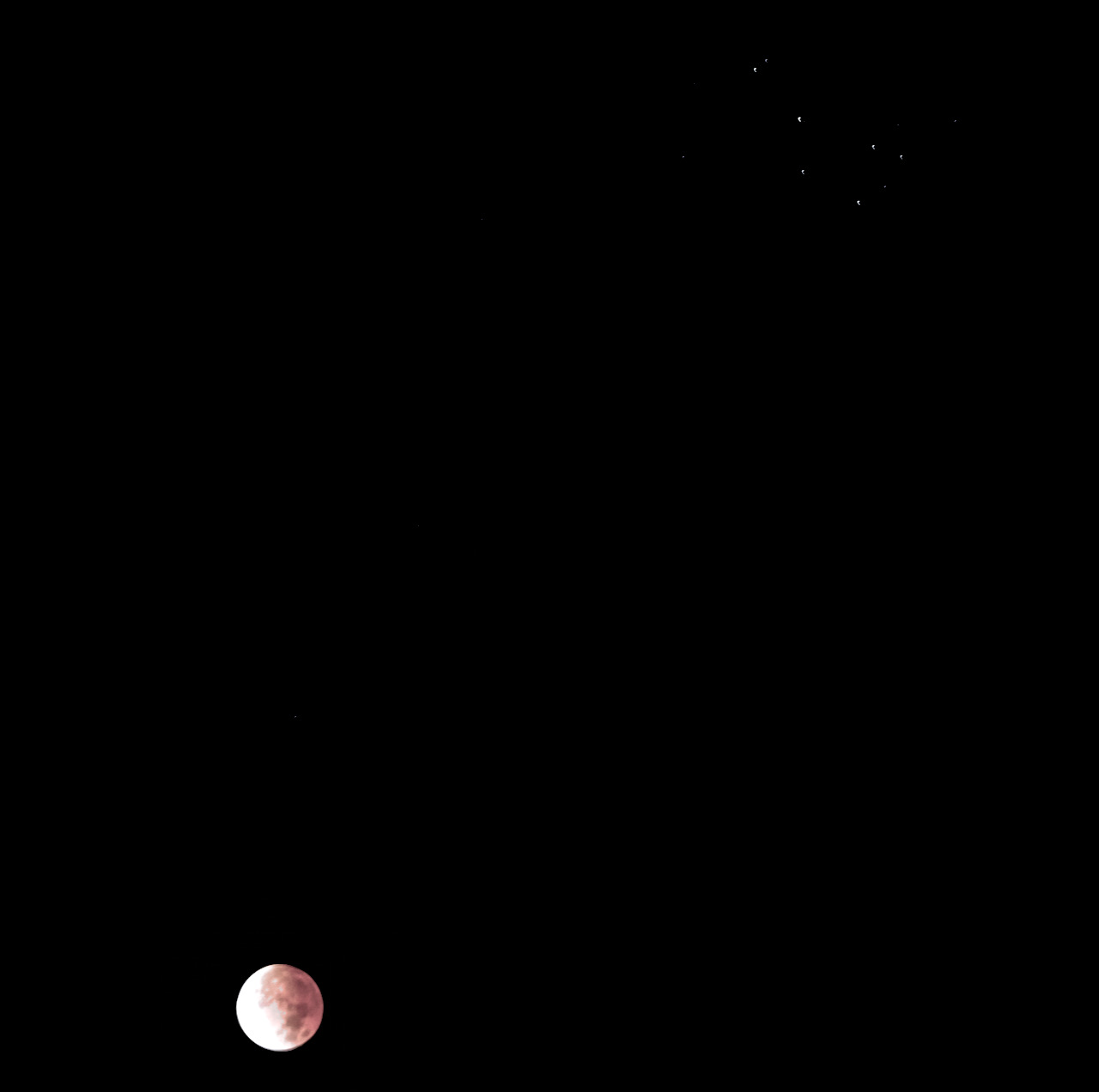
I couldn't shake the impression that it was not a moon; it was an ovum. It looked watery, diaphanous. It looked like it would jiggle like an egg yolk if you poked it. There it was floating in the vast womb of the sky, waiting for something to come swimming along and make something of it. It was unfinished, protoplasmic. I was riveted. Penumbra. That's what the disc is called, right? Even that sounds like a reproductive term.


It was very difficult to photograph, especially without a tripod. I should have digiscoped it, but fussing with a scope, tripod and phone adaptor at 4:05 am was just not something I could handle. I couldn't even deal with finding socks for my freezing feet. So I sat down on the ground, leaned against a cold concrete retaining wall, steadied myself, and shot some lousy photos. I kind of like this one, that includes the Pleiades, or Seven Sisters, in the upper right corner. Orion was bold and bright, but he was caught up in the twigs of a birch and I had no hope of capturing him. I have a sort of crush on Orion. At least he makes me smile each time I run into him.

I went back upstairs and it was getting light when I finally drifted back to sleep. I opened my eyes again at 6:55 AM. Four wakeups feels like a lot, even for me. Still, getting to enjoy the celestial events (that always happen at miserable hours) is one of the very few benefits of chronic insomnia. 

Who could be droopy and sorry, though, when this is waiting for them in the living room upon arising? 

We call this Wide Stance. He assumes it when he is asserting himself. Such a guy. I'm very proud of Curtis because a quick check-in at the vet's today showed that he has dropped more than four pounds! He's a lithe 43.4 lb. and I am delighted about that. It's all about the crispy fall weather. Running weather. And run he does. I can't believe my companion is 7 now. Where do the years go? Well, we started the clock at Year 4. That's most of it. How I wish I could have loved him from Day One. But his life experience has made him the dog he is. He is the Most Wonderful Dog.


I walked out the meadow with him. First, there had to be zooms, and hiding. He doesn't hide himself very well; I think he thinks I'm blind.  He hides the way an adult hides from a baby. He lets me find him.


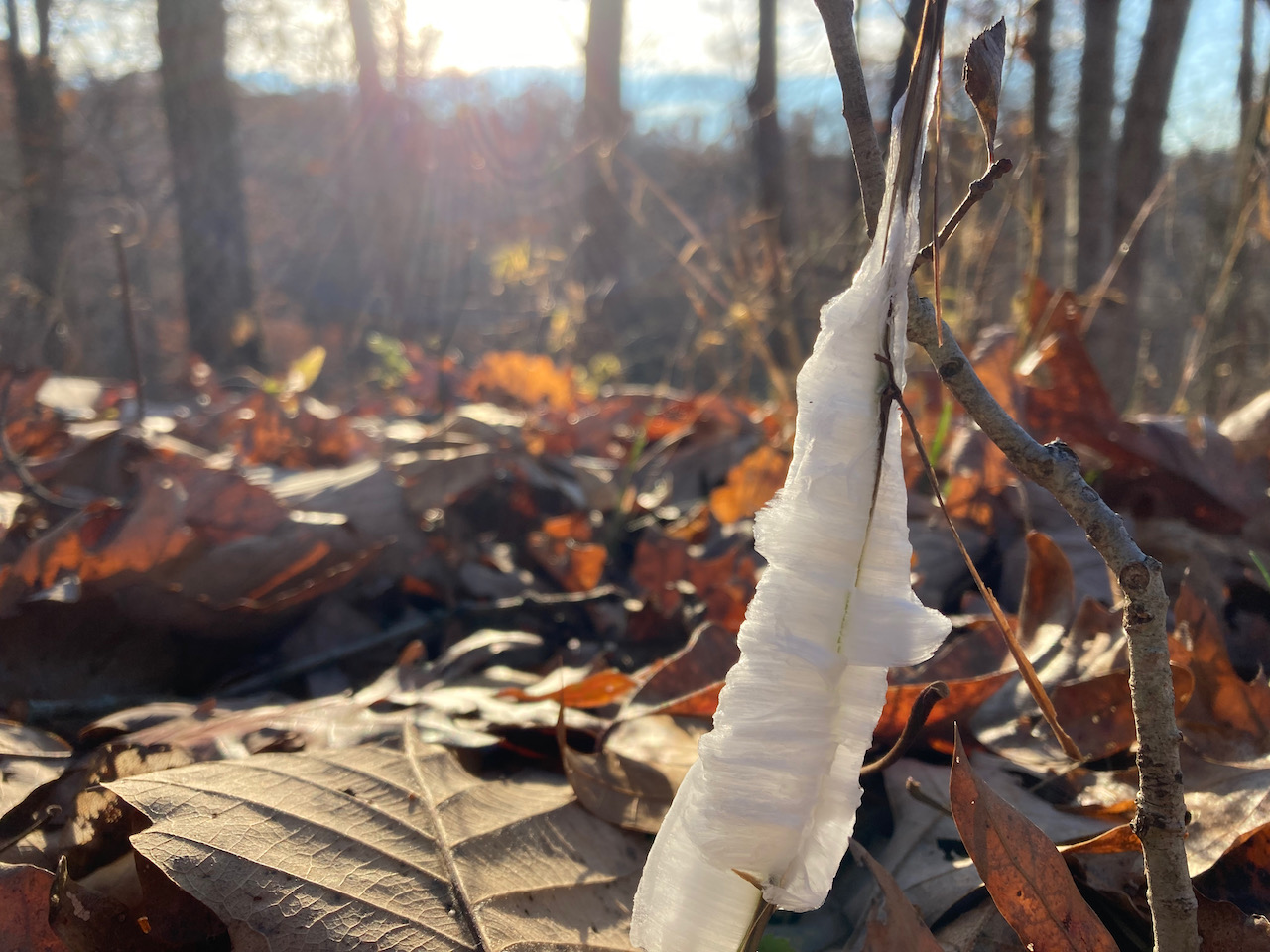
We went out the orchard next, and I got an idea. After a slowly spectacular near-total lunar eclipse, well, there might just be another surprise out there. Yes! The first frostflowers of winter 2021! The red blackberry leaf says it all. It's still fall, and they're already out.


I was so intrigued. There was a freshness, a pristinity to them I hadn't seen before. I think these are the earliest frostflowers I've ever found. Please click on each photo, because the detail is so beautiful, and these photos are so small.


One American dittany plant, its stems splayed, a flower on each one!


Being so fresh, and the first, these were tight, beautifully formed, close curling flowers. This one looks like a cone shell.


I almost threw this photo away before I saw the only in-focus part: a frost flower just forming in the rightmost dark stem! Wow! Do click on the photo to see what I mean. The stem is split, and the flower is just starting to protrude.


This one reminded me of Casper the Ghost's friend. Elmore? I can't remember his name. I love the way they're rising up into the frigid morning light. OooooOOoooOooo


There's something so delicious about seeing fresh frostflowers with green grass blades.


For those new to my blog, you can get the whole story on frostflowers and why they form at this post:

Please note that in this post, I had the plant incorrectly identified as pennyroyal when it is in fact American dittany. I was in the right family (mint), but it took awhile to ID the plant from the withered remains I found. I'm also bemused that last year's post is from November 22...pretty much right on target. See, that's the great thing about getting older. You forget when stuff happened, so everything is fresh and new all the time! Here I was thinking these were my first November frostflowers. Well, they're earlier by maybe two days...


This is a much better post about frostflower origins:


It's devilishly difficult to photograph American dittany (Cunila origanoides) complete with frosty skirts because the stems are hair-thin and just vanish in the clutter. But those small paired green leaves belong to the frostflower plant!


It's wonderful to get down and close with them, especially when there are still green leaves about.


Yes, it was a frostflower morning, and a fine one. Everything old is new again. I am continually amused by the wonders laid out for me to find. For that I am continually thankful. 


I made my way back up the orchard from the gasline cut where the dittany dances. I had long since misplaced Curtis; he was giving occasional bays from deep in Orchid Valley, safely in the middle of my land, and that was fine. 

I walked very slowly as the orchard was seething with birds. Gleaming cedar waxwings in the tulip tops, preening and cuddling. I love a bird that will sit touching shoulders with its friends. 

The winter wren that chimps at me every time I walk past Bill and Elsa's graves. 

And hermit thrushes. Man, do we have the hermits this year. I have a way of talking to them that, if I'm very patient and lucky, often results in their singing a few phrases. They're pretty territorial in winter, I guess, because my pitiful imitations of their songs and a much better imitation of their tchup! call bring them right in. Today, after much waiting, I was rewarded with November songs. Ahhhh how that conjures the boreal forest for me, even as I stare into a miserable tangle of Japanese honeysuckle in Appalachia. I do adore these little elves of the thicket. I'm so grateful they stay the winter here. All hail sumac and honeysuckle fruit; withered grapes and the odd snail or slug. 


I've been wanting to blog for a very long time, but just couldn't pull the trigger. I'm too busy. Crazy to imagine someone living in the middle of the woods being too busy to blog, but there you go. New ventures, new directions, good things. I miss writing to you. I especially wrote this one for Jeanne. 


I'll leave you with a Towertop Sunset. Sound up for a bonus white-throated sparrow, rambling adorably. Dootin-doo-doo, feelin' groovy! in a sparrowy kind of way. 

                  
[Back to Top]