Background Switcher (Hidden)

Orioles and Rosebreasts, In Detail

Friday, May 8, 2020

8 comments

This frigid spring weather really smokes out the birds. I've been very thankful that I overbought on peanuts and seed a few months back. I remember thinking, "Now how am I going to use 50 pounds of  peanut halves?" Well.

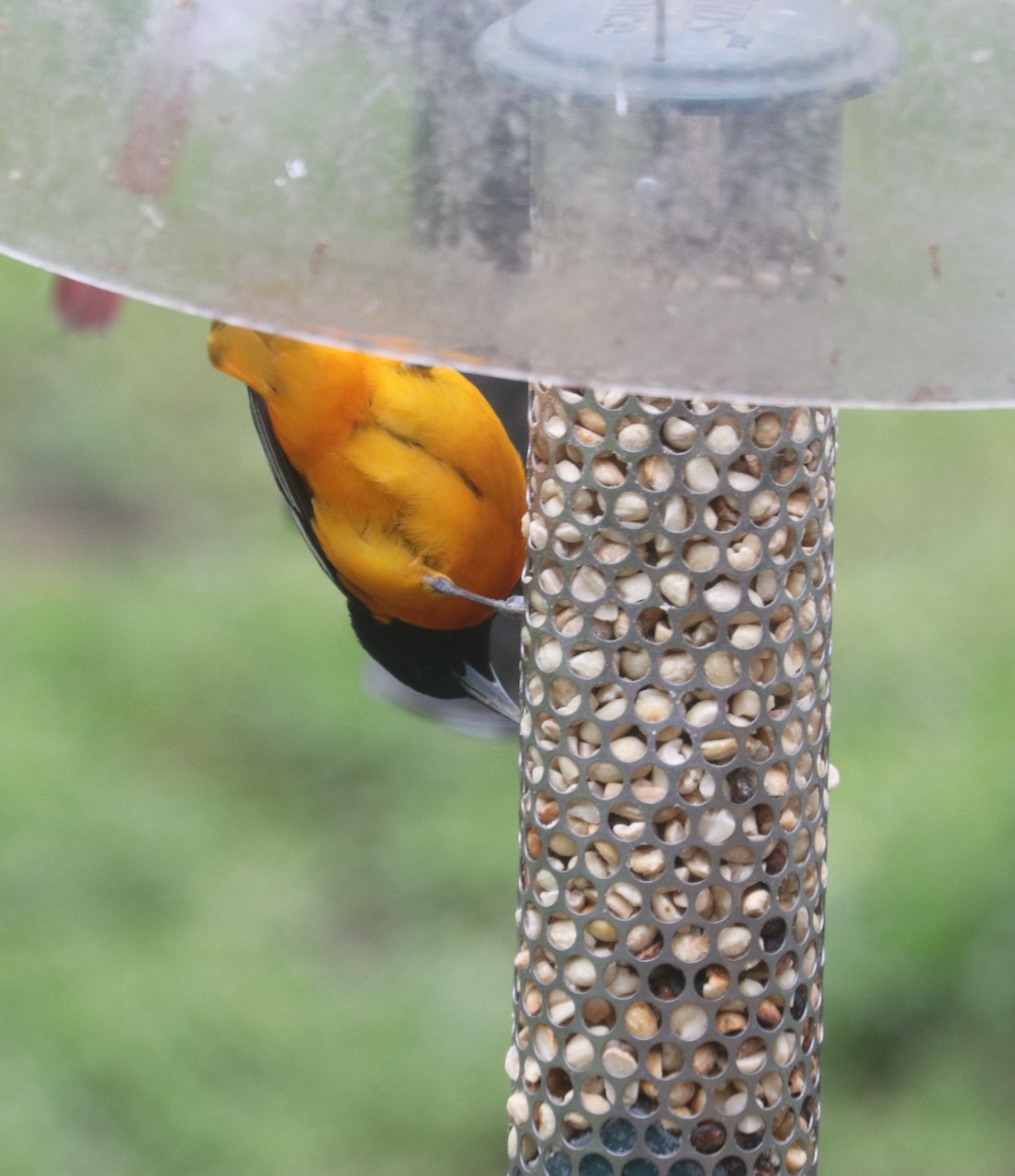
But when orioles come in, I have to get creative. Turns out a grapefruit half will serve just as well as a navel orange or Clementine.


This is an interesting plumage. It's an adult female Baltimore oriole, and she's fairly old, as evidenced by the increasing black coming in on her face and back. Some might think this is a young male, but the secret to sexing Baltimore orioles is in the tail. No matter how much black an old female Baltimore has on her head and back; no matter how bright her orange breast, she will always show an olive-brown, not black tail. So don't be fooled by male-like coloration. If the tail is olive-brown and dull orange, it's a female.


Male Baltimores have black deck feathers on their tail. The deck feathers are the two that sit atop all the rest, forming the center stripe of the tail.

I got this smart fellow to try Zick Dough by loading an exhausted Clementine half with it. He took a shine to it right away.


When a bird does something novel, other birds watch it. This female rose-breasted grosbeak wondered about the Clementine the young male oriole was feeding from.

I've had good luck with peanuts and rose-breasts. Everybody seems to like peanuts. Though this is the only rose-breast this year who's gone for them.


He liked them so much he got into some good spats with the resident redbellies over access. Red is a battle flag for birds. He's intimidating her with that fancy shirtfront.


She is, however, better armed in the poking department, having a vicious stabber rather than a pincer.  

Rebelly: I WIN.
Rosebreast: I wait.


They love my Bird Spa, with its bubbling water. Rose-breasts are avid bathers. Seeing one on it always stops my heart, in a good way. 


This little female grosbeak was watching the oriole eating fruit. So. Is that good to eat? Should I bump you off and try it?

Look at the oriole's response! Ha ha!! He is evil!


His evil eye sufficed to drive the grosbeak away. Look at her beautiful yellow wingpits! If this were a young male, they'd be pink. And carmine-rose on an older male.


Here's a young male rosebreast, taking off from our sycamore,  from early autumn. Isn't that underwing gorgeous? So that's how you sex a bird in all-brown plumage. In rosebreasts, yellow= girl, pink= boy!


 I raised a baby grosbeak one summer years ago--Jeffy. He was one of my favorite clients EVER. So gentle and sweet and easy to be with. When I released him, he hung around eating from little cups of mixed vegetables and mealworms around my yard. At the time he left, he still had yellow wing linings. Though there was no way to be sure, I had a strong feeling he was a male. 
I didn't see Jeffy for several weeks. Then one September day, he came out of nowhere and circled over me, calling, as I worked in the garden. I was SO excited to see him. And I saw his pink wingpits, and knew I'd been right about his sex all along. That was such a great moment, one of the gifts of sticking with rehab and being there for the magic moment when a bird returns to say hi and show me his wingpits. This is my watercolor of that moment (as described in The Bluebird Effect). 


The older a male rosebreast gets, the more immaculate his coloration. Young males will show an admixture of brown in their black parts, especially on wings and head, and lots of speckling on the breast and flanks. Look at this amazing male, probably in his second spring (though as always I'm happy to be corrected!He's got fully black feathers in his wings, so maybe he's in his third spring?)  Wing linings are pale pink, and he has a very small pink cravat. Lots of streaking on the underparts, as well, and brown mottling on head and back. Taken May 2, 2016 here. Click on the photo to embiggen it and see the details I'm talking about.


This is interesting. I've been digging around trying to find out how long it takes a male rose-breast to attain full adult plumage. Found this in Birds of North America (now known as Birds of the World!): 

"Some males may not acquire complete Definitive Alternate (what we plebes know as breeding) plumage until their third year or later. Smith () cites a single male that was banded as a yearling in 1961 and did not acquire a completely bright-pink bib until 1965. "

Whoa! Like a bald eagle, taking four years to get that cravat? WHO KNEW? Probably not the case for all individuals, but still. Who knew?

This is the best shot I've ever gotten showing molt in a second spring male rose-breasted grosbeak. Look at the retained juvenile plumage in wings and tail! It shows as dull brown. He's got the remnants of the broad white crown stripes he wore as a juvenile.  All his ebony finery is still on its way in. And the deck feathers on his tail are newly grown, and black. Taken May 3, 2016, in Whipple, OH.


 This one has just a few black specks on his breast. But look at the extent of the carmine on this boy! Runs all the way down his midline, goes almost from shoulder to shoulder across his breast. From what I've observed, I suspect the rose cravat gets more extensive as he ages, as well. I'm fascinated by the progression of molt in birds, especially as it is used to age them. 


It has been such a delight having grosbeaks around this spring. They are one of the great gifts of early May. I know they're helping keep me content on the gray rainy cold days when I'm not grubbing in the garden or ranging through the forest. 

Another reminder, my last. Tomorrow, May 9, I will be participating in the Virtual World Series of Birding, with an all-star team of 22. Proceeds from our pledges will go to monarch butterfly research. The money is needed more than ever, with the recent slaying of two of Michoacan's most ardent monarch conservationists by drug cartel fiends on the butterflies' mass wintering grounds. My esteemed friend Mark Garland has put together the team. I'm included for geographic diversity, since most of us are from the East Coast. I got 61 species on my place alone on my dry run May 7, so you can do the math if you wish to pledge. At 10 cents per bird, that would be $6.10. :) Who knows how many species we can rack up, with people like Louise Zemaitis and Michael O'Brien birding their yard in Cape May? Scott Weidensaul will be checking in, with highs in the 30's and blowing snow in northern New Hampshire. Seth Benz's forecast on the Maine coast isn't much balmier. Nowhere but Texas, where Angel and Mariel Abreu will clock in,  is the weather going to be salubrious, but we're all going out and seeing all the birds we can. I'm hoping for peeks of sun, but it won't even reach 50 degrees here tomorrow. 

 I'll be birding around my admittedly largeish "yard" and along my bluebird trail, as I feed hungry babies in the box and leave little crocks full of live mealworms on the box roofs. Just got back from my second run today. All are warm and well-fed. One more run before nightfall. 

 If so moved, you can pledge for monarch conservation here: 


Thank you so much!


What to Feed Orioles...and What NOT to Feed

Wednesday, May 6, 2020

11 comments

This is an unusual sight: a Baltimore oriole eating sunflower chips with a cardinal. Another unusual sight: the same oriole, eating peanuts!


But then, this is an unusual spring. April was terrible: cold and wet. I had high hopes for May, but it was 38 at wakeup this morning, May 6, in southeast Ohio, and the birds are hurting. I lay awake all night figuring out ways to help them. I've got to go on another Zickpotition to feed baby bluebirds in their boxes today. My third such trip this nesting cycle. I hate that I have to do that, but it's that or clean the dead little ones out of my boxes, and that I really don't want to do. 
When it's cold and wet, bluebirds and other insectivores have a terrible time finding enough food for their young. So I help. If you haven't seen the video yet, click here: http://tinyurl.com/zicklife


These orioles are migrants, and they normally make their living like this. Here, he's spreading apart a dead leaf wad with his opened bill, looking for caterpillars or spiders. 


But in this craptastic weather, the orioles are forced to mooch. 

I had literally two tiny Clementines in the house when they blew in. 


 Do you like my oriole orange feeder? It was a gift from my sweet dear friend Kim Beard, last October. It happens to have a prong on it that works for impaling a small orange. :) 


The wee clementines were disappearing fast. So as I lay awake all night, it occurred to me that the orioles might accept grapefruit. And they did, though they shake their heads at the sourness. This is a young male, who still has some olive-brown immature plumage around his eyes.


The first thing I did when I got up this morning was make a double batch of Zick Dough. Here's the recipe: 

Zick Dough Improved

1 cup peanut butter
1 cup lard (can be bought in large tubs at Walmart)
Melt the fats together in microwave until liquid. 

Combine dry ingredients: 
2 cups chick starter (make sure it's unmedicated; available at feed store)
1 cup cornmeal
1 cup flour

Add melted fats and stir until crumbly. Does not need refrigeration. Serve in hanging plexi dome feeder so it stays dry. Serve in winter, or during unseasonably cold spells in spring and summer. It is too rich for a steady diet and can possibly cause issues with gout, but it's great for pulling birds through hard times. So feed sparingly, and only when needed.

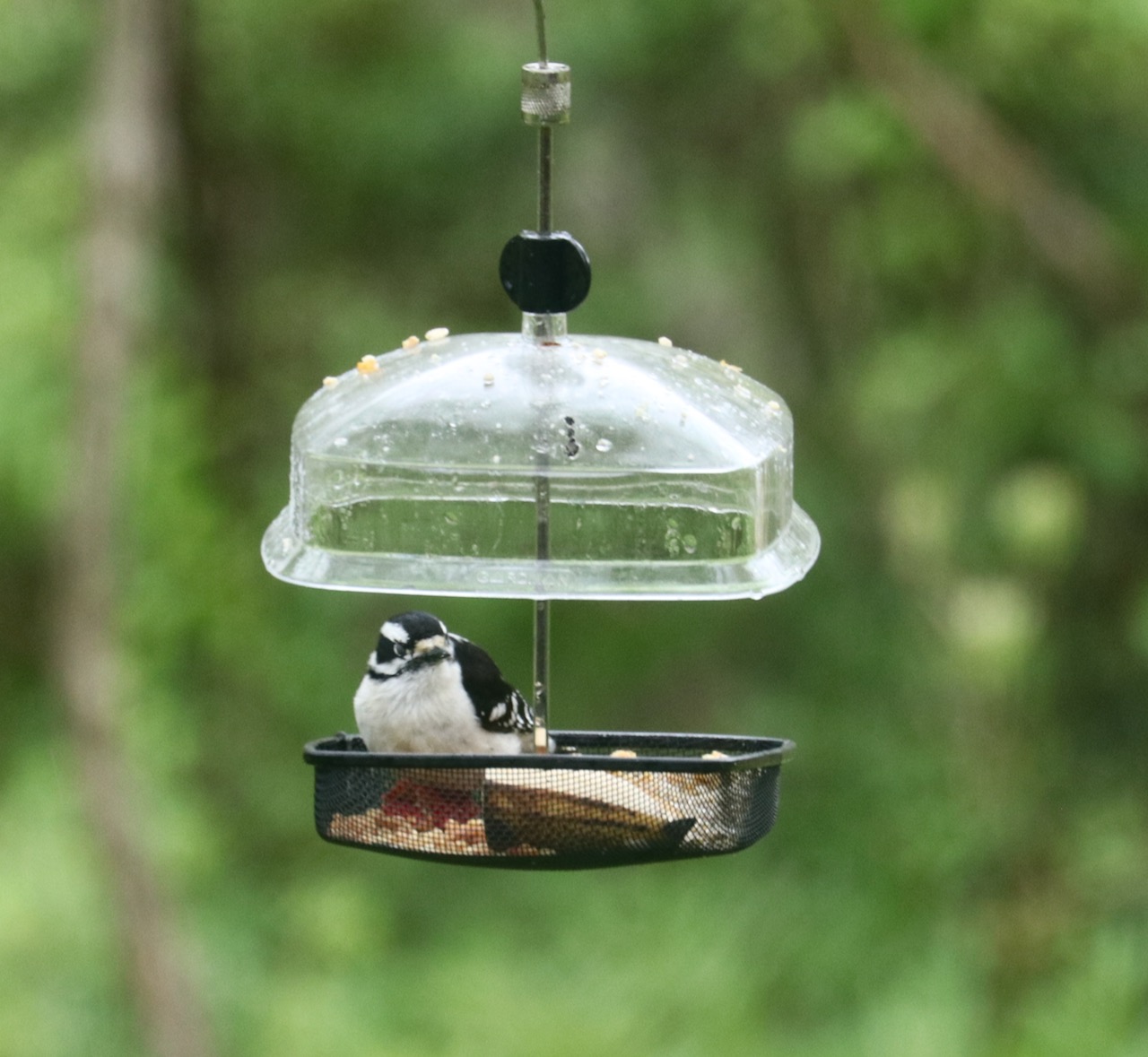
Here's a hanging plexi dome feeder I got at White's Mill in Athens OH. Has a screen bottom so water won't collect, and an adjustable dome so you can keep starlings out by lowering it so only cute little natives like this female downy woodpecker can wiggle in. Such an awesome little feeder! 


While I was lying awake this morning, I got this idea that I might entice the orioles to take higher-quality fare than orange pulp by using a little birdy psychology. So as soon as the batch had set, I stuffed an exhausted Clementine skin with fresh warm ZickDough.

The older male oriole came down, tasted it, and approved. I was squealing with joy from inside my studio blind. 


 Along came the young male. Whatcha got there? (This is how birds learn: by observing each other). And old boy says, "Nothing you'd want! Mine!"


When an older female dropped in, she was attracted to the Clementine, but didn't consider ZickDough fit for consumption. You can see her spreading her mandibles, trying to get down past the dough to the fruit pulp. Oh well. Two out of three ain't bad. 


Between the ZickDough and the grapefruit, I've got them covered until I can get some big navel oranges today. I also ordered 3,000 mealworms from thenaturesway.com , my favorite supplier of mealworms. Tell Tim Vocke that Zick sent you!

(I don't normally feed mealworms to the birds in my yard. But in a spring like this one, they can make the difference between life and death for nestlings).


You will notice that I am NOT feeding grape jelly to these birds. I do not consider straight grape jelly a fit food for any wild bird. It is practically pure refined sugar, full of artificial color, and not a fit food for any bird.  I hope that if you are feeding grape jelly to orioles you will stop and consider my warning. I've been rehabilitating and experimenting with feeding wild birds since 1982, and I would never, ever feed straight processed grape jelly to one of my clients. If I did, I'd expect to see it keel over from liver damage in short order.

You will see a lot of people recommending feeding jelly to orioles. This is classic anthropocentric behavior. I enjoy it, so I do it. I don't even think about whether it's good for the birds. It brings them in, they like it, and that's enough for me. Well, just because a bird will eat something doesn't mean they SHOULD eat it.

No, there aren't any studies as yet to prove me right, but you can ask any avian dietitian if they'd feed jelly to orioles. You'd get an "absolutely NOT!" And neither are there targeted studies to back up the assertion that Red Dye #40, as found in artificial hummingbird "food," is harmful, and I think there's now solid agreement on that score (except from the manufacturers who continue to make money on it).

For more information on that, see my blogpost, Red Alert for Hummingbirds.


And, at the risk of making this post a real linkfarm, I wanted to let you know that I'll be raising money for monarch butterfly research this Saturday, May 9! Mark Garland, my dear friend from Cape May, NJ, has asked me to bird around my home and contribute my sightings to his Virtual World Series of Birding team, The Monarchists. We have an AMAZING team of 15 people. They are: 

Lu Ann Daniels, Ron Rollet, Elle McGee, Bert Hixon, Michael O-Brien, Louise Zemaitis, Meg Hedeen, Mark Garland, Dick Walton, Erik Bruhnke, Drew Lanham, me, Seth Benz, Geoff Heeter, and Scott Weidensaul. 

Talk about good company! If you'd like to contribute to our knowledge and research on monarch butterfly migration, you can donate a per-bird amount (any amount is fine! A penny! Whatever!) at this link: 


Thank you, as always, for reading and enjoying this wonderful spring with me.

Real Life, Served Hot

Monday, May 4, 2020

9 comments
When you see a sopping wet gobbler walking on a new-mown path, you know there's been too much rain. Wild turkeys hate hard rain. They hate getting their feathers soaked, for good reason--they can get chilled and die. So they resort to meadows and even lawns--anywhere they can go and not brush up against wet vegetation--when it's cold and rainy. I know to look for them in the meadow on such mornings, and am often rewarded.


It's especially nice when they come close to the deck, and I can creep ever so softly out and photograph them through the railings. Nice beard on this one. It's the height of turkey season here now, and there are more hunters in the woods than usual because they're bored and not working. I'm sure any hunter would like to bag this gobbler as a trophy. It seems so dumb to me,  get all excited about how long a turkey's beard is,  or how long his leg spurs are, but people do what they do. They're always counting coup on wildlife, lying in wait and calling them up, spreading corn in the woods, trying to kill them, then setting up ways to measure how "good" a gobbler is. To me, if he's out there and alive, he's good. He's no good dead, unless you're hungry. He won't get shot on my 80 acres, if everyone behaves himself.


I'd no sooner finished photographing this gent than another showed up on the other side of the meadow. Phoebe spotted him and sent me scrambling to get in position again.


You can see he's got a livid red engorged wattle, so he's probably been displaying down in the woods. 


He was headed for Bill's grave, which is the dark patch to the right, and backed by a blizzard of dogwood, and he stopped to gobble right there! If you click on the photo you can see the gobble posture: head thrown forward, a little awkwardly.


I like this shot because it says so much. The dogwoods tell you it's late April. The lone pine where Bill decided he wanted to rest. His grave to the left. And in the foreground, a crummy looking little shrub. That's got a story to it, too. The whole time we were living here, Bill was buggin' me about digging a pond out in the meadow. He wanted a pond smack dab in the middle of the meadow so he could watch for ducks and solitary sandpipers and yellowlegs and snipe and the like. Bill was a goal-oriented birder. 


Our argument hinged on the inescapable fact that this pond would be at the high point of a dry ridge. I told him, again and again, that I had no desire to look at a dry hole or a mud puddle, because I could guarantee that thing was gonna dry up every summer. Where's the runoff? I'd ask. 

So he had a test hole dug by our friend Mr. Crum when he was out here doing some bobcatting with his little dozer. And it holds water...sometimes. In spring. Some springs. And because you can't mow a hole, some shrubs sprang up and there they are to this day. With a hole. With a few inches of water at the bottom. That, I guess, is Bill's pond. That's as far as he got. I'm frankly glad it isn't a couple acres big with shrubs all around it. That's what I'm glad of. You can't mow a hole.

I've been watching jays. I have a lot of jays this spring. I watch them like some kind of addled eagle, all day long (when I'm at my desk). Because if I watch long enough, I might catch something like this.

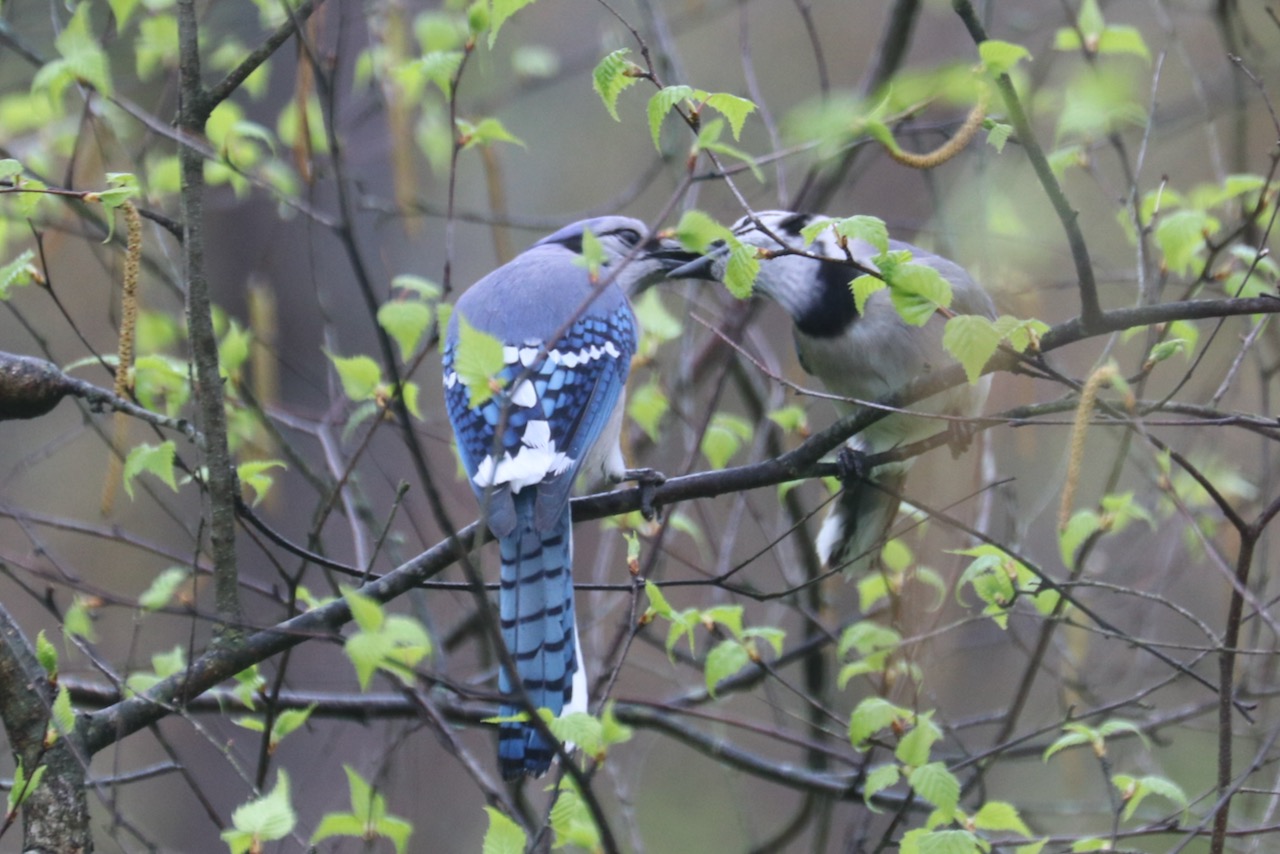
On the right is a known jay from 2017 that I named Little Bit. See the little flash of white at the primary coverts? Unique. Nobody else has that.


In this shot, you can see the little bit of spangled white on Little Bit's brow, if you click on the photo.
I was under the impression that Little Bit was a male. In 2018, I had photographed it making a call that I thought was the male jay's "squeaky gate" call. 


Apparently not. Because LIttle Bit is getting fed by her mate here. I about fell over. Data points. Gathering them like a jay gathers acorns, all the time. Storing them away. Hoping to learn something. Learning every minute.


The real point of this post is to show you something wonderful. In mid-April, I answered a plaintive call from Geoff Heeter at the New River Birding and Nature Festival, based in Fayetteville, West Virginia. I have given a keynote without fail every Friday of that festival for the last 18 years. EIGHTEEN YEARS. I look forward to it sooo much. I love the festival, its organizers, Opossum Creek Resort (where it's held). I love the birds and mountains and wildlife. I love being around my old friends and making new ones. I love taking my dog, whether Chet or Curtis, to charm and entertain the people who come. Last year was Curtis' debut and he did not disappoint. 

I also love the fact that the festival raises money for an education fund that brings nature education into Fayette County schools. I really love that. 
But the festival had to be canceled this year, and we all hated that. 
Geoff wanted me to do a virtual keynote. Uh oh. I am real good at real life, at showing up and entertaining people. I am not good at virtual life, unless you count this blog as virtual...

So I thought about it, and decided to take my phone along and set it on VIDEO and just record a normal Zick morning on the bluebird box trail. 

And amazing stuff started to happen. 


One after another, amazing things happened. Was it because I was recording? Was it because life is just amazing, and when you make a video of it, you realize how jam-packed it is? I'm not sure, but I am so glad Geoff Heeter asked me to do this. Even though it took me most of a week to collect, edit, string them together, make transitions, and then consult with my kids to figure out how to present them in a goof-proof way for my "virtual keynote." Which actually came off without too much of a hitch, as long as you don't count the entire day I spent freaking out before we figured out how to put them all on a YouTube playlist for easy access. Virtual anything...bleh. These videos though...YAY!


Without further ado, I refer you to a series of five very short videos. Clicking this link will play them all in order. And you won't be sorry. It's a Day in the Life, Zick Style.


[Back to Top]