 In this cold, rainy spell, our Montana friends had a big flock of western tanagers in their backyard, feasting on suet cakes. What an amazement, to see them whirling around the feeder, a blur of orange, yellow and black.
Female western tanagers are more modestly attired.
 No modesty in this rooster ring-necked pheasant! Another bird I could never take for granted, extravagant in its beauty. I don't mind that they came from China. I'm simply amazed that they took hold here.
 Speaking of amazed...one of my unspoken goals for this trip was to see a badger's face. I'd seen their disappearing carpetlike bodies as they dove into North Dakota ditches. And I'd sadly stroked the fur of one who'd been shot at the mouth of her den, doubtless leaving kits to starve. Oh, I wanted to see their faces, alive and doing badger things.
While on the road to John and Durrae's, we were advised to be on the lookout for a badger den where they frequently see the animals during the day. We found the den...and there were two little faces at the entrance.
 Oh joy, oh rapture. Badgers, alive, beautiful, doing what badgers do.
Though we kept a discreet distance and viewed them through the spotting scope, the female badger seemed perturbed by our scrutiny. She took her kit up the long hillside and under a barbed wire fence into another pasture, throwing dirty looks over her shoulder the whole way.
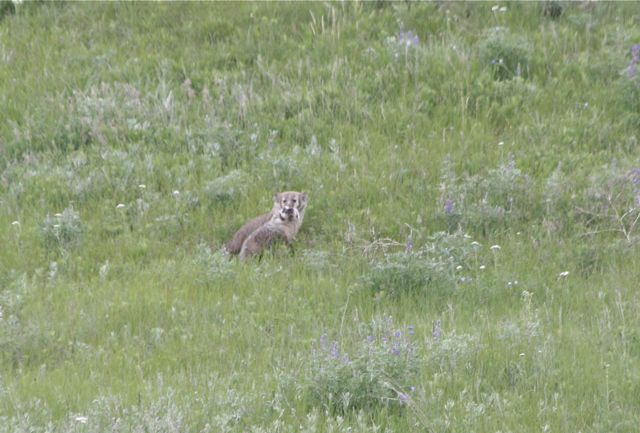 The kit is in front, sniffing the air...you will need to click on the photo to see its face. Badgers!
What a thrill. One of my most-wanted North American animals, finally seen well. I wish we'd make more room for badgers in this world. They are the coolest of weasels, great broad-shouldered trundlebeasts.
I turn now to the better glass of Bill's fixed 300 mm. Canon telephoto with its 1.4 doubler for these two shots:
 Here's Mom in lovely profile, and the kit turning away. Badgers have the neatest ears, great big things set low on the sides of the head, as befits a burrowing animal. I'm sure there are neat adaptations to keep from getting dirt down in them, too.
 See how the mom looks faded, while the kit looks newly-laundered?
File this next photo under "you had to be there." While the badgers were trundling up the hill, a western tanager came down and landed on a boulder to watch them pass by. You can just make out the grayish spot of their backs to the left of the tanager. It's not much of a photo, I know, but the waving flax and gray-green grasses, the undulating badgers and the brilliant color accent of the tanager all combined to lay me low. You really did have to be there, in that fresh cool wind, seeing live badgers humpeting up a hill.

I love Montana.
If you're in the Parkersburg, West Virginia area this weekend, please come by tomorrow, Friday, September 10, to see our new quintet, The Rain Crows, perform from 7 pm-10pm in the Blennerhassett Hotel's lovely rose garden. Bill and I have been working doubletime to pull together a very promising lineup, which includes bassist Craig Gibbs, formerly of Hoodoo Hand, and two former Nashville session musicians, singer/keyboardist Wendy Eller and drummer Jeff Eller. We're rehearsing as you read this, no doubt. Hope to see you there!










Thursday, September 9, 2010
9 comments