Background Switcher (Hidden)

Showing posts with label Los Tarrales. Show all posts

Tarrales Farewell

Wednesday, March 26, 2008

11 comments
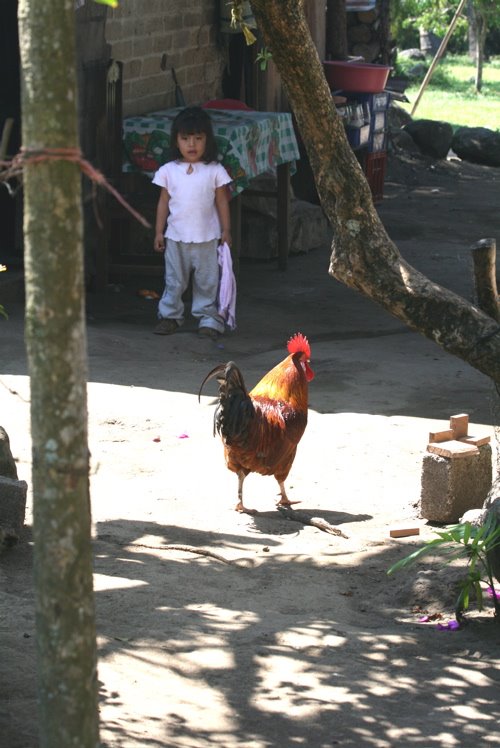
One of my favorite images from Los Tarrales: a toddler-sized chicken with a chicken-sized toddler.

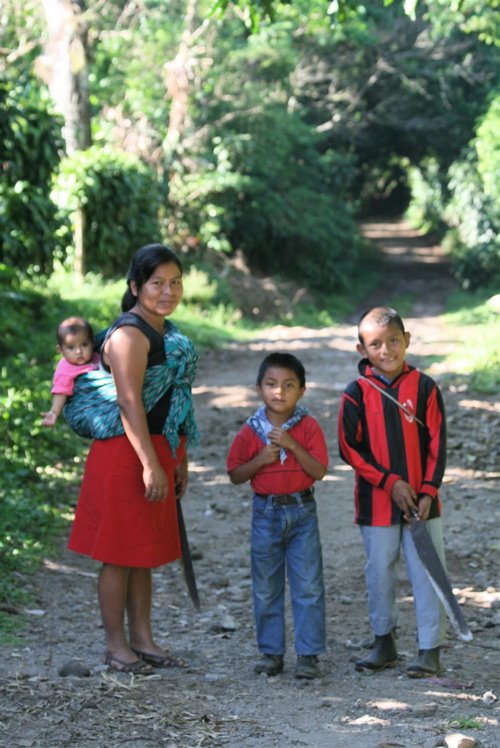
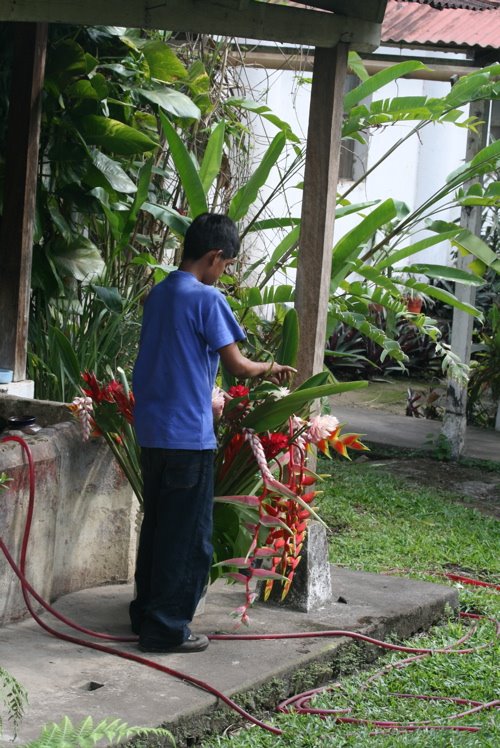
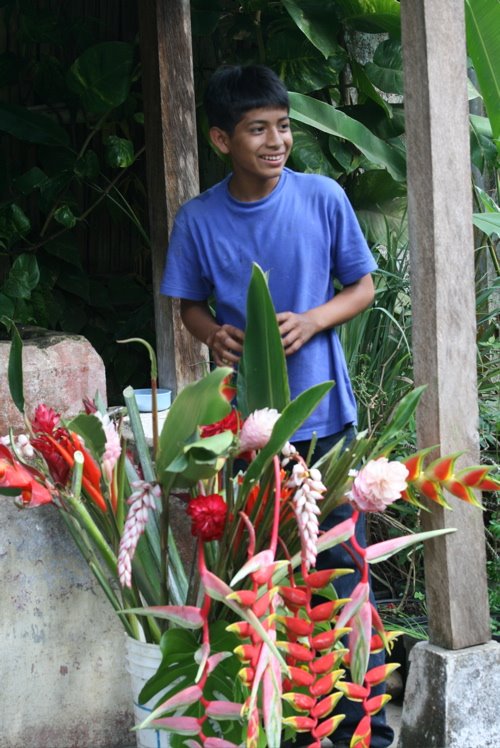
Los Tarrales is a place where an ecoutorist can feel at home, as if she is contributing something of value to a vital, functioning establishment which gracefully balances tourism with sustainable agriculture. A family goes to work in the morning, to cut flowers or hack away weeds with their machetes. They pass me, going out to watch birds. I remind myself that watching birds is part of my work. The baby has tiny diamond earrings. Eddie, whose older brother Josue showed us many elusive birds, arranges some freshly cut heliconias. It was hard to sneak up on Eddie; he's just as sharp as Josue.Hearing my camera, he gives me a shy smile. I look at the riches in the joint compound bucket, and know that a hotel in Boston or New York would willingly pay hundreds of dollars for such a bouquet of heliconias and gingers, if one could be had.

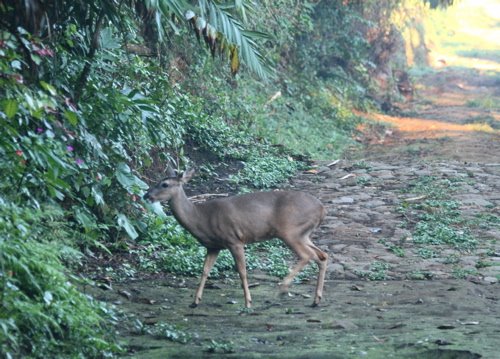
Just down the road, a white-tailed deer steps lightly across the path.
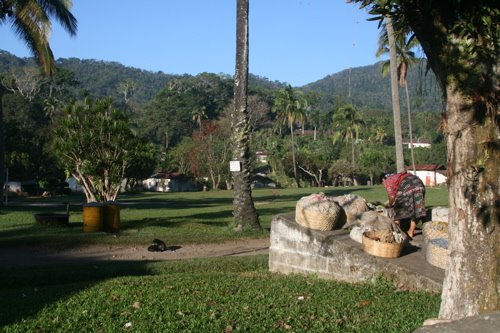
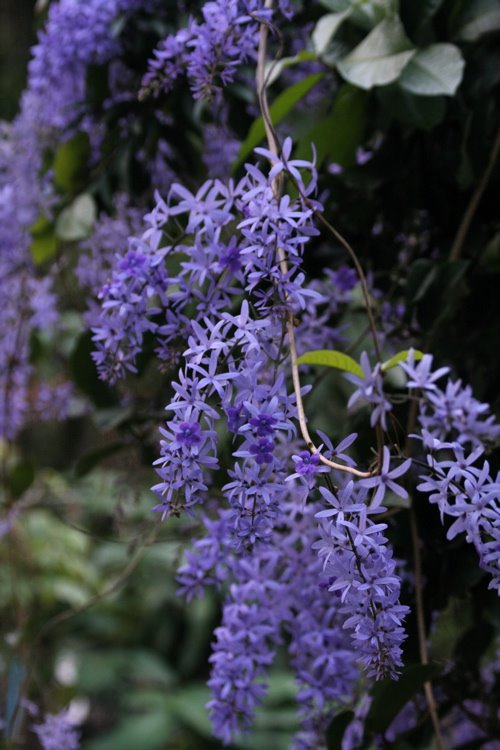
A Maya woman packs bananas for shipment, overlooking the playing fields that serve as a gathering place for Tarrales' residents. Cinnamon hummingbirds hover around a luminscent vine, its color shivering in the shadows. Petrea volubilis, Queen's Wreath (Verbenaceae). The true flowers are darker blue; the calyxes are persistent, and extend the apparent bloom time by hanging on. Thanks to Liz Gordon for the ID!

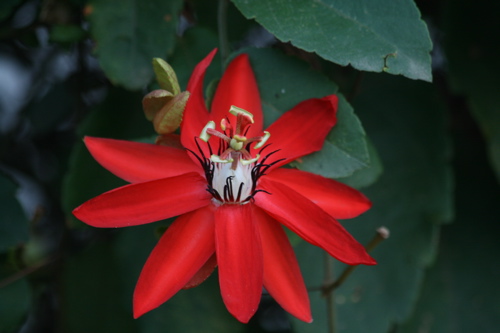
A passionflower glows like a hot coal as it clambers over a fence.
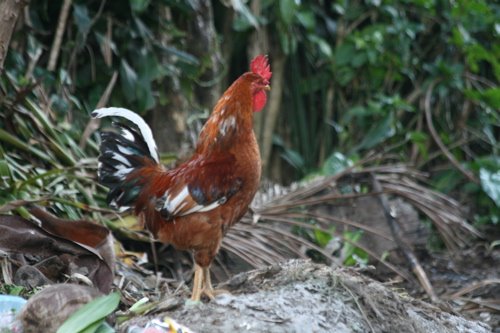
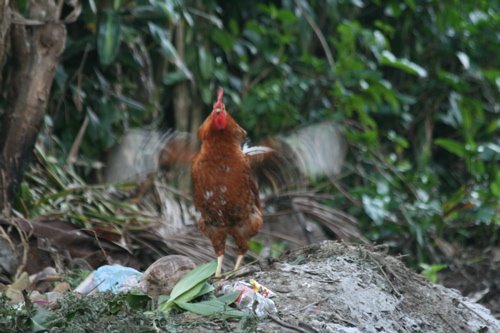
The rooster's comb is almost as bright.
He flaps, to show me that he is king of the rubbish dump.
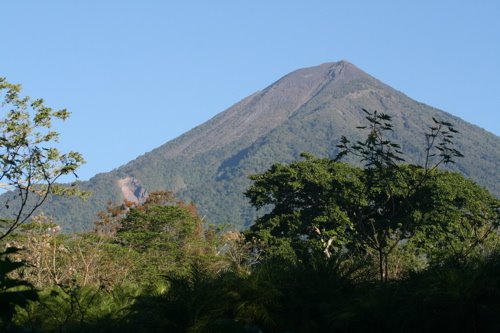
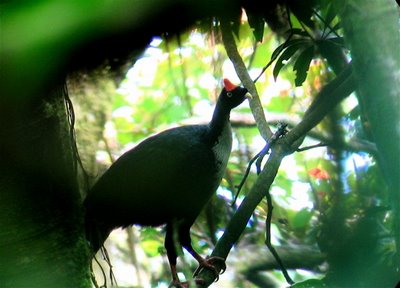
Volcan Atitlan hovers over it all. I look at its slopes, knowing that horned guans clamber in the highest reaches of the forest. Having given its rich ash to the farm fields of Los Tarrales, it is silent, for now
while an unquiet neighbor to the east lets off a belch of smoke to start the day.These are some of my favorite images from an enchanted three days at Los Tarrales in Guatemala. Please, consider going there, too, for an ecotourism experience that excites, then calms the soul.

Beauty at Every Turn

Tuesday, March 25, 2008

14 comments

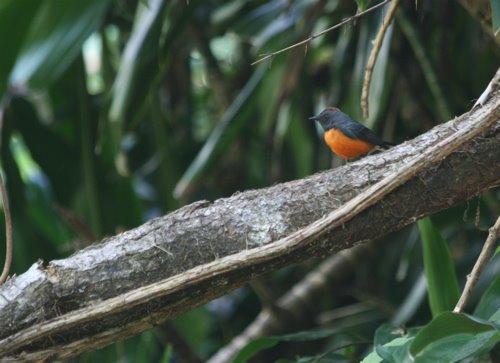
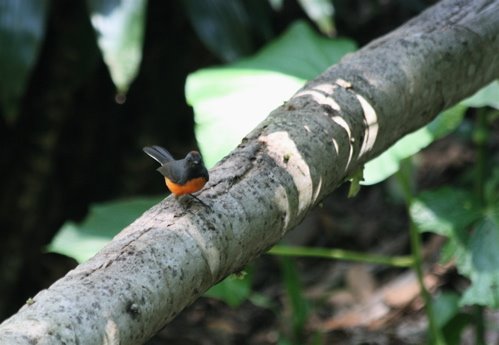
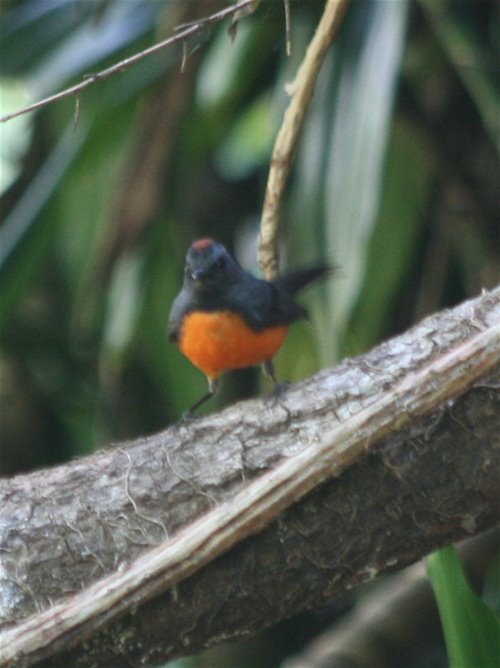
Dull name, beautiful birdlet: the slate-throated redstart. These little tropical warblers forage for flying insects along trails, perching predictably on fallen logs as they sally out to catch their prey. They are flashy as all get-out and pretty easy to photograph, being confiding and always ready with a fabulous pose.As if deep slate-blue upperparts weren't enough, they have this ruddy crown, like our ovenbird. I find their color combinations captivating. Fierce, as Christian from Project Runway might say. This bird is workin' that little red Mohawk.
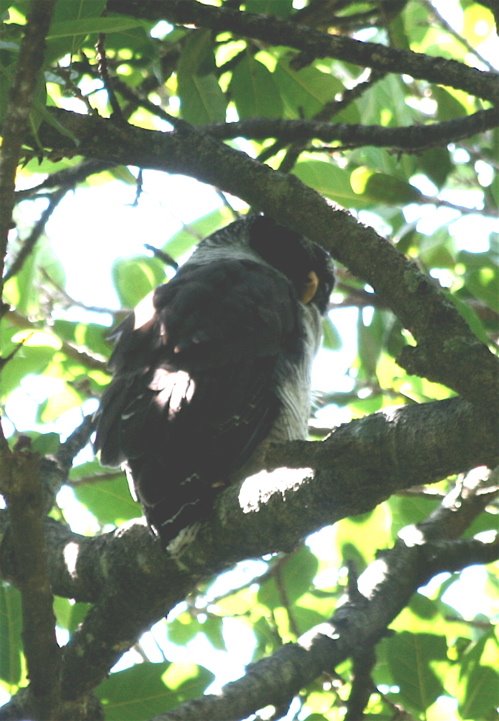
I found the slate-throated redstart on the way up to find a roosting black-and-white owl in an enormous strangler fig at the top of a long hill above Los Tarrales. The black-and-white owl is a prize of tropical birding, rarish and hard to see, unless there's a stakeout like this one. I'd never have known to look for him unless our guide, Josue, had pointed him out. We'd made a long climb and Josue asked if we were game to climb another 5 km to see the owl. Without hesitation, Liz, Jeff, Lisa and I said, "Sure!" Josue smiled and led us another 100 feet to the shade of the strangler fig. We looked up and there it was, the beautiful strange owl we'd been hoping to see. Understand that this is a horrible photo, because it was pitch-dark in the canopy of the fig (as an owl would have it), and I had to burn everything out to get any detail at all. This is a sharp owl, barred black and white with burning red eyes and corn-yellow bill and feet. I'll never forget watching a family of them catching moths under a light at Las Ventanas de Osa in southwestern Costa Rica. What a privilege to have seen a handful of black-and-white owls.

Just beyond the owl tree, an endemic blue-tailed hummingbird taunted me by sitting close and still in terrible light. It seems ever to be thus with iridescent hummingbirds in the tropics. The light is usually tough, and they're usually between you and the sun. You'll remember the photo in my last post--blurry with decent color. Well, this one is sharp, with no color. Take my word--he's bronze, green, and violet-blue, and very beautiful, except here. Hummingbirds are fan dancers; they only give you a peek and then cover it up again.
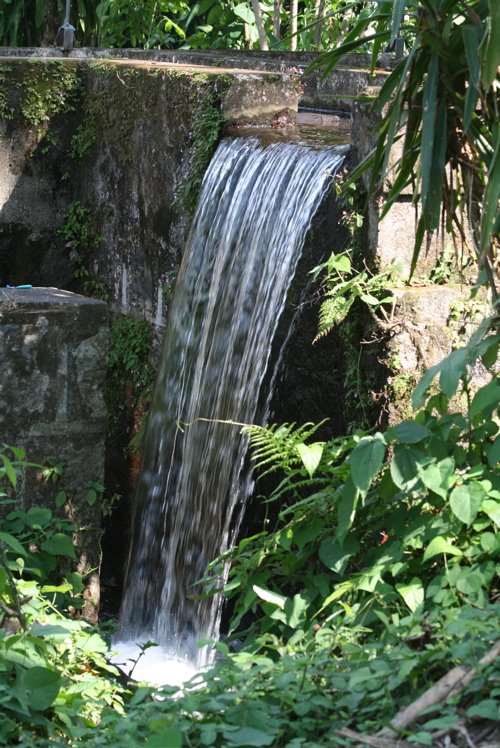
Water poured from a weir. Rushing water, in canals and chutes, is everywhere at Los Tarrales, watering the plantations of flowers and bananas. It was such a balm to my soul to hear running water, having been frozen into our iceblock in Ohio for so many months.
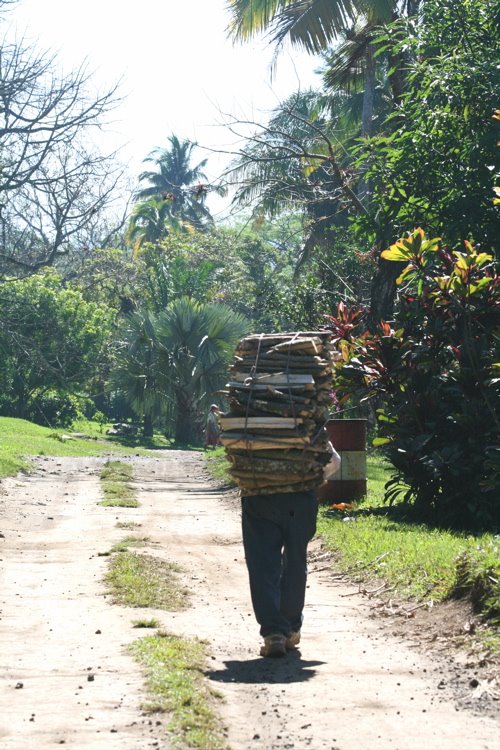
As I came down from fairyland, I was reminded that everyone else was working around Los Tarrales. This elderly man was bent almost double under probably 100 pounds of firewood. Still, he had a bright smile and a soft "Buenos!" for me.
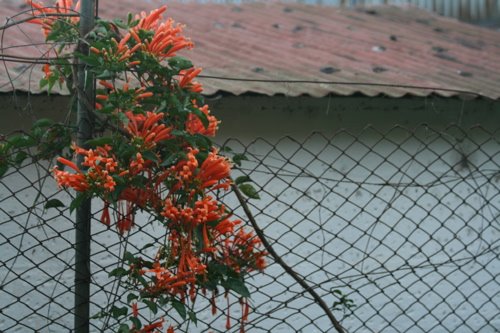
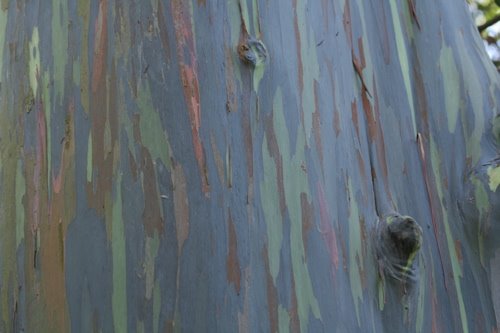
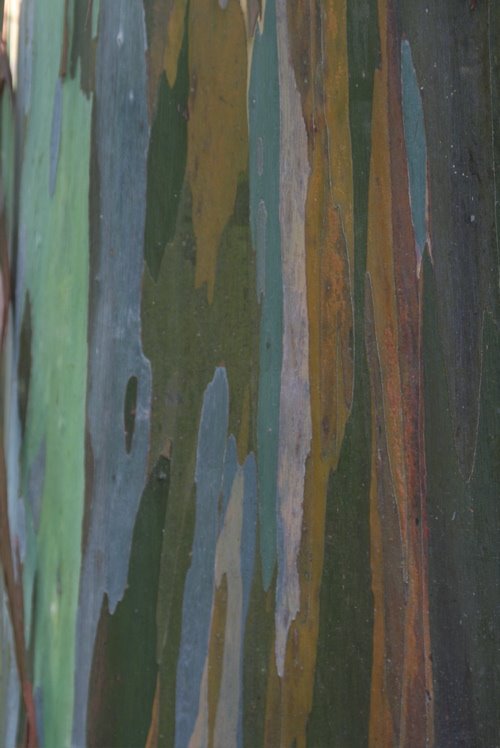
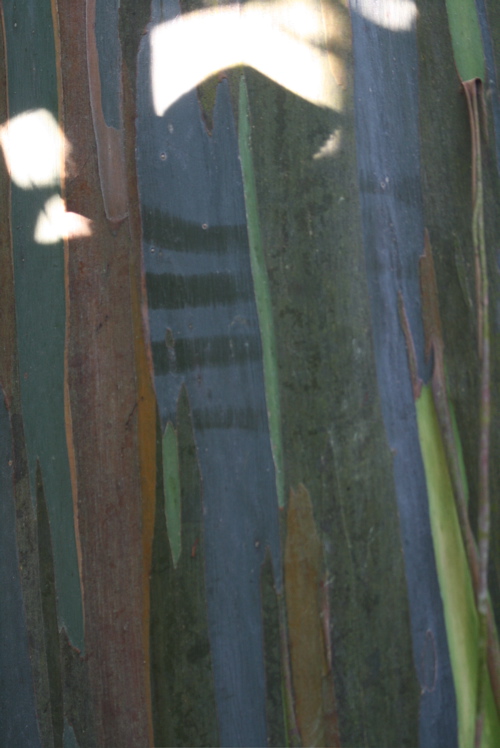
Beauty peeks out of every corner here. A nameless vine, clambering over a chain-link fence near the coffee processing plant. Needless to say, the cinnamon hummingbirds were working it.I'll leave you with a tree that completely blew me away. This is a rainbow eucalyptus. Its trunk was smooth and cool and damp, striped with the most perfect Martha Stewart colors. Andy Burge's grandfather planted several of them decades ago, and only two remain, because as Andy put it, "Lightning likes those eucalypts."The thought of having a yard full, an allee, perhaps, of rainbow eucalyptus trees is almost enough to make me move to Guatemala. I could lose myself in these colors. As I moved around the tree, moaning in delight, I saw that I was not the first to admire it.

In the Shade Coffee Plantation

Monday, March 24, 2008

10 comments

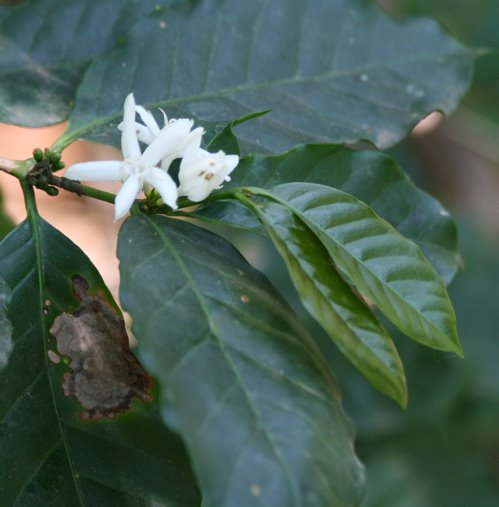
Coffee in bloom. Do you ever think of the flower that precedes the bean, with its light, citrusy fragrance?

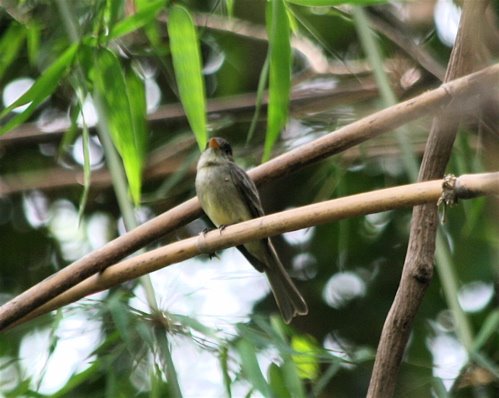
That day with the long-tailed manakins at Tarrales was magic. As I sat and watched for the manakins, a tropical pewee came down and sat quietly not far from my right shoulder.
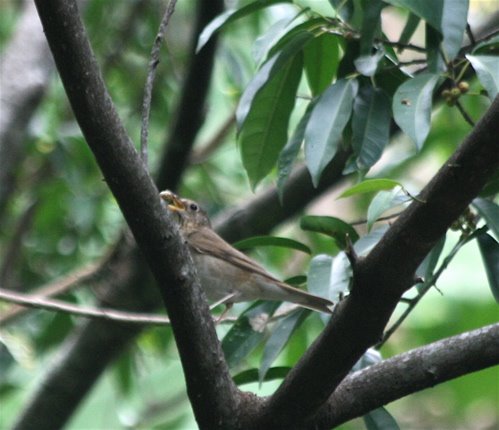
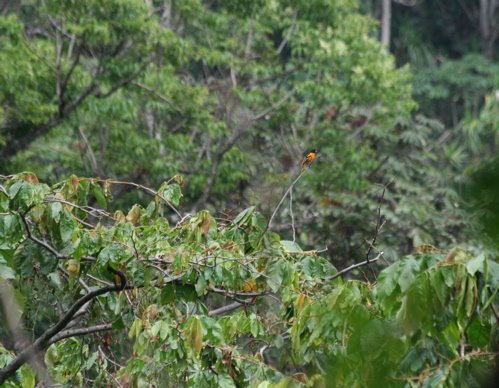
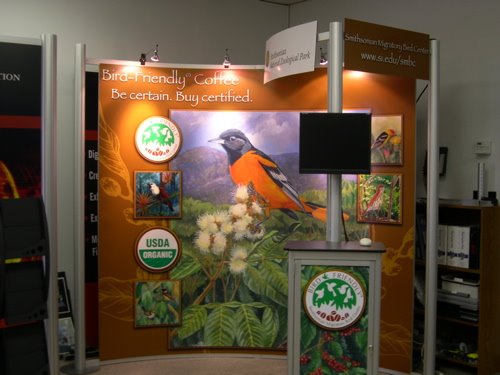
Waiting for manakins, I saw everything else--a Swainson's thrush, eating the same lauraceous fruit that the manakins were enjoying. A Baltimore oriole, perched on an inga tree above the shade coffee plantation where the manakins were foraging. It was a flash back to my painting of the same subject for the Smithsonian Migratory Bird Center. Full circle! Trying to get a photograph of the oriole reminded me why there will always be a place for artists who can paint an idealized scene. Would you know that the oriole in my photo was inhabiting a shade coffee plantation? The fact is, all this bird activity was taking place within an active agricultural field of shade-grown coffee. Shade growing leaves the overstory largely intact, if thinned, and replaces the understory with coffee shrubs. It's not virgin forest by any means, but it's highly valuable habitat for Neotropical migrants and tropical resident birds.
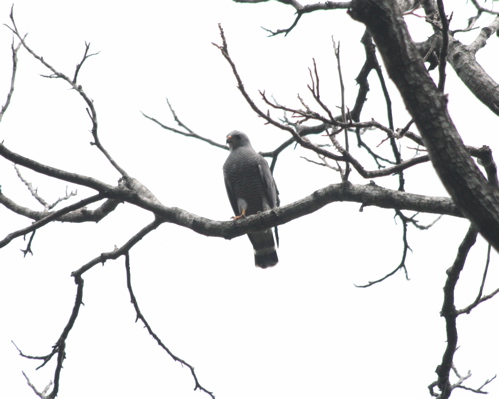
The entire time I sat quietly watching for manakins, a gray hawk screamed at me from across a valley.
It was clear to me that this vociferous bird had a nest nearby, because its mate would periodically come to join it and add its protests.
Gray hawks (Buteo nitidus) sound a lot like gulls, or red-shouldered hawks. This species is a rare prize near Nogales, Arizona, on the Mexican border, but they're very common around Tarrales.
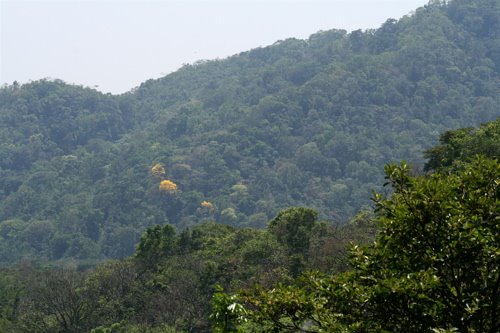
Looking across the valley, I could see the most gorgeous golden trees in full bloom. Could anything send a clearer message to a honeycreeper to come sample some nectar?
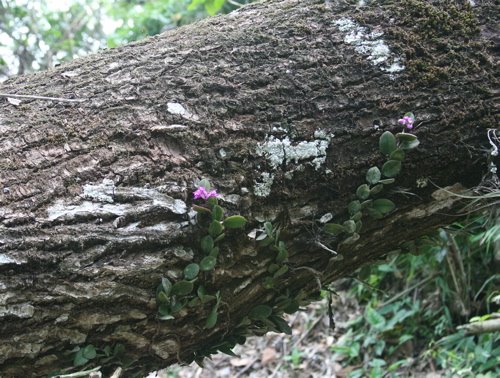
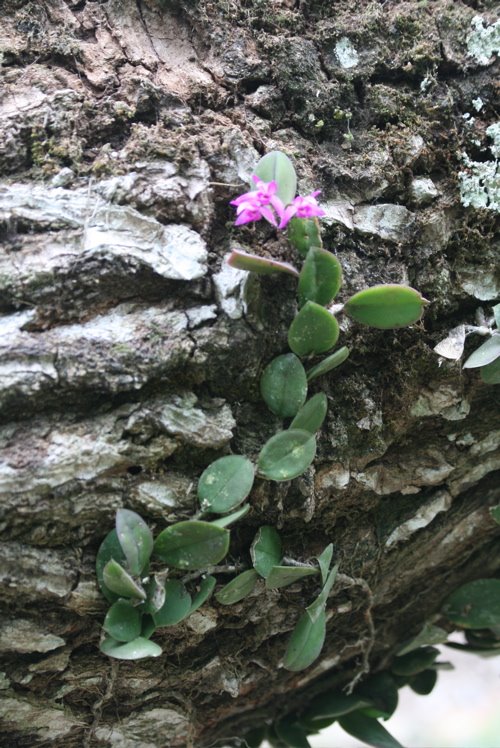
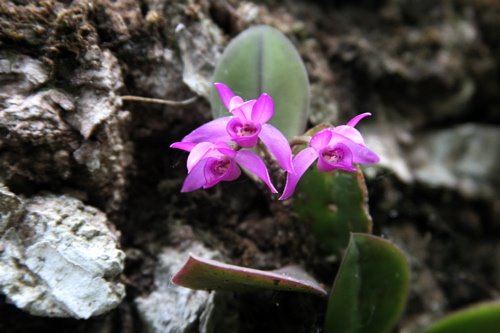
Walking down from the manakin feeding area at last, I found a tree that had fallen across the path. The richness of canopy life hit me when I realized that the trunk was covered with creeping orchids. Oh, oh, oh. Of course, they were spicily fragrant, their tiny pink flowers no larger than my thumbnail. Charmed, I'm sure. Twitching, in fact.
Like the vast majority of things I found in Guatemala, I had no idea what they were. I knew they were orchids, and that was about it. Sigh. Another thing to figure out. Being mostly on the tree's underbelly, I hoped they would get enough moisture to survive, or perhaps be transferred to a more suitable spot before the tree rotted away. One could collect many such doomed plants if one were so inclined. Every tree that comes down holds treasures untold from the upper reaches of the forest. I could go pretty wild, having a garden in Guatemala.

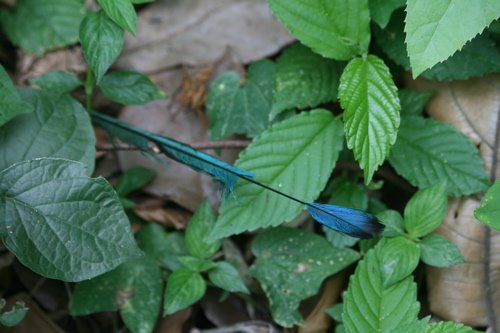
As I rounded a turn in the dark trail, I spotted my life white-eared ground-sparrow (Melozone leucotis). What a bird! Buried in shadow, there was no way I could get a photograph of it. I stood, letting the feeling wash over me, of seeing something I'd never seen before. I looked down at the ground--I usually stare at the ground when I'm not looking for a bird--and there in the leaf litter lay the molted tail feather of a blue-crowned motmot. Well, would you look at that.
Magic, that's all it was, the whole day, and as tough as the trip turned out to be, I was glad I'd come here. I dream of spending a week or so just doodling around Los Tarrales, seeing what it has to show me.

Department of Shameless Promotion

Note to New Yorkers: I'll be speaking at The Cornell Lab of Ornithology at Sapsucker Woods in Ithaca on Monday evening, April 7--and opening the Letters from Eden art show at the same time. The show of 60-plus watercolors and drawings will hang at the Lab until July 7. Having never seen the new building, I'm really excited to be loaning some art to decorate it for three months! Many thanks to Jerry Regan and the Ned Smith Center for Nature and Art for helping me put the show together, creating the fabulous labels, curating and transporting the show, and kicking off its national tour! For more details, see the Lab of Ornithology's web site.

Ivory-billed Birds

Sunday, March 23, 2008

9 comments
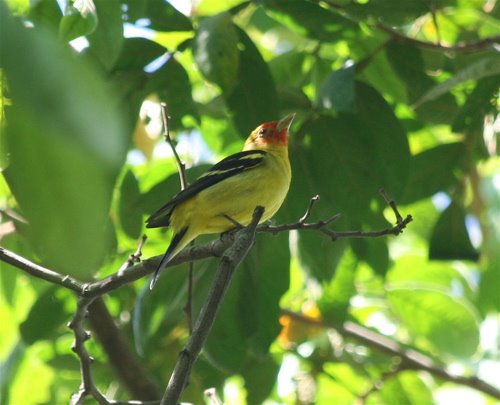
Thanks to the lush plantings, small clearings, hummingbird and fruit feeders that are carefully maintained, birds are EVERYWHERE at Los Tarrales. You can idle away hours in the garden, watching tanagers, orioles, thrushes, honeycreepers and even great fruit bats feeding at the bananas and grapefruit that are put out each morning for their enjoyment. It makes you want to run home and put oranges, grapefruit and bananas out for orioles. Except that they're still in Guatemala. But it is cool to think that our Baltimore orioles will recognize tropical fruits, because they might have encountered them on the wintering grounds. Western tanagers are everywhere. Here's a nice male, coming into spring plumage; i.e. getting an orange head:
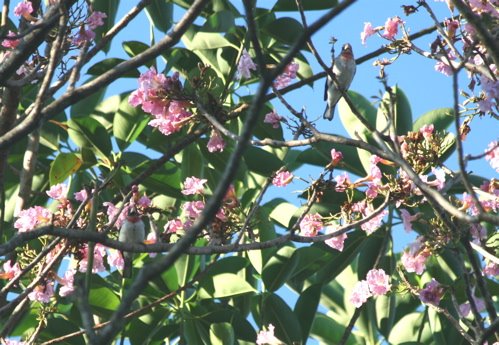
Los Tarrales has some special birds, endemics that are found only in a limited area. The blue-tailed hummingbird is one. This is a lousy picture, but you can tell what it is, and get a hint of its beauty in better light. One of my favorite shots from Los Tarrales is this pair of male rose-breasted grosbeaks in a flowering tree. It's hard to find them, but they look so fine in that setting! (You have to know how frustrating it is for a Science Chimp to have to describe any plant as "a flowering tree.") Agghhh. Eee. Eee. They'll be at our feeders before you know it. I noticed that most of the male rose-breasts in Guatemala had very pale pink cravats. Perhaps some white feather edges have to wear off before they will be in full spring finery.

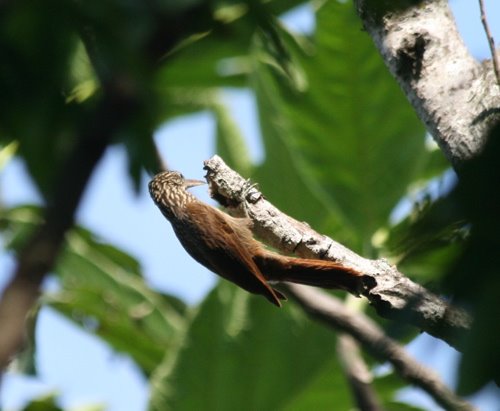
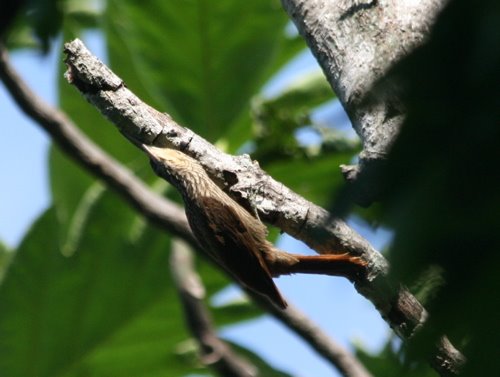
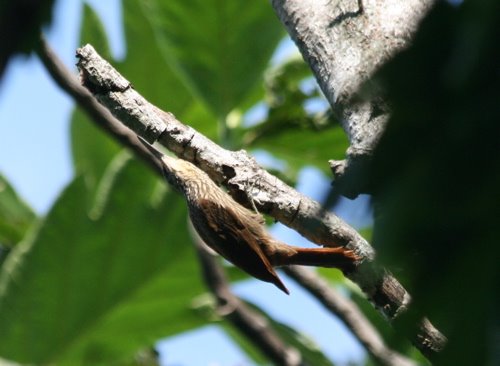
Woodcreepers are part of a large Neotropical family called the Dendrocolaptidae.  Most are variations on a theme of burnt sienna. Many have spine-tipped tails, like woodpeckers, but they're not generally as robustly built as woodpeckers, since they tend to probe and glean rather than hammer for their food. They're tame and easy to spot as they work the bark, mosses and epiphytes on forest tree trunks. One of the commonest is the ivory-billed woodcreeper, a nice hearty bird with a spine-tingling name. Long, flexible necks and a slightly decurved bill allow this IBWC to probe into forgotten crevices, looking for insect and invertebrate prey. It's always surprising to see the positions a bird can get into when it's foraging. If you're used to our robust woodpeckers, woodcreepers look kind of willowy and gracile in comparison, with fine legs, toes and bills, and soft fluffy plumage.
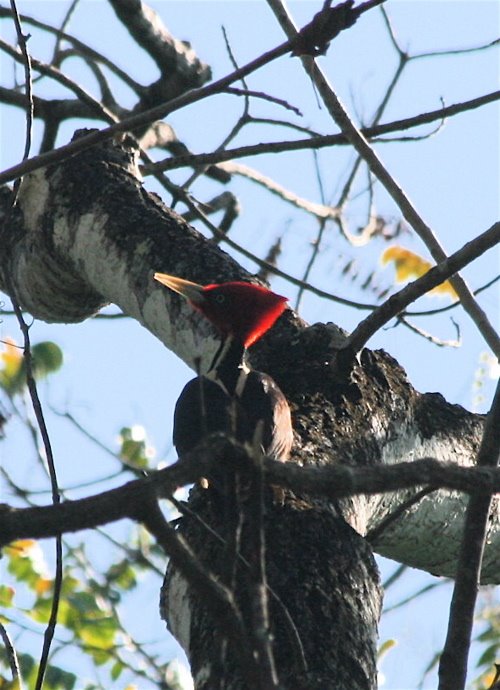
And speaking of ivory-bills, here is the tropical Campephilus that always raises the hair on the back of my neck with its double-raps and yapping calls--the pale-billed woodpecker. Ba-DOCK! Yip yip yip yip! I guess "Ivory-billed woodpecker" was already taken. I shot photo after photo as it hitched up the tree, its massive bill and flaming crest backlit by morning sun. Would that our Campephilus were so cooperative, but who can blame it for shunning the company of man?

I got an e-mailed response from Dr. Stephanie Doucet, Asst. Professor of Biology at the University of Windsor, Ontario, who answered from her field station in Costa Rica. I asked her about tail molt in long-tailed manakins. I was kind of embarrassed to have to ask her, because the manakin painting I showed you was on the cover of the issue of The Auk (the journal of the American Ornithologists' Union) that featured her awesome article about...molt in long-tailed manakins. As the cover artist, I was provided a copy, and I can't find it; it's probably swallowed in the bowels of my big wooden flatfile. Duh. She sent me a copy of her article, which is absolutely fascinating; she mist-netted and color-banded  1,315 long-tailed manakins to figure out what was going on with their plumage development. It takes young males FIVE YEARS to come into definitive adult plumage! And she figured out how to tell exactly how old a manakin was, up to age five, by its plumage. Obviously, manakins can tell, too, and the social implications of wearing your age like a badge are multitude. It all plays into that odd lek-based mating system, where social rank and age determine whether a bird can pass on its genes. Anyway, Stephanie was kind enough to write to say:

In answer to your question, they re-grow their central rectrices (tail feathers) each year,
and as they go from juvenal plumage to definitive adult plumage, their tails get longer every year.

So Katdoc, you were right--the older males just shed their feathers, then grow a new longer tail every year, like an older buck growing a new set of big antlers each summer. Think about that--I'm thrilled to see five or six manakins, and Dr. Doucet has banded over a thousand of them, keeping records on each one. There's interesting, and then there's amazing.

Hope you had a wonderful Easter. We did. Church, communion for 400? zzzzzz, two egg hunts, lamb gravy.

Liam: I LOVE that lamb gravy! Can I put it on my asparagus?
Me: Sure. Knock yourself out.
Liam: Suddenly, it doesn't look so appetizing.

Last night he said his bed didn't look so sleepitizing to him. That's my boy.

Chasing the Long-tailed Manakin

Thursday, March 20, 2008

21 comments
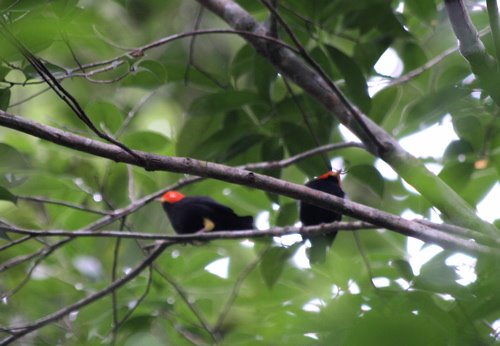
As a manakin fan from way back, one of the tremendous attractions of Los Tarrales is its population of long-tailed manakins, Chiroxiphia linearis. These odd, impossibly cute little birds are part of a family distinguished by outrageous breeding displays (remember the moonwalking red-capped manakin?)
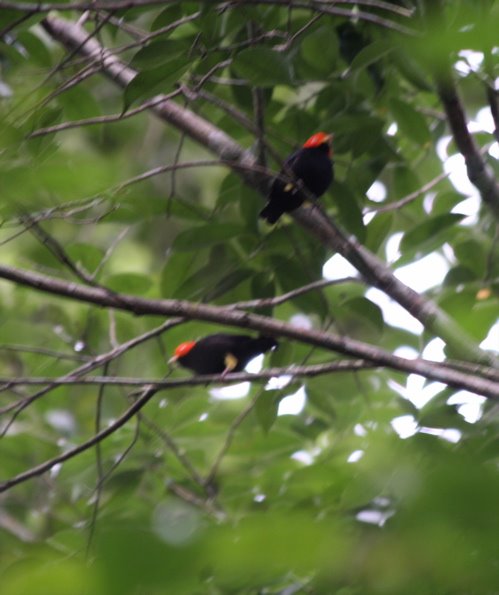
Here are a couple of photos from Tikal, last year, of red-capped manakins dancing. Gotta love those yellow leggings!

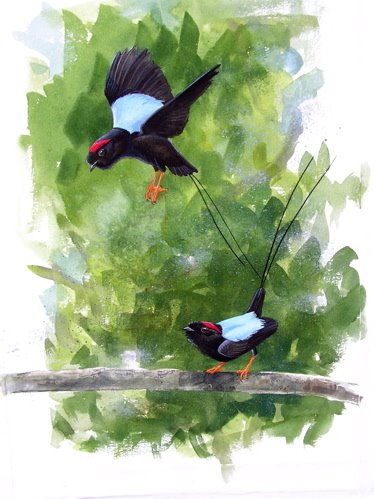
Well, long-tailed manakins have a similarly captivating dance, in which two males cartwheel over each other's backs, boinging up into the air like popcorn, making a kind of wheel of blue, black and red on a horizontal branch deep in the forest. You can watch a video of it here.
This is my painting of the dance.

Since college, when I spent a great amount of time writing papers that compared the courtship displays of manakins (without ever seeing one!), I've dreamt of spending quality time with manakins. I'd had lousy looks at long-tailed manakins in Costa Rica, and some pretty satisfying experiences watching red-capped manakins both there and in Guatemala. So when Jeff, Liz and Lisa announced their plan to climb Volcan Atitlan to try to see horned guan (did that two years ago, didn't want to do it again), I decided to spend a day with long-tailed manakins. I have to say it was my favorite day in Guatemala, because I like to be alone with birds, and like most artists I crave unstructured time, the chance to soak up a habitat, to hear my own thoughts, to get some feel for what it's like to be a manakin. Dang, I'm glad I have climbed to see the guan though. That is a bird what am a bird.

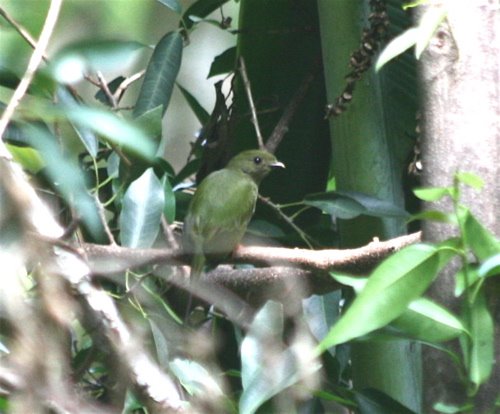
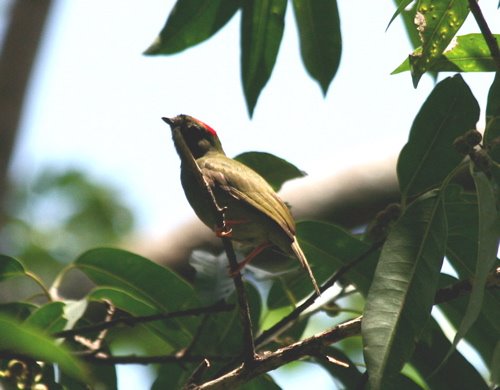
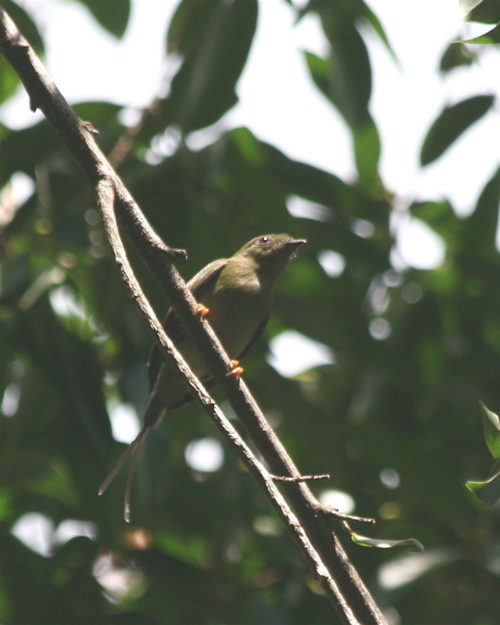
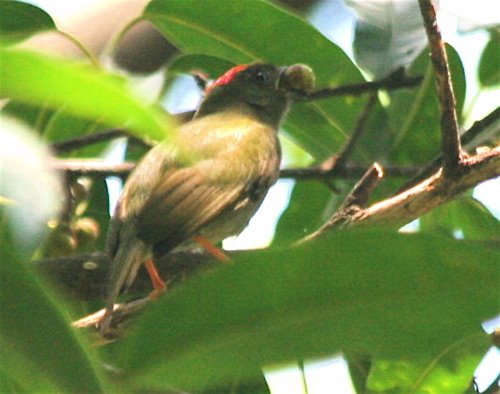
Manakins are very long-lived birds, and males take at least three years to come into full breeding plumage. Think about it--how many other small passerines stay in immature plumage that long? We're used to such intervals with raptors and gulls, but they're very unusual in tiny birds. This hints at their interesting social system. The plumage of manakins holds many hints to their age, sex and social status. The basic female plumage is an odd, deep bronzy olive. She has elongated central tail feathers, but no red on the head. This is the only female long-tailed manakin I saw all day. The plumage of young males is similar, except that they show longer central tail feathers and varying amounts of black and red on the head, eventually sporting blue on the back.
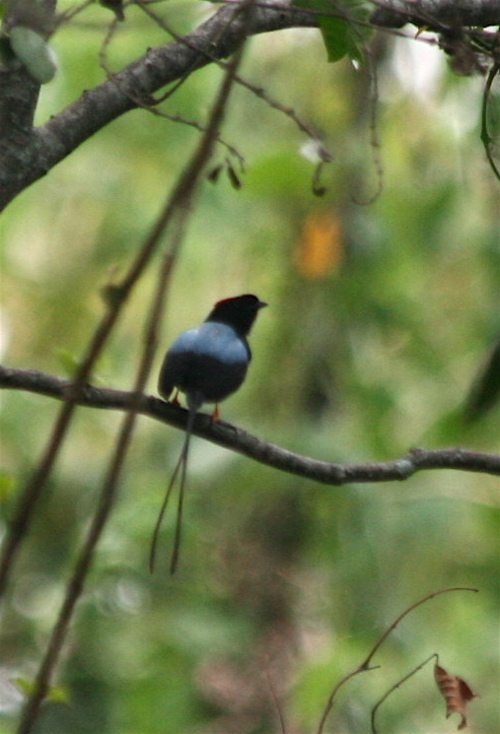
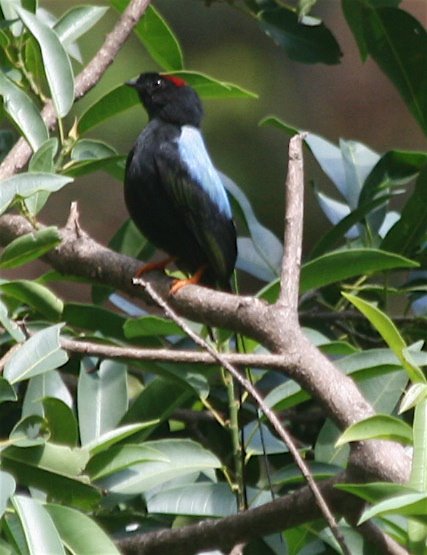
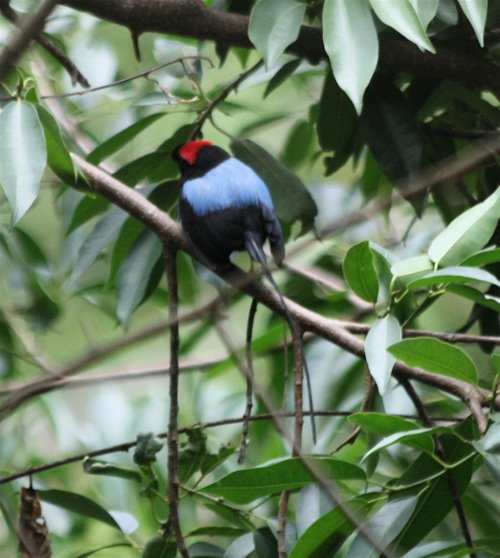
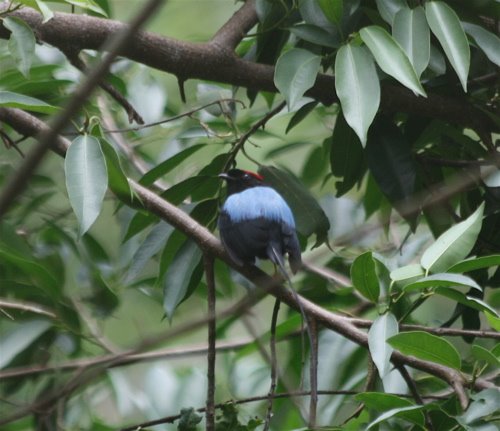
Even once male manakins attain full breeding plumage, the longer they live, the longer their tail feathers grow. So there is a continuum of social signals encoded in the birds' plumage.An adult male long-tailed manakin in full breeding plumage. Two words: Just Adorable. Portly, colorful, lively, noisy; just what the doctor ordered for a mind and spirit dulled by the most endless of winters.
Part of the key to why manakins behave as they do lies in what they eat. They are frugivorous, taking mostly fruit with some insects. They leap and hover, plucking small fruits (they favor lauraceous, or fig, fruits) and insects from branches and leaves. A wide, flat bill and large gape enable them to swallow some pretty outsized fruits. I Can Has Figburger.
Because their fruit food tends to be abundant and patchily distributed, manakins benefit by hanging out together in loose little flocks. They can all descend on a tree they know to be fruiting without worrying about competing with each other for food. When breeding time comes, long-tailed manakins display together (see the video link, above) in a lek formation, which means that several males get together, partner up, and display within sight or earshot of each other. Female manakins are free to visit the lek and choose which male to mate with based on the splendor of his display. When males display together, this raises all sorts of interesting questions. Which of the partners gets to mate? The older one? The one who dances most vigorously? And where do immature males fit into the picture? It's all up to the females. Ladies' choice. No monogamy, no pairing up; just a quick visit to check out the hombres, pick the best one, mate, and then here comes Ms. Manakin with a baby carriage.Wearing his sky-blue cape, a manakin shows off his bifurcated crest. Check out the length of his tail! He may well be dominant to a shorter-tailed bird, and more likely to pass his genes along.

Because there are so many egg predators in tropical forests, the female manakin lays only two eggs a year, in a shallow cup suspended by its rim from a horizontal fork of a limb at about eye level in the understory. She builds the nest, incubates the eggs and raises the young all by herself. A gaudy male would be no help in such a predator-rich setting. It may take a female her entire 20-year-plus lifespan to replace herself; it may take a young male manakin years of understudy at the lek to attain his right to mate. This is part of what's so fascinating about tropical birds; they often operate on entirely different time frames and feeding regimes, with much higher site fidelity, than our more fecund, ephemeral, migratory temperate birds.All these questions and more swirled about my head as I spent the day watching and photographing long-tailed manakins. As I prepared to leave, the nasal nyaaaah! and hauntingly rich whistle--t0-LE-do! of displaying long-tailed manakins chimed from a brushy hillside above me. It was impossible to see more than a glimpse of the dancing birds, but knowing they were dancing, finally hearing the song I'd read about for years, filled me with joy. The air was warm, bird song rang out all around me, a few blackflies buzzed, and I stayed and listened and smiled, immersed in the peace of being among wild things.

Have a lovely Easter. I've been in town all afternoon, being a bunny.
[Back to Top]