Background Switcher (Hidden)

Showing posts with label motmot. Show all posts

Frigates and Motmots and Howlers, Oh My!

Tuesday, March 1, 2016

2 comments
La Ensenada is a dude ranch and birder's resort on Costa Rica's northern Pacific coast. It's a magic combination of ranchland, mangrove and shore, looking out on the Golfo de Nicoya. 
Pastoral scenes include carob trees in full bloom, an astounding old rose over the pastures...


beautiful ponies who put up with the riding styles of diverse foreigners, not including us

photo by Jenny Minton

photo by Jenny Minton


a pickup that has clearly hauled its last rolls of hay


and outside the gates in the village, a little shop with a creepy mannequin who was wearing a swimsuit when we arrived and this Daisy Mae getup when we left. 


Turquoise-browed motmots are a dry savannah delight. Really, is there a more delightful bird? Don't miss its little racquet-tipped tail.


On our first morning at La Ensenada, we took a boat ride into the mangrove forest. Fidel brought that boat's nose right up out of the water as we skimmed to our destination.


The flats at the mouth of the mangrove swamp are coated in great birds. Whimbrels by the gazillion; western sandpipers, short-billed dowitchers, semipalmated plovers, black-bellied plovers, willets and marbled godwits teem. Black skimmers, royal and Sandwich terns and a smattering of laughing gulls round out the cast. It's pretty amazing to see these far northern nesters taking it easy in the hot Costa Rican sun. 

The only Caspian tern I was able to pick out amongst many royals was discovered in this photo, flying along behind a magnificent frigatebird. Oh my. 


I loved this tandem team of young male frigates. If there is a more graceful flyer I haven't seen it.


The frigates, gulls and terns were dogging a little shrimp boat. What a beautiful smile from the fisherman, with his gorgeous great big prawns to show us.


We sought the mangrove yellow warbler with its chestnut head; the mangrove vireo and  mangrove hummingbird, and found them. Rufous-necked wood rail, not so much. 


Pygmy kingfisher. Almost too tiny to believe. 


Deep in the mangroves, lesser nighthawks roosted. 


We enjoyed rare looks at perched frigates. The red dollop there is his gular sac, which he can inflate to cantaloupey proportions when displaying to passing females on the breeding grounds. He'll spread his wings, throw his head way back, and shake that thing while making a bloobling noise. They can't resist. Don't miss his ooky toes.


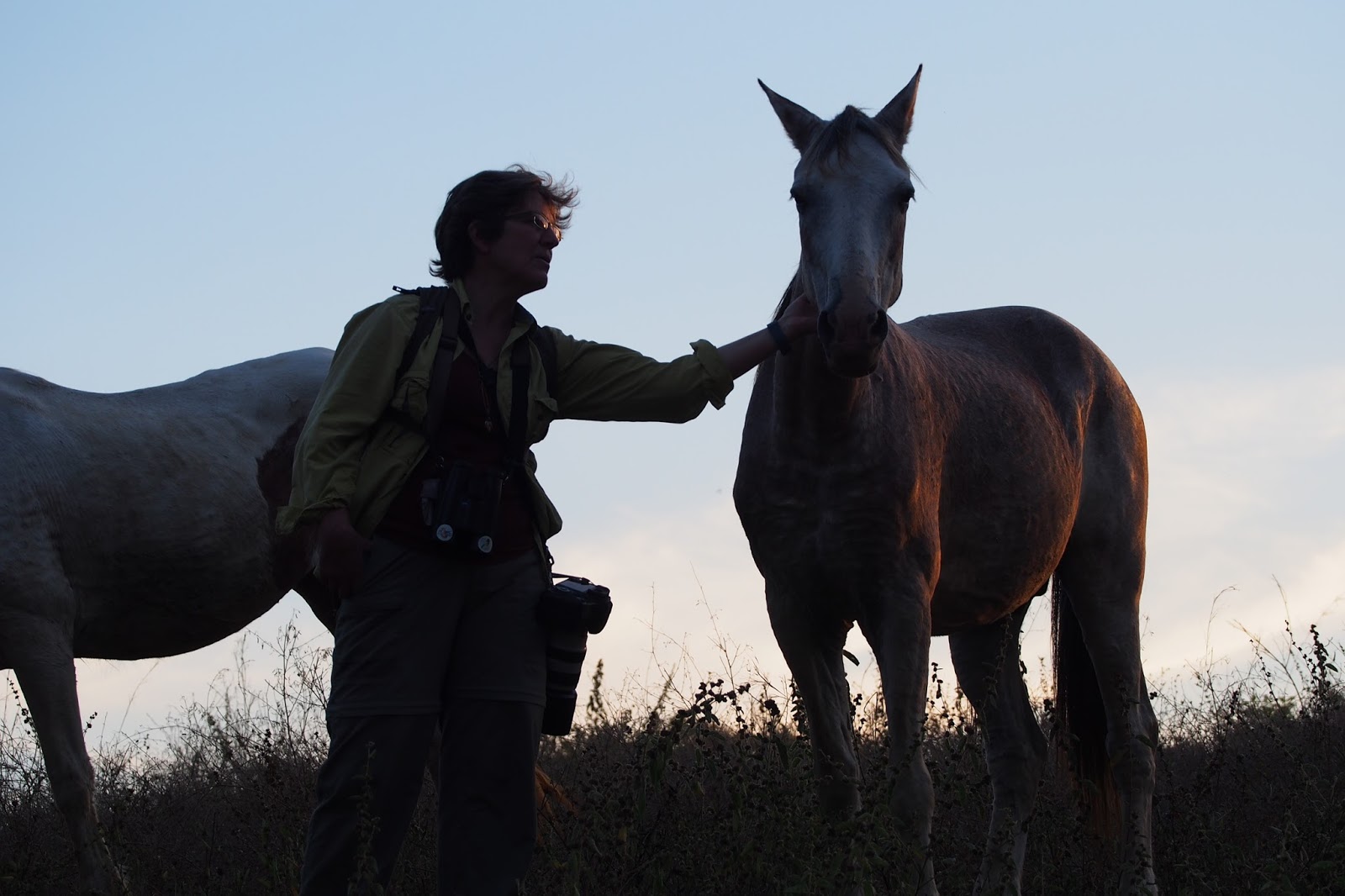
We have a great, easy going group this year. Interested in pretty much everything, quiet and respectful in nature. It's nice.


Which is a very good thing when the full moon draws the Gulf of Nicoya down so far that the pier we're supposed to land on is high and dry. Fidel and Mario had to improvise a landing on sharp mussel shells that was nevertheless reasonably safe and dry. We had a good old walk over mucky shell-strewn rocks to get to the ranch, though. 

photo by Jenny Minton

Better, we all agreed, to have an adventure than have smooth sailing all the way.

La Ensenada has its share of birders. I loved the pose on this man who was photographing black-headed trogons.


Birds are plentiful and great. A crested caracara makes off with a quarter of a broad-winged hawk. We'll never know how he got that, but there you have it. Weird stuff birders see.


And a baby mantled howler feasts on figs. 
There's so much more than birds out there. There's everything to be enjoyed. What fun to be in such exotic places, taking it all in. 


In the Shade Coffee Plantation

Monday, March 24, 2008

10 comments

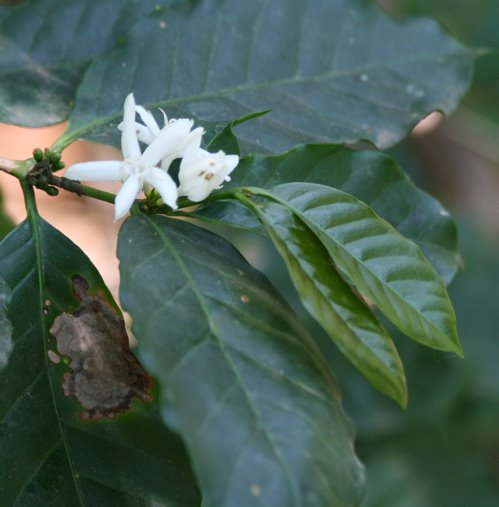
Coffee in bloom. Do you ever think of the flower that precedes the bean, with its light, citrusy fragrance?

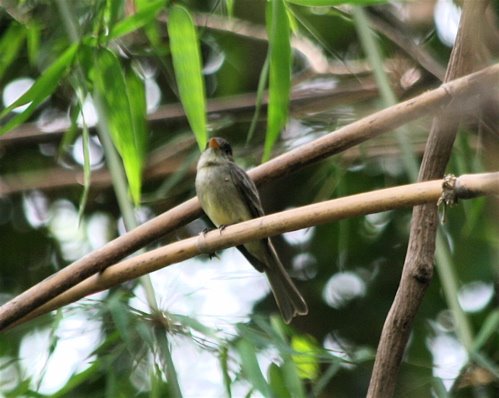
That day with the long-tailed manakins at Tarrales was magic. As I sat and watched for the manakins, a tropical pewee came down and sat quietly not far from my right shoulder.
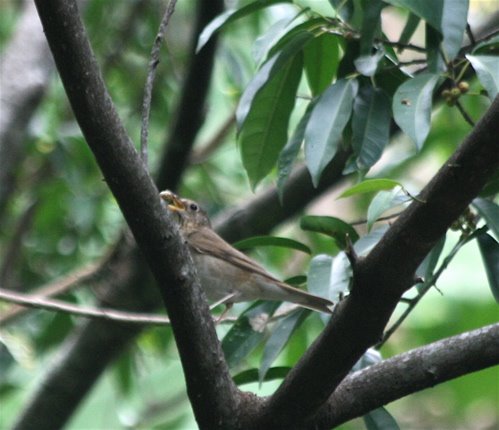
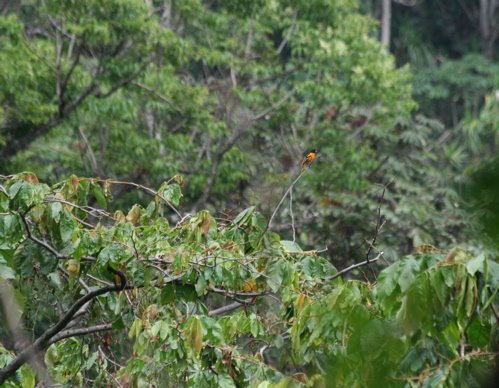
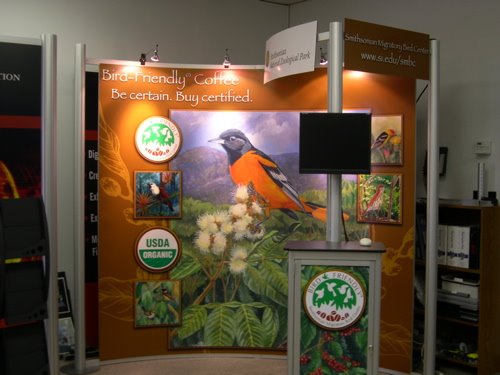
Waiting for manakins, I saw everything else--a Swainson's thrush, eating the same lauraceous fruit that the manakins were enjoying. A Baltimore oriole, perched on an inga tree above the shade coffee plantation where the manakins were foraging. It was a flash back to my painting of the same subject for the Smithsonian Migratory Bird Center. Full circle! Trying to get a photograph of the oriole reminded me why there will always be a place for artists who can paint an idealized scene. Would you know that the oriole in my photo was inhabiting a shade coffee plantation? The fact is, all this bird activity was taking place within an active agricultural field of shade-grown coffee. Shade growing leaves the overstory largely intact, if thinned, and replaces the understory with coffee shrubs. It's not virgin forest by any means, but it's highly valuable habitat for Neotropical migrants and tropical resident birds.
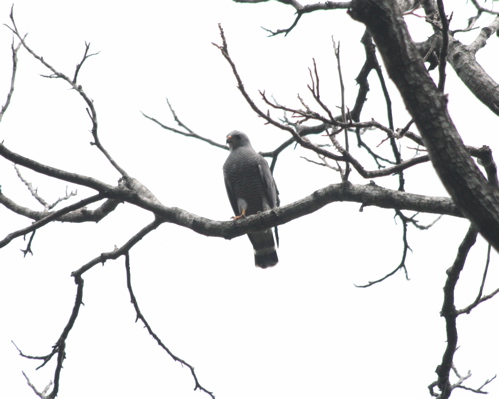
The entire time I sat quietly watching for manakins, a gray hawk screamed at me from across a valley.
It was clear to me that this vociferous bird had a nest nearby, because its mate would periodically come to join it and add its protests.
Gray hawks (Buteo nitidus) sound a lot like gulls, or red-shouldered hawks. This species is a rare prize near Nogales, Arizona, on the Mexican border, but they're very common around Tarrales.
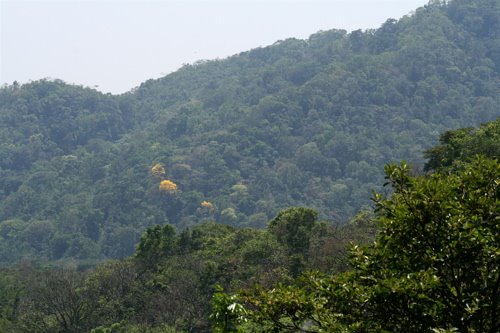
Looking across the valley, I could see the most gorgeous golden trees in full bloom. Could anything send a clearer message to a honeycreeper to come sample some nectar?
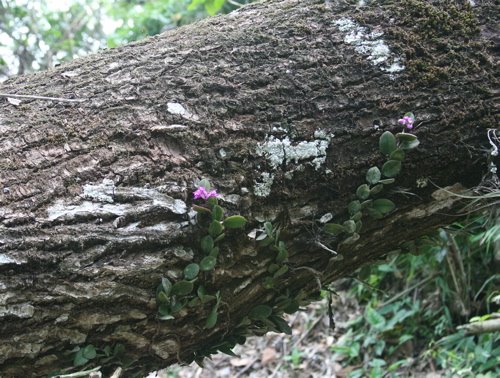
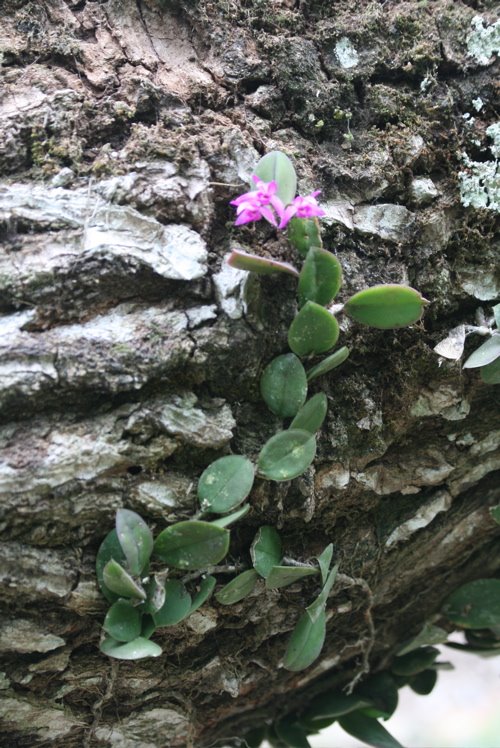
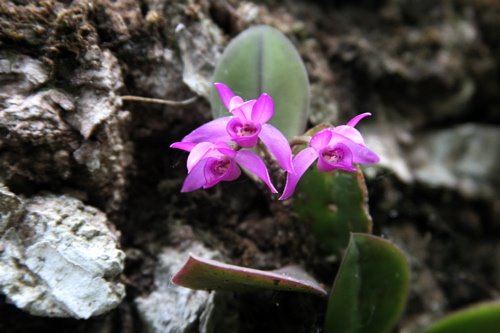
Walking down from the manakin feeding area at last, I found a tree that had fallen across the path. The richness of canopy life hit me when I realized that the trunk was covered with creeping orchids. Oh, oh, oh. Of course, they were spicily fragrant, their tiny pink flowers no larger than my thumbnail. Charmed, I'm sure. Twitching, in fact.
Like the vast majority of things I found in Guatemala, I had no idea what they were. I knew they were orchids, and that was about it. Sigh. Another thing to figure out. Being mostly on the tree's underbelly, I hoped they would get enough moisture to survive, or perhaps be transferred to a more suitable spot before the tree rotted away. One could collect many such doomed plants if one were so inclined. Every tree that comes down holds treasures untold from the upper reaches of the forest. I could go pretty wild, having a garden in Guatemala.

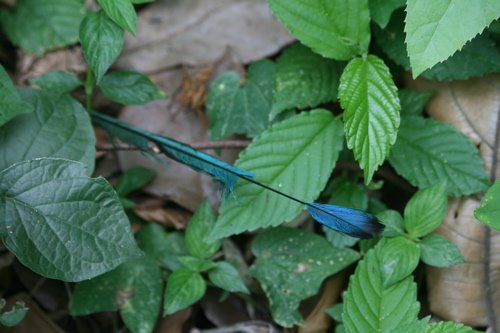
As I rounded a turn in the dark trail, I spotted my life white-eared ground-sparrow (Melozone leucotis). What a bird! Buried in shadow, there was no way I could get a photograph of it. I stood, letting the feeling wash over me, of seeing something I'd never seen before. I looked down at the ground--I usually stare at the ground when I'm not looking for a bird--and there in the leaf litter lay the molted tail feather of a blue-crowned motmot. Well, would you look at that.
Magic, that's all it was, the whole day, and as tough as the trip turned out to be, I was glad I'd come here. I dream of spending a week or so just doodling around Los Tarrales, seeing what it has to show me.

Department of Shameless Promotion

Note to New Yorkers: I'll be speaking at The Cornell Lab of Ornithology at Sapsucker Woods in Ithaca on Monday evening, April 7--and opening the Letters from Eden art show at the same time. The show of 60-plus watercolors and drawings will hang at the Lab until July 7. Having never seen the new building, I'm really excited to be loaning some art to decorate it for three months! Many thanks to Jerry Regan and the Ned Smith Center for Nature and Art for helping me put the show together, creating the fabulous labels, curating and transporting the show, and kicking off its national tour! For more details, see the Lab of Ornithology's web site.
[Back to Top]