Background Switcher (Hidden)

Showing posts with label La Ensenada. Show all posts

Howler Sunset

Tuesday, March 22, 2016

3 comments

In birds, the hyoid bone is a flexible Y-fork anchoring the tongue. In humans, it's a forgettable little scrap at the back of the tongue. In howler monkeys, it's really something else. 


 I had an excellent conversation with this male howler near the dining room at La Ensenada, an eco-dude ranch in Guanacaste, Costa Rica's cowboy country up north. We ooked and grunted and talked.  I don't know what I was saying, but it sure was a thrill to make contact with him. I started the conversation with an ook or two, imitating him, and he plopped down right there and had a good chat with me. Ook. Ook. Owwww. Owwwwwwwwwww ook ook ook. OOK!

As I wrote in the previous post, howlers use their voices to mark and hold territory--yelling takes a lot less energy than, say, chasing and fighting off other monkey troops. Which is good if you eat nothing but leaves and a little fruit. Pardon the blur. I got excited when he opened up that big ol' chamber at close range.


Male howlers are charged with the job of holding feeding territory for their troop; females busy themselves raising young. So males have some special equipment, other than the swag you can see. The hyoid bone is enlarged into a bony bulla, or sac, which makes a resonating chamber for his voice. It's as if he has a megaphone right in his throat. He's got one of the loudest voices in the animal kingdom. And as far as we know, this is the only mammal with a hyoid bulla made of bone, rather than esophageal tissue. Lots of monkeys and apes have large fleshy elastic laryngeal pouches (think gibbons and orangs) but only howlers have bony bullae.
1.These are the skulls of red howler monkeys (Alouatta seniculus). Female is on the left, and the male on the right.  
Howler Monkey

2. is the rear view of the skulls. A female howler has a nice bulla, too, but the male's is almost three times its size. So it's the males who can really roar.

Check out the incredibly deep and massive jaw bone on both sexes (3). That tells me I do not want to get bitten by a howler monkey. With masseter muscle inserts like that, they must have some tremendous crushing power! Let's face it. Nobody wants to get bitten by a monkey. So I try to be polite when talking with them, and not escalate things with empty rhetoric.

I've borrowed these photos from the University of Edinburgh Natural History Collections. You can read more at their page.  There's also a highly detailed discussion (condensed to a couple of sentences here) by Darren Naish at the excellent science blog, Tetrapod Zoology. 
I thank both sources for publishing such cool stuff online, where pikers like me can share it. They're welcome to my photos of the live creatures!


Are you going to grow up to have a bony bulla in your throat? What does that feel like, little monklet?

How is it to trip so lightly over a palm frond? To have a tail that reaches out like a fifth hand to grab whatever's nearest? To know you're not going to fall?


It feels good to be a howler, hanging with my troop in the dry forest, waiting for sunset. We're going to sleep down the slope tonight, where the bougainvilleas are blooming. I'll wrap my tail around a limb and drift off, blinking at the moon.


I was blessed--blessed!! to have a lovely group of travelers on Costa Rica 2016. And my dear friend Ann Hoffert came along which pretty much made my year. We had a lot of catching up to do, many stories to tell. I've known Ann for 13 years; she hand-crafted the Potholes and Prairie festival that Bill and I worked for 11 years. With Ann, we crafted uniquely North Dakotan experiences for festival goers like Pipits and Pie and the Prairie Ramble. Bill and I gave talks, played live music, and joyfully soaked up and shared the richness of the Potholes region, where all the ducks are born.
Ann and Ernie have watched our babies grow up. This is my favorite photo of her. Yep, that's Liam, when he was under 4' tall. Two platinum blondes in the June prairie sunshine.


It was a beautiful thing, an impossibly rich mix of social events, bird appreciation, prairie rambling,  sumptuous gardens, home-made food, and music. I hold those memories close in my heart.

After all that, to get to travel with Ann, and share some of the things I love about the Neotropics,  which is  yin to North Dakota's yang, was a great and precious gift. 


On this trip, Ann and I got to tell each other some of the untold stories of our abundant lives. Something best done as the full moon rises over the Golfo de Nicoya. Hard to believe it was already a month ago: I look and the moon is full again, Jupiter and his moons cuddling up next to her at sundown.


In this little clip, Ann and I stand beneath a tree where a howler troup is bivouacking for the night. You'll hear their song, that storm in the treetops. Come--stand there with us. Listen to them sing the moon up at La Ensenada.




Wild About Howler Monkeys

Friday, March 18, 2016

1 comments
The first time Bill and I went to Costa Rica together, he was fixated on monkeys. He wanted to see a monkey. In his mind, that's when he'd truly be in the Neotropics. "I wanna see a monkey," he'd repeat, on the plane on the way down. It became sort of a mantra. I liked it because he says "monkey" in this weird, cute way. Mawnkey. It took awhile, but we finally did see monkeys, and it was awesome. I always enjoy seeing monkeys.

Howler monkeys are a special favorite of mine, because they transform the forest with their songs. I'm thrilled to pieces to be able to give you video I made of them singing as they go to bed. But that's dessert. First, a bit about howlers.

The species native to the dry forest in the north Pacific coastal zone of Costa Rica is the  mantled howler, named for the fringe of golden fur hanging off its flanks. There's also a black howler, and in the lowland tropical forest farther south is the beautiful red howler. I've seen all three species!  but not all in Costa Rica. This is a particularly beautiful mantled howler, likely a female. Look at the individual vertebrae in the prehensile tail; many New World monkeys have those, while Old World monkeys don't. If I had a tail I'd want a prehensile one. It would be very handy when you had toddlers.


One thing I absolutely adore about the dry tropical forest is that it's not very tall. So, as they make their way through the trees, you're much closer to these wonderful creatures than you are in humid lowland rainforest. The leaves in dry forest are much smaller and sparser, too, and the light's a lot better as a result. What you get from dry tropical forest is much better photos of monkeys than you can get at, say, Carara,  down near the Osa Peninsula, where the trees are wicked tall and the forest is dark. 

But mantled and black howlers present a real challenge to the photographer, because your camera will expose on their black hair, letting in more light to compensate for what it perceives as darkness, and the well-lit background is almost invariably "blown out" or overexposed as a result. My trick to keep that from happening is to expose and focus on a medium-toned branch or leaf right next to the animal, hold the shutter button halfway down, compose the shot and press it. That way I get a better-exposed shot.  This adorable girl came out OK, but the background is blown out.  I still love the shot, for her expressive face. What a cutie!


This one's somewhat better-exposed, but still a tough shot--a black monkey against a bright sky. The other thing that I noticed about this photo, as an illustrator, is the peculiar anatomy of the far hind leg. Weird, or what? If I drew it from this photo nobody would believe a monkey's leg could even do that. 
Mine sure couldn't! 
This is a very long-legged monkey--deceptively so. 
They kind of flow along the branches, very smoothly. She's just letting go of the trunk with that trailing foot, and the tail has a hold on a branch--it's her safety rope. Five points of contact ensure she won't fall. 


As monkeys go, howlers are phlegmatic and slow-moving. This is because they live on leaves, a relatively low-quality diet that takes awhile to digest. The caecum and colon are extra-long, and colonized by special cellulose-digesting bacteria. Howlers do a lot of lying around digesting, and they eat nearly constantly, as you would if all you had was SALAD. Whew. I don't know how they do it. I'd probably be more of a egg, lizard and bug-eating monkey. 

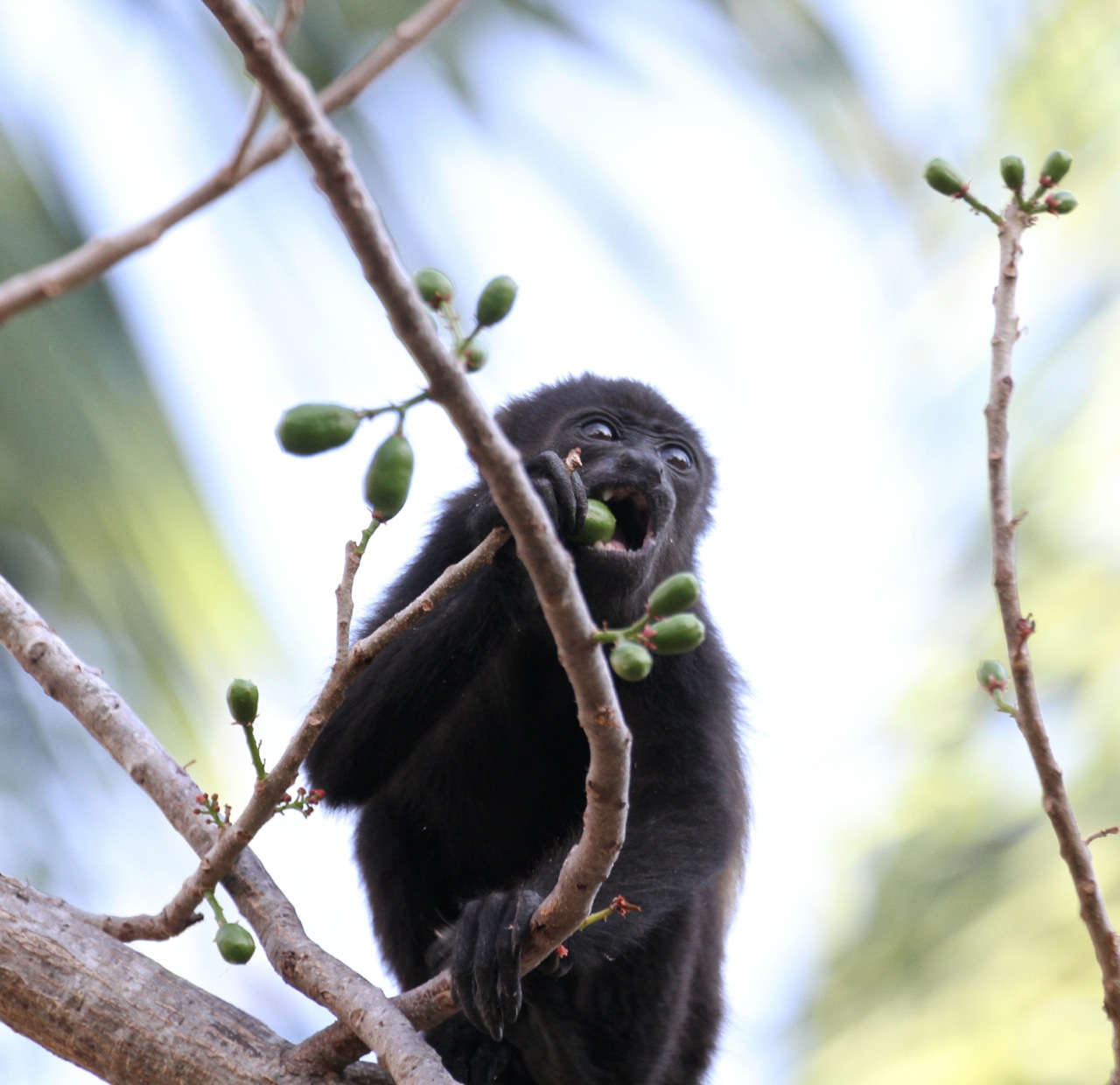
I had fun shooting this baby eating some kind of green fruit.


It amazes me how young they are when they're set free to just go brachiating along by themselves. 


She liked the little green fruits and could move freely in the small branches to nab them. 


It was a great privilege to stand beneath the trees where the troop was feeding, and be a part of their evening.

I got one shot that really captures the contemplative nature of the mantled howler, and it was nicely exposed, too. That's because I focused on the tree limb instead of the monkey. Please click on these to enlarge them. They really aren't as crappy as Blogger makes them look.


Male howlers use loud calls to advertise the presence and possibly the territory of a troop; to let other troops know a fruiting tree is occupied. They howl first thing in the morning (which can be 3:30 or 4 AM, ow!) and last thing at night. I will never, ever forget the first time I heard howlers. It was 1979, and I was trying to sleep in a crappy American hammock along the Rio Tapajos in Brazil's Amazon. We were deep in the forest. And at dusk came this sound like a storm in the treetops--haunting and powerful and actually scary. I had yet to see howlers, so my imagination ran wild. Never buy an American hammock. Brazilian ones are ever so much better.

Here's just a taste of the howler's song.  This male howler (ya think?) is making his way to a tree where he may spend the night with others of his troop. You don't often see them on the ground; they may feel safe around La Ensenada's camp; less likely to be attacked by a puma, jaguar or ocelot. 


You can get a feel for that deep voice. More on how it's produced and a real howler concert in the next post!


Frigates and Motmots and Howlers, Oh My!

Tuesday, March 1, 2016

2 comments
La Ensenada is a dude ranch and birder's resort on Costa Rica's northern Pacific coast. It's a magic combination of ranchland, mangrove and shore, looking out on the Golfo de Nicoya. 
Pastoral scenes include carob trees in full bloom, an astounding old rose over the pastures...


beautiful ponies who put up with the riding styles of diverse foreigners, not including us

photo by Jenny Minton

photo by Jenny Minton


a pickup that has clearly hauled its last rolls of hay


and outside the gates in the village, a little shop with a creepy mannequin who was wearing a swimsuit when we arrived and this Daisy Mae getup when we left. 


Turquoise-browed motmots are a dry savannah delight. Really, is there a more delightful bird? Don't miss its little racquet-tipped tail.


On our first morning at La Ensenada, we took a boat ride into the mangrove forest. Fidel brought that boat's nose right up out of the water as we skimmed to our destination.


The flats at the mouth of the mangrove swamp are coated in great birds. Whimbrels by the gazillion; western sandpipers, short-billed dowitchers, semipalmated plovers, black-bellied plovers, willets and marbled godwits teem. Black skimmers, royal and Sandwich terns and a smattering of laughing gulls round out the cast. It's pretty amazing to see these far northern nesters taking it easy in the hot Costa Rican sun. 

The only Caspian tern I was able to pick out amongst many royals was discovered in this photo, flying along behind a magnificent frigatebird. Oh my. 


I loved this tandem team of young male frigates. If there is a more graceful flyer I haven't seen it.


The frigates, gulls and terns were dogging a little shrimp boat. What a beautiful smile from the fisherman, with his gorgeous great big prawns to show us.


We sought the mangrove yellow warbler with its chestnut head; the mangrove vireo and  mangrove hummingbird, and found them. Rufous-necked wood rail, not so much. 


Pygmy kingfisher. Almost too tiny to believe. 


Deep in the mangroves, lesser nighthawks roosted. 


We enjoyed rare looks at perched frigates. The red dollop there is his gular sac, which he can inflate to cantaloupey proportions when displaying to passing females on the breeding grounds. He'll spread his wings, throw his head way back, and shake that thing while making a bloobling noise. They can't resist. Don't miss his ooky toes.


We have a great, easy going group this year. Interested in pretty much everything, quiet and respectful in nature. It's nice.


Which is a very good thing when the full moon draws the Gulf of Nicoya down so far that the pier we're supposed to land on is high and dry. Fidel and Mario had to improvise a landing on sharp mussel shells that was nevertheless reasonably safe and dry. We had a good old walk over mucky shell-strewn rocks to get to the ranch, though. 

photo by Jenny Minton

Better, we all agreed, to have an adventure than have smooth sailing all the way.

La Ensenada has its share of birders. I loved the pose on this man who was photographing black-headed trogons.


Birds are plentiful and great. A crested caracara makes off with a quarter of a broad-winged hawk. We'll never know how he got that, but there you have it. Weird stuff birders see.


And a baby mantled howler feasts on figs. 
There's so much more than birds out there. There's everything to be enjoyed. What fun to be in such exotic places, taking it all in. 


Getting My Doolittle On: La Ensenada, Costa Rica

Saturday, February 27, 2016

4 comments
 Amazingly, I'm blogging from Costa Rica. I know, never happens. But I was fresh out of one-eyed deer and I have fast Net at Villa Lapas and hey why not. It's what's in front of me, and it's awesome!
I have the loveliest group this year (well, they're all lovely). But ohh these folks, so wonderful to be in the woods together.

A saman tree. Also known as a Raintree, this enormous acacia-like tree (Albizia saman) spreads four times wider than it grows tall. It's native from Mexico to Brasil, but has been widely distributed around the world.  I looked at the ring of cabinas sheltering under its canopy (I was in #2, which must've been the Presidential Cabin because there were three beds!) and wondered who'd had the foresight to plant this thing in the middle of them, and how they knew the way it would define the entire space. And how long ago that might have been. One in Venezuela is a national treasure, and is thought to be more than 500 years old, having been described by Alexander von Humboldt around 1800--and it was old then!!


The view from beneath, out my cabin door. I had to set my phone to Panorama to capture it.


You could lead an entire trip to Costa Rica just focusing on its
amazing trees. Any one of the hundreds of trees we've seen here could be a tourist attraction in the US. Mario says it's called Raintree because cicadas live in it and piss down liquid. He says sometimes it's still green beneath a raintree when everything else has dried completely up. Good to know, about the cicada pee, I'd think. Or maybe not. Maybe better to think it makes its own weather, no?


So La Ensenada has an open-air dining room as do most eco-lodges we frequent, and there are white-throated magpie jays freely stealing stuff off plates and out of bread baskets. It's very amusing, at least to American tourists; less so to the staff I'm sure.  See jay, second plate from front.

Blue jays on steroids...crows in leisure suits. WTMJ's are pretty darned cool birds, smart and bold and opportunistic to a fault.  Big as a magpie and twice as purty. I believe this to be an immature.


It posed prettily for me when I imitated its scraping chuckles. Here, we're talking up a blue and white storm. Rawwk! Oop! dok dok dok! I'm getting my Doolittle on on this trip.


Ol Mr. Bluejay, in them baseball clothes of his
Struttin' 'round the premesis...

Gotta love the head doo-dads. What a bird!

Meanwhile, down by the pool, SIX black-headed trogons were feasting on figs.
Here, a female gags one down whole. She'll choke up the pit somewhere else, maybe plant another tree. 


I was just trying to get a photo of one black-headed trogon eating a fig when five more swooped in.


File under: Costa Rica problems. Durn trogons! Gotta swat 'em away!


And then there are the mantled howlers, waking me up at 3:28 AM. It's OK. I love the sound, like thunder in the treetops. 


I think this is an adult male. Just a hunch.  I made a video of one walking and howling at the same time. So amazing and so funny. I just love observing howlers. 

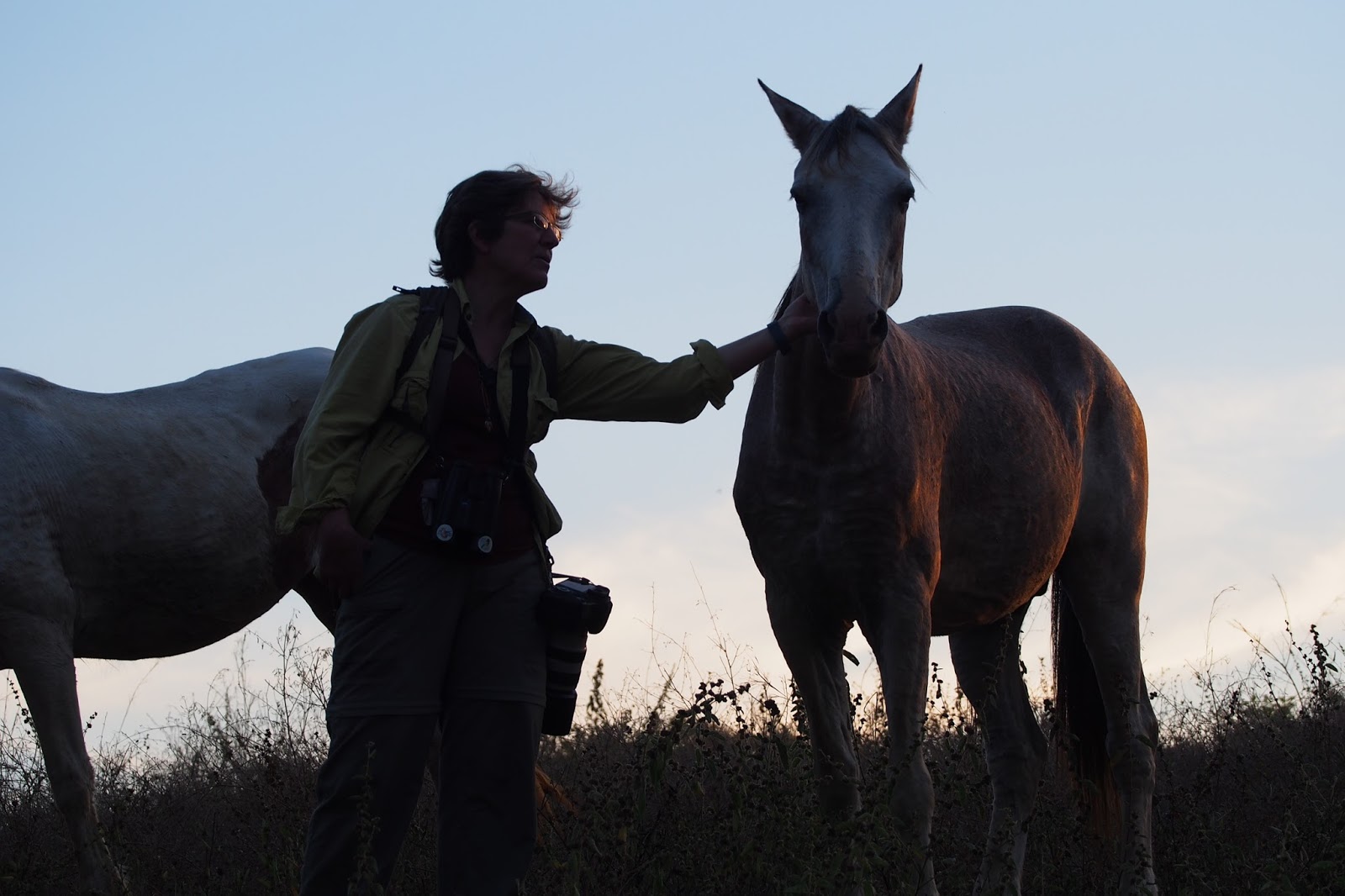
There are horses on this dude ranch. I made friends with a shy gelding at sunset, scratching his withers and jawbars and brisket. 


Lucy and Jenny M. took pictures of the whole thing. I took one back, of tiny Lucy and big horse.


But my favorite shot from La Ensenada was the theft of a whole slice of soft white farmer cheese by a young magpie jay and its parent. Well, the adult was loading up on scrams. That interface of wildlife and people... I find it irresistible. 


[Back to Top]