Background Switcher (Hidden)

Showing posts with label birding. Show all posts

Foggy Day, Fiddle Tune

Tuesday, January 24, 2017

6 comments


Every once in a great while we go down to the river just to look for birds. We used to do that a lot. Now we seem to need an excuse, like having Corey here for a New Year's visit. But when we do, we find the birds were out there waiting for us, anyway.

Whipple Flats produced a young red-shouldered hawk. I know, it doesn't look identifiable, but there are obvious clues that might not immediately present themselves unless you've been seasoned by experience. The two species in contention for this buteo ID are red-shouldered and red-tailed. First, it's sitting on a power line, something most redtails are too large to do comfortably. The red-shoulder's small feet and short toes fit better than a redtail's on such a small-gauge perch. Second, those blobby, heavy streaks all down the front of its breast are typical of a young red-shoulder.  A redtail, even a young one, usually has a clear white or buff upper breast, with finer streaking across the middle of the belly. Third, it's got a small, fine bill. Fourth, the tail seems short and the bird overall compact and cobby. A redtail would look more elongated and much more massive. And it wouldn't be sitting on a wire! For those who are wondering, the call between broad-winged hawk and red-shouldered is much closer and more difficult to make. For the purposes of this ID, we are safe in assuming that all the broad-wings are in Costa Rica by January. Red-shoulders stick around, hence their folk name, "winter hawk."


We didn't have to give our second raptor of the day a second look, other than to ogle it. An adult bald eagle beats its way up the Muskingum. Fantastic. I love the impossibly long arms of the sycamore in the foreground. And I still can't take an eagle sighting for granted, no matter how much more frequent they are.


We got out to bird Devol's Dam, only to find it hopelessly fogged in. Waiting around didn't help. The rivers stayed foggy all day. 
Bad for birding, good for photography.


If Corey couldn't find any birds, there were no birds to be found.


I buy Phoebe's outerwear (Eddie Bauer) at the Eddie Bauer Warehouse in Columbus. The really nice stuff that winds up in the warehouse tends to be in wild colors. We're good with that.
I like imagining those colors against her hair when I'm holding up a prospective purchase. 


Corey and Phoebe are standing on the oldest existing hand-operated lock in the country. The system of locks that segment the Muskingum River are still operated by hand-cranking, and I've seen the guy come out and do it, when I've locked through in my Wee Lassie canoe. It's so cool to see a human being turn a crank to singlehandedly open the giant gate to drain the lock chamber. It's even cooler to be in a canoe and sink quickly down along the algae-slimed sides of the lock, or rise up as the water rushes in (if you're going upriver). 


Canada goose tracks in old mud below the lock.


Hey. Act like you're birding, even though the fog's too thick.


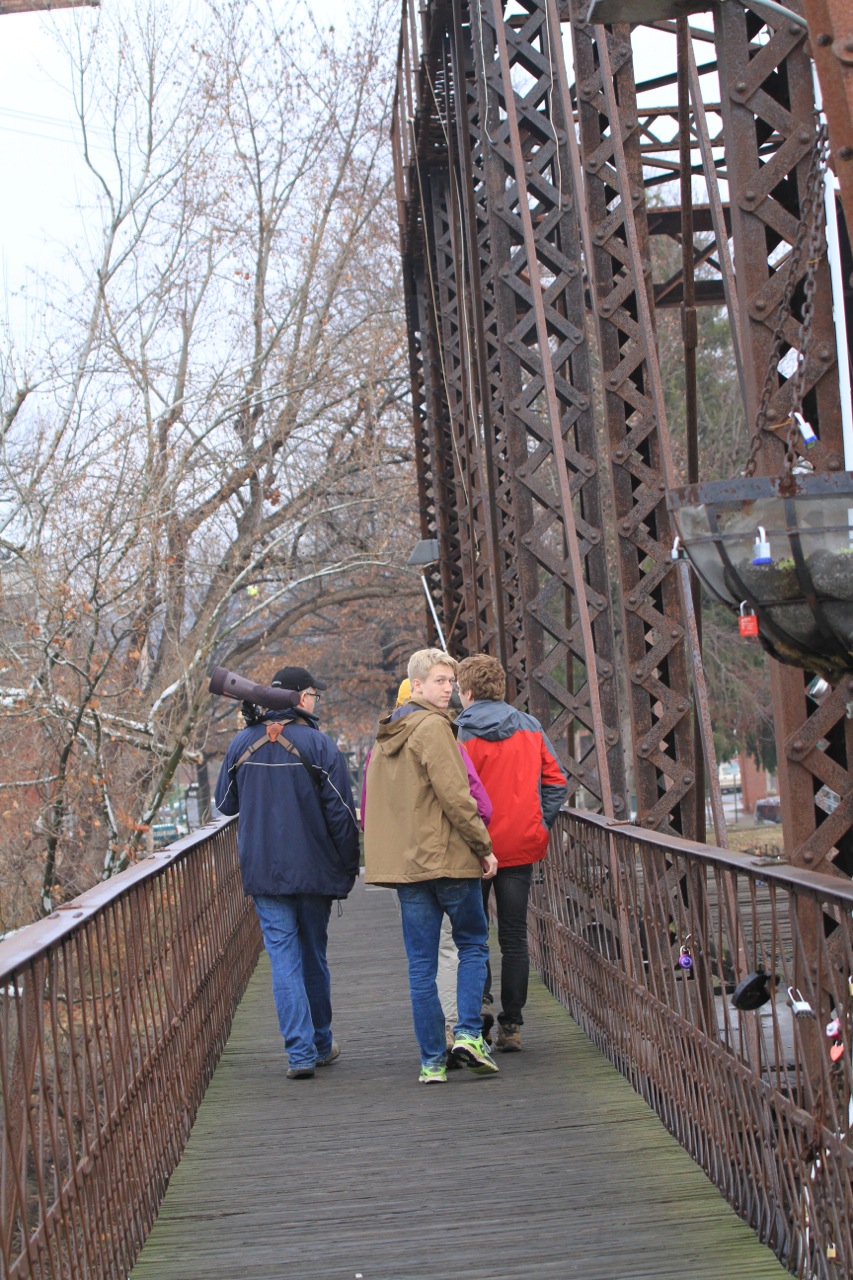
We walk across the Harmar railroad trestle to Marietta. Liam looks back to see if I'm still back there. Yes, slow as usual, drinking in the sight of you all.


I'm trying to capture the enormous old sycamore I love so well, that threatens to grow completely over the Marietta end of the trestle, and is succeeding.


Out at the confluence of the Muskingum and the mighty Ohio, a raft of Canada geese shelters one redhead duck, near the right end of the main flock.


Bill stops to read a sign next to an old engine, something my dad would have done. He's framed by crabapples.


I feel so lucky to spend time with these people, lucky that we all love watching birds on foggy days, walking around Front Street, and so many other things.

 
If they mind being followed around by their personal paparazzo, they haven't said anything. I think they like reliving these moments, too.

Seems like time for another fiddle tune from Corey and Bill. For your foot-stomping pleasure, here's "Coon Dog." I could listen to these fiddle tunes all day, or forever, while the cauliflower burns in the pan.


The Luckiest Lab

Tuesday, January 10, 2017

13 comments

My friend Alan Poole had a couple of visiting bird people on his hands, and an apparent desire to dazzle us with winter beach beauty. Erin and I were up for that! 


Alan  and his daughter, Phoebe, a flower farmer with Weatherlow Florals, right handy by Dad's spiffy new digs in South Dartmouth, Mass. They both know how lucky they are to be near each other. Alan called Phoebe to come join us for a little birding.  I love this photo. Phoebe has made a little bouquet of sea lavender and grasses. Right out of a catalogue, those two.

Alan's first call when I threatened to land on him was to his friend Geoff Dennis, who, because he's out every day and misses nothing, knows where the birds are, even the ones who shouldn't be there.  

Like blue-gray gnatcatchers in the dead of winter.

Christmas Day, 2016, somewhere in Rhode Island. Geoff's got the goods.


We met Geoff on his home turf, at Goosewing Beach in Little Compton, RI. 


The sun was playing peekaboo with the beach and the clouds. 

Geoff had a dog with him, a big black Lab mix.


Koda had kind eyes and a good smile. He registered me, and I registered him right back. We made an impression on each other.


 I felt that instant connection that you get with some people, and some dogs. Geoff and Koda were two of those types. We had common ground. I snuck a couple of muzzle smooches on this lovely boy.


I could see by the look in his eyes that this dog, now 12, had a story to tell. He was telling it with every glance. I overheard snippets of conversation between Geoff and Alan about how Koda had come into his life. It sounded pretty unusual.


I figured I'd get the whole story later. For now, I wanted to watch the birds, this dog and his best guy. Geoff is a clam fisherman; he goes out in a boat and rakes them up in every weather condition imaginable. He is cheery, rugged; built for the outdoors, and he pays attention to every nuance of sea and sky. His persona and voice are straight out of Central Casting for a New England waterman. It's little wonder he finds the birds nobody else knows about. He doesn't chase many rarities. He finds them. On this day, he had a flock of more than 30 snow buntings, with a Lapland longspur included. And me without my camera. Geoff says this photo he sent is a "terrible" picture, but it shows the snow buntings we saw that December 7. Oh, they were magic! What could be better than living snowflakes, swirling around in the late golden light of a December evening?


And he sent me a photo of the Lapland longspur! (rightmost bird, with the dark cheek pattern--the rest are snow buntings.)


It was a cold day, not as cold as it could be by far, but I wouldn't have wanted to wade in a salt pond. Koda was all for it. Besides, Geoff was throwing things in the water.


Koda hasn't always been Geoff's dog. For the first ten years of his life, he lived with a family with children. And then there came a divorce, and the wife, J., who loved Koda dearly, took an upstairs apartment on a busy street with the kids, which wasn't a good situation for him. Koda stayed back at the house where they'd been living, and most of the time he was chained in the yard. Things changed there, too, and one day J. got a call from her ex-husband that he was going to have to move, too, and he'd have to take Koda to the pound.

J. talked with her landlord, and he agreed to let her take Koda into the apartment. He is a good dog, and wouldn't be a problem. At this point, Geoff and J. were working together managing endangered species along Rhode Island beaches, and she asked if she might keep Koda in his barn during the day. Geoff said, "He's not going in the barn, he can come right in the house!"

Geoff and his wife Emily had always had dogs, but by 2006, they'd lost two beloved dogs in a row to cancer, at the ages of only 10 and 9. It was very hard for them, and Geoff said, "That's it. No more dogs." He felt he just couldn't go through that again. And along came Koda, ten years old, needing a part-time home. Well, maybe just for awhile...

"We just fell in love with him. He’d stay with us during the day and J. would pick him up and bring him home. Something came up and she asked if he could stay with us and we said sure, no problem.  He stayed with us for a week. He was sleeping on the floor next to the bed. We bought a dog bed for him. I started really fallin' for him.  It was all new to him, running in the woods, running on the beach.  J. might have him  for two weeks straight and I’d go pick him up and bring him down here, keep him for a few days and bring him back to her.

"I walked into her house one day and Koda went nuts on me, crying and barking and licking me. She said, 'Oh my God, I’ve never seen him do this with anybody.' I don’t know how it segued from her house to (staying with us). Finally she realized it was too much for her to make him happy. And she saw the connection with me. He ended up moving in with us. When J. got Koda from her ex, when he was about to go to the pound, he weighed 101 pounds. He was chained up all the time. He got fed a lot. He was a barrel on four pegs. He’s now 78-80 pounds."

Ack. I tried to imagine Koda with 30 more pounds on him, and forced that vision away. Yet it's one we all see far too often, when dogs are fed ad libitum and given no opportunity for real exercise.


I hunkered down and watched this gorgeous gentleman self-actualizing, doing exactly what a Lab mix is supposed to do. I found him so beautiful, his eyes so clear and bright, his step so springy.


He emerged from the marsh with a long stick and commenced chewing it up while we birded. Keeping busy, doing dog things, while the people did people things, looking through tubes at distant specks (which turned out to be wigeon, pintails, teal, scaup, black ducks, ruddies, black and white-winged scoter...)


He had this whole beautiful place to himself, yet he orbited happily around Geoff, the center of his solar system, his new Sun. He'd range out and find something to investigate, but he was always within earshot and sight of his best friend.


Twelve years old, and now, in the autumn of his life, finally able to become who he was meant to be. This is the gift Geoff has given Koda.

"If it’s two beaches (the distance we walk each day) could be up to two miles. He’s probably doing twice the distance I am. He has never shown reluctance to go out when it’s super cold. He’s panting at 10 degrees. He goes through the water, he has ice pellets on him—salt water freezes instantly. I love going there when it’s like that. It makes you feel alive when the wind’s howling and it stings your face.  I don’t wear a face mask. I’ll walk with my hands on my face to bring the temperature back up. You get the screaming northwest winds after the storm will pass. And all the snow is blowing off the pond onto the beach. He comes out of the snow looking like the Abominable Snowman.  He loves it."

Geoff sent me this photo, taken by Koda's beloved J., just yesterday. He's getting in touch with his inner Arctic wolf.

The light got lower and the shadows got longer. Erin watched scoters just off the breakers, photographed the cloudbank rolling in.


The sun dipped toward the horizon and we realized the show would soon be over.


I thought, and have been thinking, about the generous soul of this New England fisherman, opening back up to another soul in need. Even knowing what he knows about aging dogs and broken hearts. Going against his better judgement and going for it yet again, adopting a senior dog. 

"That’s the only thing about Koda that bothers me. I’ll lay on the floor with him in the living room at night and I'll start crying, because it’s just such a tease, to have only a few years together."

If I have learned anything, it's that our time with good dogs is never long enough. If ever there were a reminder to savor the now, it was this golden December evening at Goosewing Beach, in the presence of those who know how sweet and short life can be. 

We said our good-byes, nabbed each others' contact information, shook hands. And then Geoff said, "You all go on. I'm gonna put a few more miles on the dog."


I chuckled, having said those exact words myself. My heart gave a fish-flop


watching them get smaller and smaller, headed back toward the snow buntings and the last sunlight slamming that beautiful dune.


It would be hard to decide who was the bigger gift to whom: Geoff to Koda (immense), or Koda to Geoff (just as great).

As we drove slowly away, the potholes lit up, punching sky into sand, and I reflected too, about love and loss and how the human heart will dive in, over and over, toward the unknown, sure-to-be-rocky bottom. Love and loss, it seems, are always in cahoots.


Bright-eyed, beautiful, wise, lucky Koda, long may you splash and run.


Dog and Bird Spotting at Hacienda Solimar, Costa Rica

Thursday, March 10, 2016

4 comments

I am happy to report that, after 8 days away, my laptop has been returned by the excellent gentlemen of Elan Technologies, fitted with a new top case, keyboard, trackpad, and battery. No more will its swollen and aging battery impede progress on all fronts. Back in the blogging saddle! I took this time to write thank-you notes, 27 of them, to people who helped me with Baby Birds. It was like doing Christmas cards, and hand-writing a different letter to each recipient. Being that nice for five days was exhausting. :) I want to thank you all for the vote of confidence on old-fashioned prose posts, though; my photo-free post "Becalmed" has done better than most of my glitzier photo posts. Huh.

On Day 4 of our Costa Rica expedition, we made a lunchtime stop at Hacienda Solimar, a working cattle ranch of epic propotions in the Guanacaste region of the northwest Pacific coast. On this enormous ranch, beautiful Brahma cattle are bred and raised, mostly for breeding stock.
They are definitely a cut above the usual, even to my untrained eye.  I'm guessing the red X's on these cows indicate they've been bred.


On this day, the cowboys were separating calves from moms, and there was a lot of bellering going on, and dust rising in the air.


They use horses for much of the cattle cutting, but there were also some fancy four-wheelers in the garage. I spotted a very cute doggie resting in the shade. She had the nicest smile!


And then, feeling a little self-conscious, she yawned, and displayed perhaps the longest tongue I've ever seen on a dog.  


Just down the road, a classic yaller dog trotted home, curled tail held high over his back.  A good yaller dog is not too far from a dingo, if you ask me. Survival instincts keen and sharp; a coat that blends into dry grass, a yaller dog is a hunter, vigilant and crafty. Perhaps the ancestral dog.


  Much as I love cattle and dogs, I had to admit we were here for birds, and Hacienda Solimar did not disappoint. A pair of rufous-naped wrens drinks from a coconut shell. Oh sweet scene, there in the dappled light.


And just down the driveway, a Pacific screech-owl pretends to nap. It's a real good bet that an owl who looks like he's sleeping is glaring at you from behind those heavy lids. And wishing hard that you'd bug off.


Good as the land birding is, the marshes of Solimar are stupendous. We were gobsmacked by throngs of black-bellied whistling ducks. Struggling to comprehend why there were so many, I kept asking Mario and Solimar guide Demetrio if they were  massing for migration, enjoying  a post-breeding break or what? No, they replied; they're always here in numbers. Well, that just didn't make sense to me.


The more I thought about it, the more it bugged me. The black-bellied whistling duck is a cavity nester. It's a big duck, almost goose-sized. That's a whopping cavity! And every one of these ducks was born in a cavity.


Where do they find all those huge cavities for their nests?? And what are they all doing here? How can there be enough food in these sloughs for all those ducks? Sometimes nature just befuddles me. 

And wading around with the whistling ducks and an amazed great blue heron was an enormous jabiru, nearly five feet tall. 


These endangered storks nest at Solimar, and we were privileged to see a nest, with three young, at a great distance, so as not to bother them. What a tree, what a nest, what amazing storks they are.


In flight, with those pure-white primaries beating, they're magnificent. I expected their wings to be trimmed in black.  Melanin strengthens feathers for the inevitable wear flight brings. That's why most white birds like terns, gulls, gannets, wood storks and snow geese have black-tipped primaries at least. Not the jabiru. Does it not make long-distance flights? How come no black? Always scratching my head. Especially in the Neotropics. 


This is a fun shot. If you click on it to embiggen it, you'll find that three of these things are not like the others. Three of these things are not the same. Can you name all the birds in the photo?
** Answer at the bottom of the post. **


I'm just going to say right now that for some reason my photos in this post, viewed at normal size, look like crap. And when you click on them and see the larger version, you see that they are largely not crap. This is something I've been noticing about Blogger lately. If you like a photo, by all means click on it and see it how it's supposed to look. For instance, you can vaguely tell that the large birds in the photo above are some kind of craney storkey thing. Click on the photo and boom! Wood storks!

We watched the flocks for signs of danger, for the high whistled calls of the ducks and sudden explosions and rises. For there were peregrines about!


And why not? Wherever there are huge flocks of shorebirds and waterfowl, the wandering peregrine will attend them.  These two sparred playfully, thrilling us to bits.


Look at that leg extension! Wow!!


It always gets me when birds fly upside down. It never gets old.


By now you're probably figuring out that birding in Costa Rica is just fun, fun, fun. Especially with the Science Chimp jumping around scratching her head and asking questions. Right, Mario? Heh.


**The flock consists of 19 wood storks, and from left a black vulture, a tiny high-soaring anhinga, and an osprey, heading the other way. 
[Back to Top]