Background Switcher (Hidden)

Showing posts with label fox sparrow. Show all posts

Animal Tracking School

Sunday, April 23, 2017

7 comments


Please pardon the interruption in the Dean's Fork story. There's this thing called spring ephemerals, and in order to be of most use to my readers, I decided to publish the ephemerals posts while they were blooming in southeast Ohio. I knew you wouldn't mind. 

We've now made it through another winter, and it's early spring 2017. I hadn't been up to the beaver  pond since late September 2016. I didn't want to see it dry; it depressed me so. On March 28,  just the end of last month, I went on a walk from the house, intending to turn right when I got to the road and take my usual route to the lower end. I hoped to meet up with a skunk, as I have on earlier walks, but none appeared this time. That's OK. I would find even more wonderful things.


Skunk selfie. My only one to date. I plan to get more this summer. It's not that hard. Skunks don't pay much attention to me.

I made my way from the hayfield down into the woods, headed for the Fork. Seven fox sparrows rustled and scratched, and hopped up one by one to eye me briefly, then go back to their work. They're migrating through, headed north, and one even sang, a tentative, wandering melody that sounds like a white-throated sparrow who's been listening to meadowlarks. 


 The next thing I found was a bobcat print! Just about twice too big to be a housecat, but otherwise very similar. Look at the three-lobed rear edge of its pad, those lovely oval-round toes, and lack of any claw marks. Ahh, good fine silty mud is a beautiful thing. You'll find me out after rains and snows, finally able to get a read on my neighbors' doings.


Bobcat, hind (top) and front (bottom) prints

I find bobcat scat all the time. And it's hard to take a walk without finding their tracks. I love knowing they're around, all around. 
They don't even bother to cover their poop around here.


Wild turkey poop is everywhere, too. There are a jillion turkeys in the woods these days, thanks to the cicada hatch of 2016. Everybody ate.
You can tell this is bird poop by the white urates. Lovely twisty cylindrical galliforme poop with the sun coming up over Dean's Fork.


I kept walking and found most excellent pair of coonhands, the first of the spring. One reason trying to text on my phone with its persistent and maddening AutoCorrect is so frustrating is that I have to try three or four times to get a word like coonhands past it. No. I don't mean coin hands. No. I don't mean coonhounds. I mean coonhands dammit!!


some coywolf poop  (rawther large)

and a very nice double pair of coywolf tracks. They're much larger than fox tracks; neater and narrower than domestic dog tracks. Note how the large heel pad is two lobed (the bobcat's is three lobed) and heart-shaped; how the front two toes are long and narrow.  


Here's a domestic dog track (a big one) from the same area. It's much rounder and spreads more overall than the coywolf track, and it has the two big claw marks in front that mean it's not a cat.  Dog spoor is kind of staggered. They're sloppy walkers compared to coywolves and foxes and bobcats, whose tracks are in a neat line.


 I'll admit, I got kind of excited when I found these prints, because I couldn't find claw marks on the first dozen I found, and they were so huge!


But they're dog tracks, all right. I hope Chet and I don't meet up with this one. From the depth of the tracks, it's a very heavy animal. Big! 


So I'm trucking along finding one great track in the fresh mud after another. Here's a big old buck who's in a hurry and leaping. You can see the smeared imprint where he slid, and the two fetlock toes are sinking in, because his "ankle" joint is flexing all the way down, and he's so heavy. 


I find a section of Dean's Fork that has raccoon (bottom left), bobcat (just above the coon on left margin of photo) and striped skunk (right margin, deep claw prints) all together!! I have just come out on the road from the steep descent through the woods. As I cross a tributary to the main stream, a great sense of peace comes over me. I feel at home on this road. The sight and sound of running water sets me at ease. I smile, though there's no one there to see. Dean's Fork is working its magic on me again.


Next: a great discovery.

Tarrales Regulars

Thursday, March 13, 2008

9 comments
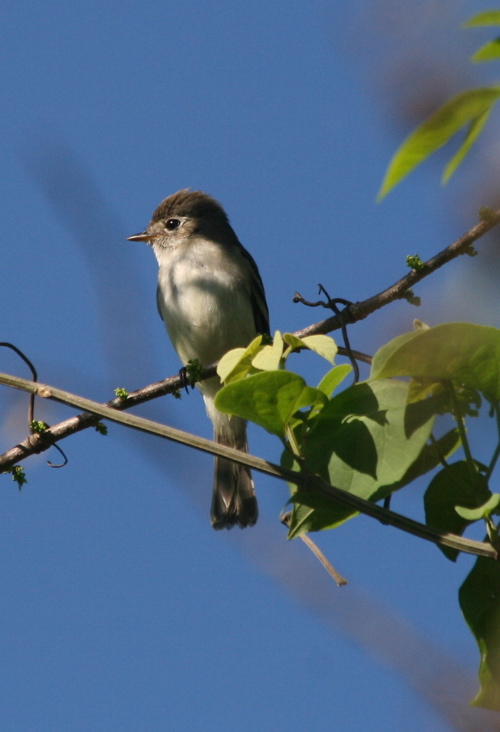
Many of the more cooperative birds in Guatemala were Neotropical migrants, like this least flycatcher. Well, they were cooperative about having their photos taken, but none of them would call for us, so we were left with trusting our instincts and the range maps in the field guide as to their identities. The tapered, elliptical eyering and overall grayness of this little Empid pointed to least flycatcher for me.

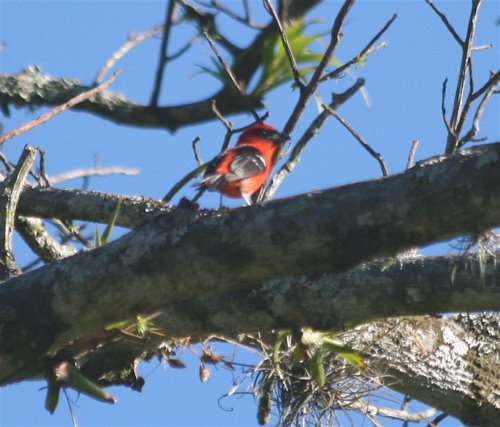
In blogging about Guatemalan birds, remember that I'm limited to writing about the ones for which I got decent pictures. They tend to be the commoner, easier to see birds. No matter: they're fabulous enough for nature-starved folks like you and me. Because I always had the blog in mind, getting pictures of even a fraction of the birds we were spotting became a neurotic quest for me. I came back with gobs of pictures that are no good at all, a few that are at least identifiable, and a tiny handful that are worth looking at twice. The white-winged tanager here is a good example. You can tell what it is, but even with sharpening and cropping, it doesn't come close to doing a terrific little bird justice. Overall, they're snapshots, just me trying to bring you something to look at, struggling against the nocturnal shadows and blinding sun of the tropical forest. In this modest quest, I felt well-matched to my camera rig, which is a Canon Digital Rebel XTi with 70-300 mm. zoom lens. It's fairly light and easy to carry, and ready to be swung up at a second's notice. I've developed a rudimentary understanding of what I have to do in difficult light conditions (and they all seem to be difficult in deep tropical forest). Picture me madly spinning dials, opening up f-stops and speeding up ISO. It's cool to get at least some souvenir of a memorable sighting. So let the parade of mediocre bird pictures begin!

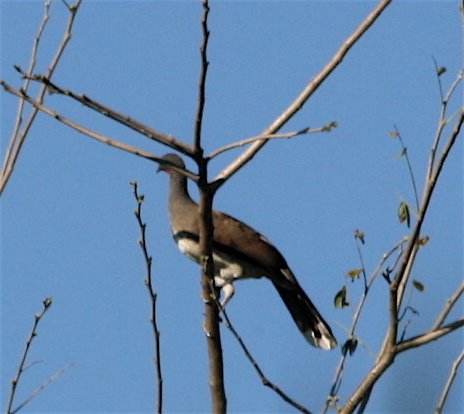
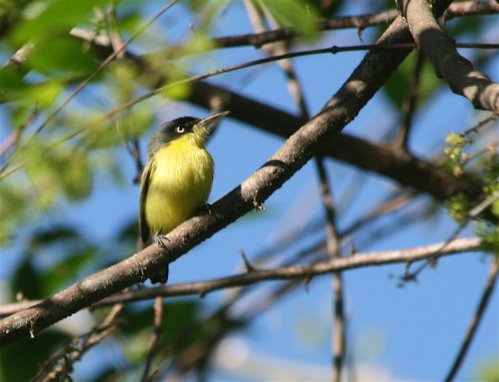
Chachalacas make more of an aural impression on the landscape than a visual one. Drab brown, with a white vent (this is the white-bellied chachalaca, a nice regional endemic that lots of birders like to tick off their lists in Guatemala), the white-bellied chacha cuts the air with its grating chorus of cha-cha LAC! cha-cha-LAC!, given in groups of five to ten. It's very loud, a classic sound of the tropics. Chachas, as we liked to call them, are related to guans and currasows, and are generally quickly hunted out unless protected, as they are at Los Tarrales.An unfortunate shot, with the branch obscuring his nice red wattle. Oh well, you take what you get, and not all of it is National Geographic caliber. It's a chachalaca. The dark band on the breast is a branch shadow. Here, a chacha sings out the day as the tropical night falls like a cloth. He's the tiny fleck in the left center of the picture.One of the cutest little characters of mid-level tropical forest is the common tody-flycatcher. An Andy Gump chin, long, flat bill, staring white eye and gnatcatcher-like tail characterize him. The best thing he did I couldn't capture in a picture. When it's excited, the common tody-flycatcher raises its long thin tail up over its back and slowly swivels it in a circle, like he's waiting for a pitch. I found myself chanting, "Hey, batter batter Hey batter!" and talking to him as if he were a pet parakeet. He didn't seem to mind. The whole affair is maybe 4" long. Tiny, cute Todirostrum cinereum, we could use some of you up here in the Ohio woods.

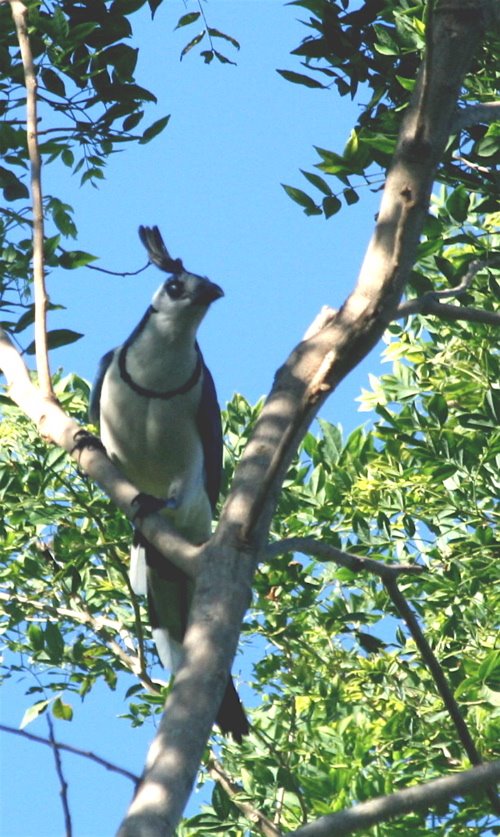
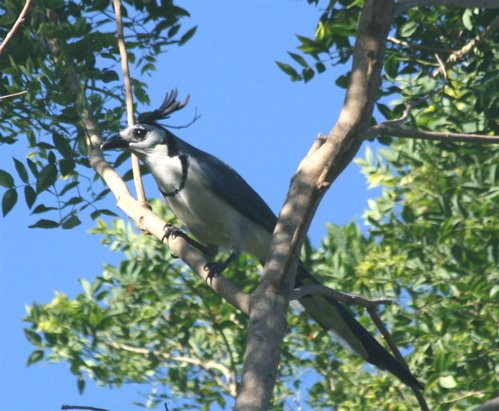
Perhaps the most striking bird to inhabit Los Tarrales is the white-throated magpie jay, Calocitta formosa. Those of you who've done a bit of global birding know that any bird with "magpie" in its name is going to be well-endowed in the gee-whiz department. White-throated magpie jays do not disappoint. I will never forget the first time I laid eyes on one, in the Guanacaste province of Costa Rica. Lee-ord. It was like a giant blue jay that had gotten into the dress-up trunk in the attic. What's that they say about a picture being worth...This creature is loud, raucous, tame and inquisitive. It is also 18" long. It's about what you'd get if you scaled a blue jay up by 200% and gave him a good stiff mojito to remove his inhibitions.
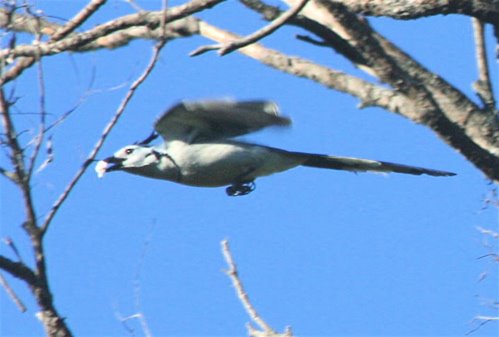
Gotta love the hairdo. Just a little fillip to add to his general impressiveness. In flight, they're unmistakable, always breathtaking.Imagine living in a place where such sights are commonplace; not even giving an 18" long crazy beautiful magpie jay a second glance. We all take for granted that which is common. The jays seemed to enjoy being gasped at by the greenhorns draped in optics.

As I write, the first fox sparrow of spring is feeding on the greening lawn. And the woodcocks sang and danced last evening. Bill raced home to catch the end of their act, and we grilled lamb and asparagus in a welcome-spring, welcome-home celebration.
[Back to Top]