Ephemera! I chase ephemera. I'm obsessed with fleeting natural phenomena and plan entire days around being there to catch moments. I guess these passing phenomena are my movies and crossword puzzles, my soap operas, my alcohol and tobacco. I live for them.
Around this time of year I go to town more often than usual, because there are trees there I need to connect with.
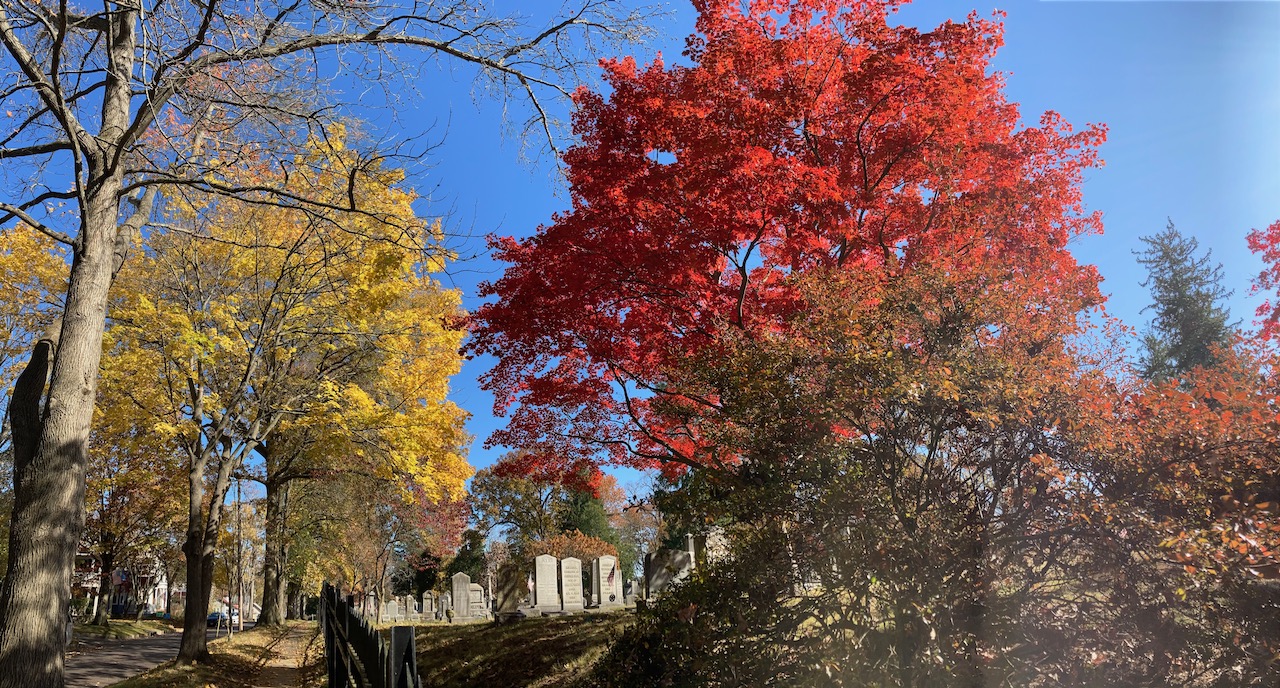
It starts with some maples in Mound Cemetery, Marietta, Ohio. This is a Japanese maple, but it's not one of your little weeping threadleaf frailties, all twisted in on itself. There's a lot to be said for those, but I kinda like the rangy ones. This is a stalwart and stately tree, a towering fountain of crimson.
It talks to a Norway maple just across the street. They almost brush fingertips.
The synergy between the Scandinavian gold and the Japanese lacquered red just sets me afire. I do drive-by checks for weeks in advance of their peak color. And then one fine November day (this was the 7th) I finally strike gold and scarlet.
Hitting the Mound Cemetery at peak color is only part of the fun, because I start gathering persimmons under trees in town about a week before Halloween. This is my squashy haul, gooshed into the bottom of a feedsack, from October 25.
These are cultivated American persimmons, and they are about 10x bigger than wild ones, but with the same fabulous flavor. Best of all, many are seedless!
I absolutely don't care that people stare at me as I circle around beneath the trees, looking down at the ground like a dog trying to find the perfect place to poop, then picking objects up, sometimes tasting them, then putting them in a shopping bag. Let them stare. There seems to be almost no competition for this precious food resource, and that's how I want it. Think I'm a weirdo? Great! I quietly feel sorry for you, because being weird is way more fun (and delicious) than rudely staring, wondering what somebody else is up to.
I bring them home and pick the seeds out and peel them, mostly, with my fingers and it takes way too long but I'm happy, standing at the counter, sucking on pulpy seeds, staring out the window, and dreaming of persimmon custard pies to come. I freeze the pulp in Ziploc quart bags, and eat it all year long over cottage cheese, with goat cheese, in yogurt, and atop pies.
Oh, you want my persimmon custard pie recipe? Well, I've been blogging long enough to know I have to give it to you here, or do it in the comments. Make Velvety Vanilla Pastry Cream and chill it with Saran on top. Then make a graham cracker crust with lots of butter and bake that until it's browning. Fill the cooled crust with velvety vanilla custard (I am drooling) and then top it with persimmon pulp. I jazz up the pulp with vanilla extract and just a touch of sugar. THEN put whipped cream on top. See you in Heaven. I just cobbled that recipe together, because I figured persimmons would pair well with vanilla custard, and they do, they do.

Pro tip: Taste every dang persimmon as you process it. Don't throw them all together until you're sure they're ripe. A persimmon that looks gorgeous and not squashy like the one on the left, below, is going to turn your mouth inside out and line it with fur. The squashier the better, honestly. They do NOT have to freeze to be edible. They just have to be ripe. If they survive the fall without breaking, they're probably not ripe yet. So taste. It's part of the fun.
This post was supposed to be about ginkgo trees, but I haven't blogged in so long that I had to share some maples and persimmons, too.
Depending on where you live and when you get your first real hard freeze, you can catch ginkgo drop. It wasn't until I started this post that I realized I've been spelling it gingko all my life. Nope, it's gink-go.
Ginkgos are amazing trees, native to Xitianmu Mountain in China, but endangered in the wild. Go figure. They're everywhere in America, being just too odd and alluring not to plant. Kind of like the Dawn Redwood, which is fairly common in cultivation, and extinct in the wild in China.
Harking way way back to my Harvard botany class with Carroll Wood, I remember that the ginkgo's structure is extremely primitive, as they were among the first trees to evolve. Ginkgos don't have twigs like most later-evolved trees do. What they have is leaves that sprout directly from long branches. Isn't that cool?
Not only that, but their leaves are super-primitive. They are formed from tiny twigs that come out in a fan-shape and fuse to form the simplest possible leaf. I may have mangled that, but I remember Dr. Wood telling us that. The parallel, fanned venation recalls that of maidenhair fern, another very primitive plant, and in fact the ginkgo is often called Maidenhair Tree. These leaves have been found in fossils on every continent, unchanged for 200 MILLION YEARS. Gack! The first ginkgo in America was planted by John Bartram, a well-known botanist, in his Pennsylvania garden in the 1780's.

Ginkgos can achieve tremendous heights and live for centuries. To me, it's a pure miracle that they get planted in cities, where they get mangled because they grow up through wires and such. They get planted because they are almost impossible to kill; they thrive in compacted soil full of pollutants; and they are very easy to prune back because they have no branches, only long straight limbs. I love to see them planted, though, where they have room to grow! Here's a young hopeful with plenty of space overhead.

Landscapers try to plant only male trees, but the occasional female sneaks through the lines. Apparently, the trees can change sex, perking along being a male for 20 or 30 years, then suddenly taking to dropping fruit! Though I'm tempted to call them drupes, they are technically cones, with a fleshy outer layer designed to be alluring to...something. You know how a juniper has fleshy fruits that everyone calls berries? Those are cones, too. Now I'm thinking that yews must have cones, as well. Yep, the red aril on a yew fruit is actually a highly modified cone scale. COOL. Sometimes cones are fleshy and look just like fruits.
A female ginkgo drops jillions of fleshy, olive sized, pinkish-orange cones that smell like puke, which does not endear them to anyone. People have tried everything from shaking the green cones from the trees to (in Seoul, Korea) paying an army of more than 400 workers to hand pick the green cones so nobody has to slip on them and smell vomit come fall!
Ginkgos are said to be toxic to insects that try to eat their leaves, and as I think about it, I have NEVER seen a ginkgo leaf with a hole chewed in it. Nor have I seen anything eat the fruit. It may have been dispersed by dinosaurs. Whatever liked to eat fruit that stinks of dogvomit is, evidently, long extinct.
But back to ephemera. The coolest thing, at least for me, about ginkgos is the way they shed their leaves.
First, they turn entirely golden yellow, and they hold that for a little while, maybe a week, maybe two.
And then one fine night it gets really cold, down to the 20's. And the next morning, the ginkgos drop all their leaves almost at once. I'll quote a
fine article in the Atlantic:
In the autumn, deciduous trees form a scar between their leaves and stems to protect themselves from diseases and winter’s coming chill. Most flowering trees, like oaks and maples, form the scar at different rates, in different parts of the tree, over the course of weeks. Their leaves then fall off individually. But ginkgoes form the scar across all their stems at once. The first hard frost finishes severing every leaf, and they rain to the ground in unison.
The article also quotes soil microbiologist and professor Serita Frey, who found records for one tree in front of James Hall at the University of New Hampshire. In 1977, ginkgo leaf dump occurred on October 24. With each decade, the tree dropped its leaves three days later. Now, leaf dump occurs around November 7. She has shown the effects of climate change on a single tree! The article is well worth checking out.
I was thrilled to see evidence of leaf dump, in the soft carpet of perfect golden fans beneath each tree.
From splendid to utterly naked, with a tablecloth of gold beneath.
At the elementary school Bill and his siblings attended in Marietta, there's a particularly nice ginkgo that paints the still-green grass with gold. Look at that structure, compared to the twiggy oak behind it!
Just once, I'd love to be beneath a tree when it dumps its leaves. Until then, I'll settle for driving around town from tree to tree, gawking and hoping, and slishing through the carpet beneath them.
On my way home, I noted that the Three Graces had dropped their dresses entirely. I missed most of their coloring, because I hadn't gone anywhere much at all.
I've revised their identities. Leftmost is a red maple. The middle tree, which I'd thought was a sugar maple, appears to be a black maple, Acer nigrum. And the rightmost tree, who holds her arms down, is still a black tupelo, and a fine one at that.
Tonight's ephmeral event was a sunset that brought me to my knees. I actually had to lie down, it was so beautiful. It caught me and Curtis out in the orchard, where I was freeing young trees of honeysuckle vines. I didn't think I had time to make it to the tower, so Curtis and I watched it through the trees.
He was clearly enjoying it, looking left and right, gazing fixedly at the sky. There could be no better companion for such a show. His only agenda, to keep me company. I am a lucky woman, and he is a lucky dog.
The sunset went on and on, and I did have time to climb to towertop and take in its last flames, on this soft warm evening in late November. What a gift. What a gift they all are--the maples, persimmons, the ginkgos; the ephemeral things I live to see and share.










Saturday, December 26, 2020
6 comments